Introduction
Real estate buyers increasingly expect more than static architectural renders and pre-recorded walkthroughs. They want to explore spaces, understand natural lighting, compare material finishes, and experience their future homes before construction is complete.
Traditional architectural visualization relies on offline rendering, where every image or video sequence is produced in advance. While this delivers high-quality visuals, making changes to lighting, materials, or camera perspectives often requires additional rendering time.
Unreal Engine 5 is changing this process.
With real-time rendering, advanced lighting systems, and high-density geometry processing, Unreal Engine 5 enables developers to present interactive, photorealistic property environments. Buyers can explore architectural spaces, customize finishes, and experience different lighting conditions within the same 3D environment.
At V-Estate, Unreal Engine powers interactive Digital Twins and real-time visualization platforms that transform architectural designs into immersive property sales experiences.
1. The Shift from Static CGIs to Real-Time Rendering
Traditional architectural visualization follows a fixed production workflow. Models are created, materials and lighting are configured, and individual frames or videos are rendered before being presented to buyers.
The limitation becomes evident when buyers request changes. Exploring alternative flooring, adjusting lighting, or viewing another perspective can require additional rendering cycles.
Unreal Engine 5 replaces this fixed presentation model with an interactive rendering environment.
Its real-time processing capabilities allow sales teams to navigate properties, modify supported visual elements, and respond to buyer preferences during consultations.
Key advantages include:
- Immediate visual feedback: Explore different materials and finishes without waiting for new offline renders.
- Interactive exploration: Navigate rooms, inspect architectural details, and discover different viewpoints.
- Flexible presentations: Adapt demonstrations to individual buyer preferences.
- Faster content iterations: Update supported assets and configurations without recreating entire video sequences.
Static renders remain useful for brochures and advertising. However, real-time rendering provides a more adaptable platform for interactive property sales.
2. Lumen: Dynamic Lighting for Realistic Architectural Experiences
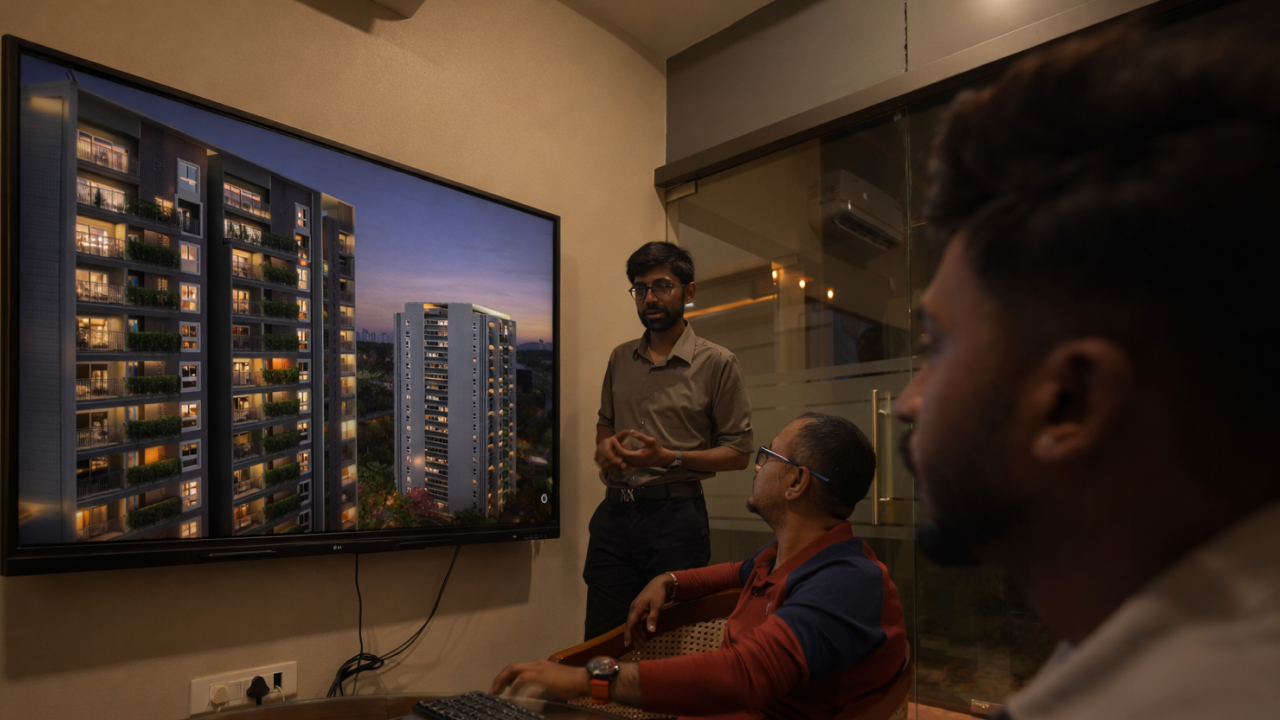
Lighting significantly influences how buyers perceive a property. Natural daylight entering a living room, shadows across a balcony, and reflections on interior surfaces all contribute to the spatial experience.
Unreal Engine 5 addresses this through Lumen, its dynamic global illumination and reflection system.
Lumen calculates how light interacts with surfaces and surrounding environments in real time, allowing lighting conditions to respond dynamically as the environment changes.
For real estate visualization, this enables:
- Natural daylight simulation: Demonstrate how sunlight enters different rooms and interacts with interior surfaces.
- Dynamic shadows: Visualize changing shadows across balconies, interiors, and surrounding structures.
- Global illumination: Represent indirect light bouncing between surfaces for more realistic lighting conditions.
- Material reflections: Improve the visual representation of glass, polished stone, metal, and other reflective finishes.
- Time-of-day exploration: Present different lighting environments, from daylight to evening settings.
For buyers, this creates a better understanding of how architectural design influences the experience of living in a space.
For developers, it provides a more dynamic way to communicate architectural quality and interior specifications without relying entirely on fixed lighting renders.
3. Nanite: Managing Complex Architectural Geometry
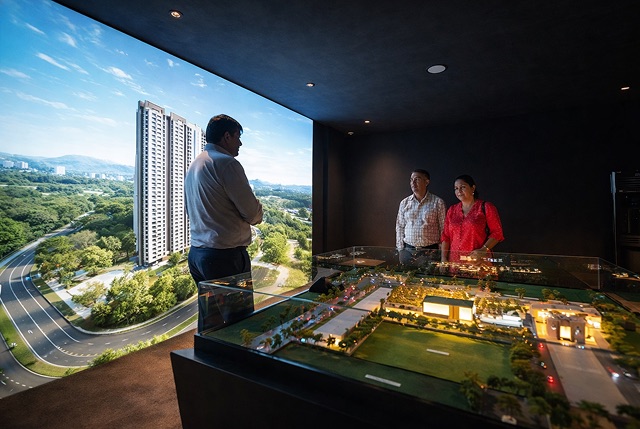
Large residential developments involve significant geometric complexity. Detailed façades, intricate interiors, landscaping, and surrounding structures can create demanding 3D environments.
Unreal Engine 5 introduces Nanite, a virtualized geometry system designed to render highly detailed 3D assets efficiently.
Nanite manages geometric complexity through virtualized geometry and dynamic detail streaming, helping visualization teams preserve intricate architectural elements while maintaining rendering efficiency.
Its applications in real estate visualization include:
- Detailed architecture: Preserve complex façade patterns, structural elements, and intricate design features.
- Dense environments: Support detailed landscaping and surrounding architectural assets.
- Geometry management: Dynamically manage geometric detail based on visibility and screen-space requirements.
- Reduced manual optimization: Minimize conventional level-of-detail workflows for supported assets.
This is particularly valuable for premium developments where architectural detailing influences buyer perception.
However, BIM and CAD models still require preparation, conversion, material configuration, and compatibility checks before real-time deployment. Nanite also has specific asset and platform limitations.
The objective is to maintain architectural accuracy while delivering responsive visualization.
4. Real-Time Customization: From Material Selection to Lighting Control
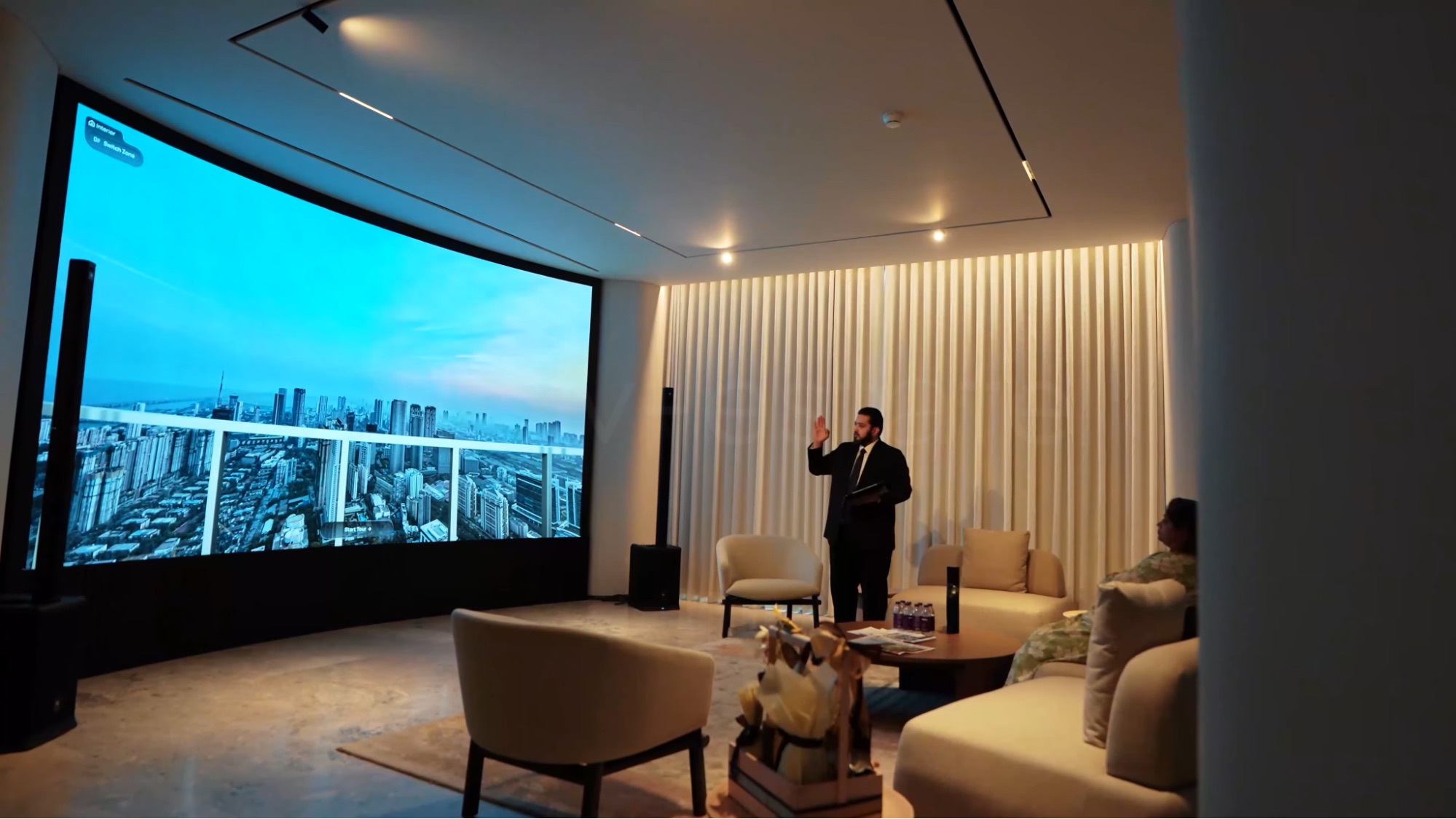
One of the biggest commercial advantages of real-time rendering is buyer-led customization.
Instead of viewing predetermined interior combinations, buyers can explore different finishes and design options within the same interactive environment.
Unreal Engine 5 allows developers to build customized material and environment controls that support:
- Material selection: Switch between marble, wooden flooring, countertops, and wall finishes.
- Interior customization: Explore alternative cabinetry, furniture finishes, and supported design configurations.
- Lighting adjustments: Experience different lighting intensities and colour temperatures.
- Daylight simulation: Understand how natural lighting changes throughout the day.
- Spatial exploration: Navigate individual rooms and examine architectural details.
These capabilities make property demonstrations more participative. Buyers can evaluate design alternatives based on their preferences, while sales teams can present multiple configurations without switching between separate visualization files.
This also helps developers communicate premium specifications and material choices more effectively.
5. Deployment: Taking Real-Time Visualization Beyond the Desktop
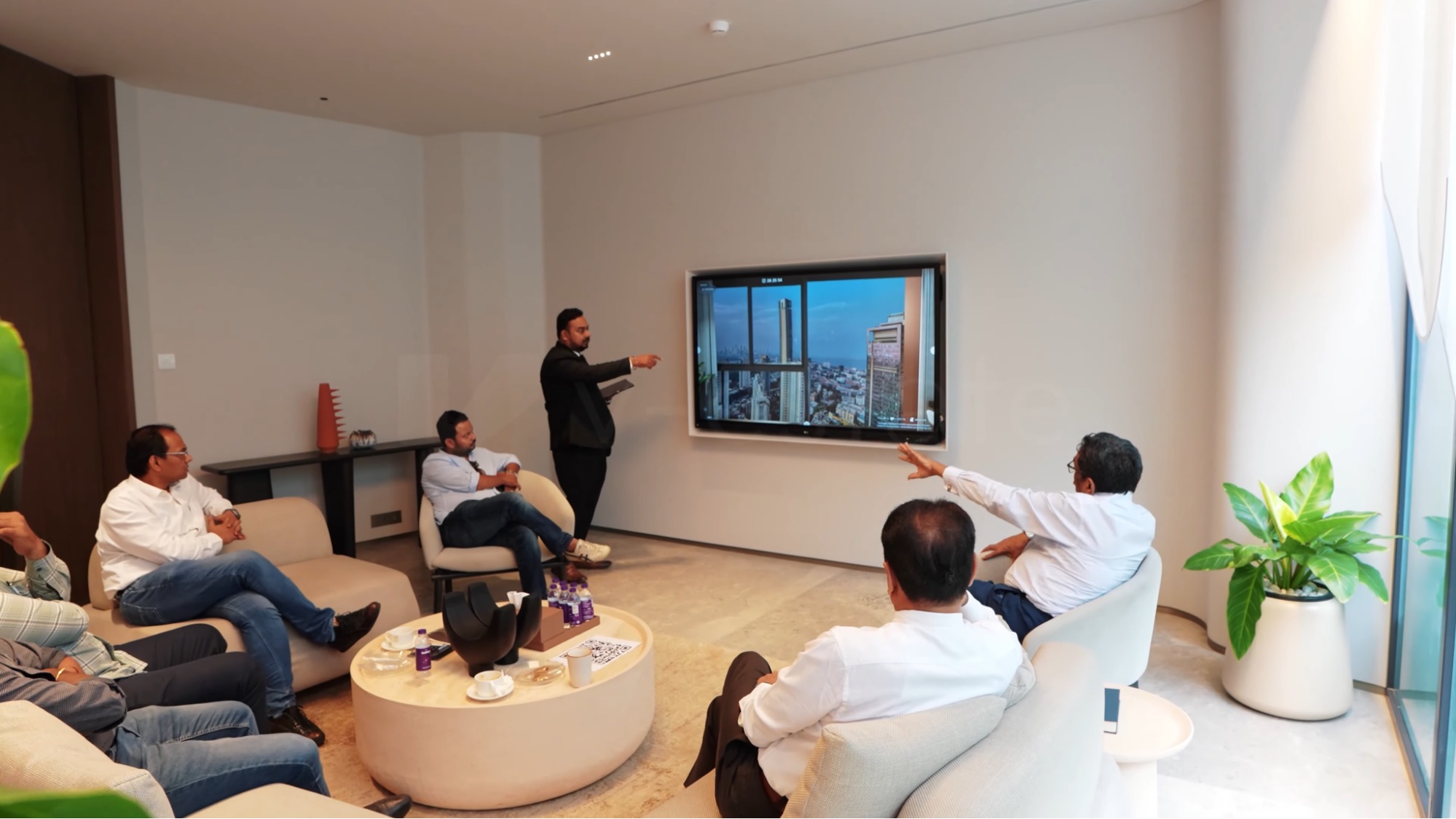
A real-time visualization platform must perform across the hardware and display environments used in property sales.
Unreal Engine 5 supports multiple deployment approaches, depending on the intended experience.
iPad-Controlled Applications: Compatible Unreal Engine applications can run on supported iOS devices. In experience centres, iPads can function as interactive controllers for digital twins, unit selection, amenity navigation, and compatible IoT-enabled scale models.
Web-Based Experiences: Pixel Streaming can deliver Unreal Engine environments through a browser using server-side rendering. This extends interactive property demonstrations beyond physical sales galleries.
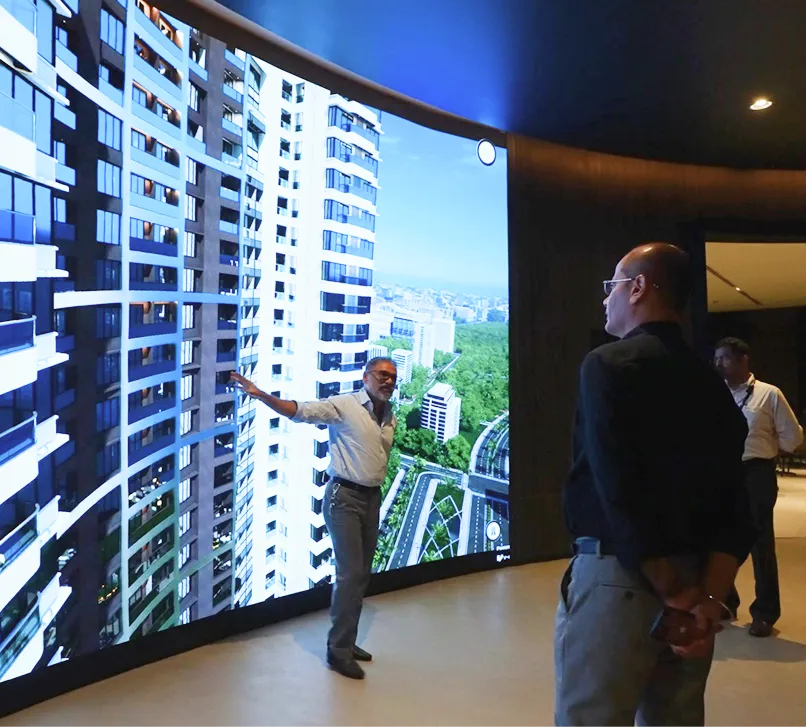
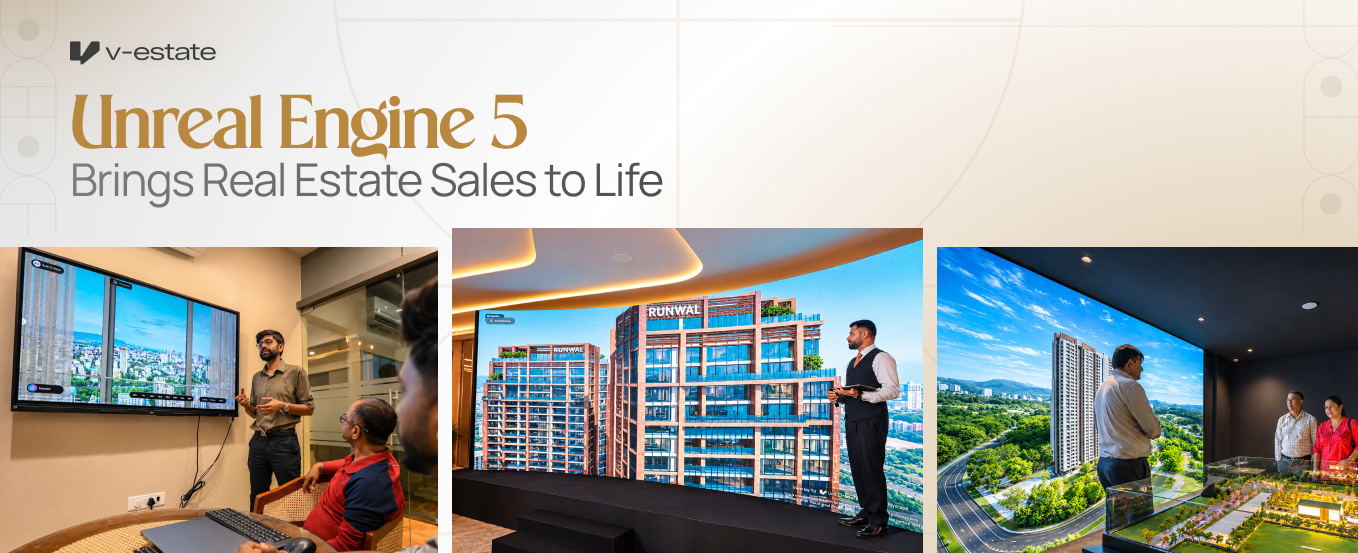
Large LED Displays: High-resolution and curved LED environments can present detailed architectural scenes at scale. Rendering configurations must account for display resolution, GPU capacity, and synchronization requirements.
Integrated Experience Centres: Real-time visualization can connect with interactive touchscreens, IoT scale models, display controllers, and immersive walkthrough environments.
Each deployment requires hardware-specific optimization to maintain visual quality and responsive performance.
V-Estate in Action: Unreal Engine Powering Real Estate Visualization
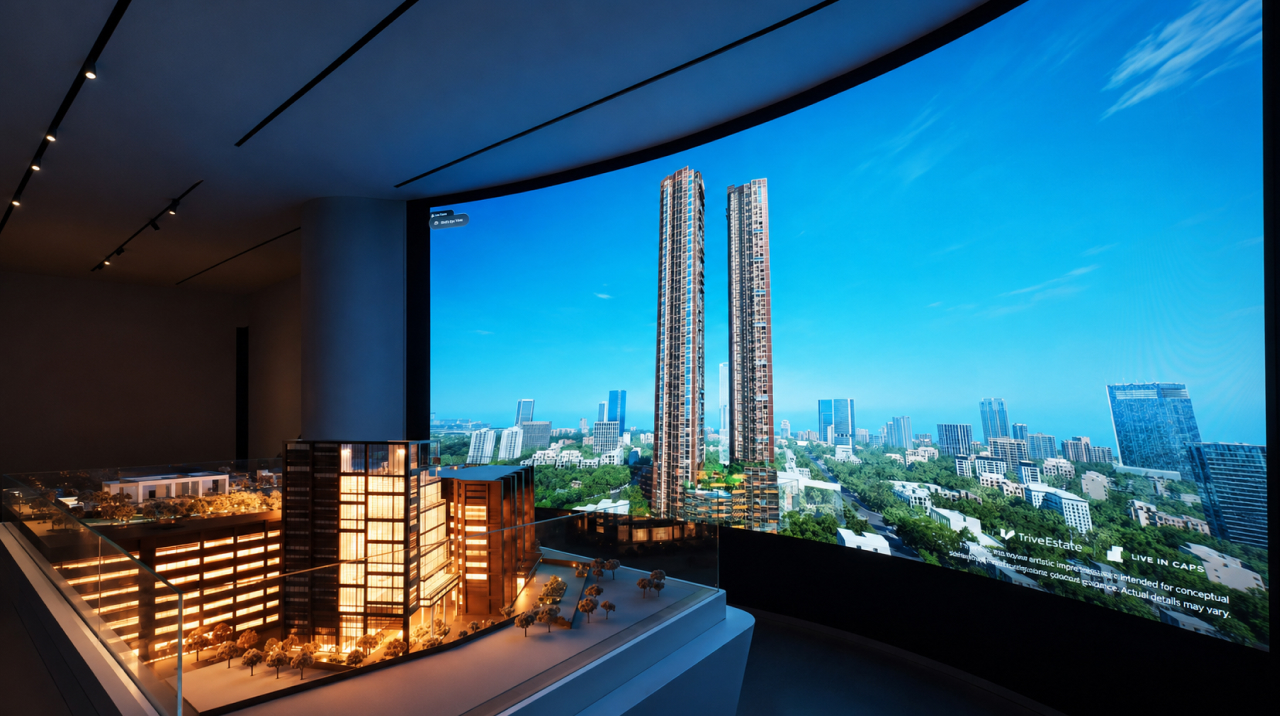
V-Estate applies Unreal Engine technology across residential developments, translating complex architectural models into interactive sales environments.
Runwal Raaya, Worli
Developed using Unreal Engine 5.4, Runwal Raaya's interactive Digital Twin enables buyers to explore residential spaces and 50+ lifestyle amenities. The BYODH module further supports immersive, buyer-controlled property exploration.
V-Estate used Unreal Engine 5.4 and the Procedural Content Generation (PCG) framework to develop extensive green environments. Procedural placement of large numbers of trees and foliage assets helped visualize the project's landscape at scale.
Ma Sarada, House of Sapiens, Bengaluru
V-Estate developed a real-time interactive environment featuring three residential towers, a four-floor clubhouse, and 40+ photorealistic amenities. The project also incorporated 10 km vicinity mapping and voxelization techniques in Unreal Engine 5.7 to visualize the largely undeveloped surrounding landscape.
These projects demonstrate how real-time engines support architectural detailing, environmental complexity, and interactive property exploration across different development requirements.
Conclusion: From Architectural Visualization to Real-Time Sales Infrastructure
Unreal Engine 5 is expanding the role of architectural visualization in real estate.
Lumen enables dynamic lighting and global illumination. Nanite supports highly detailed geometric environments. Real-time material systems allow buyers to explore design alternatives, while flexible deployment pipelines bring interactive visualization into sales galleries and remote presentations.
Together, these capabilities move property marketing beyond fixed renders and pre-recorded walkthroughs.
For developers, the opportunity extends beyond visual quality. Real-time visualization creates an adaptable sales environment where buyers can explore, compare, and understand properties through interactive experiences.
V-Estate brings Unreal Engine 5 capabilities into real estate sales through interactive Digital Twins, photorealistic architectural environments, and buyer-controlled property exploration.
Explore V-Estate's PropTech solutions to discover how real-time visualization can transform your property's sales experience.