Luxury buyers no longer walk into a sales office looking for more information they walk in looking for proof. This is where kinetic architectural installation luxury real estate experiences become valuable. Instead of relying on looping films, brochures or static displays, developers can turn engineering, façade systems, materials and building performance into physical, motion-led demonstrations that buyers can see and understand.
For high-value projects, the role of the experience centre is shifting from simply presenting the property to giving buyers tangible reasons to believe in its premium.
The Core Problem with AV Rooms in Luxury Sales Contexts
AV rooms were designed for volume — not depth. They work well for mid-segment launches where the buyer needs orientation. They fall short in luxury contexts where the buyer needs assurance.
Three failure points emerge consistently:
- Passive consumption. A video plays. The buyer watches. Engagement ends when the screen goes dark. No interaction. No recall. No conviction.
- Generic narratives. Standard AV content covers location, lifestyle, and views. Engineering quality — waterproofing systems, seismic compliance, fire-rated shafts — rarely makes it in.
- Sales team dependency gaps. When AV content ends, the executive takes over. Without a structured tool to anchor technical conversations, those conversations stay surface-level.
Buyers leave with an impression, not a decision. The follow-up cycle stretches. Closure rates underperform the product's actual quality.
Kinetic Installations: The Offline Format Built for Luxury Selling
Kinetic installation technology operates entirely offline — no app downloads, no internet dependency, no QR codes. It is a purpose-built, sensor-driven, motion-triggered physical experience embedded directly into the sales centre layout.
The format works on two levels simultaneously:
- Sensory engagement. Motion sensors trigger animations as buyers move through the space. The experience is instinctive — no instructions needed.
- Technical depth. Each animation maps to a specific engineering USP. Buyers see waterproofing systems illustrated in real time. Fire-rated shaft logic explained in a 40-second visual sequence. The invisible becomes visible.
This is not a digital upgrade to an AV room. It is a structural replacement of the passive sales experience.
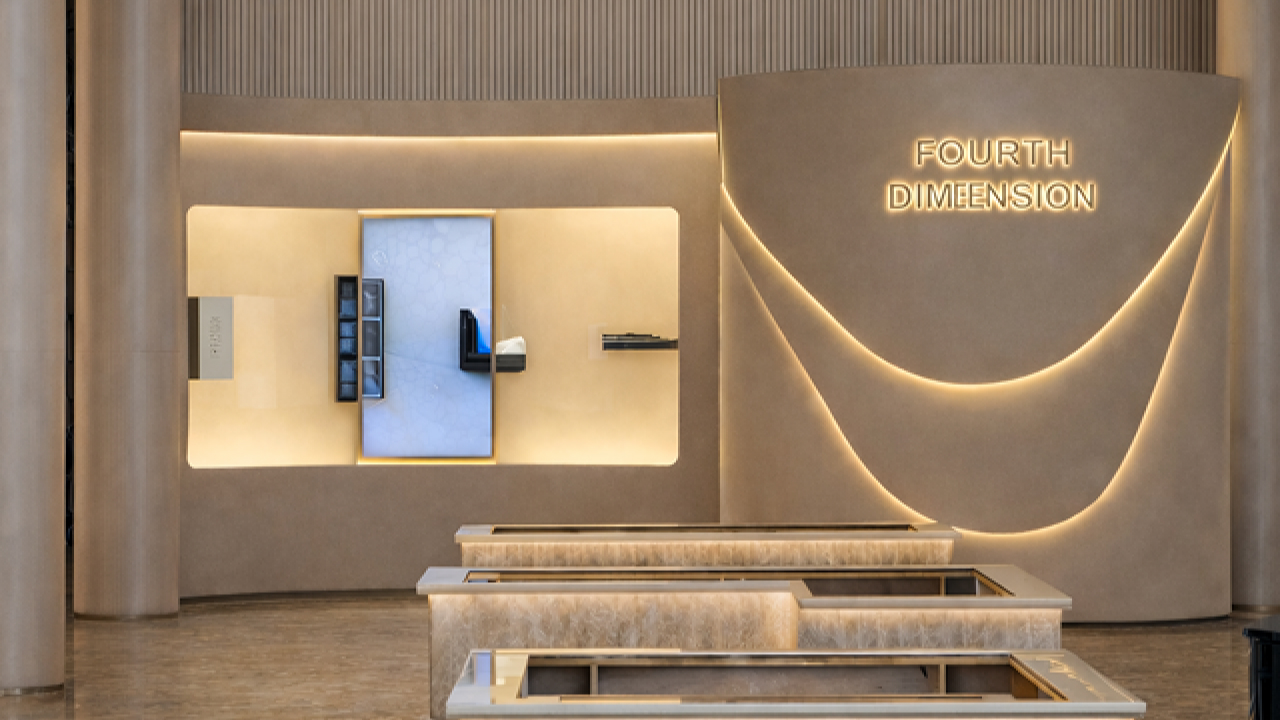
The Godrej Trilogy Deployment
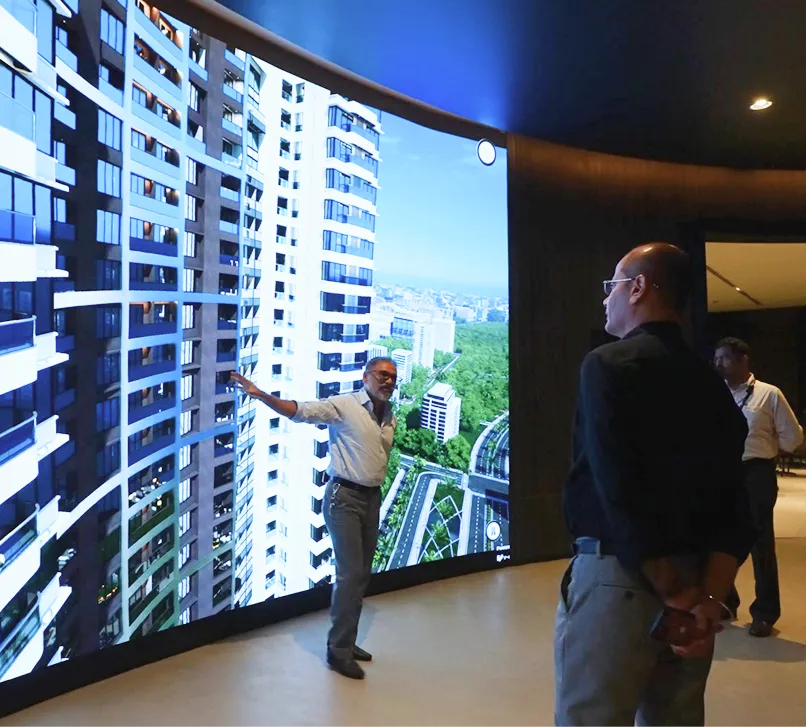
Godrej Trilogy's sales office in Worli replaced its AV theatre with a two-zone kinetic installation built around a single S-shaped curved walkthrough pathway.
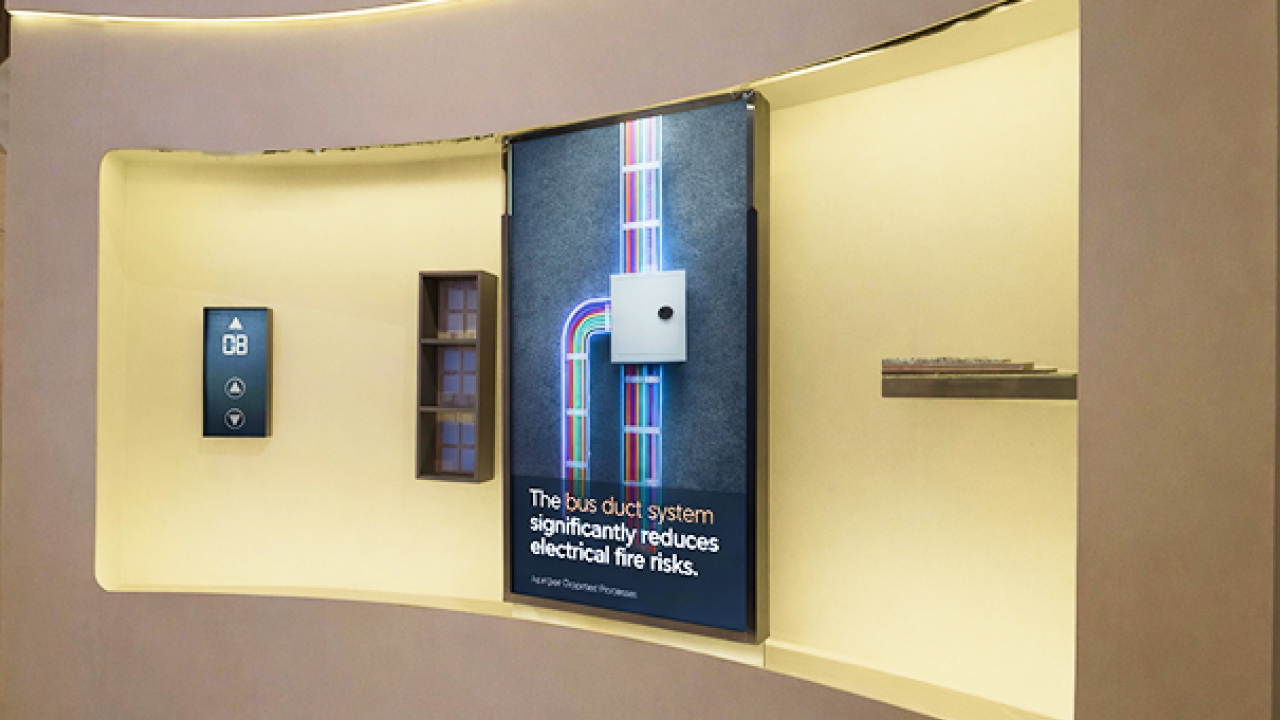
Zone 1 — Curved Rotoscopic Wall (10 feet high)
Motion sensors trigger kinetic storytelling as buyers approach. Technical USPs animate in real time. Average engagement: 15 minutes per visitor. Natural pause points open engineering conversations before buyers reach the pricing stage.
Key narratives delivered:
- Dual-layer waterproofing tiles with RCC seepage prevention
- High-speed elevators with minimal wait-time engineering
- Fire-rated shafts, FRLS wiring, and fire-retardant structural elements
- Double-glazed windows tested for wind load, noise, and coastal resistance
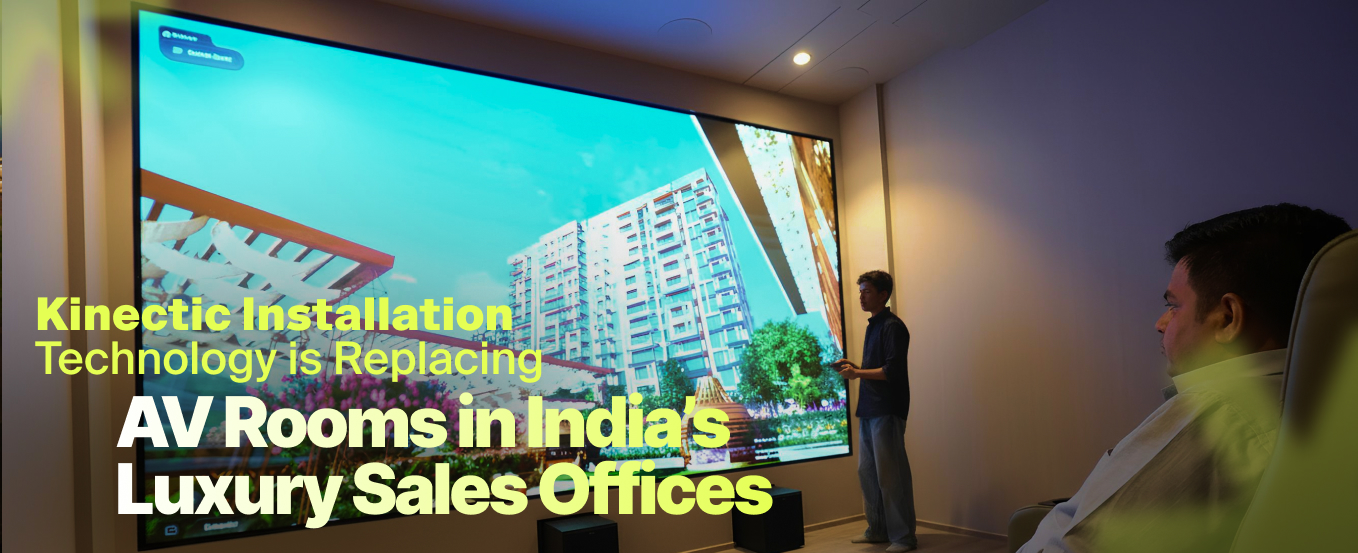
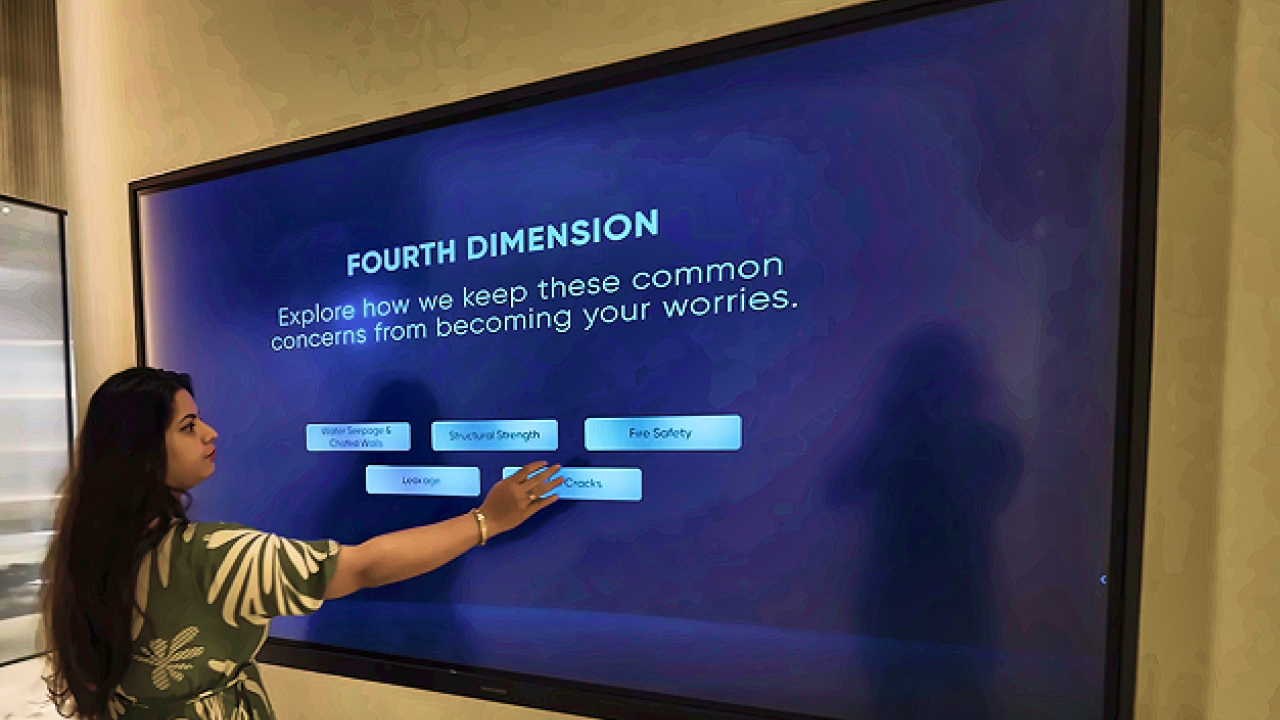
Zone 2 — 86-Inch Interactive Touchscreen Wall
Buyers — guided by the sales executive — explore build quality at their own pace. Short 30–50 second animations per topic. Average dwell time: 5 minutes per buyer.
Topics covered:
- Anti-capillary waterproofing against seepage
- Earthquake-compliant reinforcements and load distribution systems
- FRLS wiring for smoke and heat reduction in fire scenarios
- CPVC plumbing for long-term leak prevention
- PU foam application to manage structural stress cracking
- Wind-tunnel test certification by global engineering consultants
The modular content structure allows updates without hardware replacement — relevant as product specifications evolve during long sales cycles.
Structured Sales Journey: Zone by Zone
The S-shaped pathway controls narrative pacing. It is not accidental — it is engineered.
- Orientation briefing. Sales executive sets context before the walkthrough begins.
- Rotoscopic wall engagement. Buyers absorb construction quality through motion-triggered visuals.
- Touchscreen deep dive. Guided exploration of specific build systems at buyer-controlled depth.
- Q&A backed by visuals. Questions arise from what buyers just saw — not from verbal claims.
- Pricing and unit conversation. Follows after full product conviction is established.
The sequence matters. Pricing discussions anchored in engineering understanding close differently than those that open with a view and a rate per square foot.
Measured Outcomes from the Worli Installation
Post-deployment observations from the Godrej Trilogy sales centre:
- Buyers asked more technical questions — a consistent indicator of deeper conviction before unit selection
- Engagement per visit increased by approximately 20 minutes compared to prior AV setup averages
- The kinetic walls replaced brochures and AV decks as the primary sales conversation tool
- Sales teams reported more structured conversations with buyers on construction quality and material standards
This was the first kinetic tech deployment across Godrej's luxury project portfolio — and it has since become the benchmark format for future launches.
Relevance for Developers and Marketing Heads
India's luxury residential segment is entering a phase where product transparency is a competitive differentiator. Buyers at this price point do their research. They compare. They ask hard questions. The sales office that answers those questions through a structured, immersive, offline experience gains a measurable edge.
Kinetic installations address four priorities simultaneously:
- Buyer conviction — engineering proof replaces verbal assurance
- Sales team effectiveness — structured tools replace ad-hoc explanations
- Sales cycle compression — convinced buyers decide faster
- Brand positioning — the sales experience itself communicates premium quality
The format is also repeatable across projects. Once the content architecture is established — USP mapping, zone sequencing, animation logic — it can be adapted for new launches without rebuilding from scratch.
Implementation Roadmap for Developers
Step 1 — USP Audit Map your project's engineering differentiators against typical buyer questions. Identify which 8–12 features need visual proof, not just verbal mention.
Step 2 — Pathway Design Design a single, curved walkthrough that sequences from trust-building (rotoscopic) to exploration (touchscreen). Two zones are sufficient. More creates cognitive overload.
Step 3 — Content Architecture Build 30–50 second animation modules per feature. Each module must work standalone — buyers will pause, skip, and return. Linear storytelling fails in this format.
Step 4 — Sales Team Training The installation is a tool. Its effectiveness depends on how executives use it. Train teams on walkthrough pacing, question handling at each zone, and transition to pricing conversations.
Step 5 — Engagement Monitoring Track dwell time per zone. Track which features generate the most questions. Use that data to refine content before the next launch cycle.
The Shift Is Already Underway
AV rooms served their purpose. For the luxury segment in 2025, that purpose is expired.
Buyers spending ₹5 Cr and above are not persuaded by passive content. They require immersive, interactive, offline proof experiences that hold up under scrutiny — before, during, and after the sales conversation.
Kinetic installation technology delivers that. The Godrej Trilogy deployment demonstrates it works at scale, under real sales conditions, with measurable impact on buyer engagement and conversation quality.
The developers who reconfigure their sales centres around this format are not investing in a trend. They are correcting a structural gap in how luxury real estate is sold in India.
.jpg)