A family walked into a sales gallery. They had already made up their minds not to buy, just to look. They left an hour later, having configured their unit finish, watched the sunrise from their future terrace, and argued about which bathroom tiles they preferred. They had not yet seen the actual apartment. They had experienced it through an interactive property walkthrough tool. And that changed everything.
The virtual tour is the new battleground in luxury real estate sales. Not the site visit. What happens before it.
Buyers today are not passive. They research, compare, and form strong opinions before a salesperson ever greets them. The question is whether your pre-visit experience gives them something real to form opinions about or leaves them guessing until they physically arrive.
The developers who answer that question well are not just shortening sales cycles. They are fundamentally changing the psychology of how buyers commit.
Why Static Presentations Are Losing the Room
Real estate developers spend hundreds of crores building projects and then present them on A4 sheets.
The friction the process creates is measurable. Buyers struggle to visualise spatial relationships from 2D floor plans. Sales teams spend the first half of every meeting explaining what things look like instead of building desire. For ultra-luxury projects, where the gap between a floor plan and the finished experience is enormous, static formats actively undermine the product.
The shift to interactive property tours is not about novelty. It is about closing a comprehension gap that was costing conversions.
Here is what that gap costs in practice:
Buyers need multiple site visits before committing, extending the sales cycle significantly
Sales teams spend 40-60% of consultation time on basic spatial orientation
Ambiguity around views, finishes, and layouts generates buyer hesitation that stalls decisions
Ultra-luxury projects lose qualified buyers who could not mentally inhabit the space from static materials
3D property visualisation software solves these issues by letting buyers experience spatial reality before the physical asset exists. The site visit stops being a discovery moment. It becomes a confirmation.
Raaya by Runwal Realty: What Genuine Immersion Looks Like
Runwal Realty's Raaya project in Mumbai is worth studying not because it used technology, but because of what that technology needed to accomplish.
Raaya is a twin-tower ultra-luxury development with a lot working against easy representation:
Dual landmark views spanning the Bandra-Worli Sea Link and the Mahalaxmi coastline
A bronze fibre-textured facade that shifts in appearance through the day
A podium with over 50 landscaped amenities, designed to offer a distinct sensory experience every 20 steps
This is not a project you can represent adequately on paper.
The specific challenges were significant:
Translating a bronze metallic fibre facade into both physical and digital formats without losing its material quality
Rendering podium landscapes with over 50 million polygons in real time without performance drops
Demonstrating how a landscape that changes character every 20 steps actually feels to walk through
Delivering all of this in a sales environment where a buyer is making a decision worth several crores
The solution was a dedicated Experience Centre built with V-estate's property walkthrough software, and it redefined what a pre-visit sales environment can accomplish.
The Technology Architecture Behind Real Buyer Confidence
The Experience Centre combined physical, digital, and sensory elements into a single coherent journey. Each layer served a specific psychological function.
Scale and spatial comprehension:
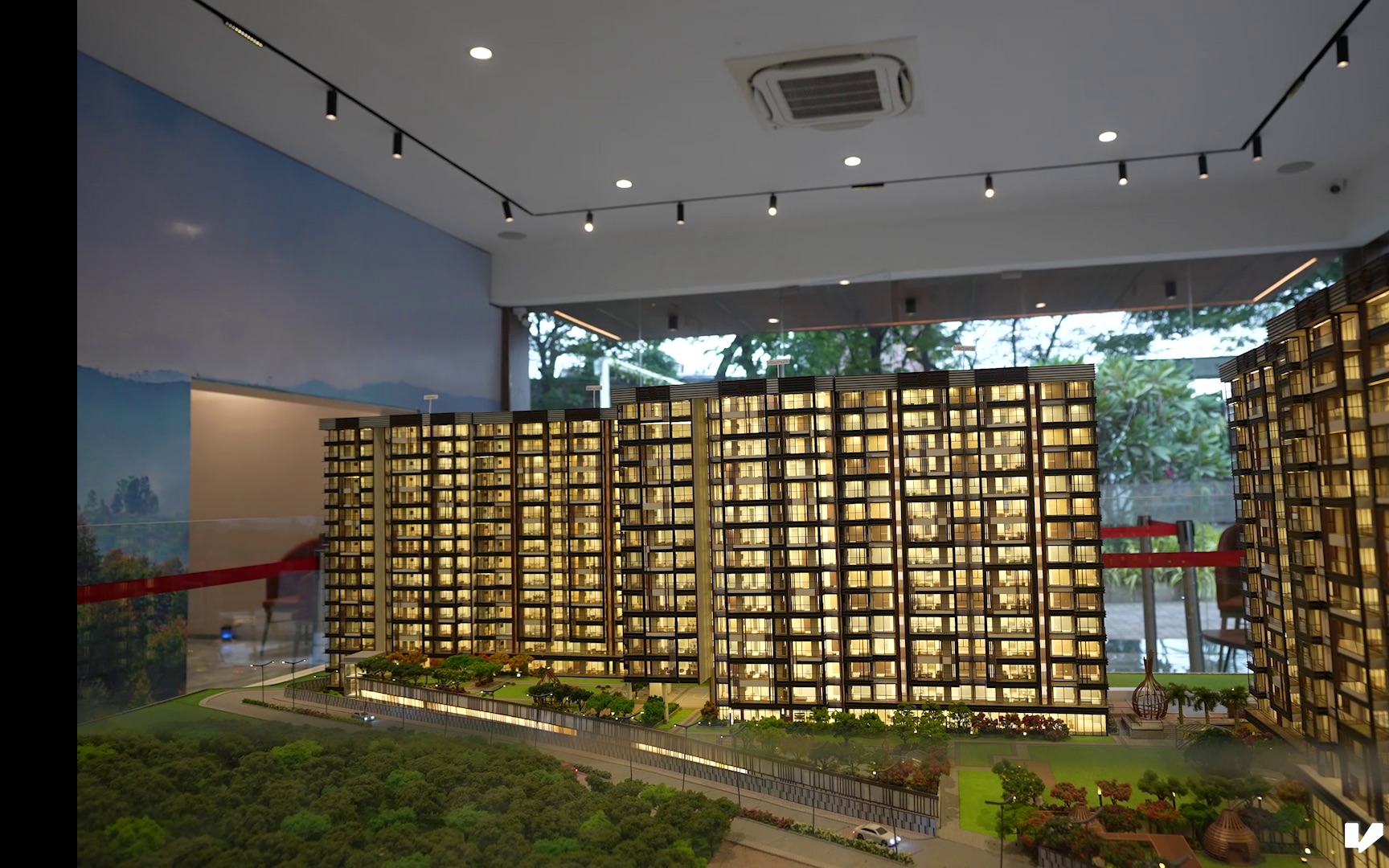
A large architectural scale model of the twin towers showed the offset tower design that enables both landmark views simultaneously
The model was embedded with 2,000+ IoT-enabled diodes connected to iPads, so buyers could tap an amenity and watch it illuminate in the model
Interactive floor plans with pinch-to-zoom allowed buyers to explore layouts digitally, replacing the need to interpret static blueprints
Photorealistic visual depth:
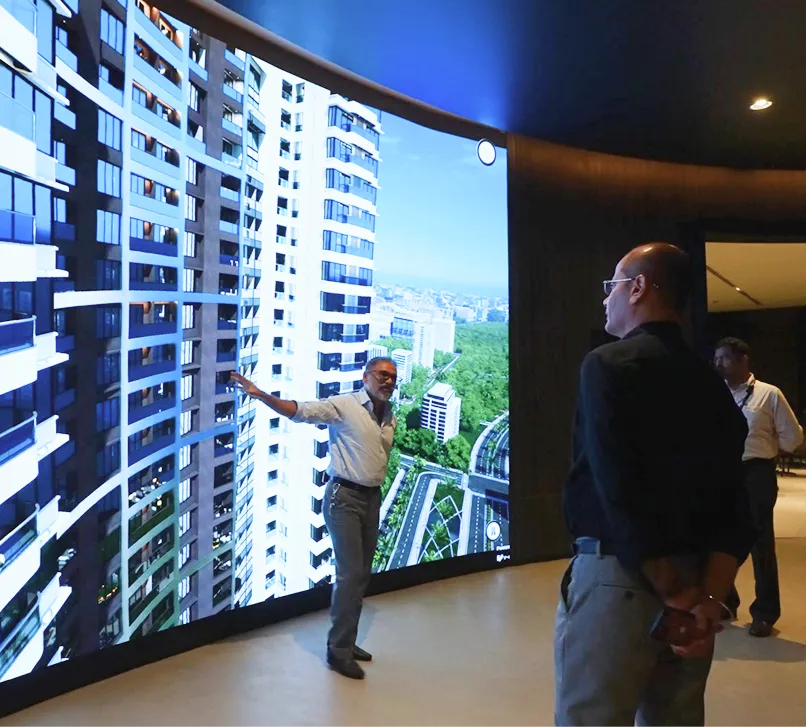
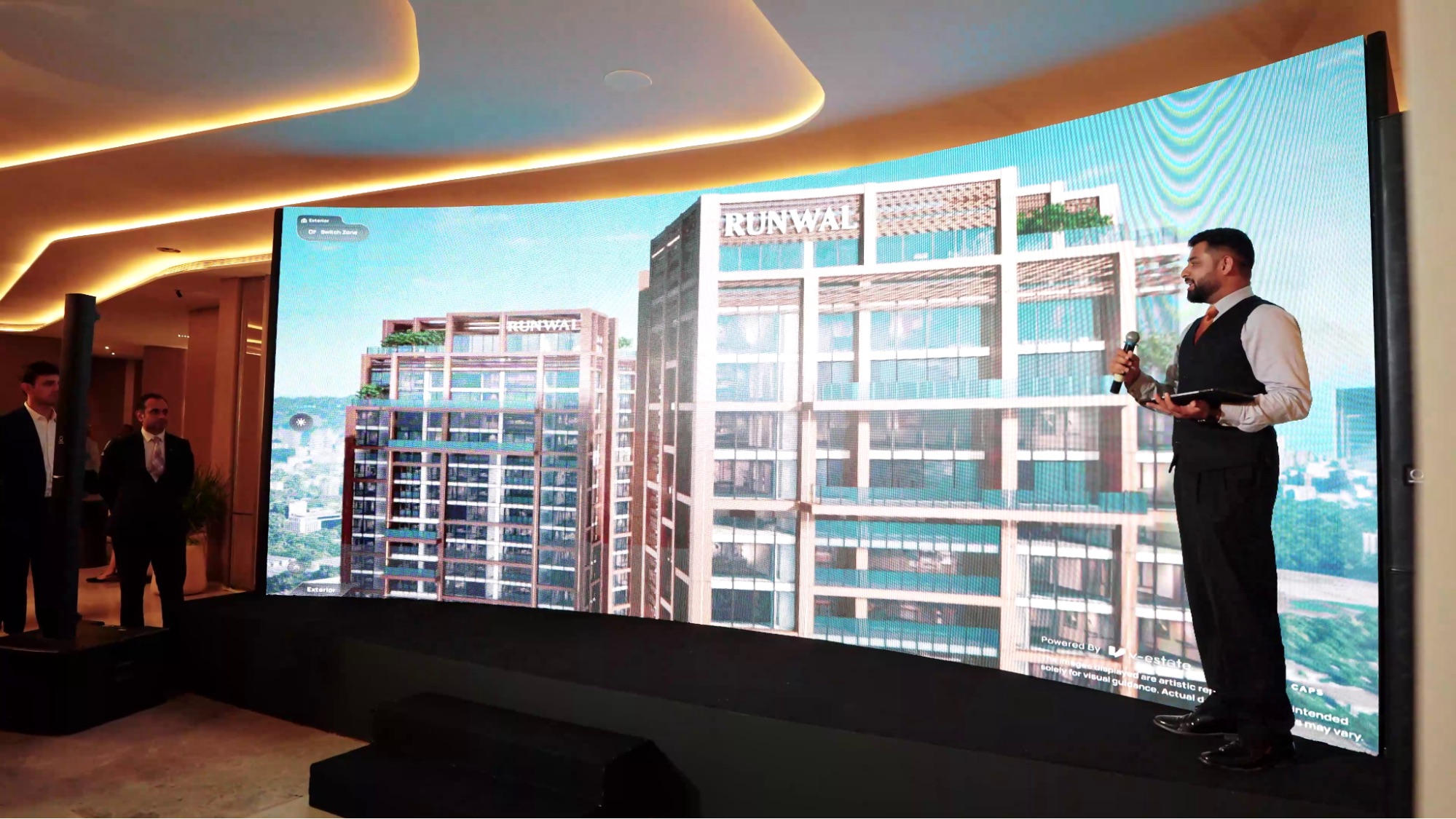
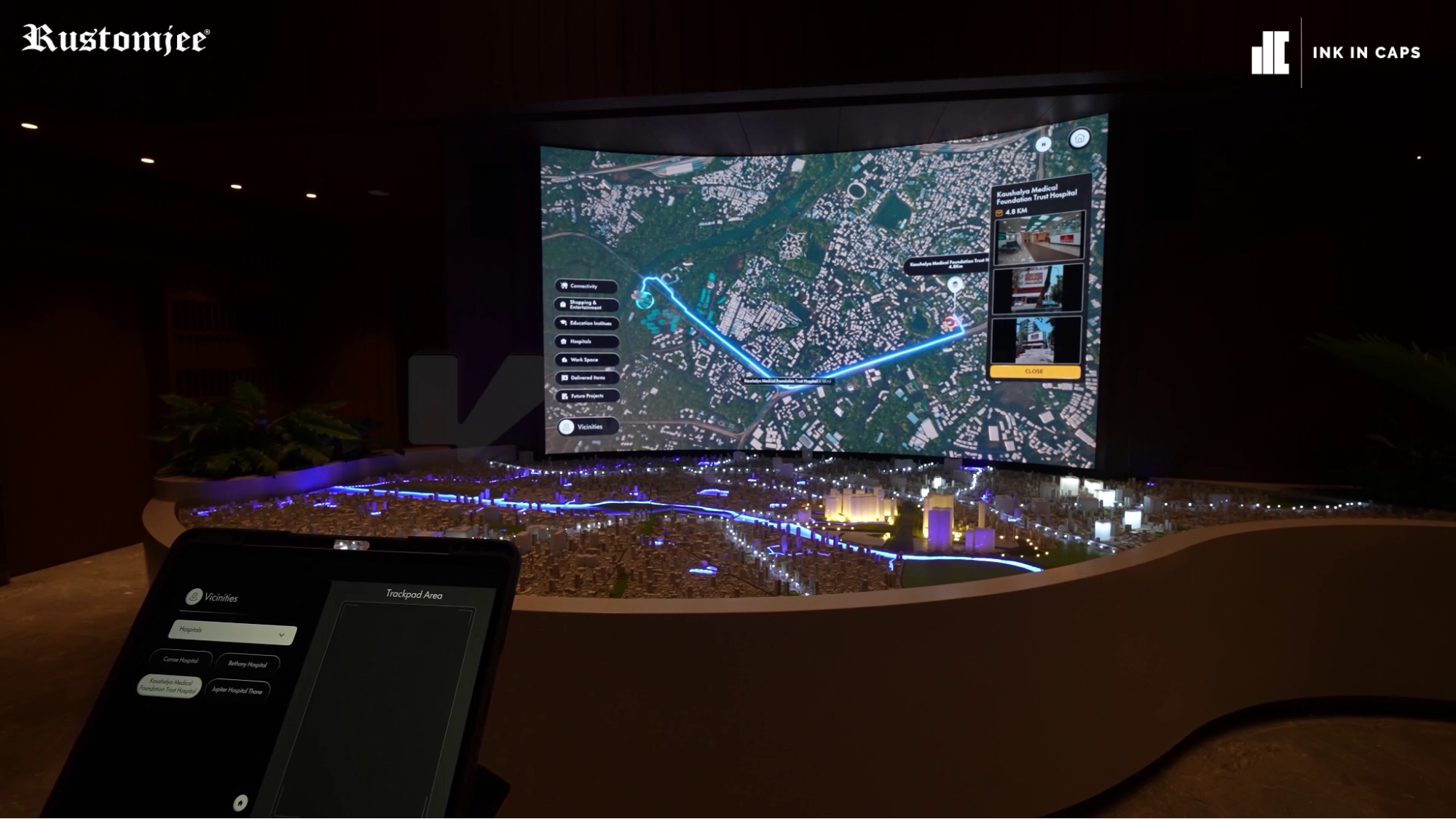
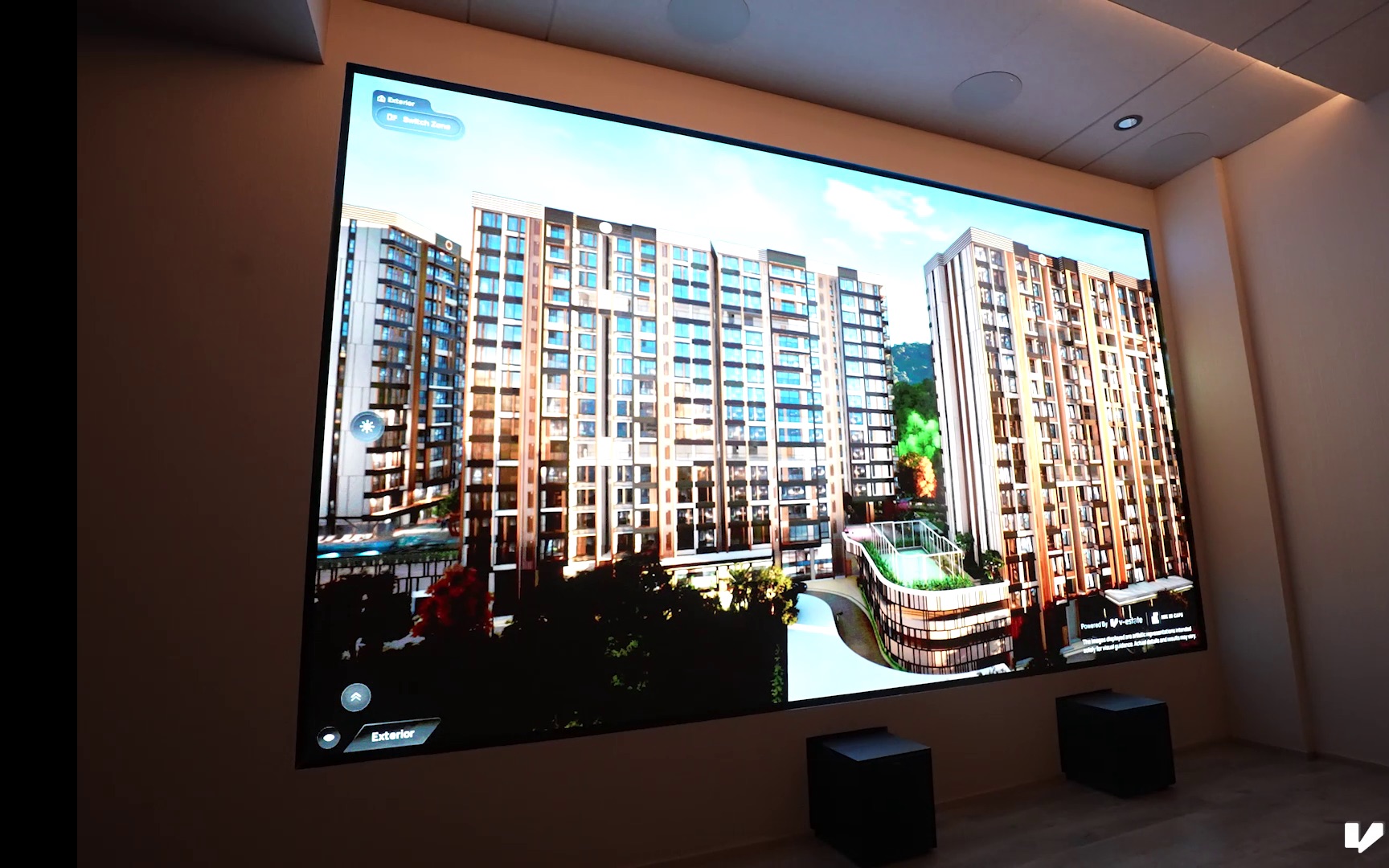
An 18 ft by 8 ft curved LED screen powered by Unreal Engine 5.4 delivered photorealistic renderings through V-estate's 3D property visualisation software
Lumen lighting and Nanite polygon optimisation allowed the system to handle over 50 million polygon landscapes in real time
Projection mapping simulated actual views from Raaya's decks: sunrises, sunsets, and city lights across the Mumbai coastline
Motion Posters: The Detail That Stops Buyers in Their Tracks
Most developers use static imagery to represent a project's character. A rendered exterior. A daylit living room. A rooftop pool at golden hour. Runwal Realty went further.
Motion posters, short cinematic looping visuals of Raaya's defining moments, were layered into the Experience Centre as part of the broader project walkthrough service for real estate buyers. What made them different:
A motion poster of the bronze facade catching late afternoon light, showing the material in a way no static render can
The cascading water feature at the podium entrance, rendered in continuous ambient motion
The treehouses and butterfly gardens brought to life, giving buyers a feel for what daily life at Raaya looks like at different hours
The strategic thinking behind the design is precise. A 360° virtual tour of real estate demands active engagement from buyers. Motion posters work on a different register entirely:
They run peripherally while a buyer is in conversation, reviewing a floor plan, or choosing between finish options
By the time a buyer sits down for a personalised consultation, they have absorbed hundreds of micro-impressions of the project
The lifestyle has already seeped in before a single feature has been formally explained
Technically, the project required a custom looping system engineered for lag-free performance across all screens simultaneously, from the 18-foot curved LED wall to the individual private consultation pods, without any degradation in quality. Frame drops during a high-stakes presentation destroy the illusion. The system was built to ensure that never happened.
The effect was visceral. Buyers were already imagining themselves inside a lifestyle.
"One family spent over an hour exploring a 2BHK unit. Not because they were undecided, but because the tool made it so real they could see themselves living there. From sunrise direction to wind flow, from marble textures to bathroom finishes, every detail was at their fingertips. This wasn't browsing. This was believing."
Sanya Runwal, Director of Retail, Runwal Realty
Personalised consultation experience:
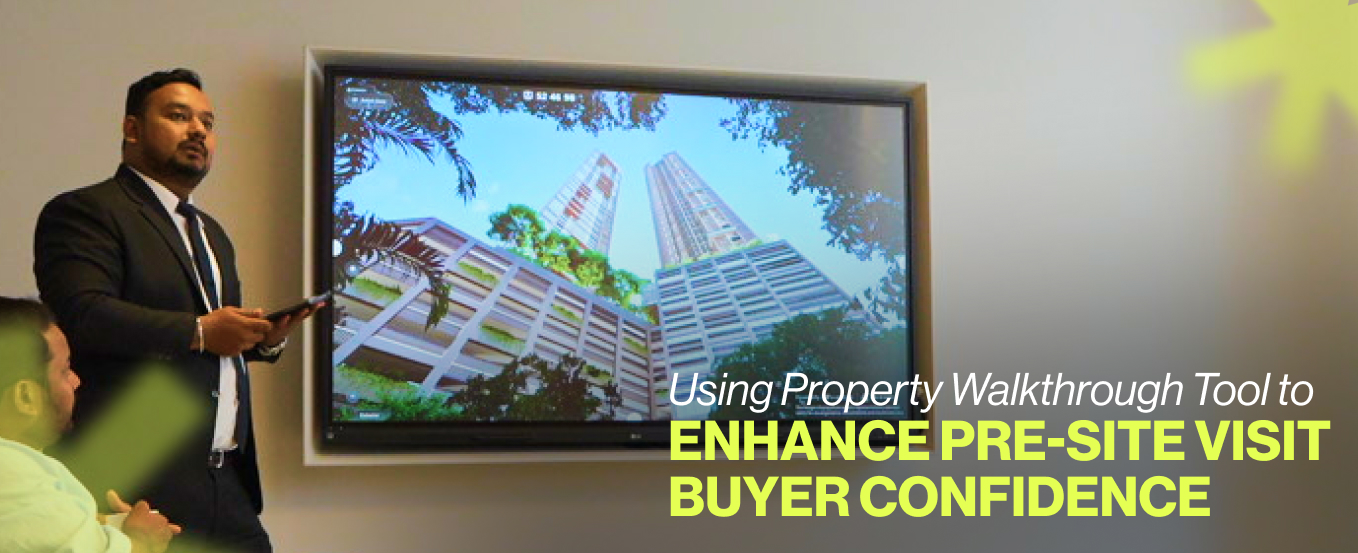
Private pods equipped with 65" and 85" LG 4K displays and JBL immersive audio created an intimate environment for the property virtual tour experience
Real-time interactive property walkthroughs during sessions allowed sales teams to configure specific unit layouts live, in front of the buyer
Material boards featuring actual flooring, facade samples, wood finishes, and glass panels made material choices tactile rather than abstract
Emotional and sensory continuity:
Curated soundscapes and time-of-day lighting effects mirrored the actual atmospheric moods of the project
VR-style 3D walkthrough software simulated the podium's landscape progression, demonstrating how the experience shifts character every 20 steps
What this architecture achieves, collectively, is a buyer who does not need to imagine. They have already been there.
What the Results Confirmed
The outcomes from Raaya's launch were unambiguous:
100% adoption by the sales team, with interactive digital tools fully replacing brochures and static renders from day one. Not as a mandate, but because the tools were simply more effective
Stronger buyer clarity on views, layouts, and amenities, with clients reporting significantly reduced ambiguity and fewer back-and-forth clarification requests
Faster decision velocity, with buyers arriving at site already emotionally invested rather than starting the evaluation process from zero
Benchmark-setting brand positioning for Runwal Realty as a pioneer in luxury real estate sales experience in India, with the Experience Centre itself becoming a talking point in the market
The last point carries strategic weight beyond a single project. When your sales process becomes the story, when buyers talk about the Experience Centre the same way they talk about the product, you have built a brand asset, not just a sales tool.
Developer’s Takeaways
The Raaya Experience Centre is at the premium end of implementation. But the underlying logic applies across project types and price points, and the core principle scales.
What Interactive Property Tours Software Must Actually Deliver
The goal is always the same: eliminate the comprehension gap that turns qualified interest into hesitation.
The most effective interactive property tour software delivers three things:
Spatial legibility, so buyers stop guessing about scale and proportion
Material and finish clarity, so buyers stop wondering what "premium" actually means in practice
View and amenity conviction, so buyers stop suspending judgement until they physically arrive
These are the three psychological barriers standing between a qualified buyer and a committed one.
How Property Virtual Tour 360 Software Has Raised the Bar
Property virtual tour 360° software has evolved significantly. Platforms now support real-time configurations, photorealistic renderings, and motion-based storytelling that can be delivered remotely or within a curated centre environment. The entry point for this quality of experience has lowered. The buyer's expected standard has risen sharply.
Developers who are still presenting on static renders are not just behind on tools. They are behind on the conversation buyers are already having with themselves before they arrive.
The Sales Conversation a Property Walkthrough Tool Creates
Consider what changes when a buyer arrives having already done the following:
Explored their preferred unit through a full interactive property walkthrough
Seen the actual view from their floor via projection mapping
Watched motion posters of the podium and amenities come alive
That buyer is not asking basic questions. They are asking closing questions. The conversation skips orientation entirely and moves straight into confirmation. The sales team's job transforms from explaining to affirming.
That shift in conversation quality is where the real ROI lives. It is not just in the polish of the presentation. It is in the compression of the decision timeline and the elevation of buyer confidence at every touchpoint.
The gap between what a developer presents and what a buyer can mentally inhabit is the single biggest silent killer of high-value conversions. The right property walkthrough tool closes that gap before the site visit happens.
Buyers who arrive already confident, already emotionally connected, and already picturing their life in the space are not a coincidence. They are the product of everything that happened before they arrived.
Developers who understand these dynamics are not just selling inventory. They are engineering conviction, one interactive experience at a time. The projects that win are the ones where a buyer has already fallen in love before they ever stepped through the door.
If you want to build this kind of immersive buyer experience, where your project sells the lifestyle before the site visit even happens, book a demo atV-Estate and see exactly what that looks like for your project.