A prospective homebuyer sits in a developer’s sales lounge, examining a beautifully printed floor plan. The unit layout is highly efficient, the pricing fits their budget, and the amenities look impressive. Yet, the buyer hesitates. They ask a seemingly simple question: "How close is the balcony to the main arterial road, and what exactly will I see from the 12th floor?"
The sales professional points to a static, stylized location map on a brochure and offers a verbal reassurance. The buyer nods, but the hesitation remains. Without the ability to truly visualize the property's surroundings, the buyer decides they need "more time to think." The momentum stalls.
This scenario plays out daily in real estate markets worldwide. Developers and sales teams successfully market the four walls of a property, but they often struggle to clearly communicate the environment those walls sit within. In real estate, context is everything. A property does not exist in a vacuum; it is part of an ecosystem consisting of infrastructure, views, sunlight, and neighborhood dynamics. When this context is opaque, buyers perceive risk. When context is clear, it becomes a powerful competitive advantage that accelerates sales velocity and justifies property value.
The Buyer’s Perspective: Purchasing a Lifestyle, Not Just a Floor Plan
For the modern real estate buyer, purchasing a property involves complex, multi-layered decision-making. Buyers are no longer just evaluating square footage; they are mentally overlaying their daily routines onto a location. They are calculating morning commute times, wondering about the walking path to the nearest school bus stop, and assessing whether the master bedroom will receive sufficient morning sunlight.
When buyers review a project, they expect a high degree of transparency. The modern consumer is accustomed to granular data in almost every other high-value purchase. However, when they step into a real estate experience centre, they are often presented with isolated information—a 2D floor plan here, a list of amenities there, and an abstract map that lacks exact scale.
Without spatial context, the buyer is forced to do the heavy lifting of imagining how these distinct pieces fit together. If they cannot confidently visualize the distance between their preferred tower and the clubhouse, or if they cannot gauge the density of the surrounding neighborhood, their confidence drops. Ambiguity breeds hesitation, and in property sales, hesitation is the primary cause of lost deals.
The Developer’s Challenge: The Gap Between Concept and Reality

From the developer's perspective, securing the right land parcel is an exercise in intense contextual analysis. Developers invest millions based on infrastructure developments, micro-market growth, and neighborhood connectivity. They design specific master plans to maximize natural light and optimize sightlines.
However, by the time the project reaches the market, this rich contextual narrative is frequently diluted. Sales presentations often strip away the very factors that made the location valuable, reducing the project to basic metrics like price-per-square-foot and configuration types.
This disconnect places sales teams in a difficult position. They are tasked with selling the value of a premium location, but they lack the tools to prove that value visually. If a developer is charging a premium for a specific unit because it offers an unobstructed view of a central park or sits perfectly adjacent to an upcoming transit hub, stating those facts verbally is rarely enough. The inability to clearly demonstrate this context forces developers to compete strictly on price, eroding margins and diminishing the perceived value of their meticulous planning.
How Missing Context Kills Sales Momentum

The immediate casualty of missing context is the sales conversation itself. When buyers cannot visualize what they are purchasing, they rely on stalling tactics. Phrases like "Let me drive around the area this weekend" or "I need to check Google Maps to see the exact distances" are clear indicators that the sales presentation failed to provide adequate geographical and spatial context.
This cognitive load causes friction. Real estate transactions require a high threshold of trust, and buyers will not commit capital to a scenario they cannot clearly picture. Furthermore, when buyers leave the sales lounge to conduct their own independent research, developers lose control of the narrative. The buyer might rely on outdated online maps, misunderstand the location of an upcoming infrastructure project, or be swayed by a competitor who presents a clearer picture of their own project's surroundings.
When sales teams are continually forced to overcome objections related to location and environment, the sales cycle stretches. In a competitive market, a prolonged decision-making process significantly increases the likelihood of buyer attrition.
Building the Complete Picture: Technologies That Add Context

To address this challenge, leading real estate professionals are moving beyond static marketing collateral and adopting visual technologies that embed the property accurately within its environment. By providing answers visually rather than verbally, developers can remove friction from the buying process.
Interactive Maps and Connectivity Mapping Rather than relying on stylized, unscaled maps, developers can utilize interactive mapping technology. These tools allow sales teams to show a project in relation to live, accurate surroundings. If a buyer asks about the proximity of a business district or a new metro line, the salesperson can immediately pull up an interactive screen to trace the exact route, showing accurate distances and commute times. This transforms a vague promise into a verifiable fact.
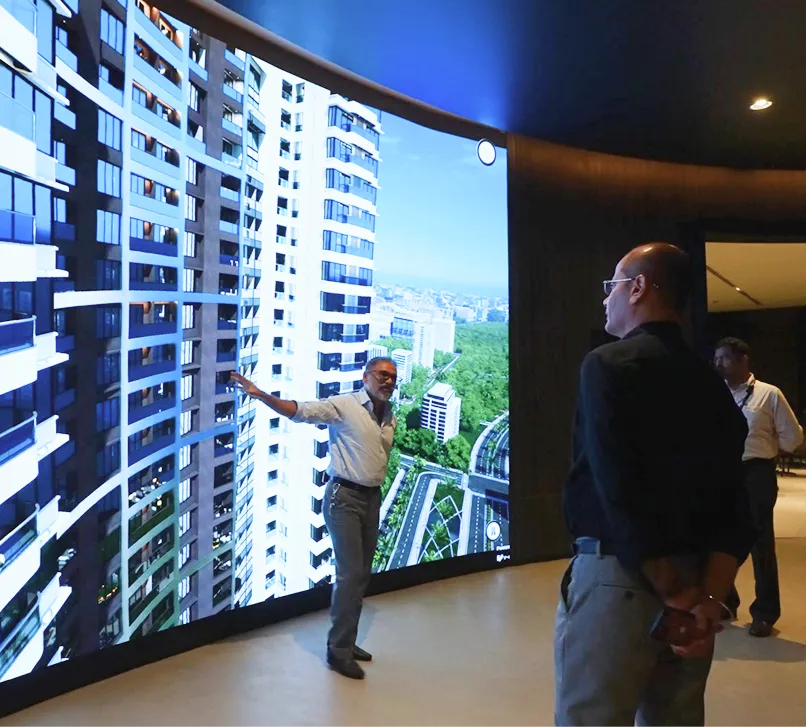
3D Environment Visualisation and Digital Twins Selling an under-construction property is inherently difficult because the physical context does not yet exist. Digital twins and 3D visualization platforms solve this by creating a highly accurate digital replica of both the project and its surroundings. Buyers can virtually stand on the balcony of a specific 15th-floor unit and look outward, seeing an accurate representation of the neighborhood skyline. This entirely eliminates the guesswork regarding views and privacy.
Real-Time Configuration and Sun Path Mapping Context also involves how a property interacts with nature. Advanced visualization tools can simulate sunlight at different times of the day and year, allowing a buyer to see exactly how natural light will enter their living room in the middle of winter. Providing this level of environmental context demonstrates a high degree of transparency and builds immense trust.
Turning Context into a Sales Strategy

Operationalising context requires more than just installing screens in a sales lounge; it requires equipping teams with the right narrative tools. The goal is to shift the sales conversation from "Here is the layout of the apartment" to "Here is how this apartment integrates into your lifestyle."
When channel partners and sales professionals have instant access to contextual tools, their efficiency improves dramatically. They can pre-empt buyer concerns by actively demonstrating the project's connectivity and environment before the buyer even has to ask.
For example, utilizing a comprehensive spatial visualization platform like V-Estate empowers sales teams to seamlessly transition from a macro view of the city's infrastructure down to the micro view of a specific unit's layout. A salesperson can use the platform to show the broader neighborhood context, highlight the walking path from the residential tower to the community retail center, and then instantly load the exact 3D view from that specific unit's windows. This unbroken, highly visual flow of information keeps the buyer engaged, answers their unspoken questions, and accelerates their journey from interest to commitment.
Conclusion
In a highly competitive real estate market, the physical attributes of a property are often not enough to secure a sale. Buyers require absolute clarity about where they are living, what they will see, and how they will connect to the world around them. Context is no longer an optional enhancement; it is a fundamental requirement for modern property sales. By implementing technologies that provide clear, visual, and accurate environmental context, developers can reduce buyer anxiety, shorten the sales cycle, and differentiate their projects based on genuine lifestyle value rather than just price.