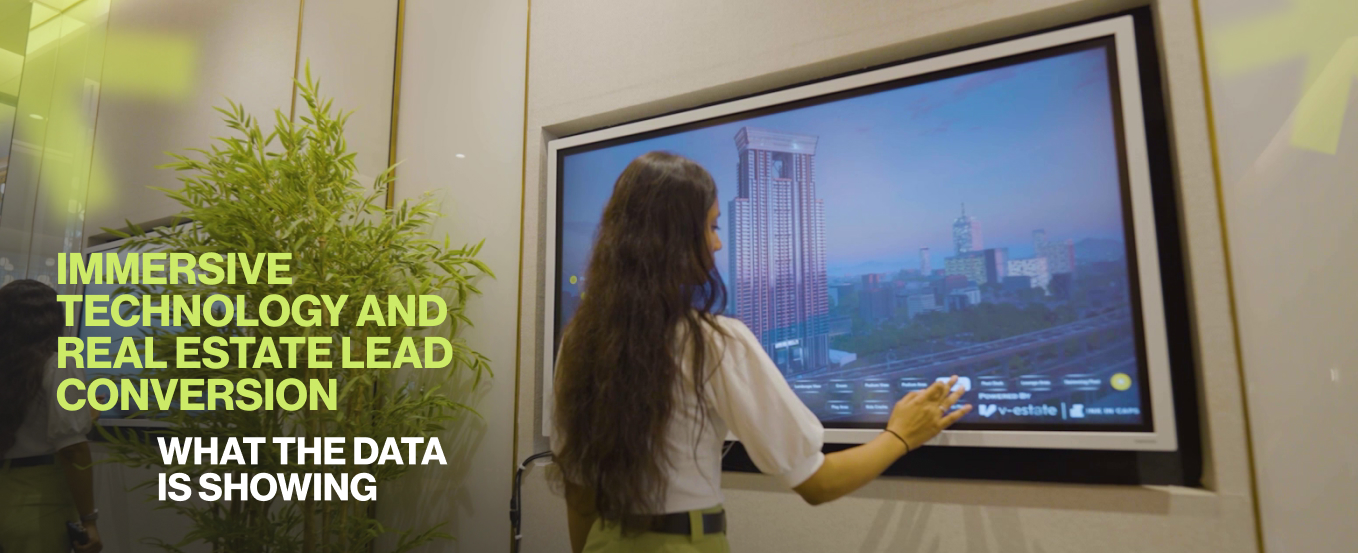
Lead generation in real estate has become relatively manageable. Lead conversion remains genuinely difficult.
Most developers today have access to digital marketing channels that generate site visit inquiries at scale. The challenge is not getting buyers through the door. It is getting them to commit once they are there — and ensuring they do not leave to "think about it" indefinitely.
This is a conversion problem. And the data from immersive technology deployments is making a compelling case for how it gets solved.
The Conversion Gap That Most Developers Underinvest In
The gap between site visit volume and actual conversion rate is where most real estate marketing budgets quietly underperform. A developer running high-volume lead generation might see hundreds of site visits monthly. If conversion from visit to booking sits at 5–8%, the cost-per-acquisition math becomes increasingly uncomfortable.
The instinctive response is to generate more leads. The smarter response is to convert existing leads more effectively. Conversion improvement is a higher-ROI intervention than volume increase in almost every scenario.
And conversion is determined almost entirely by what happens during the site visit itself.
L&T Realty — The Gateway Project, Sewri, Mumbai
L&T Realty | The Gateway Project | Premium high-rise | Sea views | Prime Mumbai location, Sewri | Grand launch at Jio World Convention Centre
L&T Realty required a platform to showcase The Gateway Project — a premium Mumbai development with defining advantages: prime location, uninterrupted sea views, and exceptional connectivity linking Mumbai's north and south.
Three distinct objectives drove the brief: give prospective buyers an immersive view of the architectural design and sea views; provide a seamless experience for international and remote clients; and create strong early engagement through a grand launch event for 200+ channel partners and stakeholders.
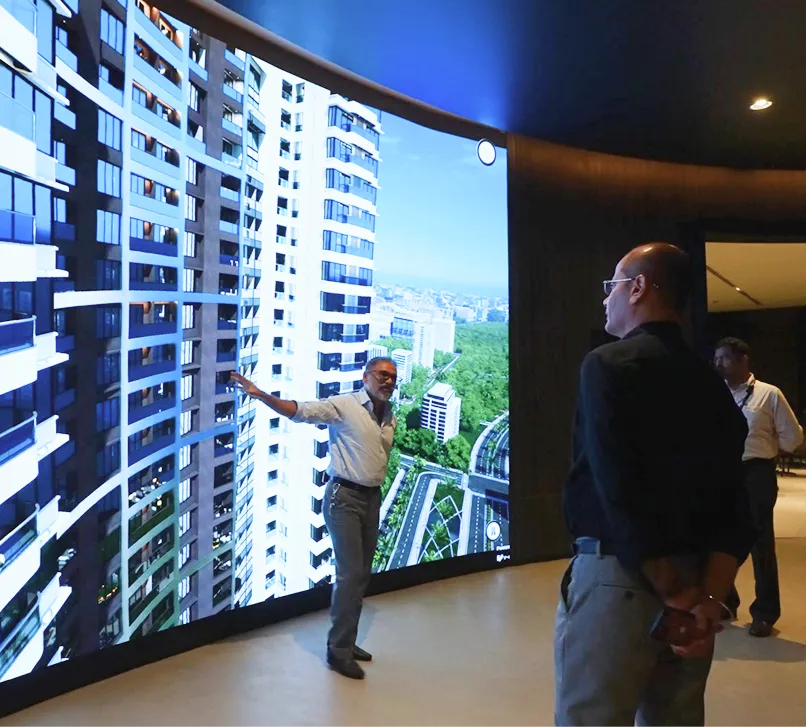
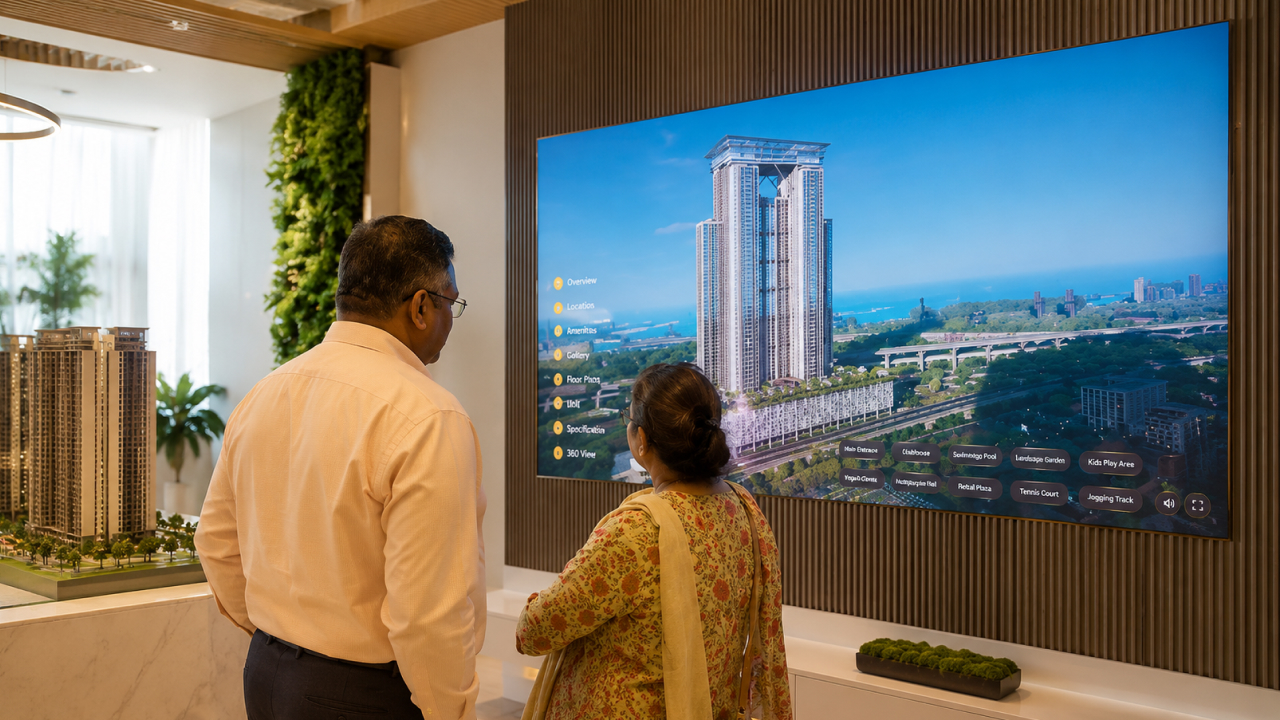
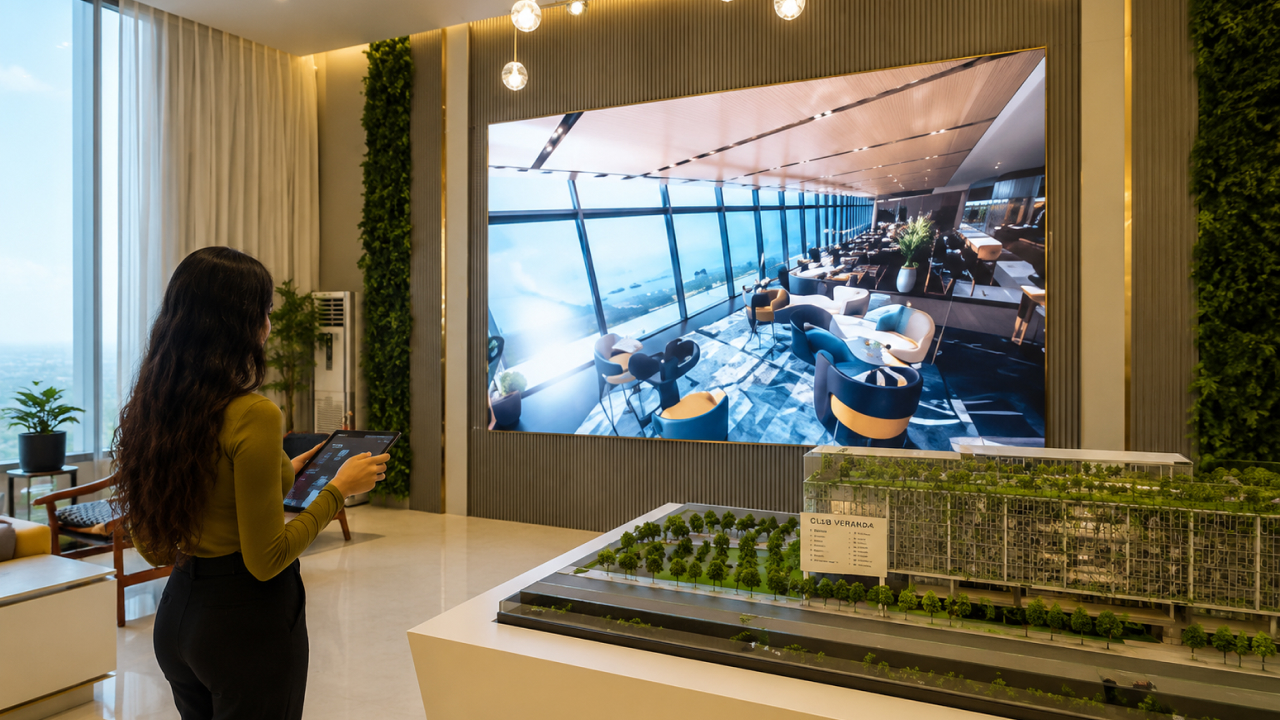
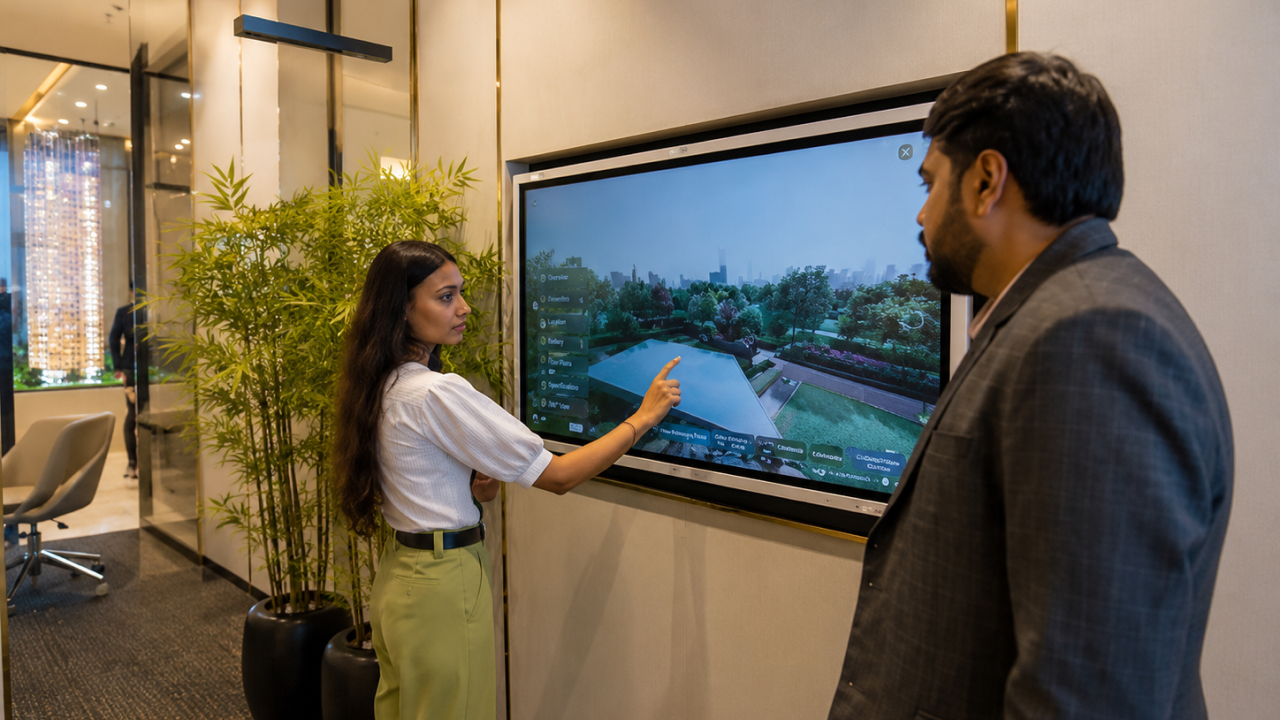
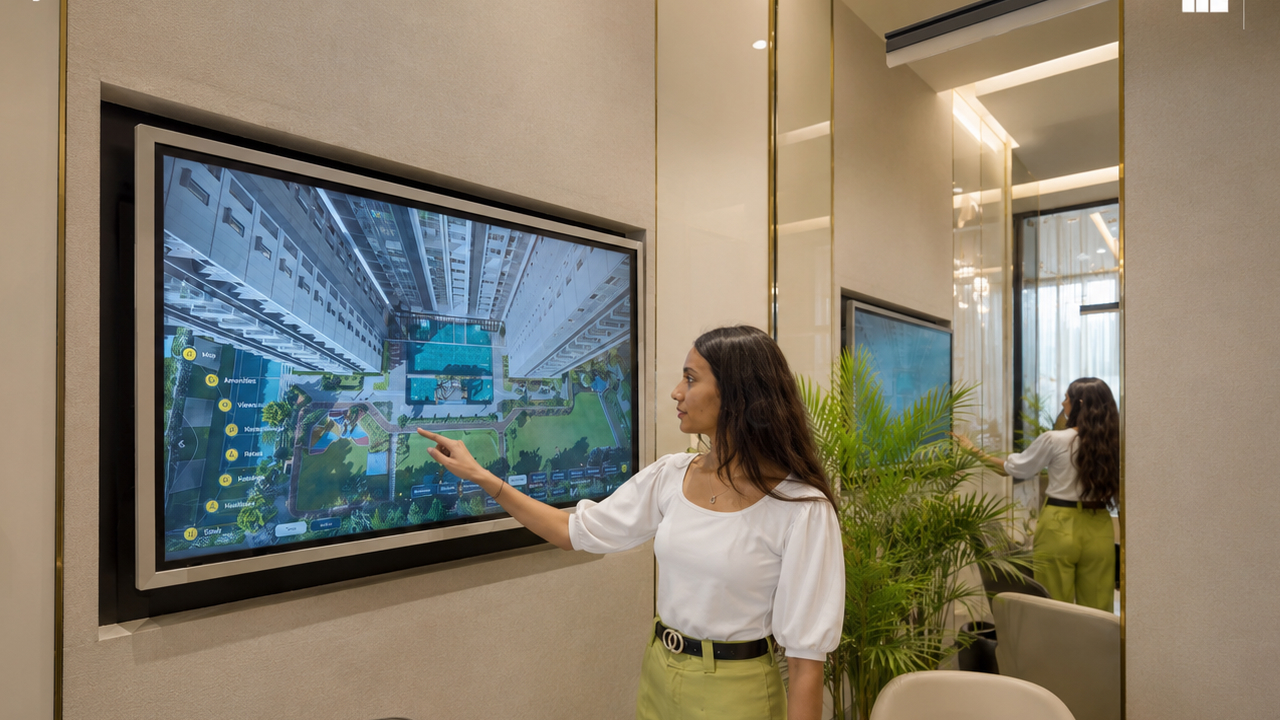
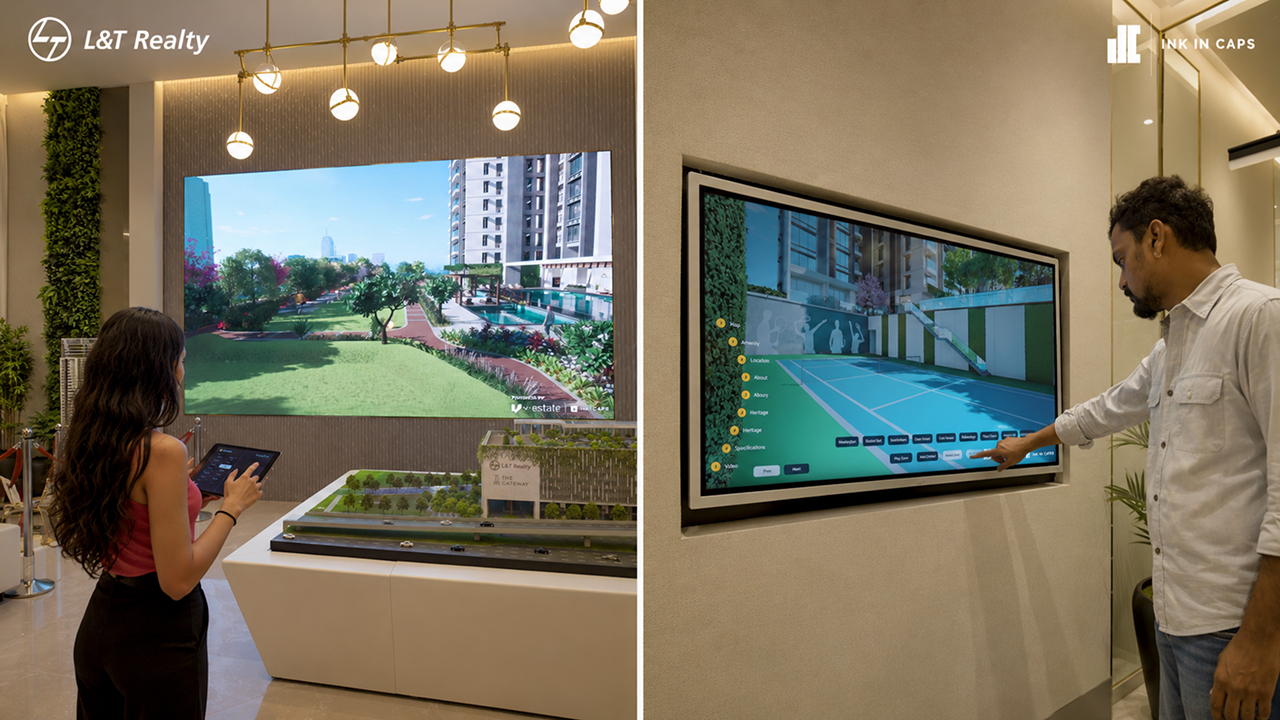
V-Estate Interactive Software: Deployed across 5 dedicated sales meeting rooms, each equipped with a 55-inch touchscreen TV connected to high-performance PCs capable of 4K real-time rendering. 15 designed touchpoints covered all main project features — dynamic window views across different settings, an in-depth virtual tour of the crown section highlighting luxury amenities, and a comprehensive vicinity map. The software was also integrated into the main LED screen in the waiting area — maintaining visitor engagement from the moment of arrival, controlled via iPad.
Sales Team Control Interface: Each room operated via an 11-inch iPad Pro, giving sales professionals flexible, intuitive navigation during client presentations.
Location AV: A dedicated video combined lifestyle narratives with connectivity storytelling — visualizing The Gateway Project's strategic Mumbai location and highlighting upcoming infrastructure including Navi Mumbai airport, the Mumbai Trans Harbour Link, and the Orange tunnel.
Launch Event — Jio World Convention Centre: For the grand launch attended by 200+ channel partners and stakeholders, hybrid 3D anamorphic content was developed alongside stereoscopic sound technology — creating the kind of opening impression that drives early sales momentum and channel partner confidence.
V-Retail — Virtual Sales Tool: The web version of V-Retail enabled live guided sessions via video calling for international and remote clients — extending the reach of in-person sales efforts beyond the physical experience centre. Sales reps could conduct real-time walkthroughs with buyers located anywhere in the world.
Results:
- The interactive sales tool moved L&T's process beyond traditional scale models and brochures — enabling a fully digital and engaging buyer experience
- The 3D anamorphic launch content generated strong early sales momentum through heightened excitement and visibility among 200+ channel partners
- Sales conversion rates saw a significant uplift during initial months following software deployment — buyers made faster, more informed decisions
- V-Retail extended reach to international clients through seamless virtual walkthroughs — removing geographic barriers from the sales process
What Breaks the Conversion Moment
Most site visits fail to convert not because the buyer dislikes the project. They fail because the buyer leaves with unresolved uncertainty.
They could not visualize the finished product clearly. They were unsure how their furniture would fit. They could not assess view quality from their preferred floor. They had questions about the surrounding area that were not answered visually.
These are all information gaps. And information gaps create hesitation.
Hesitation in real estate sales is almost always consequential. A buyer who leaves to "think about it" is a buyer who is going to visit another project, have another conversation, and potentially make a different decision. The window between site visit and commitment is narrow.
The Offline Immersive Experience Distinction
An important distinction is often overlooked in conversations about immersive property technology: offline and online experiences convert differently.
An online 3D tour is a browsing tool. It generates interest. It does not create the conditions for commitment. A buyer browsing remotely is in discovery mode — not decision mode.
An offline, in-person immersive experience — in a dedicated sales environment — creates the conditions for a decision. The buyer is present. The sales team is present. The tools are optimized for that moment. There are no competing distractions.
This is a sales environment. And the quality of that environment directly determines conversion outcomes. Developers who have invested in dedicated offline immersive sales centres consistently report stronger conversion metrics — not because the content is different from an online version, but because the context creates decisional readiness.
The Metrics That Define Immersive Technology ROI
For marketing heads and sales directors evaluating immersive technology investment, these are the metrics that matter:
Conversion rate from site visit to booking. The primary indicator. Hiranandani Belicia saw a 30% conversion rate — compared to an industry average of 5–10%.
Sales cycle length. How many touchpoints between first visit and commitment? Immersive environments consistently reduce this number.
International and remote buyer conversion. Virtual guided sessions extend conversion capability to buyer segments that traditional sales tools cannot reach.
Cancellation rate post-booking. Buyers who commit with full visual information cancel significantly less — because the decision was made with confidence, not on faith.
Channel partner engagement quality. The launch event for The Gateway Project — with 200+ channel partners — used 3D anamorphic content to build early momentum. That excitement translated into accelerated initial sales.
The Bottom Line for Developers and Marketing Heads
Immersive technology in real estate sales is a structural improvement to the sales process. Not a trend. Not a marketing experiment.
The developers adopting it are doing so because the conversion data supports it — consistently, across project types, price segments, and markets.
If your current conversion rate from site visit to booking is lower than your business model requires, the answer is not more leads. The answer is a better sales experience.
That is where the real work starts — in the sales room, not the marketing dashboard. If buyers are visiting your project and not committing, the question worth asking is not how to reach more people. It is what is leaving your existing visitors unconvinced. Fix the experience. The conversion numbers follow. Start by looking at your site visit-to-booking ratio this quarter. That number tells you everything about the quality of your current sales environment.
.jpeg)
.jpeg)