In premium real estate, there is a silent moment that determines whether a deal moves forward or stalls.
It is not when the buyer enters the sales gallery. It is not when they see the model. It is when they sit across the table and begin asking precise, high-intent questions. Which unit gives me the best view? How far is the green zone actually? What does the space feel like across different times of the day?
At that moment, most sales ecosystems start to break.
It’s because what the buyer is asking for is not information. They are asking for certainty. And certainty cannot be delivered through brochures, static renders, or verbal assurances. It requires an experience that can simulate reality with precision.
At L&T Bengaluru’s Elara Celestia, this gap was amplified. The project was not just architecturally complex. It was environmentally rich, context-driven, and spatially layered. Selling iIt required more than just communication.
It required a system that could translate complexity into clarity in real time. This point is where immersive sales tools became essential and where V-Estate built a solution designed not for presentation but for decision-making.
The inflection point in premium real estate sales
For years, the industry has relied on a predictable sales stack.
Physical scale models to establish massing
Rendered visuals to communicate aesthetics
Floor plans to explain layouts
Sales narratives to bridge the gaps
This approach works when the product is simple.
Elara Celestia was not.
Three Y-shaped interconnected towers created nonlinear spatial relationships
A landscape-heavy design introduced multiple experiential zones
Direct adjacency to the GKVK Botanical Gardens made views a core selling factor
Surrounding ecosystem including Phoenix Mall of Asia and Raintree Boulevard added contextual value
Each of these layers increases differentiation. But it also increases the cognitive load on the buyer.
When buyers cannot process this complexity easily:
Decision timelines extend
Sales conversations become repetitive
Pricing justification becomes harder
This is where leadership teams begin to see friction, not because of product limitations, but because of experience limitations.
Why immersive sales tools became essential
The decision to deploy immersive sales tools was not driven by innovation intent. It was driven by necessity.
V-Estate reframed the problem with a simple objective:
Enable buyers to make confident decisions within a single interaction.
To achieve this, the system needed to:
Replace interpretation with real-time validation
Replace static visuals with interactive exploration
Replace fragmented information with a unified digital experience
This led to the creation of a high-precision immersive digital twin integrated directly into the sales process.
Designing for the point of conversion
The most important design decision was where to deploy the technology.
Focus on the sales cabin
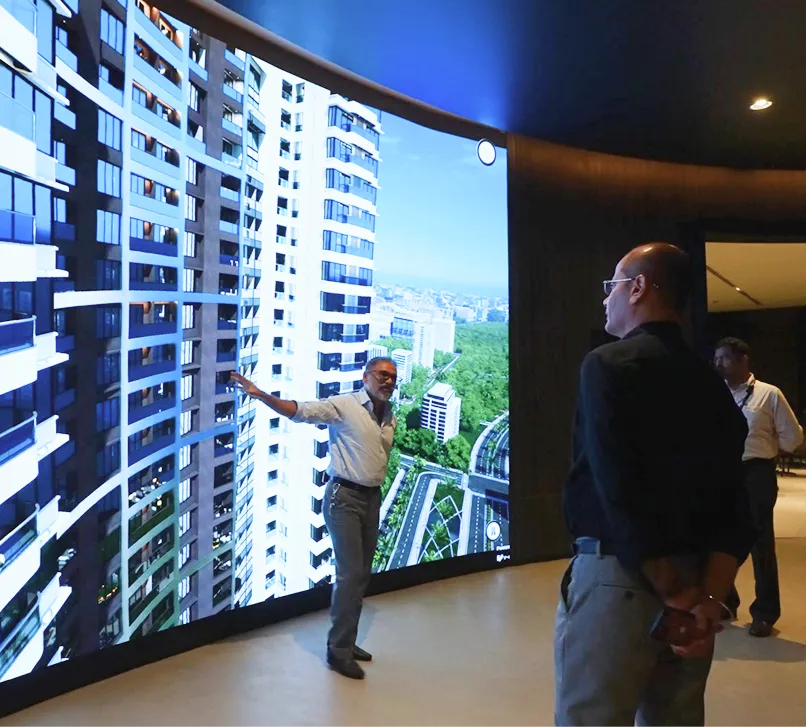
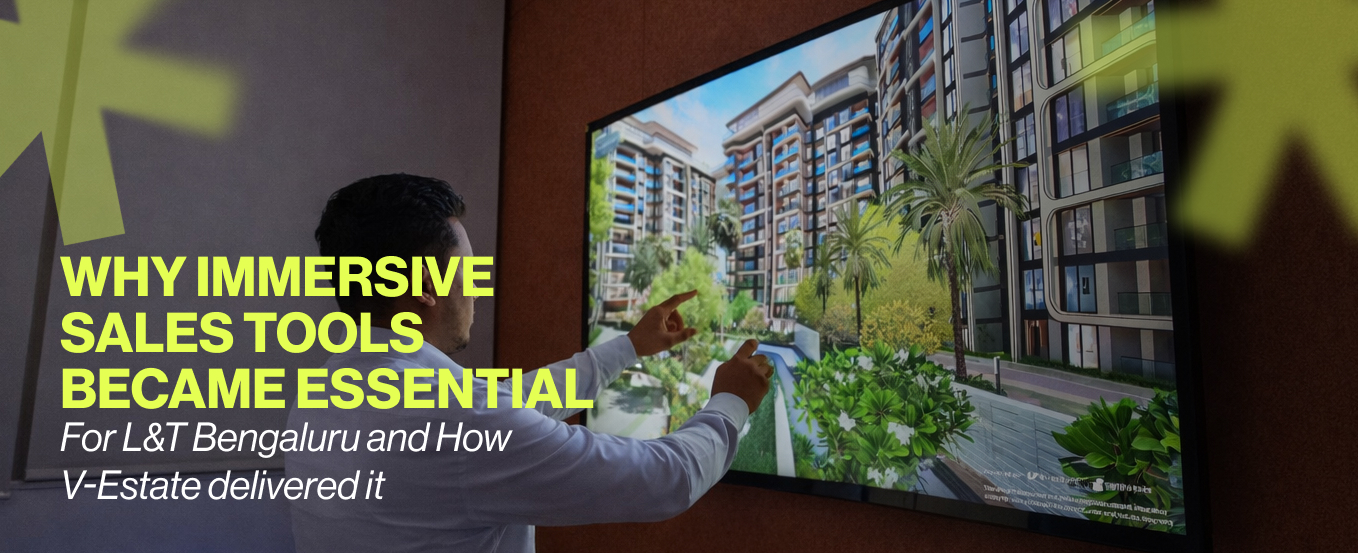
Six dedicated sales cabins equipped with touchscreen-enabled systems
Each cabin functioning as an independent decision environment with an interactive sales tool
Customer journey structure
Initial introduction at reception
Overview through physical-scale model
Final decision stage within the sales cabin using the digital twin
This ensured that the technology was not a showcase element. It was positioned exactly where conversion happens.
Engineering the digital twin at scale
The backbone of this deployment was a high-fidelity digital twin engineered for real-time performance.
Project scale
Site dimensions of 138 meters by 445 meters
Three interconnected towers forming a Y-shaped configuration
Two basement levels, ground, thirteen floors, and penthouse
Data complexity
Building polycount of approximately 2 crore polygons
Total project polycount of approximately 16 crore polygons
This scale places the project among high-density real environments, requiring advanced optimisation.
Translating architecture into clarity
The Y-shaped design introduced multiple technical challenges.
Interconnected towers with nonlinear movement
Continuous facade banding across structures
Beveled geometries and modern design language
Integration of a glass facade bullet lift
Technical execution
The RailClone plugin in 3D Max was used for the efficient placement of repetitive elements, such as balconies and wave-pattern facade elements.
Architexture workflows was used for procedural generation of facade patterns
This approach ensured that the architecture remained accurate, scalable, and easy to explore within the digital twin.
Landscape as the core experiential layer
The most defining aspect of Elara Celestia is its landscape.
Why landscape demanded attention
Direct views of the GKVK Botanical Gardens
Large open spaces due to horizontal spread
Multiple micro-level zones such as pools, jogging tracks, and seating areas
Engineering response
Deployment of three to four times more foliage than standard projects
Use of SpeedTree for custom vegetation, including Bengaluru-specific palm species
Integration of regional environmental characteristics such as red soil
Impact
Creation of layered environmental depth
Seamless transitions across different zones
A highly immersive experience within the interactive real estate walkthrough
Extending the experience beyond the project boundary
To fully communicate value, the digital twin incorporated the surrounding ecosystem.
Integrated context
GKVK Botanical Gardens
Phoenix Mall of Asia
Raintree Boulevard township
Nearby commercial hubs and infrastructure
L&T data center
Airport connectivity within approximately 30 minutes
Visible airstrip with private jet movement
Metro line running in front of the project
Strategic advantage
Buyers could validate location benefits in real time
The project was positioned within a high-value ecosystem
Conversations shifted from assumptions to clarity
This is a critical evolution. Buyers are no longer evaluating just the unit. They are evaluating the ecosystem and its future potential.
Engineering performance in high-fidelity environments
Handling a project of this scale required deep technical optimisation.
Core challenges
High GPU load due to dense geometry and foliage
Large texture sets exceeding 500 MB
Risk of crashes due to simultaneous data loading
Technology stack
Unreal Engine 5.4 as the core platform
Lumen for real-time lighting
Nanite workflows for geometry optimisation
Path tracing for selective high-quality outputs
Key optimisation strategy
Sequential texture loading to prevent system overload
Controlled asset streaming for stability
Iterative optimisation cycles to refine performance
Outcome
Smooth navigation across the digital twin
Stable performance during continuous usage
High-fidelity visuals maintained without compromise
This demonstrates how proptech software must be engineered for reliability, not just visual appeal.
From walkthroughs to decision infrastructure
The impact of this deployment goes beyond technology.
Transformation in buyer experience
Immediate clarity on views, layouts, and surroundings
Ability to explore the project dynamically
Reduced dependence on imagination
Transformation in sales process
Faster response to complex queries
More confident conversations with buyers
Reduced reliance on static materials
Extended applications
Adoption for NRI client presentations
Expansion into web-based version for remote engagement
This is where interactive real estate walkthroughs evolve into business-critical infrastructure.
Value ceation for L&T
The deployment delivered value across multiple layers.
Commercial value
Stronger justification for premium pricing
Improved alignment between product and perception
Enhanced differentiation in a competitive market
Operational value
High adoption by sales teams
Scalable usage across multiple touchpoints
Reduced dependency on physical visits
Strategic value
Ability to communicate complex projects with precision
Improved buyer conviction at the point of decision
Transformation of sales cabins into high-impact decision environments
What this signals for real estate leadership
The complexity of premium projects is increasing
Traditional sales tools are not equipped to handle this complexity
Buyers expect clarity, not interpretation
Immersive digital twins are becoming essential for high-value developments
Interactive sales tools directly influence conversion outcomes