.jpg)
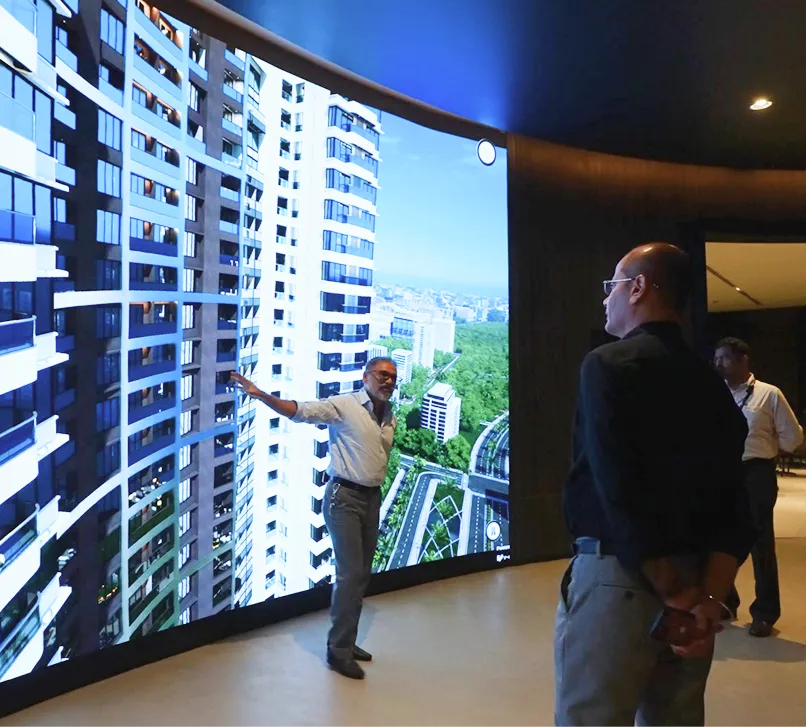
The luxury residential buyer is buying more than a layout; they’re buying a future — a rhythm of light, a line of sight from the balcony, the feel of a living room when friends arrive. For developers and marketing heads, the task is to replace speculation with conviction. The Runwal Raaya experience centre shows how disciplined experiential design and an offline activation strategy can turn doubt into a decision. This blog unpacks that approach and translates it into a playbook you can apply to premium launches and high-value presales.
Why experiential design matters at the top end of the market
At higher price points, buyers demand clarity. Drawings, brochures and staged photographs are useful, but they still ask the buyer to imagine — and imagination introduces doubt. The most effective experience centres remove that mental friction by turning abstract claims into verifiable experiences: what the view actually looks like, how the morning light reaches the living room, how a chosen sofa sits in the circulation path. When those questions are answerable in a single session, buyers move faster and more confidently.
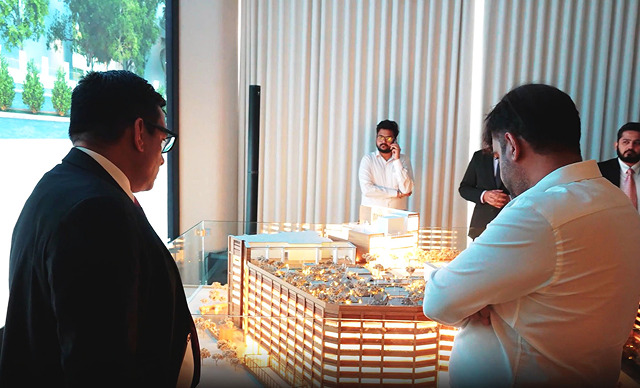
Runwal Raaya’s centre is a textbook example of this principle: a tightly controlled, offline activation built to let prospective buyers discover the property on their terms and to validate lifestyle claims in real time.
The activation strategy: offline, immersive, and buyer-led
Two strategic decisions underpin the Runwal Raaya model:
Host the experience offline in a controlled environment.
Let the buyer interact with photorealistic, configurable representations of the home and neighbourhood.
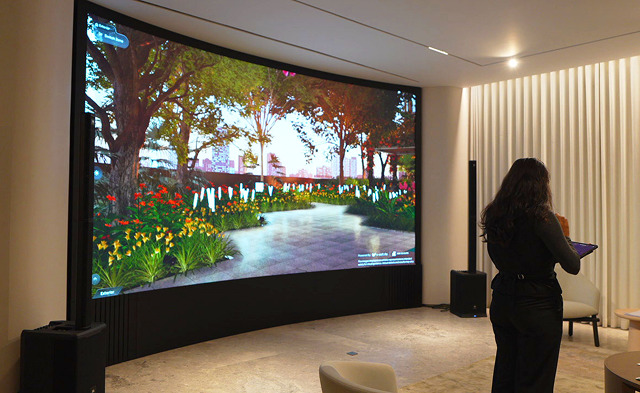
Choosing an offline activation means you control the narrative and the environment. Visitors arrive focused and receptive — not scrolling on a phone or distracted by competing online content. Photorealistic visualization and interactive controls hand the buyer the power to explore lighting, finishes, furniture layouts and sightlines, so the decision becomes evidence-based rather than hopeful.
What V-estate brings to this workflow
V-estate is positioned as an interactive real estate sales tool designed to convert the showroom into a decision studio. It’s built to be part of an offline activation and to solve the specific problems that premium buyers bring to the table:
Photorealistic 3D show flats that match finishes, furniture and true sightlines.
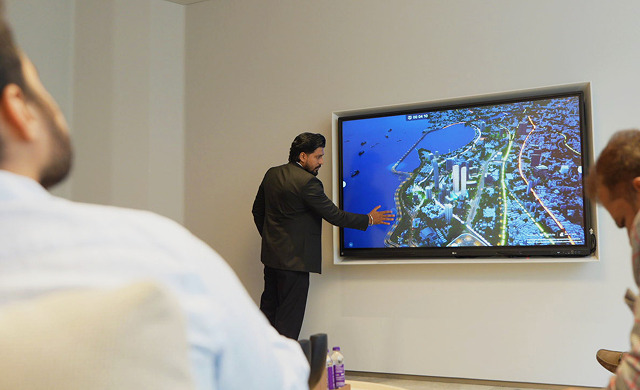
Amenity and locality mapping so buyers can immediately judge connectivity and convenience.
In-showroom customization tools — change paints, swap furniture, test layouts.
Dynamic lighting and weather controls so buyers can view a unit at different times and conditions.
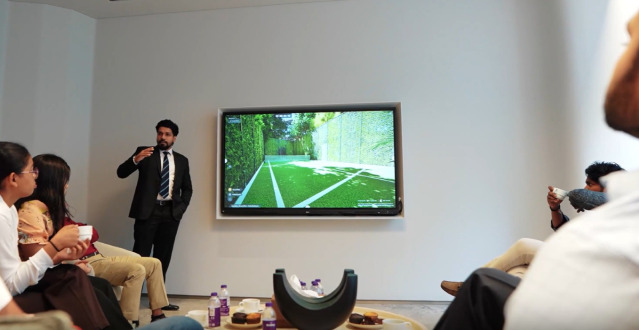
In short: V-estate turns static visuals into a hands-on discovery process. Use it to streamline presales events, guided walkthroughs and curated discovery sessions where buyers must be assured before they sign.
The buyer problems this model resolves — bold and direct
• Eliminates uncertainty about views and exposure. Buyers see exact window sightlines and the quality of the view at different times. • Lets buyers test finishes and furniture in real scale. Swapping a paint tone or placing a sofa removes a common sticking point in buyer decisions. • Reduces repeat site visits. Many follow-up visits exist because buyers still haven’t resolved spatial or visual doubts; a well-run experience centre addresses those gaps. • Speeds up decision-making. When lifestyle concerns are validated in-session, the sales cycle shortens. • Lowers handover disputes. When expectations are validated and recorded early, disagreements later in the process drop.
These outcomes are not theoretical. They are the reason high-value projects invest in immersive activations: the payoff is a faster funnel, higher-quality commitments and fewer surprises at handover.
Concrete tactics used at Runwal Raaya (and how to copy them)
These are practical, cost-effective elements that you can replicate.
Photoreal show flats with exact sightlines
Create renders that reflect the real materials, balcony details and exterior views for each floor band. When a buyer asks, “What will I actually see from the living room?”, you should be able to show them the precise answer rather than an approximation. That fidelity avoids later renegotiation and builds trust.
Dynamic lighting and weather presets
Allow visitors to switch between morning, noon, golden hour and nighttime, and to simulate common weather conditions. Buyers quickly develop confidence when they can see how the space performs at different times and under different conditions.
Configurable furniture and finish packs
Provide curated furniture layouts and finish palettes that buyers can toggle between. Also allow a “bring-your-dimensions” mode that lets buyers mock-up their own furniture to test flow and clearance.
Amenity and neighbourhood context layer
Integrate a mapped view of local schools, hospitals, transit nodes and upcoming civic or private projects. Buyers often decide based on proximity and convenience as much as on the unit itself; a mapped context answers those lifestyle questions immediately.
Guided discovery paths
Design a few standard buyer journeys — for example, a “family” path, an “entertainer” path and an “investor” path — and let visitors choose. Each path brings forward the visuals, facts and features most relevant to that buyer type, keeping the experience efficient and purposeful.
Evidence-based conversation triggers
Build micro-moments in the walkthrough that naturally lead to the next commercial step. For example, after a buyer samples dusk light on a balcony, prompt an inventory check for units that offer the same view band. These triggers are time-sensitive information, not pushy sales lines.
Implementation checklist for developers and marketing heads
Technical & content preparation
Produce photoreal renders for at least three configurations per apartment type.
Generate balcony and external view composites for each relevant floor band.
Prepare lighting presets (morning, midday, golden hour, night) and weather toggles.
Curate an amenity dataset (schools, hospitals, transit, upcoming projects).
Create furniture packs representing common buyer lifestyles.
Sales & experience design
Train sales staff to facilitate discovery rather than recite features. Facilitation is about asking what the buyer wants to see and guiding exploration.
Prepare three scripted discovery journeys that take 8–15 minutes each, plus a 30-minute deep demo.
Add CRM hooks so you capture which presets a visitor used, and how long they engaged with each.
Measurement
Log time spent on each interactive element (views, finish swaps). High engagement on certain elements often correlates with buyer intent.
Track conversion pathways to identify which sequences most often lead to bookings.
Compare repeat physical visits before and after a visitor experiences the centre.
A short sales facilitation script that works
Salespeople should guide, not sell. Here’s a simple flow:
Ask: “Would you like to start with the lighting and view, or the furniture layout?”
Listen and activate: If the buyer says “lighting,” switch to the evening preset and show the balcony light at the actual sunset hour.
Test: “Would you like to see how your sofa will fit here? Give me the dimensions and I’ll place it.”
Bridge: After the buyer engages positively, offer an evidence-based next step: “You just saw the sunset view in this floor band — we currently have three units with identical outlook. Would you like me to check availability?”
This removes pressure and replaces it with clarity and a clear path forward.
Metrics you should expect and measure
When executed properly, a decision-focused experience centre delivers measurable business outcomes:
Shorter sales cycles. Buyers validate lifestyle factors earlier and reduce indecision.
Higher lead quality. Visitors who spend time testing presets and views are more likely to convert.
Lower post-handover disputes. Early validation reduces expectation gaps at delivery.
Higher attachment revenue. Buyers making in-session choices about finishes and upgrades convert at higher attachment rates.
Capture these metrics in the first 90 days to validate the activation and iterate on what works.
Common pitfalls and how to avoid them
Glossy visuals that don’t match delivery. If renders misrepresent materials or views, you will break trust. Use exact façade drawings and agreed finishes. A demo that becomes a monologue. Train facilitators to ask questions, to stop and let the buyer steer. Too many options too soon. Start with 3–5 curated presets, then offer free-play. Too many early choices paralyse decisions. Treating the centre as a marketing prop. Design the centre as a conversion channel tied to CRM events and measurable outcomes.
Why this matters more for luxury projects
Luxury buyers value certainty over persuasion. Their risk tolerance is low because the scale of purchase is high. An experience centre that hands them control and real evidence about living conditions shifts risk perception — the buyer feels like they’ve checked the boxes themselves. That transfer of certainty is the core value of an experiential activation in the luxury segment.
Simple ROI sketch for decision-makers
Estimate whether an experience centre makes commercial sense:
Take your average ticket size and current conversion rate from qualified leads.
Apply a conservative uplift (20–40%) in conversion for those who engage meaningfully with the centre.
Multiply the incremental bookings by average ticket size to see potential revenue gain.
Compare to the cost of the centre (design, build, visualization, staffing).
Even modest uplifts in conversion can justify the investment at high price points; the math usually becomes favorable quickly.
Final operational checklist before opening
Verify that photoreal renders are aligned with engineering and façade drawings.
Prepare a 30-minute guided demo and a 10–12 minute express demo.
Map the visitor flow: welcome → choose journey → explore → evidence snippet → next step.
Integrate CRM to capture presets used and time spent per interaction.
Run staff rehearsals focusing on facilitation and empathy.
.jpg)
Closing: design the experience to resolve doubt
Runwal Raaya’s experience centre shows the difference between showing and resolving. A showroom displays; a decision studio resolves. If your next high-value launch must convert fast and cleanly, design an offline activation that:
Puts the buyer in control of discovery,
Validates the lifestyle claim with exact visuals, and
Maps exploration directly into the sales process.
Tools like V-estate are engineered to make that offline activation precise and measurable: photoreal show flats, configurators, lighting and weather controls, and amenity mapping — all aimed at converting curiosity into commitment. Use these elements to design an experience that replaces speculation with conviction and shortens the path to a signed agreement.