Buying a home is rarely a decision based on a floor plan alone.
A buyer may understand the carpet area, compare the price, look at the amenities and study the location. But there is still one question that static brochures, floor plans and conventional renders often struggle to answer:
What will this property actually feel like when I live in it?
Will the living room receive enough natural light in the morning? What will the balcony look like in the evening? Will the bedroom feel bright during the day? How will the property look after sunset? Will the view from a particular floor remain attractive at different times of the day?
These details can influence how a buyer evaluates a property, but they are difficult to communicate through static visuals.
This is where day-and-night simulation in real estate becomes valuable.
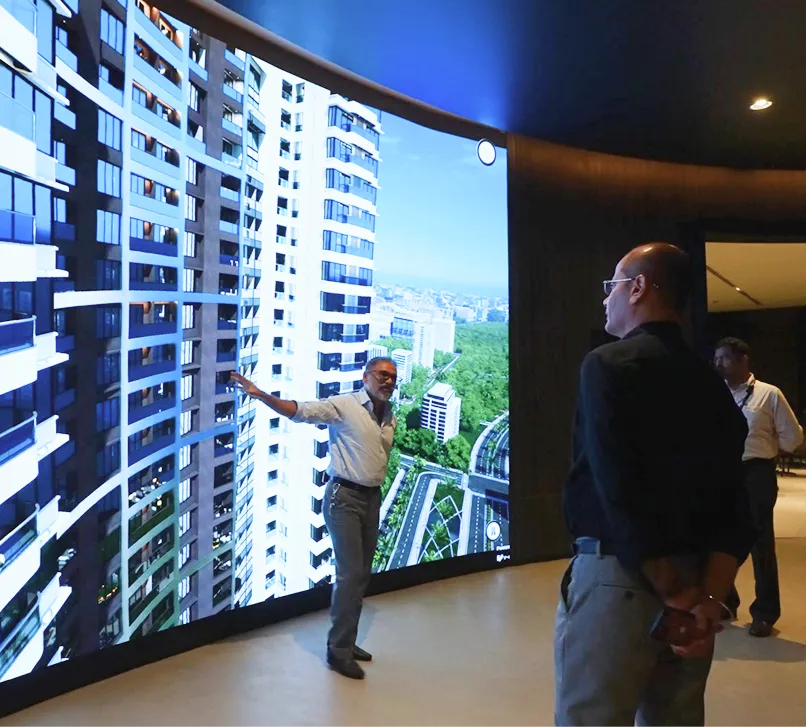
Instead of showing buyers one fixed representation of a property, interactive technology can allow them to experience the same space under different lighting and time-of-day conditions. With a digital twin, buyers can move through a project, explore specific units and understand how natural light and shadows change throughout the day.
For developers, this changes the sales conversation from simply presenting a property to helping buyers evaluate it.
Why Lighting Matters in Real Estate Decisions
Light is one of the most important characteristics of a living space.
A property may look completely different at 9 AM compared with 6 PM. The direction of sunlight, shadows from surrounding buildings, orientation of windows and the position of balconies can all affect the experience of the space.
Yet traditional property marketing often reduces this complexity to a handful of photographs or renders.
A brochure might show a beautifully lit living room.
A website might show an attractive sunset render.
A sales executive might point towards the balcony and explain the direction of the view.
But the buyer still has to imagine the rest.
That gap between what is presented and what the buyer needs to understand can create uncertainty.
Interactive day-and-night simulation addresses this gap by allowing buyers to explore lighting conditions instead of simply being told about them.
V-Estate's Spaci platform, for example, includes dynamic lighting simulation designed to show how natural light behaves inside specific units across different times of the day. Its system also uses sun-shadow mapping based on the project's real-world location and time.
That level of context can make the property easier to evaluate.
What Is Day-and-Night Simulation in Real Estate?
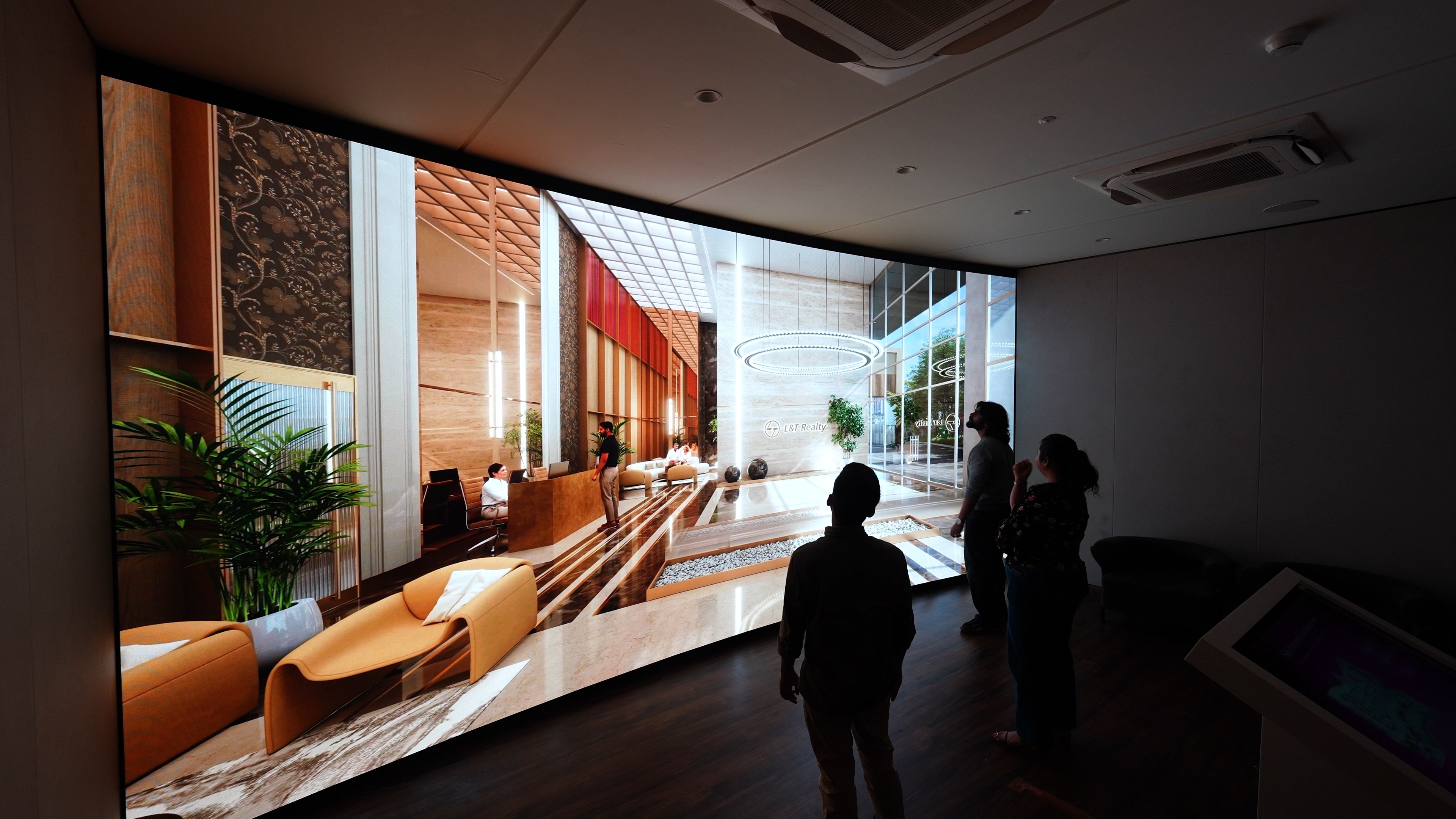
Day-and-night simulation is an interactive visualization technique that allows a buyer to experience a digital representation of a property under different times of day.
Instead of viewing one static render, the buyer can move between different lighting conditions such as:
- Morning
- Midday
- Afternoon
- Evening
- Sunset
- Night
The simulation can represent changes in natural illumination, shadows, exterior lighting and the overall visual atmosphere of the property.
When integrated into an interactive digital twin, this experience can go beyond a single room.
A buyer can potentially explore the apartment, balcony, amenities, common areas and external views while understanding how the environment changes throughout the day.
The important difference is interaction.
The buyer is not simply watching a video.
They are exploring the property and asking questions through the experience.
From “This Apartment Gets Good Light” to Showing What That Means
Consider a typical sales conversation.
A buyer asks:
“How much sunlight does this apartment get?”
The sales executive may explain the orientation, floor and window positioning.
But the buyer still needs to translate that information into an actual living experience.
Now imagine the same conversation happening inside an interactive digital twin.
The sales executive selects the buyer's specific unit.
The experience moves inside the living room.
The time changes from morning to afternoon.
The buyer can see how sunlight enters the space.
The time moves towards evening.
The shadows change.
The buyer can then explore another unit or another floor and compare the difference.
The conversation becomes more concrete.
Instead of:
“This apartment gets good natural light.”
It becomes:
“Let's look at how the light behaves in this specific apartment at different times.”
That is a very different sales experience.
The technology does not replace the salesperson.
It gives the salesperson a better way to demonstrate the answer.
Buyers Don't Just Evaluate a Property. They Imagine Living in It.
Real estate is unusual compared with many other purchases because buyers are not simply evaluating a product.
They are imagining their future life.
They imagine:
- Having breakfast near the window
- Working from the living room
- Sitting on the balcony in the evening
- Returning home after sunset
- Looking at the city lights at night
- Spending weekends around the amenities
- Waking up to a particular view
Static imagery can communicate appearance.
Interactive simulation can help communicate experience.
This distinction becomes especially important for premium and under-construction projects.
When the actual apartment does not yet exist, the buyer cannot physically experience its light, views or atmosphere.
The developer therefore has to bridge the gap between architectural information and lived experience.
A digital twin can help create that bridge.
Day-and-Night Simulation Becomes More Powerful at the Unit Level
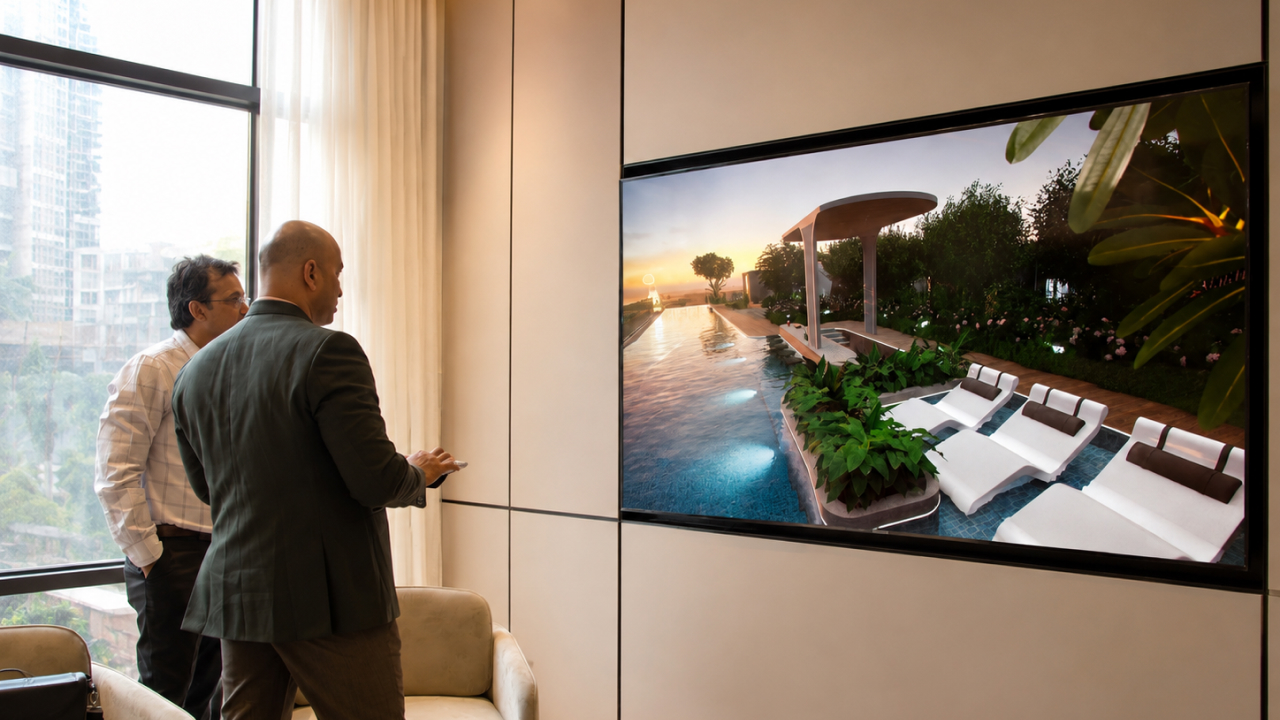
Showing an entire building in day and night mode is useful.
But showing the specific unit a buyer is considering can be far more meaningful.
Imagine a buyer comparing two apartments in the same tower.
Both may have the same configuration.
Both may have similar carpet areas.
Both may be priced similarly.
But their orientation, floor height and external views may differ.
With an interactive digital twin, the sales team can move between the units and demonstrate those differences.
The buyer can compare:
Unit A
- Morning light
- Afternoon exposure
- Evening ambience
- Balcony orientation
- External view
with:
Unit B
- Different sunlight direction
- Different shadow patterns
- Different floor height
- Different surrounding view
This turns visualization into a comparison tool.
And comparison is a natural part of the buying process.
Why This Matters for High-Value Properties
The more expensive the purchase, the more questions buyers tend to ask.
A buyer spending a significant amount on a property may want clarity around details that a casual property shopper might overlook.
Questions can include:
- Which direction does the apartment face?
- What will I see from my balcony?
- How much natural light will the living room receive?
- Will another tower block the view?
- How will the property look in the evening?
- Which floor gives me the better experience?
- How does the view change from different heights?
These are not merely aesthetic questions.
They can influence perceived value.
For a premium development, the view from a particular floor or the quality of natural light can become part of the property's appeal.
V-Estate's interactive sales technology is designed to let buyers explore floor-specific views, spatial volumes and lighting conditions rather than relying entirely on static representations.
The Experience Centre Can Become More Than a Presentation Room
Day-and-night simulation becomes even more useful when integrated into a modern real estate experience centre.
A traditional sales gallery often works around:
Brochure → Presentation → Floor Plan → Render → Sales Discussion
An interactive experience centre can create a different sequence:
Explore → Compare → Ask → Validate → Decide
The buyer can sit with the sales consultant while the digital environment is controlled in real time.
For example:
- Select the project.
- Choose a tower.
- Select a floor.
- Select a specific unit.
- Enter the apartment.
- Change the time of day.
- Explore the window view.
- Compare another unit.
- Explore amenities.
- Discuss the decision with the sales consultant.
This makes the experience more consultative.
The salesperson is no longer simply delivering information.
They are helping the buyer investigate the property.
That shift is particularly relevant as real estate buyers increasingly expect more visual clarity before making major decisions. V-Estate positions its interactive sales experience around this movement from static presentations towards validation-led conversations.
Day-and-Night Simulation Can Also Improve Transparency
There is another important advantage: transparency.
Real estate marketing naturally focuses on presenting the strongest aspects of a project.
That is understandable.
But buyers also want confidence that what they are seeing represents the property accurately.
An interactive simulation can create a more transparent conversation by allowing buyers to explore different conditions rather than showing only the most attractive render.
For example, a buyer can understand how shadows change during the day or how the external environment looks after sunset.
This does not mean that simulation can predict every real-world condition perfectly.
Weather, seasonal conditions, construction changes and surrounding development can all influence the actual experience.
But a properly built simulation can give buyers significantly more context than a single static image.
That context matters because better information can lead to better-informed decisions.
It Can Reduce the Burden on Sales Teams
A common problem in real estate sales is repetition.
Sales teams may answer the same questions repeatedly:
“Which direction does this unit face?”
“What will the view look like?”
“How much sunlight will I get?”
“What does the apartment look like from this floor?”
“Can you show me another unit?”
An interactive system can make these questions easier to demonstrate.
Instead of explaining every detail verbally, the salesperson can use the digital environment as a shared reference point.
This creates a more visual conversation.
The buyer asks a question.
The salesperson demonstrates the answer.
The buyer explores further.
The conversation becomes more dynamic.
V-Estate's Spaci platform is designed around this type of interactive sales environment, with features including floor-specific exploration, panoramic window views, multi-height navigation and dynamic lighting.
Day-and-Night Simulation Is Not Just About Making Real Estate Look Better
It is easy to think of advanced visualization as a marketing tool designed to make a project more impressive.
But its larger value is decision support.
The objective is not simply:
“Make the property look beautiful.”
It is:
“Help the buyer understand the property better.”
That distinction matters.
A beautiful render may attract attention.
An interactive simulation can answer questions.
And in a high-value purchase, answering the right questions can be more valuable than creating another attractive image.
The Future of Real Estate Visualization Is Becoming More Interactive
Real estate visualization is moving beyond static renders and conventional walkthroughs.
Modern digital experiences can combine:
- Digital twins
- Real-time 3D
- Dynamic lighting
- Sun and shadow simulation
- Interactive floor plans
- Panoramic window views
- Unit-level exploration
- Amenity visualization
- Vicinity mapping
- Experience-centre displays
V-Estate's Spaci platform brings several of these capabilities together, including real-time navigation, dynamic lighting, panoramic window views and accurate sun-shadow mapping.
The larger shift is from showing a property to letting buyers explore a property.
That is an important difference.
What Developers Should Consider Before Implementing Day-and-Night Simulation
Day-and-night simulation should not be added simply because it looks impressive.
Developers should ask:
1. Is the simulation connected to the actual project data?
Accuracy matters more than visual effects.
2. Can buyers explore specific units?
A generic building simulation is less useful than a unit-level experience.
3. Can the experience demonstrate actual views?
Views can be a major part of a property's value proposition.
4. Can the sales team control the experience?
The technology should support the sales conversation rather than complicate it.
5. Can buyers compare options?
Comparison can help buyers understand why one unit may be more suitable than another.
6. Can the experience be used before construction is complete?
This is one of the strongest applications of digital twin technology because buyers can experience aspects of the future property before physical completion.
From Visualization to Validation
The biggest change brought by day-and-night simulation is not necessarily visual.
It is behavioural.
Traditional property marketing asks buyers to imagine.
Interactive property technology allows them to explore.
Traditional sales presentations ask buyers to trust the explanation.
Interactive simulations allow them to validate the explanation.
And traditional renders show one possible representation.
Digital twins can allow buyers to investigate different conditions, units, floors, views and times.
That is why day-and-night simulation can become more than a visual feature.
It can become part of the buyer's decision-making journey.
Conclusion
A property does not remain the same throughout the day.
The light changes.
The shadows move.
The views feel different.
The ambience changes.
And the way a buyer experiences a home can change with those conditions.
For developers, communicating these differences through static brochures and conventional renders can be difficult.
Day-and-night simulation provides another approach.
By integrating dynamic lighting and time-of-day visualization into an interactive digital twin, developers can give buyers a clearer understanding of what a property may feel like across different conditions.
More importantly, the technology can turn a sales conversation into an interactive evaluation.
The buyer can select a unit, explore the space, change the time of day, examine the view and compare alternatives.
That is the larger opportunity for real estate technology.
The future of property sales is not only about showing buyers what a project looks like. It is about helping them understand what it could feel like to live there.
And when buyers can explore those details before construction is complete, the distance between seeing a property and imagining life in it becomes much smaller.
.jpg)