In the ultra-luxury segment, real estate is not a transactional purchase. It is a high-conviction decision shaped by expectation, identity, and long-term alignment.
A buyer evaluating a ₹50 to ₹60 crore residence is not simply comparing configurations or amenities. They are assessing whether the space reflects their lifestyle, whether the views feel expansive and uninterrupted, whether the design language aligns with their sensibilities, and whether the overall experience justifies the investment.
At this level, even small gaps in understanding can slow down decision-making.
Traditional formats such as brochures, static renders, and guided presentations leave too much open to interpretation. Buyers are expected to imagine scale, interpret floor plans, and trust that the final outcome will match what is being communicated.
This gap between promise and perception creates friction.
This is where 3D visualization solutions for property developers are redefining how high-value real estate is sold. By allowing buyers to experience the product with clarity and precision, these systems reduce uncertainty and enable faster, more confident decisions.
Why 3D Visualization Real Estate Software is Reshaping Buyer Behaviour
The rise of 3D visualization real estate software is fundamentally changing how buyers process information.
Instead of relying on abstraction, buyers can now interact with spaces in a way that mirrors real-world experience. This has a direct impact on how quickly and confidently they move through the decision journey.
Three behavioural shifts are particularly important.
Clarity becomes immediate Buyers can understand layouts, proportions, and spatial relationships without having to mentally reconstruct them from 2D drawings. This reduces confusion and eliminates the need for repeated explanations.
Conviction builds organically When materials, lighting, and views are presented consistently across formats, the perceived risk associated with the purchase reduces. Buyers feel more certain about what they are investing in.
Engagement becomes self-driven Interactive systems allow buyers to explore at their own pace. This increases time spent with the product and leads to deeper processing of information.
These shifts collectively contribute to shorter sales cycles, not by accelerating persuasion, but by enabling faster comprehension.
How 3D Visualization for Real Estate Compresses Sales Cycles
Immediate Spatial Understanding Reduces Decision Friction
One of the most persistent inefficiencies in real estate sales is the repetition of basic queries across multiple interactions.
With advanced 3D visualisation for real estate, the first interaction itself becomes significantly more comprehensive. Buyers can explore layouts, understand circulation, and evaluate proportions in a single session.
This leads to:
Fewer follow-up meetings focused on clarification
Reduced back-and-forth between buyer and sales teams
Faster progression from initial interest to serious consideration
When clarity is achieved early, the decision journey becomes more linear and less fragmented.
Interactive Exploration Drives Deeper Engagement
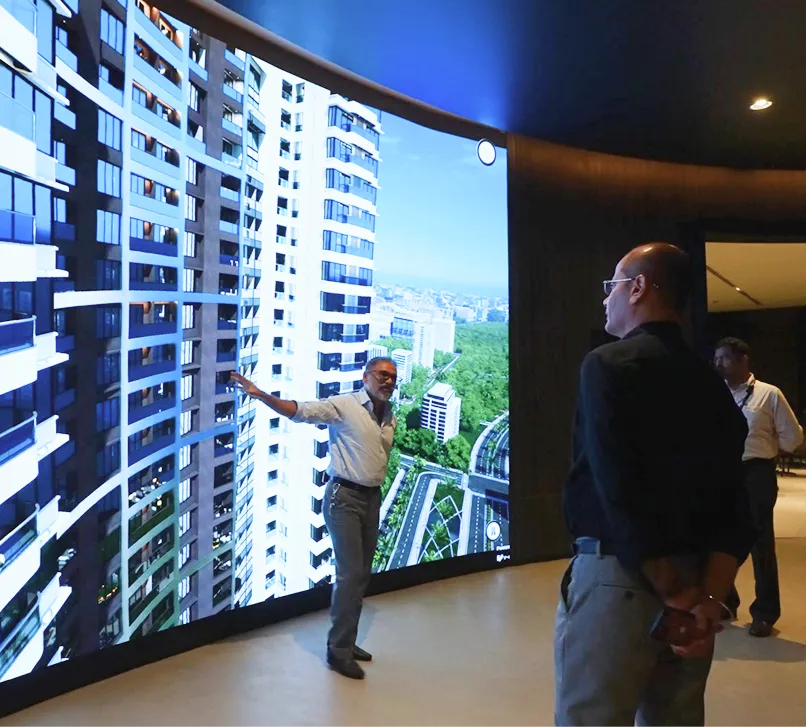
Modern 3D solutions for real estate experience transform the sales environment into an interactive system rather than a presentation.
Buyers are able to:
Switch between different unit configurations and compare them in real time
Explore views from specific floors and orientations
Understand how natural light interacts with the space across different times of day
Navigate through amenities and surrounding environments seamlessly
This level of control changes the nature of engagement. Buyers are no longer passive recipients of information. They become active participants in the experience.
In one such implementation, the average engagement time reached close to 50 minutes. This level of sustained interaction reflects not just curiosity but meaningful evaluation.
Visual Consistency Builds Trust Faster
In high-value transactions, trust is built through consistency across every touchpoint.
Discrepancies between renders, plans, and on-ground expectations often create hesitation. High-quality 3D visualization real estate software ensures that the visual narrative remains consistent across formats.
This includes:
Accurate representation of materials and finishes
Realistic simulation of lighting conditions
Alignment between floor plans and spatial visualization
Consistency in how views and surroundings are presented
When buyers encounter a unified and credible representation of the project, their confidence increases. This reduces the need for extended validation and speeds up decision-making.
Sales Conversations Become More Strategic
3D visualiser software transforms the role of the sales team.
Instead of focusing on describing layouts or answering repetitive questions, they can engage in more meaningful conversations around buyer intent and preferences.
This shift enables:
Better understanding of what the buyer is prioritising
More relevant recommendations based on usage and lifestyle
Faster movement towards decision closure
The quality of interaction improves, and with it, the efficiency of the entire sales process.
3D Architectural Visualization in Mumbai: The Runwal Raaya Experience
A strong example of how 3D architectural visualization in Mumbai is being implemented at the highest level can be seen in Runwal Raaya.
Designing an Experience Centre for Ultra Luxury Buyers
The objective was to create an environment where buyers could fully understand the project without relying on imagination.
The experience centre brought together physical models, digital systems, and sensory layers into a single cohesive journey. Every element was designed to communicate scale, detail, and quality with precision.
This included:
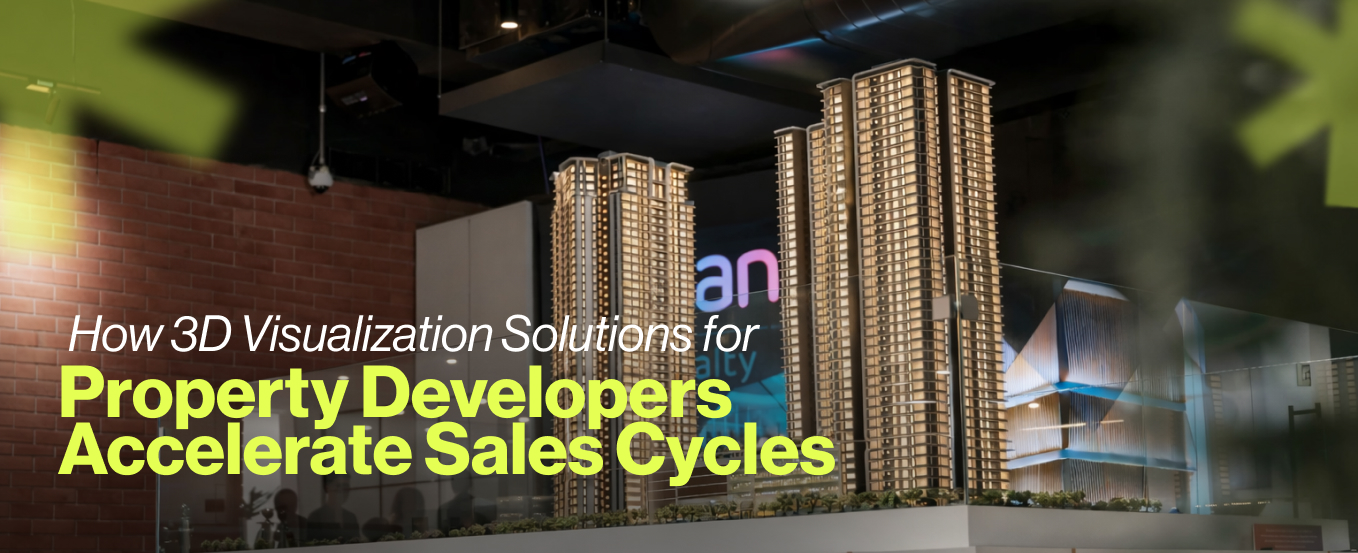
Large-scale architectural models that provided a clear understanding of tower positioning and design intent
Dedicated zones that allowed buyers to explore residential layouts in a structured manner
Material boards that showcased actual finishes, enabling tactile engagement
The goal was not just to present information but to make it tangible and believable.
Translating Architecture and Design into Experience
The architectural narrative of the project was translated into formats that buyers could intuitively understand.
Key elements included:
Detailed scale models These models highlighted the offset tower design and demonstrated how views were optimised across different units.
Material and façade representation The bronze façade, a defining feature of the project, was showcased through physical samples and digital simulations, allowing buyers to understand how it interacts with light throughout the day.
Layout visualisation zones Buyers could explore different unit configurations, evaluate spatial proportions, and understand circulation without relying on abstract drawings.
This approach ensured that design intent was not lost in translation.
Bringing Landscape and Lifestyle into Focus
The landscaped podium and amenity zones were presented as an integrated experience rather than isolated features.
Buyers could:
Understand how different landscape zones connect and transition
Visualise the scale and distribution of over 50 amenities
Experience how movement through the podium creates variation in the environment.
This made the lifestyle proposition more cohesive and easier to evaluate.
Technology Integration with 3D Visualization Software
The experience centre incorporated advanced 3D architectural visualization software to ensure that digital interactions were seamless, responsive, and visually accurate.
Key integrations included:
A large-scale model embedded with over 2,000 IoT-enabled devices, allowing buyers to highlight amenities and zones through interactive controls
A curved LED display powered by real-time rendering engines, delivering high-fidelity visualisations without lag
Interactive floor plans with zoom and navigation capabilities, enabling buyers to explore layouts dynamically
Private consultation pods equipped with high-resolution displays and immersive audio, allowing for focused, personalised discussions
These systems worked together to create a fluid and intuitive experience, where buyers could move between physical and digital layers without disruption.
Sensory Detailing Enhances Decision Confidence
Beyond visualisation, sensory elements were introduced to deepen understanding and emotional connection.
This included:
Real material samples that allowed buyers to assess texture and finish quality
Simulated views that demonstrated how lighting conditions change from morning to night
Carefully designed lighting and soundscapes that enhanced the overall environment
These layers helped buyers move from evaluating specifications to experiencing the product more holistically.
Impact on Buyer Behaviour and Sales Efficiency
The implementation led to a noticeable shift in how buyers engaged with the project.
Buyers spent significantly more time within the experience, indicating deeper involvement
Queries related to layouts, views, and amenities reduced, as most questions were answered within the system
Sales conversations became more focused on decision-making rather than clarification
The overall journey from first interaction to booking became more streamlined
The Business Impact of 3D Visualization Solutions for Property Developers
For developers, the value of investing in the best 3D real estate visualisation software goes beyond presentation quality.
It directly influences key business metrics.
Shorter sales cycles Faster understanding leads to quicker decisions, reducing the time between first interaction and booking.
Higher conversion efficiency Buyers who fully understand the product are more likely to convert, leading to improved conversion rates.
Better utilisation of sales teams With fewer repetitive explanations, sales teams can handle more prospects and focus on high-value interactions.
Stronger brand positioning Projects that offer advanced, immersive experiences are perceived as more credible and forward thinking.
Conclusion: Speed is a Byproduct of Clarity
Sales acceleration is often approached as a function of pricing strategy, incentives, or sales tactics.
But in reality, speed is a byproduct of something far more fundamental:
clarity.
3D visualization solutions do not “push” buyers to decide faster. They remove the reasons buyers delay decisions in the first place.
When buyers can
See exactly what they are investing in
Feel the space before it is built
Trust what is being presented
The need to wait disappears.
The next evolution of real estate sales will not be driven by more information but by better-designed experiences of that information.
And for developers looking to build immersive systems that drive measurable outcomes at scale, the opportunity lies in rethinking how their projects are experienced long before they are constructed.
This is where product experience begins to redefine sales velocity—turning curiosity into clarity, and clarity into commitment.
Explore how our 3D visualization software can accelerate your sales cycles. Book a demo at V-Estate.