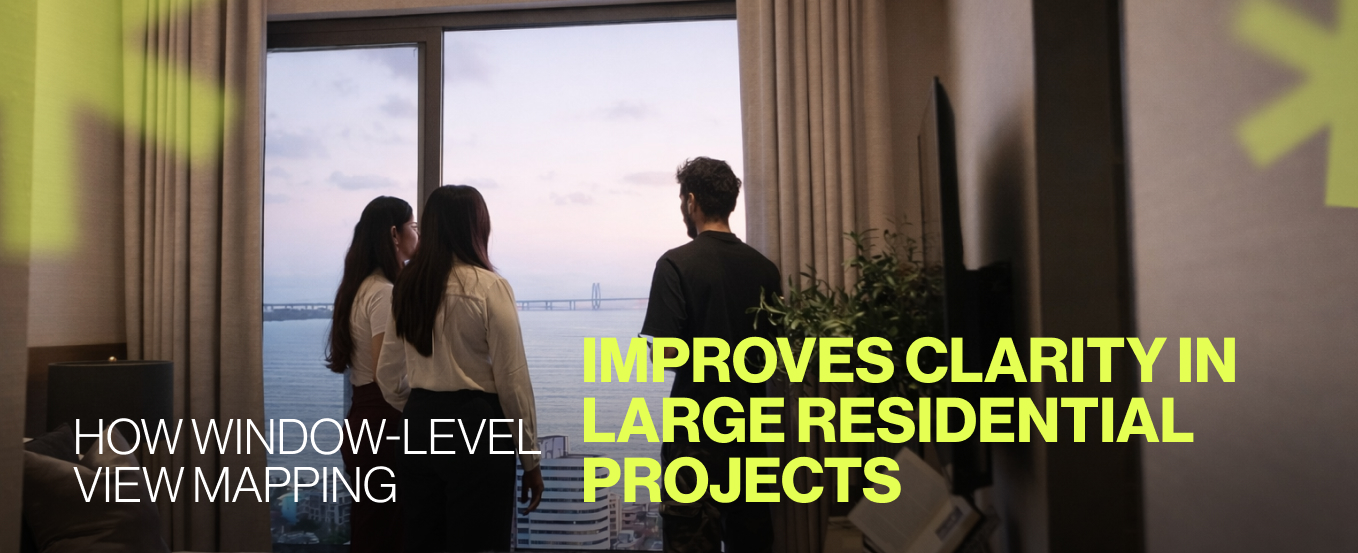
Your buyers sit at the dining table with morning coffee. They glance toward the window. Do they see a partial sea glimpse or a service alley? This single perspective determines whether they commit to ₹15 crore or walk away. Yet most developers price apartments without ever mapping what buyers actually see from seated eye level.
View mapping bridges this gap. It transforms vague marketing claims into defendable, data-backed pricing. Premium apartments demand precision. Developers who map window sightlines close deals faster. Those who skip it lose 15-20% in pricing power.
The Real Cost of Unmapped Window Views
Pricing premium apartments without window-level verification creates three critical problems.
First: Buyer Expectation Gaps
Buyers imagine a sea-facing unit means panoramic ocean views. Floor plans suggest this. Marketing collateral implies it. Then they arrive at the actual window. Reality hits differently. The view includes a neighboring tower's blank wall. Monsoons obstruct the horizon. Traffic noise dominates instead of wave sounds.
Disappointment leads to negotiation pressure. Offers drop 10-15%. Cancellations spike.
Second: Inventory Sitting Without Clear Value Positioning
Units on lower floors claim "sea-facing." Upper floors claim "city views." These labels mean nothing without precise definition. A 5th-floor unit might see more ocean than the 12th floor due to nearby cranes. Yet pricing treats them identically.
Marketing teams struggle to differentiate inventory. Sales velocities stall. Conversion rates plateau at 18-22%. The real reason? Buyers cannot visualize the actual view from their specific window.
Third: Pricing Compression and Margin Loss
Without mapped data, developers apply blanket view premiums. A 25% "sea-view premium" gets applied equally to units with vastly different sightlines. Some units are underpriced; others are overpriced.
Overpriced units linger. Underpriced units create buyer resentment. "I paid the same as Unit 1204, but my view is superior." Developers face refund demands and reputation damage.
Margins compress. Velocity slows. Capital gets tied up longer.
How Window Views Drive Actual Price Premiums
Market data reveals clear patterns. In Mumbai's premium corridors, window views directly impact pricing by 20-35%.
Full panoramic sea views command 30-35% premiums on base rates. Buyers accept price points when the window delivers what was promised.
Partial or obstructed views achieve 10-18% premiums. These units need transparent positioning. "City skyline glimpses" or "neighborhood connectivity views" work when accurately represented.
Street-level or noise-affected views demand 8-15% discounts. Yet developers often hide this reality. Transparent pricing here actually increases buyer trust and reduces post-purchase disputes.
The variance exists because each window frame is unique. Nearby construction, seasonal foliage, building orientation, and street-level activity create different sightlines for every unit. Generic floor plans cannot capture this.
Mapping reveals which units truly justify premium pricing and which need repositioning.
The Window-Level View Challenge in Dense Urban Projects
High-rise developments face compounding challenges.
Obstruction Reality: Nearby towers, construction cranes, and future developments block horizons. A sea-view promise today becomes questionable once the adjacent plot develops a 40-story tower.
Seasonal Variables: Monsoon haze reduces visibility 40-60%. Festival lighting appears only certain months. Tree growth in nearby parks fluctuates. Static renders cannot account for these shifts.
Angle Complexity: Eye level matters. Standing height shows different views than seated height. Morning light differs from evening light. South-facing windows catch different sun patterns than north-facing units.
Most developers rely on 2D floor plans and generic renderings. These guess at sightlines rather than simulate them. Buyers sense the disconnect. Trust erodes.
Marketing teams face pushback: "Why is Unit 1204 priced lower?" Without view data, answering becomes difficult. With mapped windows, the answer is clear and defensible: "Unit 1204's window frames the service lane. Unit 1506's window opens to the main boulevard."
Window-Level Mapping Through Immersive Visualization
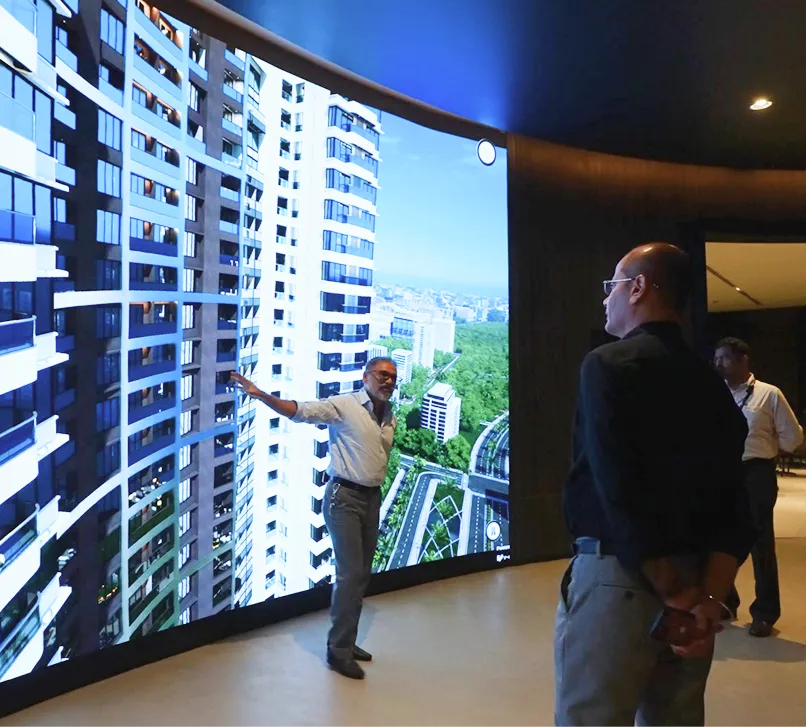
Photorealistic 3D virtual environments solve this at the point of sale.
Immersive visualization allows buyers to experience the exact window view from their potential apartment. They sit virtually at the dining table, at eye level, and see precisely what they will see in real life.
Dynamic controls reveal true conditions:
Time-of-day simulation shows how morning sunlight floods the master bedroom versus evening angles. Buyers see whether west-facing exposure creates heat issues. This matters for purchasing decisions.
Weather rendering displays monsoon-season visibility versus clear-sky panoramas. Buyers understand seasonal variations. When views get compromised during monsoons, they already know this. No post-purchase surprises.
Amenity mapping overlays nearby facilities. Schools, metro stations, shopping centers, and upcoming projects appear in context. Buyers see connectivity directly from their window. "That metro line is 800 meters away, visible from Unit 1506" becomes tangible.
Customization controls let buyers modify finishes while viewing windows. Paint colors shift. Sofa placements change. But the window view remains constant—the honest view they will experience.
This happens offline, without internet dependency. Sales teams activate immersive environments in offices, show flats, or event spaces. No travel to site required. Buyers experience properties in controlled, professional settings.
Integrating Window View Data into Pricing Frameworks
Window mapping generates quantifiable data that feeds directly into pricing models.
Assign each unit a view score on a 1-10 scale. Full panoramic sea view = 10. Clear city skyline = 7. Partial views with obstruction = 5. Street-level alley = 2.
Apply this to a pricing formula:
Premium Price = Base Rate per Sq Ft × (1 + 0.20 × View Score/10)
A 1,500 sq ft unit at ₹5 lakh base rate with view score 8 calculates as: ₹75 lakh × (1 + 0.20 × 0.8) = ₹75 lakh × 1.16 = ₹87 lakh
This formula is transparent. Marketing can explain it. Buyers accept it. Pricing becomes defensible rather than arbitrary.
Different view scores justify different price points. Units with equivalent views command equivalent premiums. No pricing anomalies. Margins stabilize.
Real-World Pricing Velocity Improvement
A Bandra 250-unit project applied window-level mapping pre-launch.
Pre-mapping assessment: 15% of inventory was overpriced based on assumed views. Marketing generated generic "sea-facing" claims without verification.
Post-mapping reality: Only 40% of units qualified for sea-view premiums. Remaining 60% required repositioning toward "city views" or "skyline access."
Prices adjusted accordingly. Overpriced units came down 12-15%. Underpriced units maintained base rates.
Result: Sales velocity increased 28%. Inventory cleared in 9 months instead of 18. Buyer satisfaction scores rose because expectations matched reality.
Immersive offline activation sealed deals. Buyers customized interiors virtually while viewing actual window sightlines. Conversion rates reached 38-42%. Site visits became confirmatory, not exploratory.
Scaling View Mapping Across Portfolio Projects
Enterprise developers managing multiple properties benefit from systematic window mapping.
Batch process units across towers. Export view data to CRM systems. Auto-generate pricing tiers based on consistent scoring. Marketing collateral aligns with mapped data.
Track conversion rates by view score. Identify which view categories convert fastest. Refine marketing positioning for slower-converting units.
Sales dashboards display view-score distributions. Inventory management becomes data-driven rather than assumption-based.
The Competitive Advantage of Transparency
Developers who map windows and price accordingly earn buyer trust. They position units honestly. Pricing reflects reality.
Buyers commit faster when they understand what they are paying for. Marketing teams face fewer objections. Legal disputes decline. Reputation strengthens.
Premium pricing demands precision. Window-level view mapping delivers it.
V-Estate in your sales operations. Let buyers see what they will actually experience. Price with confidence. Close with certainty.
.jpeg)