.jpg)
The real estate industry has witnessed a fundamental shift in buyer expectations. Today's property buyers demand transparency, control, and authentic experiences before making what is often their largest financial commitment. Yet many developers still rely on outdated sales presentations and static brochures, wondering why conversion rates remain disappointing.
Property walkthroughs have evolved far beyond simple marketing tactics. They now serve as essential tools for solving real business challenges that plague modern real estate development projects.
The Hidden Costs of Traditional Sales Methods
Real estate developers face mounting pressure from multiple directions. Construction costs continue rising, buyer financing becomes increasingly complex, and competition intensifies across all market segments. Meanwhile, traditional sales methods create their own set of expensive problems.
Sales teams spend countless hours explaining floor plans and amenities to prospects who struggle to visualize the final product. This leads to extended sales cycles, higher customer acquisition costs, and frustrated buyers who abandon the process entirely.
The disconnect between what developers promise and what buyers can actually comprehend creates a gap that costs the industry billions annually in lost sales and project delays.
Understanding Modern Buyer Decision-Making
Property buyers today research extensively before engaging with sales teams. They compare multiple projects, scrutinize every detail, and expect to understand exactly what they're purchasing before committing.
Traditional marketing materials fail to meet these expectations. Glossy brochures and computer-generated renderings often create unrealistic expectations, leading to buyer's remorse and cancellations after the booking phase.
Smart developers recognize that buyers need to experience properties, not just see them. This understanding drives the shift toward interactive property exploration tools that put control directly in the buyer's hands.
Solving Real Problems with Interactive Property Experiences
Reducing Sales Cycle Length
Interactive property installations eliminate the back-and-forth questioning that typically extends sales conversations over weeks or months. When buyers can explore properties hands-on at the sales office, they arrive at purchase discussions already educated about features, layouts, and amenities.
This self-service approach allows sales teams to focus on closing rather than educating, dramatically shortening the time from initial interest to purchase decision.
Minimizing Cancellation Rates
Buyer's remorse often stems from mismatched expectations. When customers can't properly visualize their future home, they make decisions based on incomplete information. Later, when they see the actual property, disappointment frequently leads to cancellations.
Photorealistic property visualizations solve this problem by showing buyers exactly what they're purchasing, including views from windows, natural lighting throughout the day, and how furniture arrangements will look in each room.
Addressing Location Concerns
Location remains the most critical factor in property decisions, yet traditional sales methods poorly communicate neighborhood advantages. Buyers need to understand connectivity, nearby amenities, and future development plans to feel confident about their investment.
Comprehensive area mapping and amenity showcases help buyers evaluate the complete lifestyle package, not just the individual property. This broader perspective often tips the decision in favor of developers who provide this level of detail.
The Business Impact of Strategic Walkthrough Implementation
Increased Lead Quality
Interactive property experiences naturally filter out unqualified prospects. Buyers who invest time exploring detailed walkthroughs demonstrate genuine interest and purchasing intent, resulting in higher-quality leads for sales teams.
Enhanced Customer Satisfaction
Transparency builds trust. When buyers understand exactly what they're purchasing, satisfaction rates increase significantly. This leads to positive referrals, reduced customer service complaints, and stronger brand reputation in competitive markets.
Operational Efficiency
Sales teams become more productive when they can focus on qualified prospects rather than spending time on basic property education. This efficiency allows developers to maintain smaller sales teams while achieving better results.
Technology as a Solution, Not a Gimmick
The distinction between effective property walkthroughs and sales gimmicks lies in their practical application. Genuine solutions solve real problems for both developers and buyers.
Modern interactive installations allow buyers to customize interiors, experience different lighting conditions, and understand spatial relationships in ways that traditional methods cannot match. These on-site experiences eliminate technical complications while providing the same level of immersive detail that builds confidence in purchase decisions.
Measuring Real Results
Successful walkthrough implementation should deliver measurable business outcomes:
Shorter average sales cycles
Higher conversion rates from inquiry to booking
Reduced cancellation rates after booking
Improved customer satisfaction scores
Increased referral rates from satisfied buyers
These metrics reflect genuine business value rather than surface-level engagement.
Moving Beyond Traditional Limitations
The real estate industry must evolve beyond relying solely on physical site visits and static presentations. Modern buyers expect immersive on-site experiences that respect their time while providing comprehensive property information at sales centers and experience centers.
Interactive walkthroughs represent this evolution, offering practical solutions to longstanding industry challenges. They empower buyers to make informed decisions while helping developers operate more efficiently and profitably.
Bringing the Future Home: On-Site Interactive Experiences
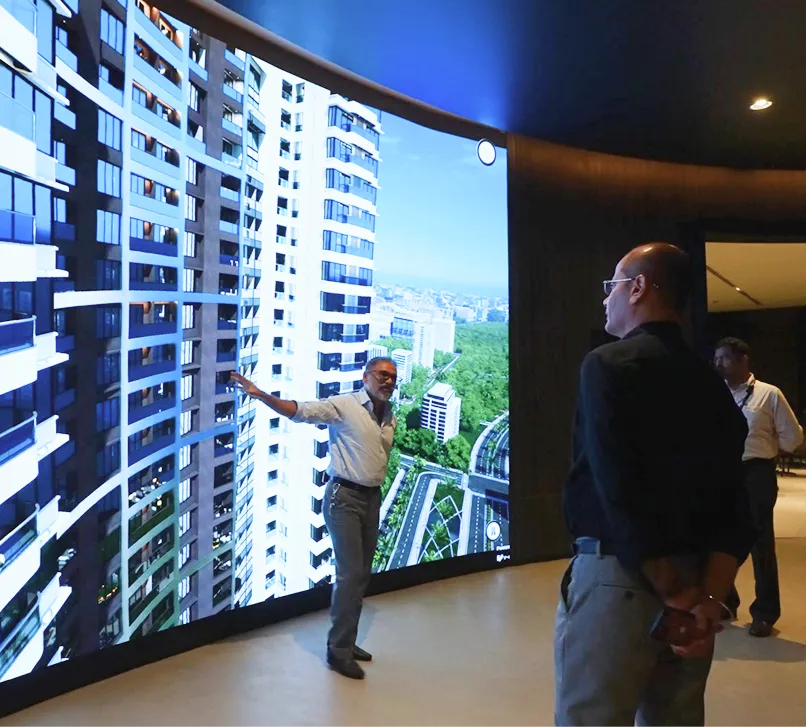
The most effective property walkthroughs happen where buyers feel most comfortable making decisions - at the sales office or experience center. Offline interactive installations create controlled environments where sales teams can guide prospects through comprehensive property exploration.
This approach eliminates technical barriers and internet connectivity issues while ensuring every prospect receives a consistent, high-quality experience. Sales teams can actively participate in the walkthrough process, answering questions in real-time and highlighting specific features that matter most to individual buyers.
The question for real estate developers isn't whether to adopt interactive property experiences, but how quickly they can implement them in their sales environments. In an increasingly competitive market, the developers who provide superior on-site buyer experiences will capture disproportionate market share.
The shift toward interactive property walkthroughs reflects broader changes in consumer expectations across all industries. Real estate developers who recognize this trend early and implement thoughtful on-site solutions will establish significant competitive advantages in their markets.