High-rise sales stall — not because the product is weak, but because the buyer cannot picture it.
Multiple towers. Repeated floor plans. Units that look identical on paper but differ significantly in light, view, and orientation. Buyers hesitate. Sales cycles stretch. Inventory sits longer than it should.
This is a communication problem, not a product problem
Buyer Confusion Starts at the Floor Plan
Walk into any high-rise experience center. The buyer's first question is rarely about price.
It's about clarity.
Which floor gets morning light?
What does the balcony actually face?
How close is the neighboring building?
Does the view change between the 12th and 22nd floor?
Printed floor plans cannot answer these. Sample flats represent one configuration. Sales executives repeat the same explanations, visit after visit.
The result is predictable — buyer hesitation, delayed decisions, and drop-offs.
The Operational Cost Nobody Talks About
Sales teams carry the burden of spatial confusion.
Every unclear layout becomes a repeat conversation. Every undecided buyer requires a follow-up site visit. Walk-in conversions stay low. Marketing budgets increase to compensate for the drop-offs.
The core problem remains untouched — buyers cannot spatially understand what they are purchasing.
This costs developers in three measurable ways:
Longer sales cycles — decisions stretch across weeks
Higher site visit dependency — teams spend time managing logistics instead of selling
Lower conversion ratios — uncertainty at the decision stage kills momentum
Visual Floor Mapping Changes the Buyer's Reference Point
When buyers can see unit positioning within a tower — not imagine it — their reference point shifts.
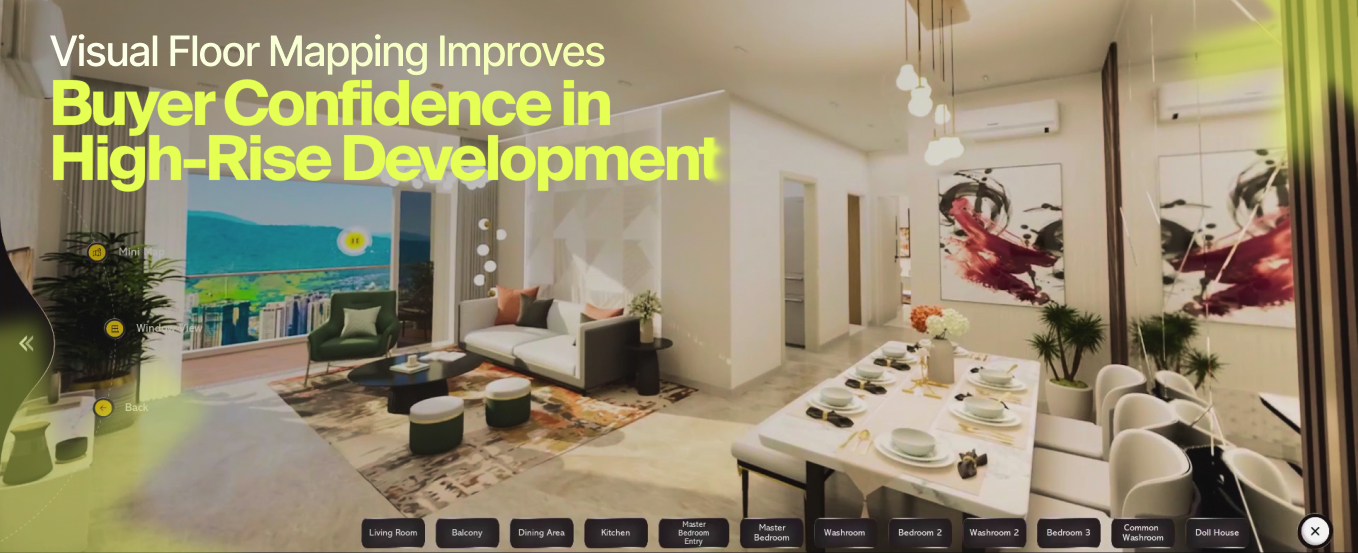
Visual floor mapping places each unit in its actual context.
Exact placement on the floor plate
Orientation relative to sun and wind direction
Distance from adjacent towers and open areas
View corridors, obstructions, and external surroundings
Buyers stop assuming. They start evaluating.
The comparison between a standard unit and a premium unit becomes immediate and visual. No verbal explanation required.
Inside the Experience Center — Structured, Not Static
Physical experience centers remain essential in high-value real estate sales. But static displays limit what a sales team can demonstrate.
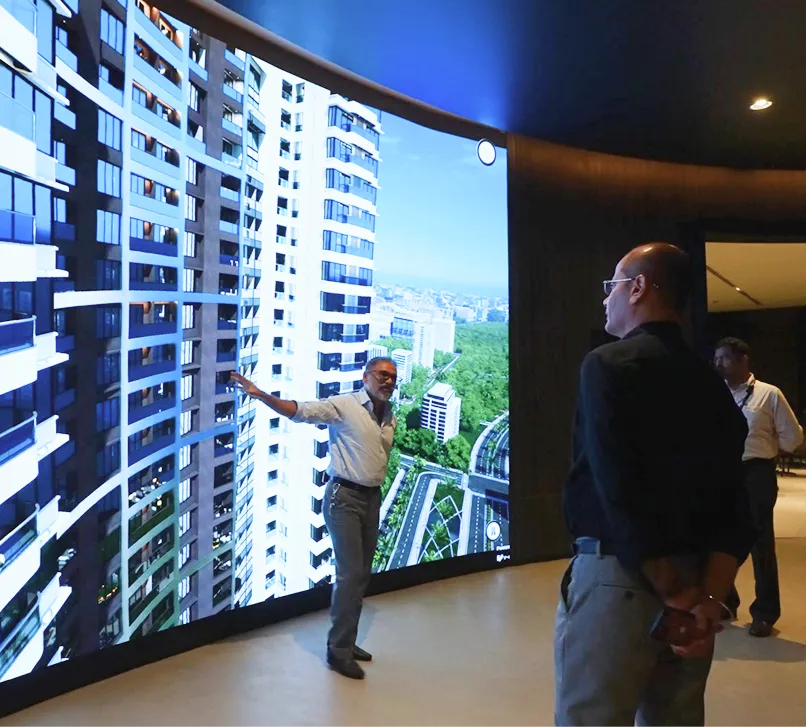
V-estate transforms the experience center into a working sales environment.
Through an offline interactive system, sales teams can:
Display photorealistic 3D representations of every unit configuration
Walk buyers through floor-wise comparisons in real time
Show actual window views from specific units at different times of day
Demonstrate how light and weather conditions affect the living space
Buyers control the pace. Sales teams deliver precision.
The conversation shifts from explanation to exploration. Multiple configurations are covered in a single session — without repeat visits, printed handouts, or verbal assumptions.
From Floor Mapping to Full Spatial Awareness
Visual floor mapping is the entry point. What follows is complete spatial understanding.
V-estate extends beyond floor plates.
Amenity mapping — nearby infrastructure, current and upcoming projects, connectivity
Interior customization — wall finishes, furniture configurations, material choices explored in real time
Dynamic lighting and weather controls — buyers see the property across different times of day and seasons
Detailed window view simulation — not a render, but the actual projected view from that unit
A buyer sitting in the experience center can visualize their evening routine from their specific balcony.
That level of clarity removes the single biggest barrier in high-rise sales — the gap between what is promised and what is understood.
Alignment Between Marketing Messaging and Sales Delivery
Marketing campaigns promote views, lifestyle, and openness.
Sales teams then struggle to demonstrate exactly that — because the tools available do not support it.
This misalignment erodes trust at the most critical touchpoint.
When visual floor mapping is embedded into the sales process:
Campaign visuals match what buyers experience in the room
Sales presentations remain consistent across executives and sessions
Buyer expectations align with the actual product
Consistency across touchpoints builds credibility — not just confidence.
Measurable Advantages for Developers
Beyond buyer experience, the operational gains are concrete.
Reduced sales cycle duration
Higher walk-in to conversion ratios
Lower dependency on repeat site visits
Clearer inventory differentiation
Stronger premium unit justification
Sales teams operate with precision. Marketing spend becomes more targeted. Inventory moves faster.
Relevance in Dense, Competitive Urban Markets
In markets where multiple projects compete on similar configurations and price points, clarity is a competitive differentiator.
Developers who structure their inventory presentation effectively do not just sell faster — they build stronger project credibility.
Buyers remember the experience. Referrals follow.