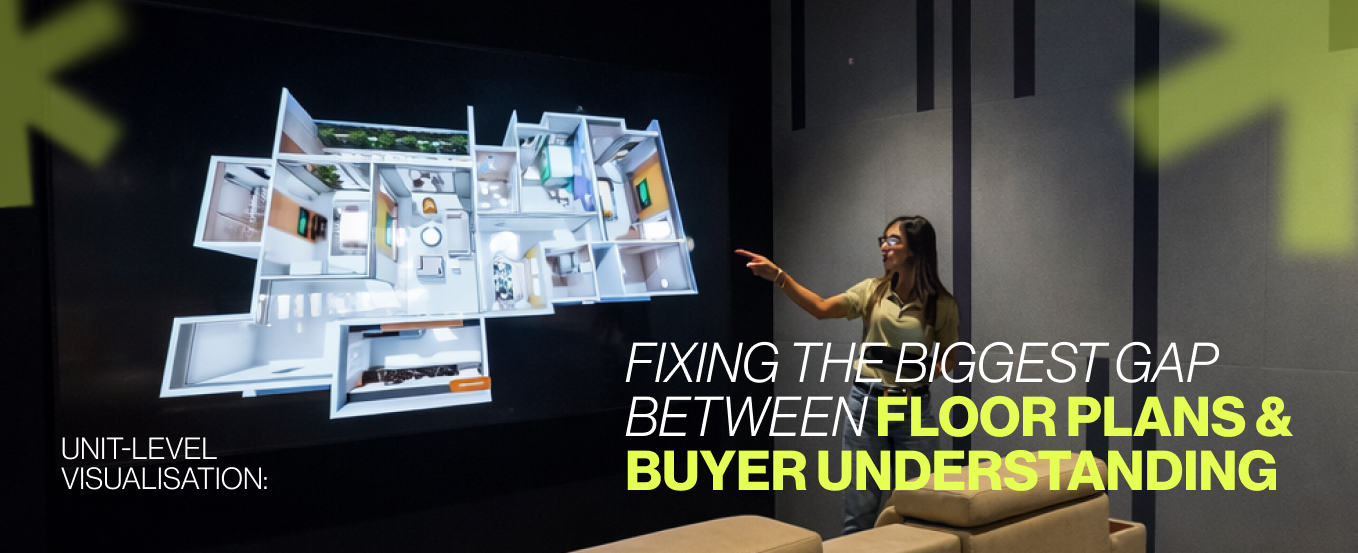
Floor plans are incomplete. They communicate dimensions. They fail to communicate lifestyle.
70% of buyers struggle to visualize spatial relationships from 2D drawings. They see measurements. They don't see themselves living in the space. This visualization gap exists in every sales office across India. It costs developers qualified leads. It extends sales cycles unnecessarily. It creates misaligned buyer expectations that surface as complaints and regrets post-purchase.
Marketing teams report this problem consistently. Buyers arrive with floor plan assumptions. Buyers leave confused about whether the unit fits their daily life. Some never return for a second look.
Why Floor Plans Alone Create Buyer Hesitation
Static 2D layouts communicate floor area and room count. They communicate almost nothing else that matters.
Buyers cannot assess:
Scale and proportion. A 1,200 sq ft unit reads as a number, not an experience. Buyers misjudge whether their furniture fits. They miscalculate walking distances between rooms. They overestimate or underestimate ceiling heights.
Natural light and views. Floor plans show window locations. They don't show how morning sunlight enters the master bedroom at 7 AM. They don't reveal whether the living room faces a park or a busy street. Buyers make view assumptions. These assumptions often prove incorrect on site.
Spatial flow and movement. Paper layouts don't convey how naturally someone moves through connected spaces. Buyers can't sense whether the kitchen feels isolated from the living area. They can't feel how transition zones function in real movement patterns.
Customization possibilities. Wall colors, furniture arrangements, finishes—these aren't visible in floor plans. Buyers can't picture personal styling choices. They can't test whether their preferred sofa length fits the wall they're considering.
Amenity connectivity. Floor plans show the unit. They don't connect buyers to what surrounds the unit. Proximity to schools, hospitals, transport, future infrastructure—these contextual details remain abstract.
This incomplete information forces buyers toward site visits. Site visits require time commitments. Time commitments reduce lead volume your marketing team can handle. Sales cycles extend. Conversion rates stagnate.
The Business Impact on Your Sales Operations
This visualization gap translates directly to operational and financial friction.
Marketing teams waste resources clarifying what floor plans should communicate. Sales representatives field repetitive questions about scale, views, and fit. Customer support addresses post-sale dissatisfaction when buyer expectations misaligned with reality. Developers repeat explanations across multiple site visits for the same prospect.
Lead qualification suffers. Without clear unit understanding, prospects can't self-assess fit. Sales teams invest time in unqualified leads. Qualified leads don't advance because buyers lack confidence in their decisions.
Sales cycles extend 20-25 days beyond necessary timeframes. This delays cash flow. It increases carrying costs. It compounds across a portfolio of projects.
Retention suffers. Buyers who didn't truly visualize units beforehand file complaints, request modifications, or withdraw from transactions post-agreement. These situations erode margins and damage reputation in competitive markets.
Introducing Offline-Activated Unit Visualization
Unit-level visualization technology addresses this gap directly through offline-activated immersive experiences.
Offline activation matters. Your sales teams operate in areas with inconsistent connectivity. Events, show offices, site trailers—these locations can't rely on cloud infrastructure. Offline-activated tools function independently. They function everywhere. They require download once, deployment immediately.
This is where immersive 3D visualization enters your sales workflow—not as an optional add-on, but as operational infrastructure that scales your sales capacity.
Core Capabilities That Change Buyer Decision Certainty
Photorealistic 3D unit representations. These render units at architectural precision. Buyers see how afternoon light creates shadows on kitchen countertops. They see how the view from the sitting area frames when they're seated at eye level, not looking down from above. They experience scale intuitively—not as a number, but as spatial awareness.
Interactive real-time customization. Buyers control paint colors, flooring finishes, and furniture placement within the 3D environment. They test whether their sofa fits the living room wall. They see how navy blue paint reads on their master bedroom wall. This active engagement transforms passive observation into personal ownership of the design process.
Dynamic lighting simulation. Properties look different at 7 AM than at 6 PM. They appear transformed during monsoons versus summer. Buyers see these variations. Morning light entering kitchens. Evening city views from balconies during dusk. Seasonal variations that affect daily living quality. This removes the gap between "what the sales brochure shows" and "what you actually experience."
Comprehensive amenity mapping. Current facilities, upcoming projects, connectivity infrastructure—all visualized within a 5-km radius around your property. Buyers understand which schools fall within 10-minute commutes. They identify transport accessibility. They see lifestyle infrastructure concretely, not conceptually.
Weather and temporal controls. Rain. Heat. Winter. Sunset. Dawn. Buyers observe how the unit performs across conditions and times. This contextual understanding eliminates the surprise factor that emerges months after purchase.
How Offline Deployment Streamlines Your Sales Process
Offline-activated visualization fundamentally changes sales team capacity and efficiency.
Sales representatives demo complete unit customizations in 15 minutes. Prospects explore multiple unit types, orientations, and configurations in a single sales interaction. Site visits decline 60% because buyers develop genuine confidence in unit fit without physical presence.
Lead qualification accelerates. Buyers self-assess fit before committing time to site visits. Unqualified prospects identify poor fit immediately. Qualified prospects advance with decision certainty.
Marketing collateral costs drop. Printed brochures, repetitive site tour scheduling, video production—these traditional assets become supplementary to interactive 3D experiences. Your marketing budget reallocates toward conversion activities instead of clarification activities.
Sales teams scale across multiple projects simultaneously. The same offline tool functions across your entire portfolio. Sales representatives deploy consistent, standardized unit experiences across all properties.
Conversion rates increase measurably. Projects using immersive unit visualization report 30-35% improvements in lead-to-buyer conversion rates. This stems directly from increased buyer confidence, reduced decision hesitation, and clearer self-assessment of unit fit.
Measuring Results That Matter to Your Bottom Line
Implementation produces measurable outcomes that marketing heads and finance teams track.
Lead conversion rates improve 30-35%. Buyers understand properties thoroughly. Buyer doubt decreases proportionally.
Sales cycles compress 18-22 days on average. Faster decision certainty means faster fund mobilization and project cash flow acceleration.
Customer satisfaction increases. Post-purchase complaints and modification requests decrease significantly. Buyer expectations align with delivered unit specifications because visualization preceded purchase commitment.
Cost per acquisition drops 25-30%. Sales resources concentrate on qualified prospects. Marketing efforts shift from clarification to conversion. Operational efficiency gains cascade across departments.
Retention and referral rates strengthen. Satisfied buyers with clear pre-purchase understanding generate referrals. Word-of-mouth effectiveness improves. Reputation strengthens in competitive markets.
Immediate Implementation for Your Organization
This is not aspirational technology for future deployment. Unit-level visualization functions in your sales offices today. Your sales teams can activate it this month.
Next steps for developers and marketing heads:
Identify your highest-priority project for pilot implementation. Coordinate with your sales leadership on training and process integration. Deploy the offline tool across your sales locations. Track conversion metrics before and after activation.
Three months of implementation typically produce ROI that justifies expansion across your entire portfolio.
For marketing heads managing competitive portfolio positioning: Unit-level visualization differentiates your properties in markets where multiple developers target identical buyer segments. This capability directly influences purchase decisions when buyers compare projects side-by-side.