Clarity is not optional in residential real estate. It is the foundation of every completed sale.
When buyers stand in a showroom facing hundreds of similar units across multiple towers, confusion is inevitable. They cannot hold layouts in their heads. They cannot visualize views. They cannot imagine themselves in a space they have not truly seen. This gap between what a developer intends to sell and what a buyer actually understands creates friction. It slows conversions. It increases cancellations.
This is not a marketing problem. This is an operational problem at the sales floor level.
The Real Challenge: Scale Creates Confusion
Large residential developments have grown exponentially in size and complexity.
A typical modern township includes:
Multiple towers with varied heights
Hundreds or thousands of unit variations
Phased construction timelines
Shared amenity networks
Complex view orientations
Evolving neighborhood contexts
Your sales team does not control this complexity. But they do face it daily.
The result? Salespeople spend disproportionate time explaining layouts, floor heights, directional orientations, and amenity distances. Buyers leave site visits without clarity. They compare units based on incomplete information. They hesitate on decisions that should be straightforward.
Even with the best sales team, static printed plans and one sample flat cannot represent hundreds of unit variations.
Where Clarity Actually Breaks Down
Sales environments expose specific friction points that directly impact conversions. These are not abstract concerns—they happen in your sales office every single day.
Unit differentiation becomes invisible. Corner units, larger balconies, and superior frontage units look nearly identical on 2D plans. Your salesperson must point out these differences repeatedly. Buyers struggle to recognize why one unit is priced differently from another.
View certainty remains uncertain. Buyers ask basic questions: What will I see from my window? Is it open sky or another building? Will there be morning light or evening shade? Without seeing actual sight lines, they cannot make confident decisions about units with premium pricing.
Amenity proximity is abstract. Distances to the clubhouse, gym, or entrance feel theoretical. Buyers cannot visualize walking routes. They cannot assess whether a unit's location serves their daily lifestyle. This uncertainty extends decision timelines.
Buyer imagination runs short. Even sophisticated buyers struggle to mentally furnish empty spaces. Room proportions feel different in reality than in imagination. A 550-square-foot apartment cannot be truly understood until a buyer visualizes furniture placement, natural light angles, and seasonal changes.
Each salesperson explains differently. Without a consistent reference system, buyer understanding varies based on individual salesperson communication style. This creates expectation mismatches and post-purchase dissatisfaction.
These gaps accumulate. One confused buyer becomes a longer sales cycle. Multiple confused buyers become reduced conversion rates.
Interactive Unit Mapping: Control Shifts to the Buyer
Real-time unit mapping transfers decision-making power from the salesperson to the buyer.
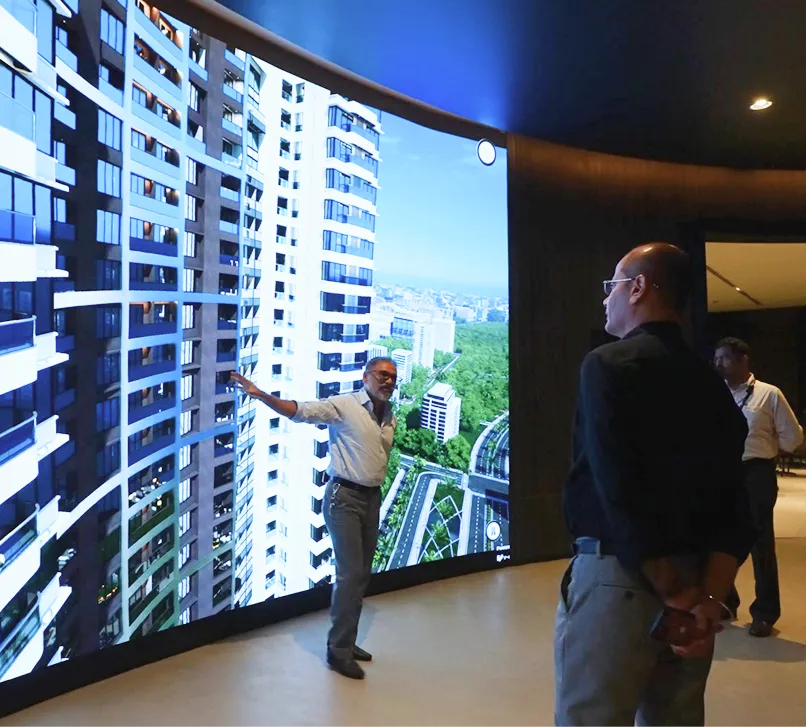
Instead of listening to explanations, buyers become active explorers. They select towers. They choose floor levels. They identify available units. They compare options side by side. This shift changes the entire sales dynamic.
When buyers interact directly with your project layout, several immediate outcomes emerge:
Engagement deepens. Passive listening converts to active exploration. Average time spent in sales environments increases. Buyers develop stronger ownership of their decisions because they made those decisions themselves.
Confusion reduces. Visual differentiation eliminates the "all units look the same" problem. Buyers see distinct positioning within the project. They understand tower relationships. Floor heights become obvious.
Comparison becomes efficient. Instead of asking salespeople about multiple units, buyers compare side-by-side through the system. Shortlisting accelerates. Decision fatigue decreases.
Salesperson dependency shrinks. Teams spend less time repeating explanations and more time answering qualified questions. Sales efficiency improves. High-traffic periods create less bottleneck stress.
This is not about replacing salespeople. It is about redirecting their expertise toward closing, not explaining.
Photorealistic 3D Show Flats Close the Imagination Gap
The largest single barrier to confident purchasing is imagination.
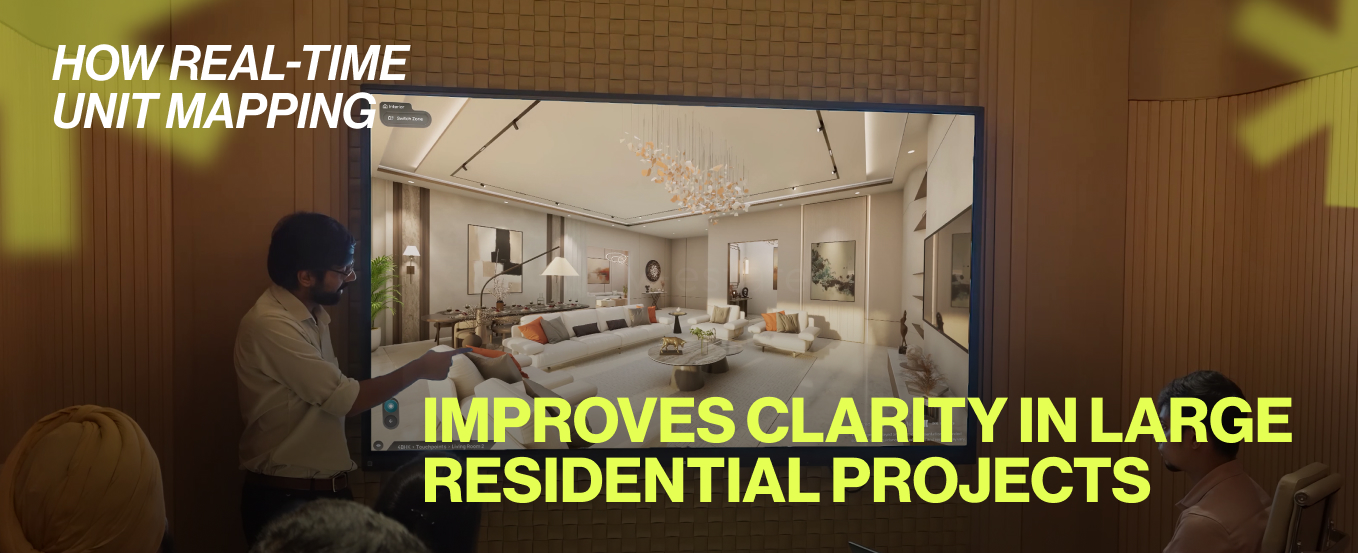
Most buyers cannot visualize empty space. They need to see furniture, materials, lighting conditions, and proportions. A single sample flat on-site serves only one specific configuration. It answers limited questions. Buyers cannot explore variations.
Photorealistic 3D virtual show flats address this directly.
Within the sales environment, buyers can:
Walk through unit interiors from different camera angles
Observe how natural light changes throughout the day
Visualize furniture placement in actual room dimensions
Experiment with color schemes and material finishes
Understand storage capacity and layout flow
This is not design exploration for aesthetics alone. This is functional visualization. Buyers validate whether spaces match their lifestyle. They confirm that a master bedroom actually feels spacious. They verify that the kitchen layout accommodates their cooking habits.
The psychological effect is significant. When buyers visualize themselves living in a space, purchase confidence increases substantially. Post-purchase satisfaction improves because expectations align with reality.
View Simulation Removes the Biggest Unknown
Window views are consistently cited as top decision factors in residential real estate.
Yet most buyers make view-based decisions with incomplete information. They may visit a unit once during daylight. They do not see how the view changes with weather. They do not experience morning light versus evening shadow. They do not witness seasonal variations.
Real-time view mapping integrates directional line-of-sight information with dynamic lighting conditions.
Buyers can observe:
Exact direction of primary views
Obstructions from nearby structures
Open sightlines to landscapes or skylines
How sunlight angles change across the day
Weather impact on visibility and ambiance
This removes one of the largest sources of post-purchase dissatisfaction. Buyers know exactly what they will see from their window when they sit down for their morning coffee or evening wind-down.
Amenity Mapping Clarifies Internal Movement and Lifestyle
In township developments, internal circulation matters more than most developers acknowledge.
Buyers are essentially asking: Where will I spend my time? How far is that space? What is the quality of the path to reach it?
Integrated amenity mapping answers these questions spatially, not verbally.
The system tags clubhouses, fitness centers, children's play areas, parking levels, and entry points within the project layout. Walking distances become visible. Route quality becomes assessable. Buyers understand the relationship between their unit and daily-use spaces.
This extends beyond internal mapping. Connectivity context layers in important information:
Proximity to public transportation
Distance to shopping and dining districts
School locations and travel times
Healthcare facility access
Upcoming neighborhood developments
Suddenly, "central location" becomes a measurable reality. Buyers make location decisions based on actual connectivity, not marketing claims.
Offline Deployment: Stability Over Connectivity
One critical distinction: this system operates entirely offline within your sales environment.
No internet dependency. No network latency during peak traffic. No cloud service outages affecting buyer experience. The system remains stable during:
High-volume site visits
Network disruptions
On-ground activations and events
Multi-day open houses
This is essential for sales environments where moment-to-moment buyer engagement decides conversion outcomes. A system that stutters or requires reloading loses credibility instantly. Offline deployment ensures smooth, consistent experience regardless of external conditions.
Operational Efficiency Gains Compound Over Time
The cumulative impact on sales operations is substantial.
Sales teams reduce time spent on repetitive explanations. Buyer shortlisting accelerates. Site visit quality improves because buyers arrive with clearer intent. Drop-off rates decrease because clarity removes hesitation at critical decision moments.
For your marketing and operations teams:
Conversion cycles compress
Lead quality improves through self-qualification
Sales team utilization increases
Printed materials and brochures become supplementary, not primary
On-ground activations become more efficient
Most importantly: Buyers reach decisions with confidence. Post-purchase satisfaction aligns with pre-purchase expectations. Referral rates and word-of-mouth recommendations strengthen because the buying experience delivered exactly what was promised.