Real estate launches usually begin with something buyers can physically see. A tower under construction. A sample floor rises above ground level. Even a few structural columns can transform an empty land parcel into something believable.
That physical progress is powerful. It tells buyers that the drawings inside the brochure are slowly becoming reality. It gives sales teams a visible anchor for their conversations.
But what happens when the project has not even started construction yet?
This was the situation when Ma Sarada Developers prepared to introduce House of Sapiens in Bengaluru. The company was already a recognised developer in Kolkata with a track record of residential developments. However, Bengaluru represented an entirely new market for them. New buyers. New expectations. And a project site that had zero site tangibility.
There was no excavation. No tower footprint. There were no physical markers that could communicate the scale of the township. For the developer, the challenge wasn't simply marketing. It was about how to build trust and clarity for buyers when the entire project existed only on architectural drawings.
The solution came through a carefully engineered sales experience centre built around advanced 3D visualisation and a real-time digital twin of the township.
The Core Challenge: A Future Landmark, Still In Progress
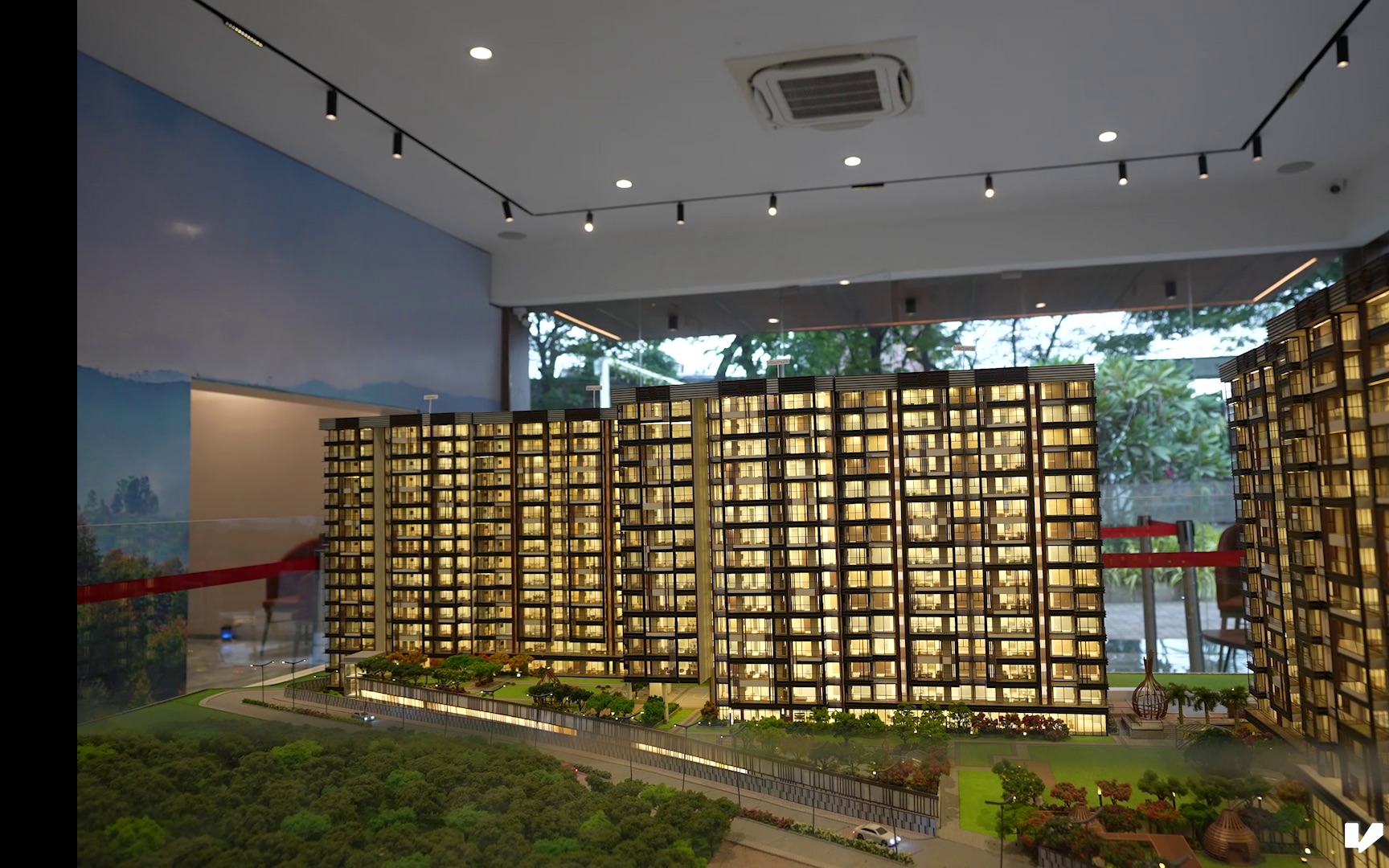
The House of Sapiens was designed as a township-scale development rather than a single building project. The development included residential towers, a clubhouse, and extensive landscape planning with multiple amenities.
From a planning standpoint, the project was strong.
But from a sales standpoint, the launch environment was complicated.
Three major issues emerged immediately.
Absence of physical tangibility
The land parcel had not yet entered the construction phase. Buyers visiting the site would see only an empty landscape. Without visualisation tools, it's extremely difficult to communicate what a future township will look like.
Complexity of the township layout
The project was designed with multiple buildings and large amenity zones. Explaining spatial relationships through brochures is difficult.
Buyers typically ask questions such as:
• Where is my tower located within the master plan • How far is the clubhouse from my building • Which amenities are closest to my unit
Without a spatial tool, these questions remain abstract.
Location clarity
The project sits roughly ninety minutes outside central Bengaluru in a region where development is still evolving. Buyers evaluating such locations want a clear understanding of surrounding infrastructure and connectivity.
These challenges made one thing clear.
Traditional marketing tools would not be enough. The project needed a system that could replace physical tangibility with visual clarity.
3D Immersive Digital Twins: Bringing an Unbuilt Township to Life
To address this challenge, Ma Sarada partnered with V Estate to design a sales experience centre powered by a real-time digital twin throughout the entire development.
The goal was simple in principle but complex in execution.
Instead of describing the township to buyers, allow them to explore it interactively.
The digital twin recreated the full master plan, including
• Residential towers • The clubhouse building • Amenity zones • Landscape design • Internal roads and circulation paths
Visitors entering the experience centre could navigate the project inside a 3D immersive environment. They could see the towers from multiple angles, explore amenities, and examine residential layouts in real time.
This approach replaced speculation with visibility.
Buyers were no longer imagining the township. They were experiencing it.
Engineering the Digital Twin
Creating the digital twin of House of Sapiens required careful engineering because of the scale of the environment.
The final visualisation scene included the following:
• 6,688,395 polygons • 6,137,328 vertices
This geometry represented
• Three residential towers • Tower A rising seventeen floors • Tower B rising nineteen floors with two wings • A four-floor clubhouse • Landscape zones and amenity clusters
The total modelled project area covered approximately 205907 square feet.
Despite this complexity, the digital twin had to run smoothly during live buyer demonstrations inside the experience centre.
Achieving this required a combination of advanced rendering technologies and optimization techniques.
Real-Time Rendering Architecture
The digital twin was developed using Unreal Engine 5.7, one of the most advanced real-time rendering engines currently available.
The engine allowed the visualisation to combine architectural accuracy with interactive exploration.
Several technologies within Unreal Engine played a critical role.
Nanite geometry processing
Nanite's virtualised geometry allows extremely detailed models to be rendered efficiently. Instead of manually reducing polygon counts, the engine streams geometry dynamically based on what the camera is viewing.
This allowed the towers and architectural features to retain high visual fidelity without compromising performance.
Level of detail optimization
The LOD optimization dynamically adjusts asset complexity based on camera distance.
Benefits included
• Reduced GPU load • Stable frame rates during interaction • Smooth transitions between high detail and simplified geometry
This was essential for a scene containing millions of polygons.
MegaLights lighting system
The latest version of Unreal Engine 5.7 introduced a lighting technology known as 'MegaLights'.
Traditional lighting systems struggle when a scene contains thousands of light sources. MegaLights reduces memory consumption while maintaining high-quality shadows and lighting distribution.
This allowed the digital township to maintain consistent illumination across buildings and landscape zones.
Simulating a Large Open Landscape
One of the unique aspects of the House of Sapiens project was the surrounding environment.
The site sits in a region dominated by farmland and open land parcels. Unlike dense city areas, there are no surrounding buildings to hide the horizon.
If the visualisation did not simulate this environment properly, the township would appear isolated.
To address this challenge, our team used procedural content generation (PCG) techniques.
Procedural generation allows the system to automatically populate large areas with environmental elements.
Using this framework the environment was able to generate
• Roads and terrain features • Vegetation clusters • Environmental filler elements that extend the horizon
Instead of manually placing thousands of objects, the software generated them automatically based on rule sets.
This allowed the visualisation to extend far beyond the township boundary while maintaining its performance.
Creating Vegetation Visual Assets with Voxelisation
Landscape design required large numbers of trees and vegetation clusters.
Foliage is one of the most computationally expensive assets in real-time visualisation.
To understand the scale of the problem, consider the following comparison.
• A building model may contain around 10000 polygons • A detailed tree asset can contain 300000 polygons or more
When thousands of trees are used in a landscape, the scene quickly becomes heavy.
To solve this, the development team used voxelisation techniques.
Voxelisation converts complex mesh geometry into simplified volumetric structures.
This reduces the computational cost of rendering vegetation while preserving its visual appearance from typical viewing distances.
Through voxelisation, the team was able to populate the landscape with dense vegetation without sacrificing real-time performance.
Hardware Infrastructure of the Experience Centre
The digital twin was deployed inside the Ma Sarada experience centre using carefully selected hardware.
AV room visualization
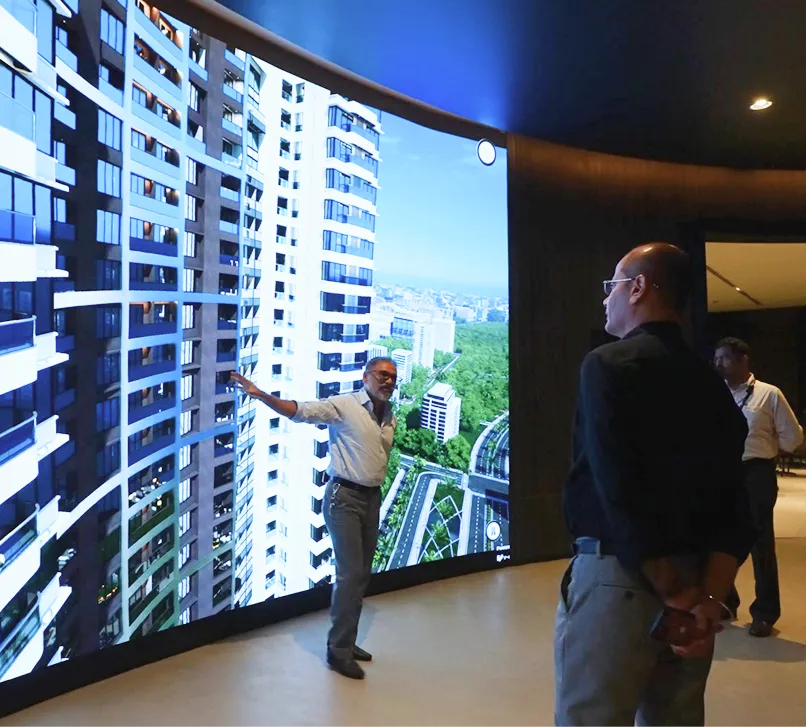
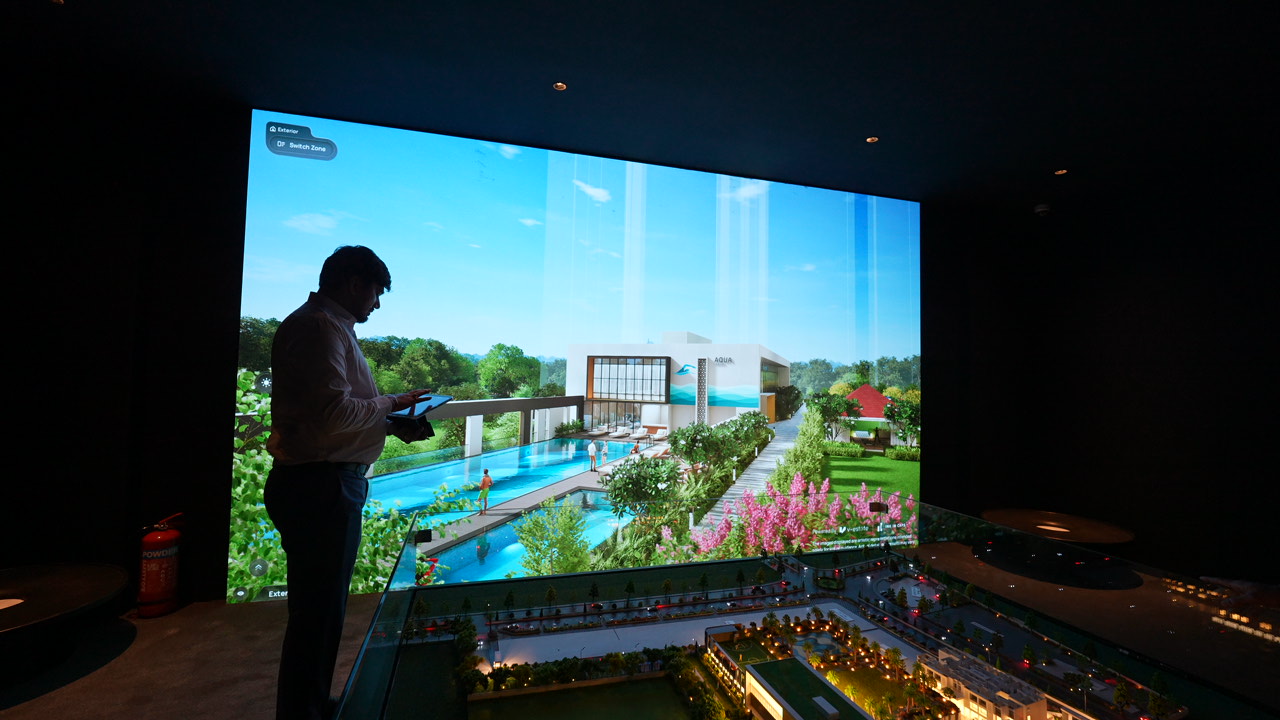
Visitors begin their journey in an immersive audiovisual presentation space anchored by a 10x8 ft LED wall, designed to set the tone for the entire experience.
Key specifications include • Pixel pitch of 1.8 for sharp, high-definition visuals • High-brightness display optimized for cinematic storytelling • Seamless content control through iPad integration
What elevates the experience further is the intuitive control layer. The entire 10x8 ft LED canvas is orchestrated via an iPad, enabling the sales lead to pivot the narrative dynamically in real time based on the buyer’s reactions and interests.
The AV room not only introduces the project vision but transforms it into a responsive, personalized storytelling experience, offering a compelling visual overview of the township.
Interactive discussion pods
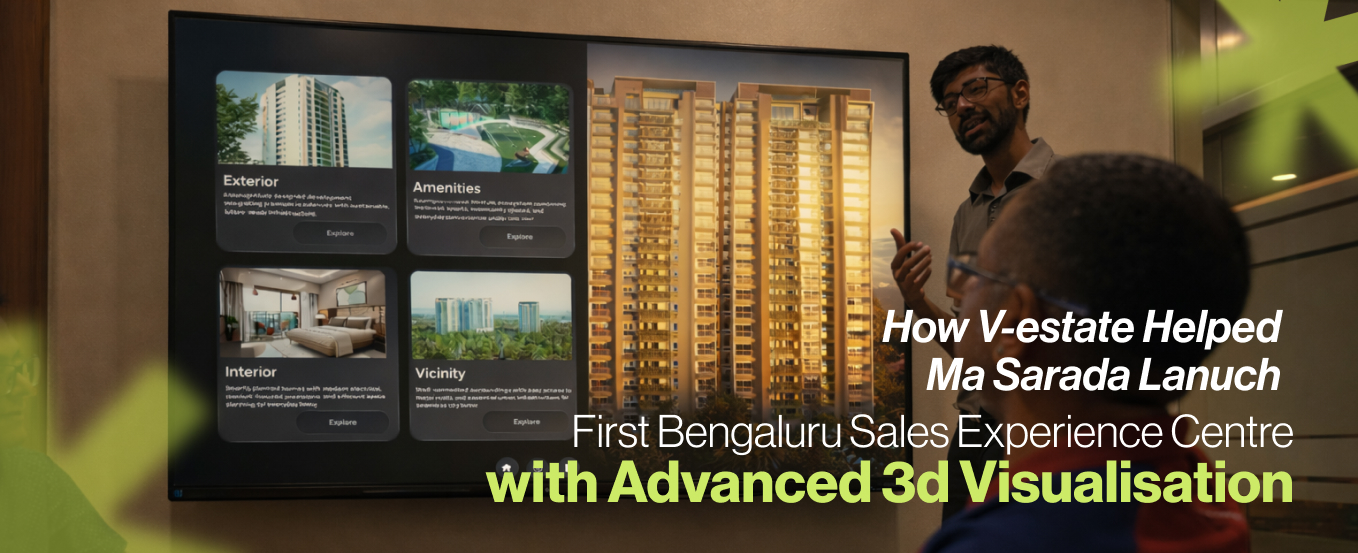
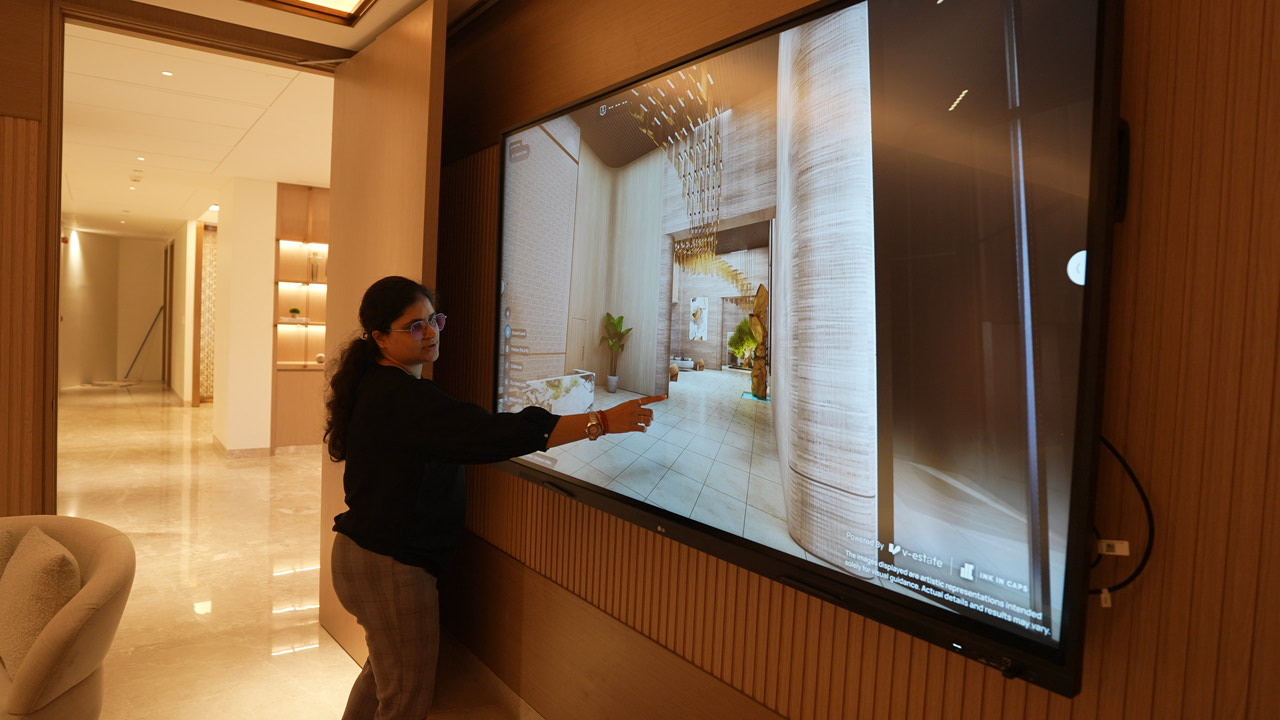
After the AV presentation, buyers move into interactive sales pods equipped with 65 inch LG touchscreen displays.
These screens run the digital twin interface and allow sales executives to interactively navigate the township.
Using the touchscreen interface sales teams can demonstrate
• Tower layouts • Amenity locations • Apartment configurations • Master plan relationships
Sample flat synchronization
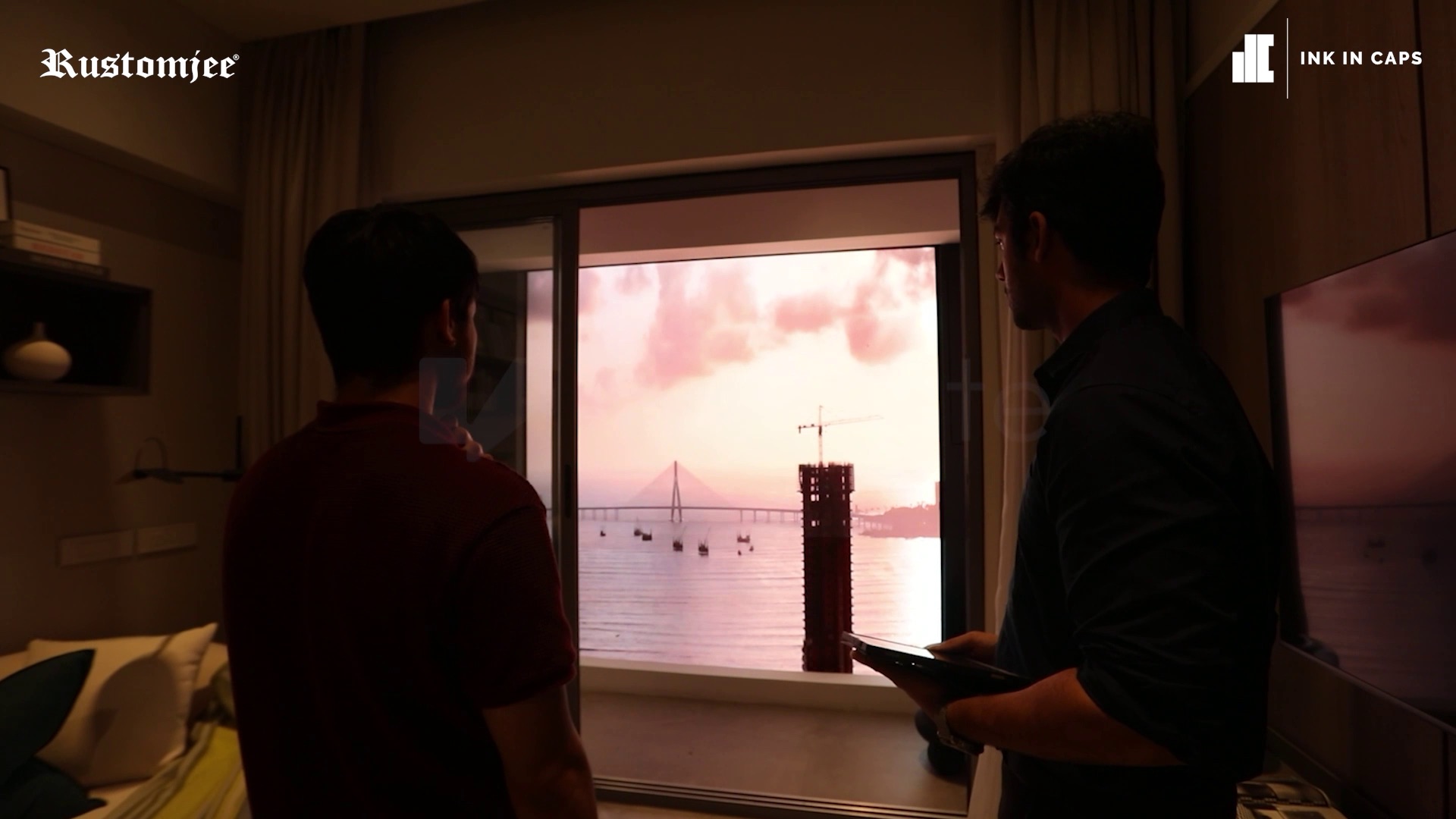
Two physical sample flats were constructed for the project
• Two bedroom unit (2BHK) • Three bedroom unit (3BHK)
The interiors inside the digital twin match these flats exactly.
This ensures complete alignment between the digital visualisation and the physical walkthrough.
Visualizing the Surrounding Ten-Kilometre Ecosystem
The project sits outside central Bengaluru; location clarity was absolutely essential.
To address this, the visualisation system included a 10-kilometre vicinity mapping feature.
This module allowed buyers to explore the surrounding ecosystem.
The digital twin could display nearby
• Educational institutions • Healthcare facilities • Transportation routes • Emerging development zones
This feature helped buyers understand how the township connects with the broader region.
Designing the Customer Journey
The experience centre was designed around a structured journey that gradually deepens buyer understanding.
Stage one
Project introduction inside the AV room where visitors view the LED wall presentation.
Stage two
Physical walkthrough of the sample flats where buyers experience the apartment interiors.
Stage three
Interactive exploration of the digital twin inside interactive sales pods.
By the time buyers reach the final stage, they already understand the project visually and spatially.
Sales conversations become more focused because the software answers many initial questions automatically.
Impact on Sales Conversations
The introduction of the digital twin had a noticeable effect on how buyers engaged with the project.
Sales teams reported several improvements.
• Buyers understood the township layout much faster • Amenities were easier to explain visually • Unit layouts could be compared interactively • Sales conversations became shorter and more productive
In early demonstrations several client meetings even resulted in immediate booking decisions after exploring the digital environment.
The biggest change was psychological.
Instead of imagining the township, buyers could experience it directly.
Why Visualization is Becoming the Core of Modern Project Launches
The Ma Sarada House of Sapiens launch illustrates an important shift in real estate marketing.
Visualisation is no longer just a supportive marketing asset.
It has become the primary medium through which early-stage projects can be experienced.
For developments where construction has not yet begun, immersive digital twins offer several advantages.
• Clear spatial understanding of the township • Improved buyer conviction • Faster decision-making during sales discussions • Stronger credibility for developers entering new markets
For Ma Sarada the experience centre did more than showcase a project.
It introduced the developer to Bengaluru buyers through a fully immersive digital environment that replaced the absence of physical construction.
The V Estate Perspective
At V Estate, we believe that the purpose of a real estate experience centre is to eliminate uncertainty.
Our digital twin platform transforms architectural designs into interactive environments where buyers can explore projects long before construction reaches the skyline.
When the site has no tangibility, the experience centre must create it.
Are you launching a project where construction progress has not yet begun?
V Estate helps developers transform empty land parcels into fully interactive digital townships that buyers can explore in real time.
Connect with us today to see how immersive 3D visualisations can power your next real estate launch.