Most real estate visualisations fail at a critical point. It looks impressive, but it does not hold up under interaction.
A static render can hide limitations. A walkthrough video can control what the viewer sees. But the moment a buyer starts exploring freely, the system is exposed. Frame drops. lighting inconsistencies. delayed responses. The illusion breaks.
Now imagine building a system where none of that can happen.
This was the challenge behind Ma Sarada’s House of Sapiens in Bengaluru. A project that had to be sold before construction began, where the entire buyer experience depended on a real-time digital twin running at scale. Not just visualise a building, but enable the complete 3D immersive environment exploration of a township that does not yet exist physically.
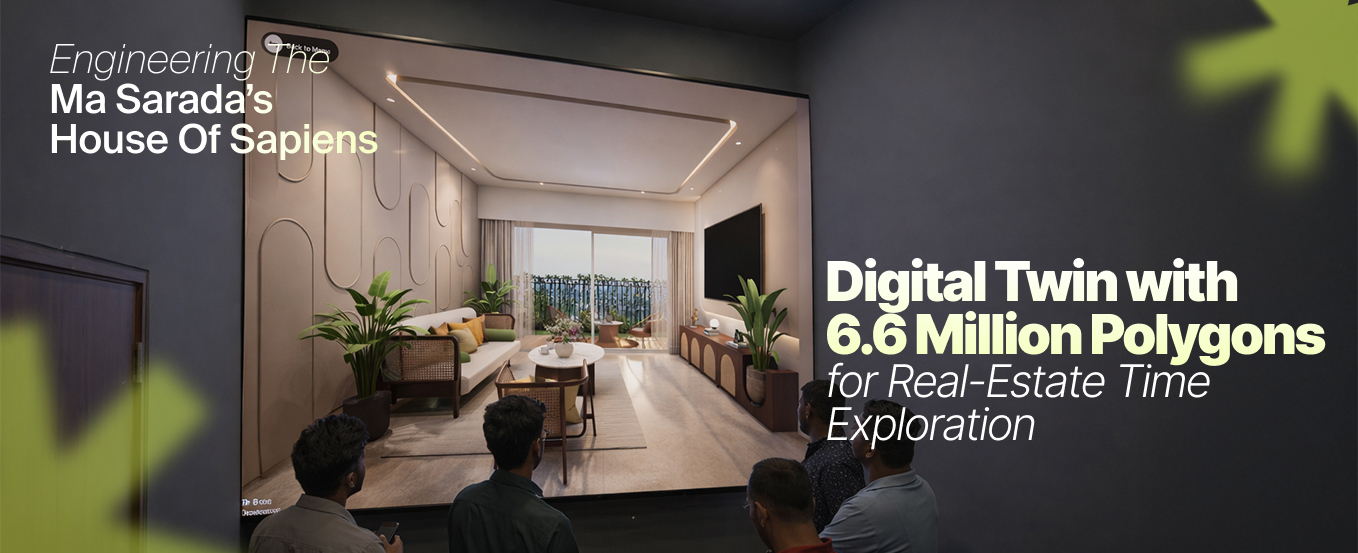
The problem was not creating a model. The problem was engineering a system where 6.6 million polygons behave seamlessly in real time in a live experience centre.
The Engineering Brief: Building a Digital Twin for Zero Site Tangibility
Ma Sarada entered Bengaluru as an established developer from Kolkata but without physical presence in the city.
House of Sapiens was designed as a township-scale project with the following:
• Three residential towers • A four-floor clubhouse • More than forty amenities • A large-scale landscape layout
At launch, the site had:
• No excavation • No structural development • No visual anchor for buyers
These requirements meant the digital twin had to do more than represent the project. It had to:
• Replace physical tangibility • Deliver spatial clarity instantly • Support continuous real-time interaction • Maintain performance under repeated usage
In simple terms, the system had to behave like a built environment, even though nothing existed on site.
The Scale of the Digital Twin: Why 6.6 Million Polygons Matter
The final digital twin was built with:
• 6,688,395 polygons • 6,137,328 vertices
This scale was not arbitrary. It was required to maintain architectural fidelity across:
• Tower structures • Amenity detailing • Landscape elements • Interior layouts
However, high polygon density introduces a direct trade-off.
More detail increases realism, but it also increases computational load. Without proper optimization, the system would lag during interactions, breaking the buyer's experience.
The entire engineering effort revolved around solving this balance.
Unreal Engine 5.7: The Real-Time Rendering Backbone
The digital twin was built on Unreal Engine 5.7, not just for visual quality but for its ability to manage complex environments in real time.
The choice of engine was driven by three key requirements:
• Handling large geometry without manual simplification • Maintaining stable frame rates during navigation • Supporting advanced lighting across large-scale environments
Several core systems inside Unreal Engine made such performance possible.
Geometry Streaming Through Nanite: Eliminating Manual Optimization Bottlenecks
In traditional workflows, 3D assets are manually optimised. Artists reduce polygon counts to ensure performance, often compromising detail.
Nanite changes this approach entirely.
Instead of simplifying models beforehand, Nanite streams geometry dynamically based on what is visible to the camera.
What this means in practice:
• High-detail models can be used directly without heavy simplification • Only visible surfaces are rendered at full resolution • Hidden geometry does not consume unnecessary resources
For Ma Sarada House of Sapiens, this technique allowed the following:
• Accurate architectural detailing across towers • Preservation of fine surface elements • Reduced need for manual optimisation cycles
Nanite essentially shifted the optimization process from manual efforts to real-time engine intelligence.
Level of Detail (LOD) Optimization: Maintaining Stability Across Large Scenes
Even with Nanite, large environments require additional performance control.
This is where level-of-detail (LOD) optimization becomes critical.
LOD works by dynamically adjusting the complexity of assets based on distance from the camera.
To understand its impact:
• A nearby building is rendered with full detail • The same building at a distance is rendered with simplified geometry • The transition between these states is smooth and unnoticeable
In the House of Sapiens digital twin, LOD ensured:
• Consistent frame rates during navigation • Reduced GPU load when exploring large areas • Stable performance across the entire township
Without LOD systems, the sheer scale of the environment would overwhelm the rendering pipeline.
MegaLights Redefining Lighting Consistency Across Multiple Sources
Lighting is one of the most demanding aspects of real-time rendering.
A township environment requires the following:
• Multiple light sources across buildings • Ambient lighting across landscapes • Realistic shadow behaviour
Traditional systems struggle when the number of lights increases.
Unreal Engine 5.7 introduced MegaLights, designed specifically to handle high-light-density scenes.
MegaLights enabled:
• Efficient handling of thousands of light sources • Reduced memory consumption • Improved shadow accuracy
For the digital twin, this meant:
• Even lighting across large spaces • No performance drop due to lighting complexity • More natural visual perception of depth and scale
Procedural Content Generation (PCG) For Simulating a 10 Kilometre Horizon
One of the most complex challenges in this project was the surrounding environment.
Unlike city projects, the site is located in an open landscape where the horizon extends far beyond the project boundary.
To recreate this, the system had to simulate the following:
• Large terrain areas • Roads and environmental context • Visual depth extending up to 10 to 15 kilometres
Manual modelling on such a scale is inefficient.
Instead, procedural content generation (PCG) was used.
This system works by defining rules rather than placing objects individually.
For example:
• Areas are defined for vegetation density • Roads are generated along predefined paths • Terrain variation is created algorithmically
The benefits were significant:
• Massive environment scale without heavy manual effort • Consistent visual distribution of assets • Reduced memory load due to instanced asset usage
This approach allowed the digital twin to feel expansive rather than isolated.
Voxelisation Simplifying Foliage for Better Performance
Foliage was the major performance bottleneck.
To put this into perspective:
• A building might contain around 10000 polygons • A single tree can exceed 300000 polygons
When the system uses thousands of trees, foliage becomes the dominant load.
To address this, the team implemented voxelisation.
We used a voxelisation technique, which transforms complex meshes into simplified volumetric representations.
Instead of rendering every polygon of a tree, the system uses a structured approximation that maintains the overall form.
Key benefits:
• Reduced computational load • Ability to scale vegetation across large areas • Improved rendering efficiency for distant objects
There are limitations:
• Minor flickering can occur at extreme distances • Visual precision reduces slightly in low-detail zones
However, for large-scale environments, voxelisation is essential to maintain performance.
Camera and Scene Composition Strategy
In dense landscape zones, lighting and shadow behaviours become unpredictable.
Issues include:
• Limited light penetration • Increased shadow complexity • Flickering in high foliage areas
To manage this, camera systems were carefully designed.
This involved:
• Selecting optimal viewing angles • Avoiding heavy shadow overlap zones • Ensuring consistent visual clarity
Camera placement was not just a visual decision. It was a performance strategy.
The Hardware Layer of Experience Centre
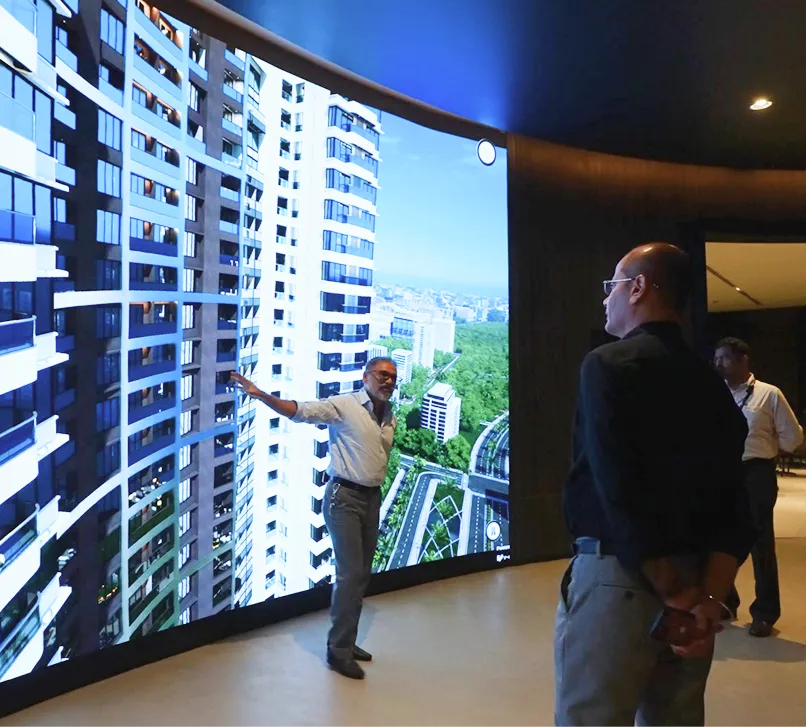
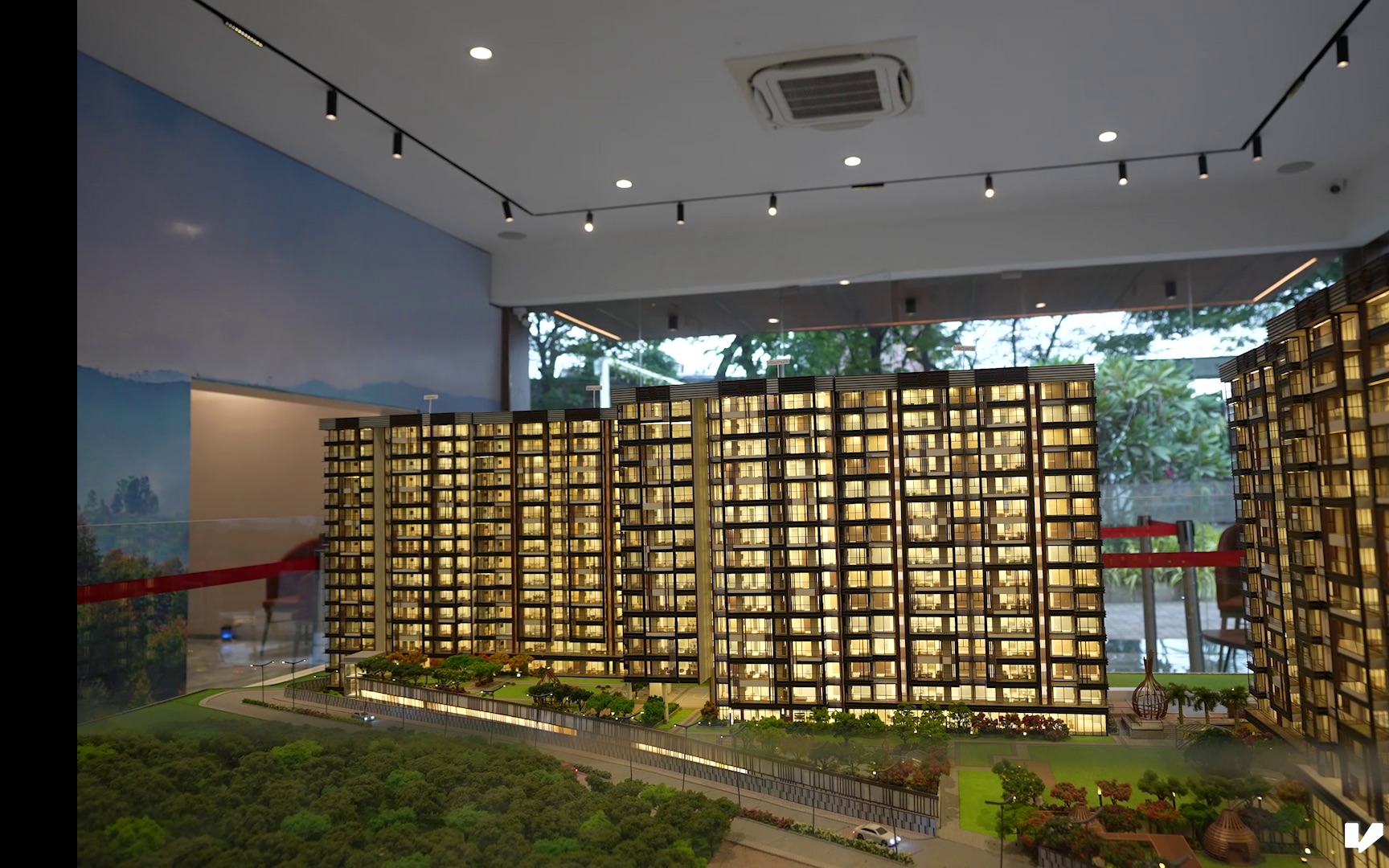
The digital twin was deployed inside the Ma Sarada experience centre with a carefully designed hardware setup.
AV Room System
• LED screen sized 10X8 ft • Pixel pitch of 1.8 • Controlled through iPad integration
This setup enabled:
• High-impact project introduction • Seamless content navigation • Centralised control for presentations
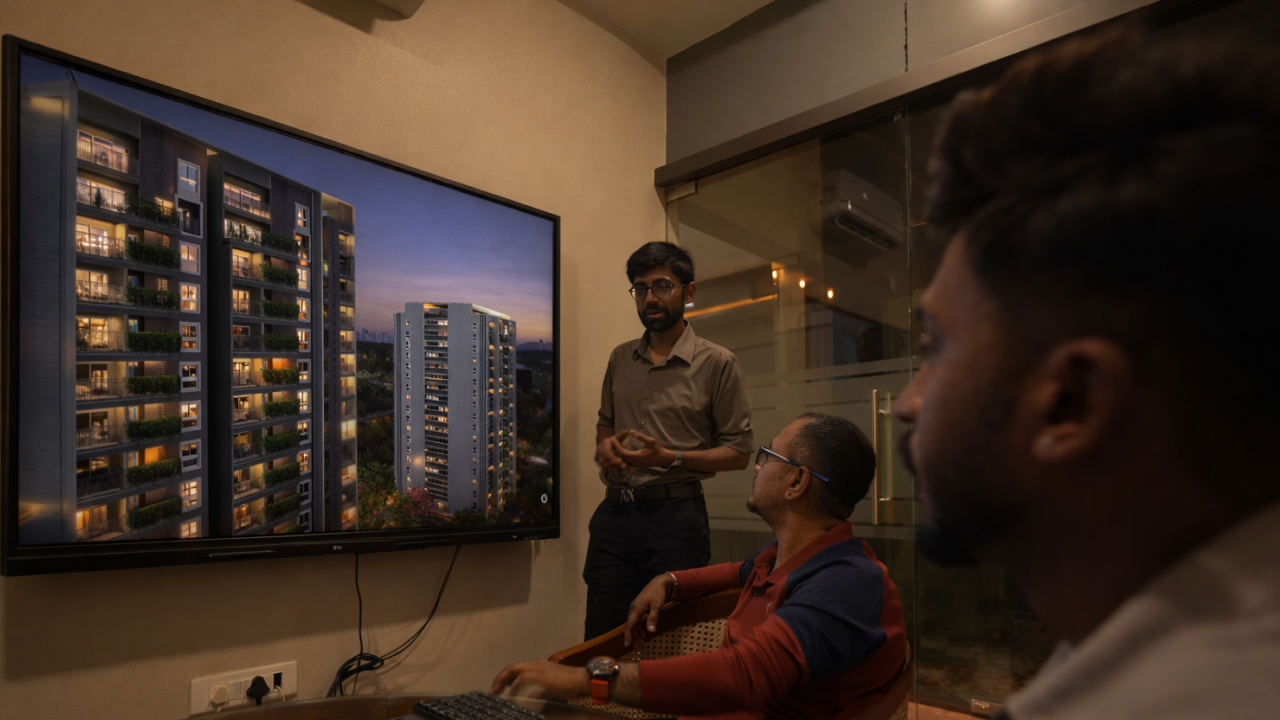
Sales Discussion Pods
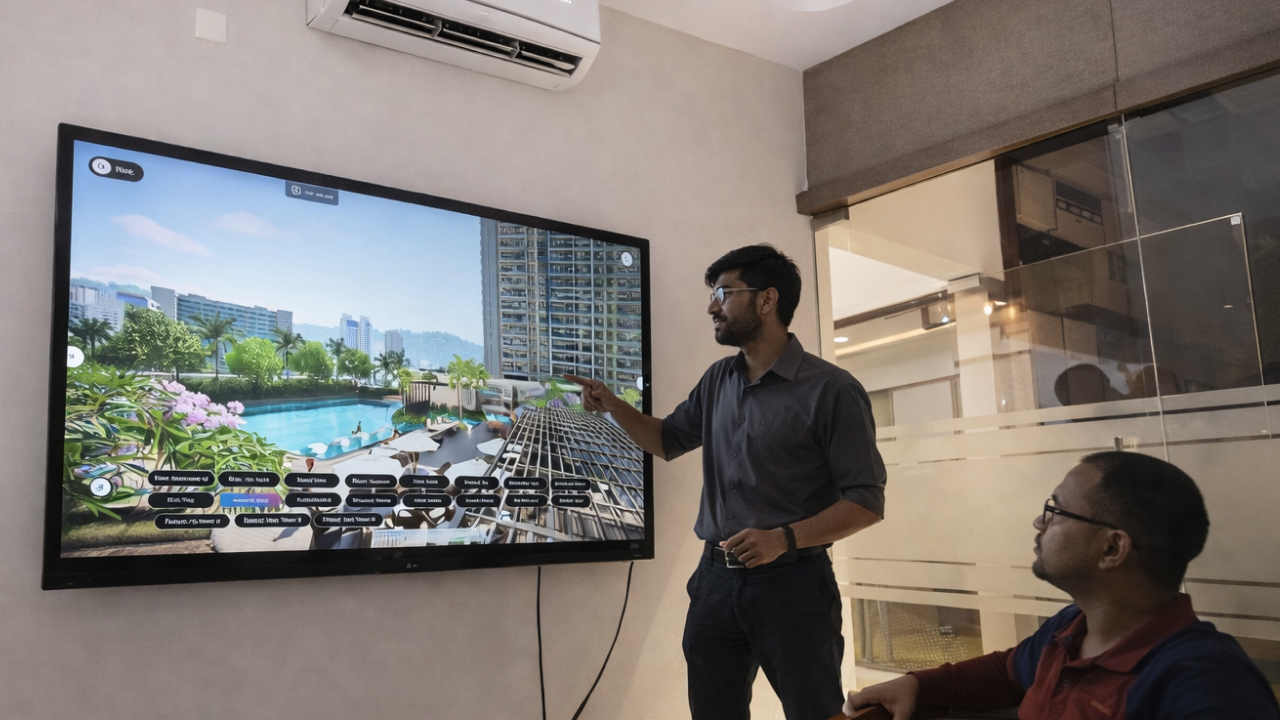
• 3 discussion rooms • Each equipped with 65 inch LG touchscreen displays
These screens allowed the following:
• Direct interaction with the digital twin • Guided exploration by sales teams • Real-time response to buyer queries
Advanced Photo Mode: Extending Visualization Beyond Live Interaction
One of the key software features implemented in the system was Advanced Photo Mode.
This feature was designed to solve a common challenge in sales discussions.
Buyers often ask for specific scenarios:
• How does the unit look in evening lighting • What will the view look like at sunset • How does the space appear under different conditions
Advanced Photo Mode allows:
• Adjustment of time of day • Real-time lighting changes • Capture of high-quality screenshots
These screenshots can then be used for:
• Sales references • Client follow-ups • Social media and marketing content
While it does not replace high-resolution rendering pipelines, it provides immediate visual outputs that enhance the sales conversation.
Integration with Physical Experience: Aligning Digital and Real Worlds
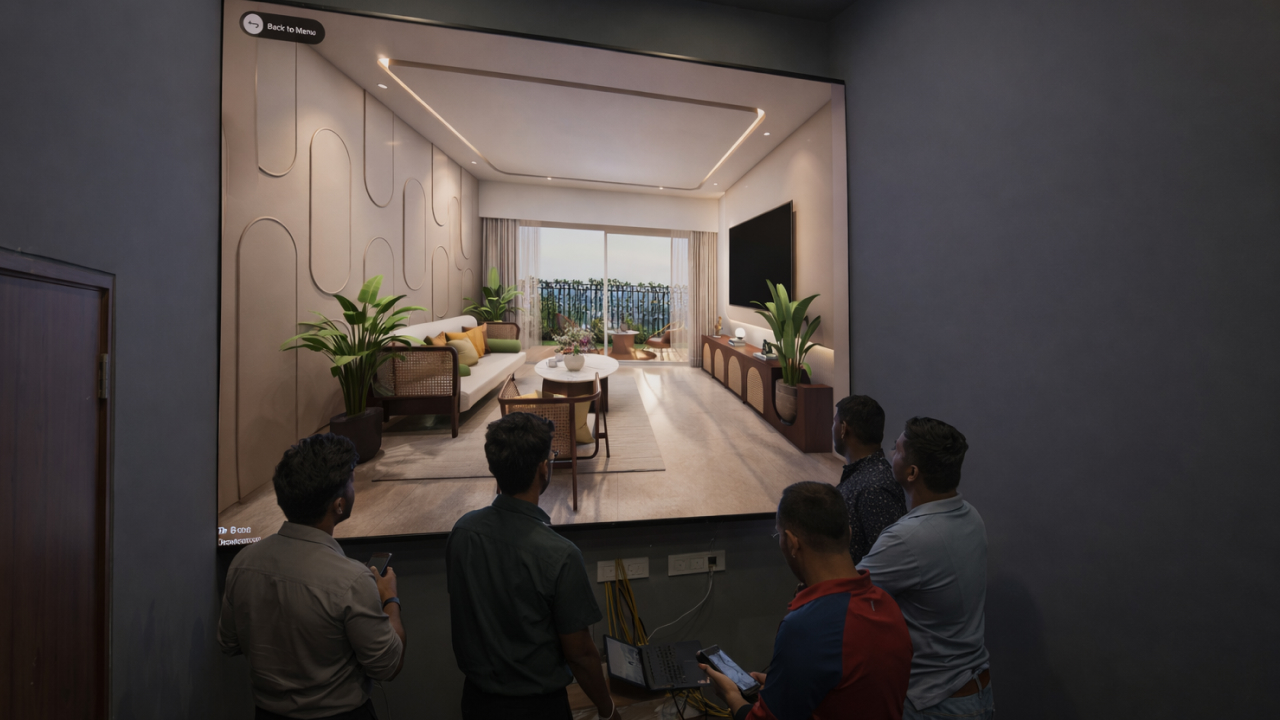
The digital twin was not created in isolation from the physical environment. To ensure continuity, two sample flats were developed as fully immersive digital twin replicas of the dollhouse:
• Two bedroom unit • Three bedroom unit
Each interior configuration was precisely recreated within the digital twin, mirroring materials, layouts, and spatial proportions with high accuracy.
This created a seamless journey where: • Digital exploration prepares the buyer with clarity and confidence. • Physical walkthrough reinforces and validates the experience
This level of alignment is critical not just for immersion but also for building genuine buyer trust.