In real estate marketing, we often talk about "lead generation" as the holy grail. We obsess over Cost Per Lead (CPL), click-through rates, and landing page optimization. But there is a darker, less discussed side to marketing success that keeps Sales Heads awake at night: The problem of abundance.
What happens when your marketing actually works? What happens when you launch a massive project in a high-volume, aspirational market like Dombivli, and suddenly, you aren’t dealing with 5 elite clients a day, but 200+ families flooding your site on a Sunday afternoon?
In the luxury segment, you can afford to spend 90 minutes with a single client, offering them coffee and a leisurely tour. But in a high-volume launch, time is your enemy. If you have 200 groups visiting in an 8-hour window,
that’s roughly 25 families per hour. Without a strategy, that isn't a sales opportunity; it’s chaos. Customers feel neglected, sales teams burn out, the noise level rises, and premium leads slip through the cracks because the "experience" feels like a crowded railway station rather than a premium housing launch.
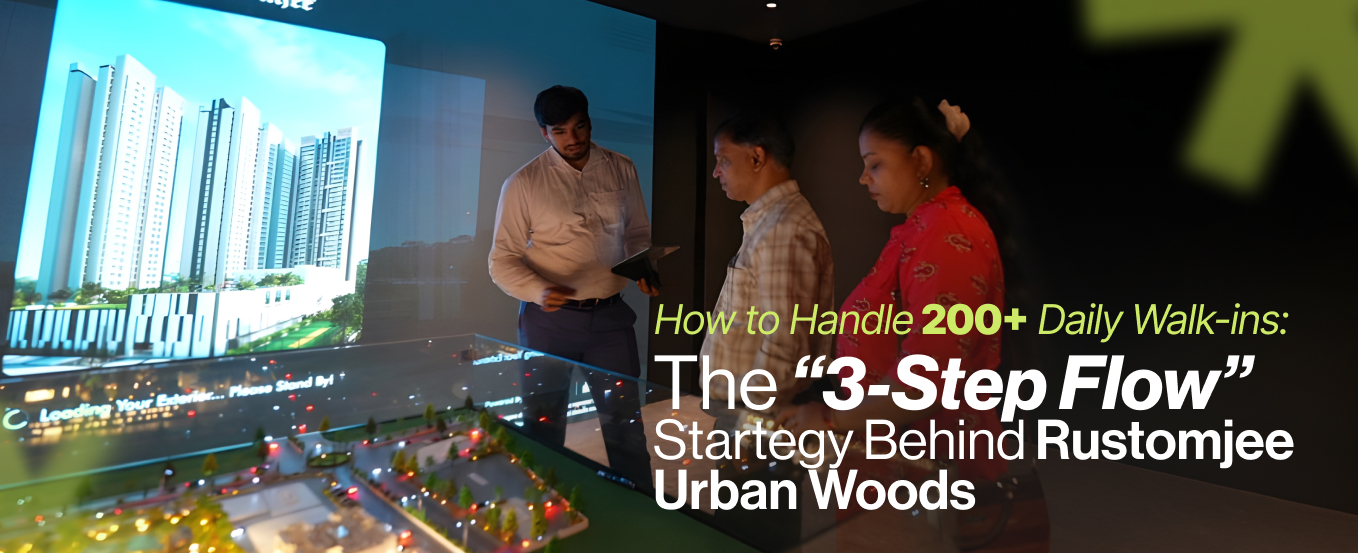
At V-Estate (INK IN CAPS), we recently tackled this exact challenge with Rustomjee Urban Woods. Rustomjee is a brand known for prestige and precision. They couldn't afford a chaotic launch. The brief wasn't just to "build a digital twin." It was to engineer a customer journey: a spatial strategy: that could handle massive footfall without compromising the premium Rustomjee brand promise.
Here is the deep-dive analysis of the "3-Step Flow" strategy we deployed to turn crowd management into conversion velocity.
The Context: High Volume Meets Premium Aspiration
Before we dissect the strategy, let’s look at the battlefield. Dombivli is a unique micro-market in the Mumbai Metropolitan Region (MMR). It is characterized by high volume, affordable housing, and an aspirational buyer demographic who is incredibly value-conscious.
However, Rustomjee is a legacy brand synonymous with luxury and high-grade construction. They were entering a market dominated by local players and needed to justify a price premium.
The Three-Headed Hydra of Challenges:
The "Flat Land" Problem: The site was a massive, flat parcel of land. There was no superstructure, no sample tower, and critically, the surrounding area was still developing. We had to sell a vision of a "Green Township" where currently only dirt existed.
The Crowd Dynamics: We estimated peak footfalls of up to 190-200 families per day, particularly on weekends. This isn't just a crowd; it's a crush. Traditional one-on-one sales models collapse under this pressure.
The Operational Agility: The site office plans were changing until the very last minute (more on that in the "War Room" section below). We needed a system that was robust enough to not crash, but flexible enough to adapt to changing floor plans.
We realized that software alone wouldn’t solve this. We needed a Spatial Strategy that acted as a physical funnel.
The Solution: The 3-Step "Decompression" Flow
To manage the flow of roughly 30 families every hour, we couldn’t just let people wander. We architected a linear, three-stage journey. This acted as a funnel, filtering casual lookers from serious buyers (Lead Qualification) while ensuring every single person received the full pitch—even if a salesperson wasn’t immediately available.
Step 1: The AV Room (The Education & Pacing Phase)
Duration: 5–8 Minutes
Tech: Cinema-style seating, Large Format Projection
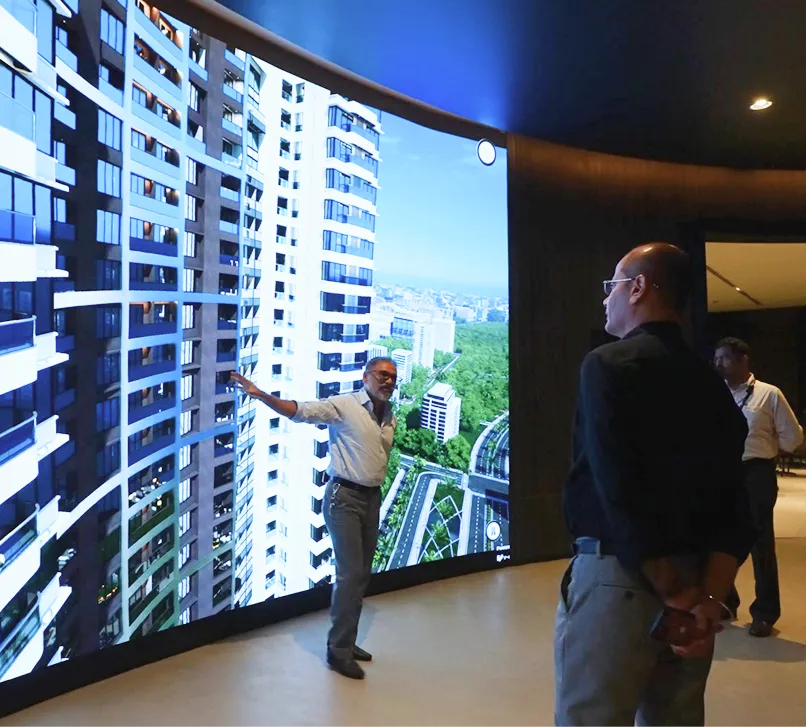
When a family enters, their first stop isn't a sales desk. It’s the Audio-Visual (AV) Room. This is a strategic masterstroke for high-volume sites.
Why "The Hold" is Critical:
Imagine 10 families walking in at 11:00 AM. You only have 8 available sales executives. If you send them straight to the floor, 2 families are left standing awkwardly in the lobby.
Instead, we usher them into the AV Room. This acts as a Decompression Zone. It creates a "holding pattern," allowing the sales floor to clear up while the new batch is being prepped.
The Content Loop:
We curated a specific visual loop based on the client's needs:
2 Minutes - The Logic (Location): A data-driven video highlighting connectivity. Distances to Dombivli station, the Nasik highway, and key schools. This answers the "How do I get to work?" question before it's even asked.
3 Minutes - The Emotion (Walkthrough): A cinematic 3D Walkthrough of the project showing the unbuilt environment.
The Result: By the time the customer steps out of this room, they are educated. They know where the project is and what it looks like. The salesperson doesn't have to waste the first 10 minutes explaining basic location details. They can jump straight to value and closing.
The "Phygital" Scale Model (The Awe Phase)
Duration: 10–15 Minutes
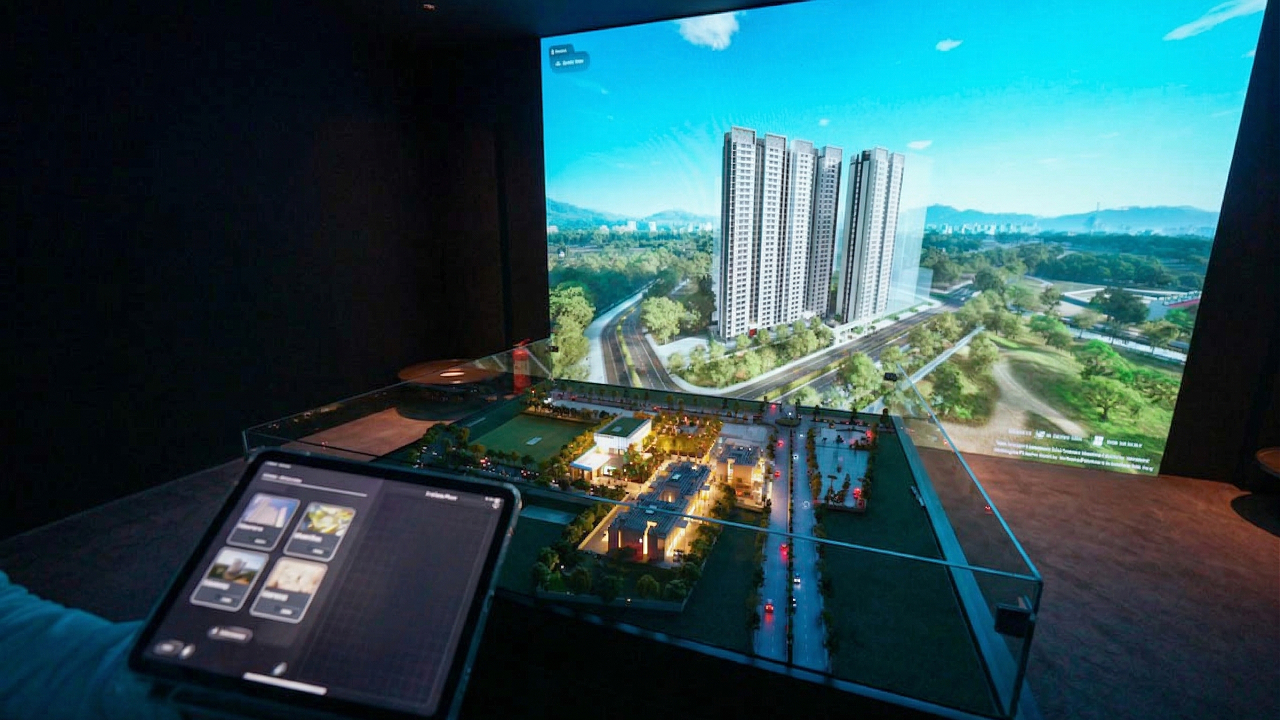
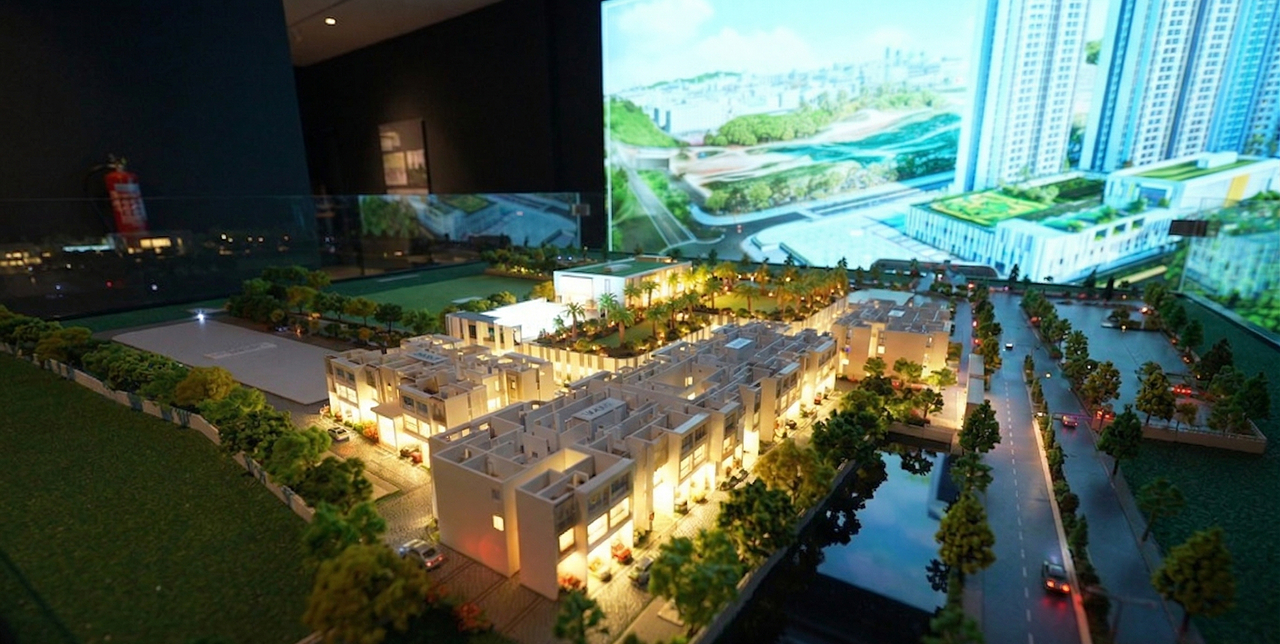
Tech: IoT-Integrated Physical Model + iPad Controls + 16x7ft LED Wall
This is where traditional real estate sales usually bottleneck. Everyone crowds around a static table, pointing at plastic buildings. It’s passive, it’s boring, and it’s hard to see from the back of the crowd.
We changed the game by integrating IoT (Internet of Things) technology to create a "Phygital" (Physical + Digital) experience.
The Setup:
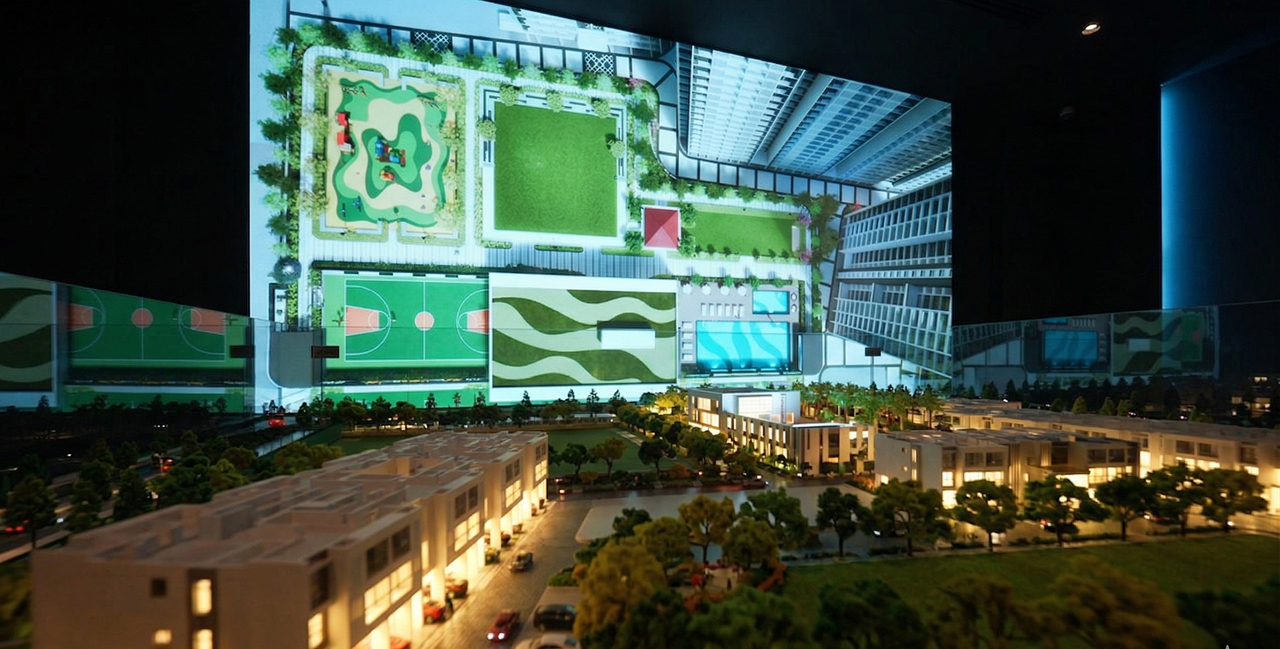
We connected the physical scale model (focusing on the podium and ground level) to the V-Estate application running on iPads. Behind the model stood a massive 13ft x 7ft LED Wall.
The Interaction Loop:
The Trigger: A salesperson holding an iPad stands with a group of 3-4 families. They click "Swimming Pool" on the iPad.
The Physical Response: Instantly, the swimming pool on the physical scale model lights up via embedded LEDs.
The Digital Response: Simultaneously, the massive LED screen on the wall displays a high-res, photorealistic render of that specific amenity, showing people enjoying the pool, the water texture, and the lighting
The Psychology of "Tactile Ownership":
Why go to this trouble? Because of Cognitive Load. When a customer looks at a complex scale model, they are overwhelmed. "Where is the gym? Where is my tower?"
By lighting up only the relevant section, we guide their focus.
Furthermore, this synchronization creates a "Magic Moment." In a market where competitors are showing basic brochures or static models, Rustomjee was showing a synchronized light-and-sound show. It keeps customers engaged visually and physically, reducing the perceived wait time if discussion tables are full.
Struggling to make your scale model work for you?
Transform your static physical models into interactive sales tools with V-Estate’s IoT integration.
Book A Demo Today
The Discussion Room (The Closing Cockpit)
Duration: 20–40 Minutes
Tech: 10 Private Cabins, 20 Open Tables, 65-inch Screens
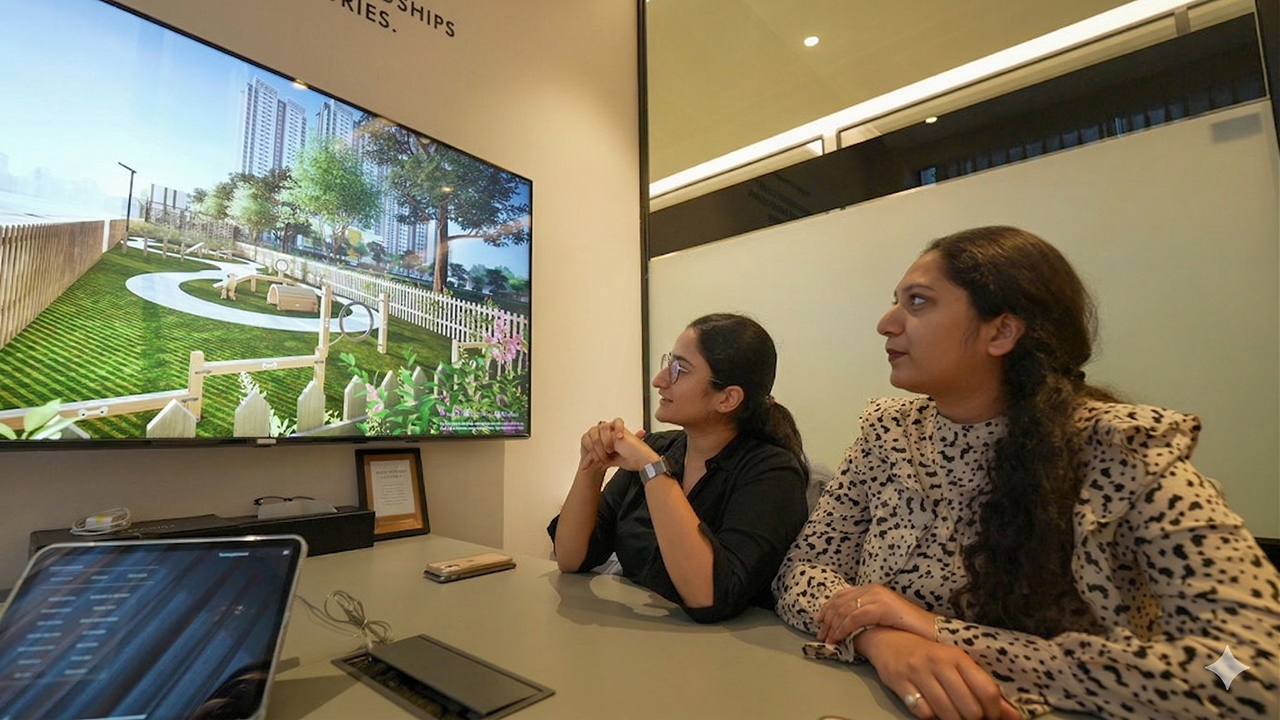
This is where the deal is closed. We set up 10 dedicated discussion rooms and an additional 20 open discussion tables, each equipped with our V-Estate sales tool cast to a 65-inch TV.
The critical innovation here was the "Window Views" Module.
The "Trust Gap" in Pre-Sales:
Since the project is on flat land, the #1 objection from buyers is: "What will my view actually look like? Will the building next door block my sun? Is the 4th floor too low?"
Usually, a salesperson says, "Trust me, it's a great view." In 2024, customers don't trust words; they trust data.
The Digital Twin Solution:
Using drone data and Unreal Engine 5.4, we simulated the exact view from every floor for the 2BHK and 3BHK units.
The Scenario: A customer asks, "If I buy the 18th floor facing West, will I see the sunset?"
The Solution: The salesperson clicks the unit on the screen, and the software generates the exact sunset view from that specific balcony.
The ROI:
Transparency creates trust. Trust shortens the sales cycle. The sales team reported that this feature alone cut down negotiation time significantly because the product (the view) was no longer hypothetical—it was visible.
Technical Deep Dive: The Engine Under the Hood (Unreal Engine 5.4 & PCG)
You might wonder, how do we render a massive township with millions of trees, complex lighting, and 33 amenities without the system crashing? Especially when we need to run this on multiple screens simultaneously for 10 hours a day?
This project was a benchmark for our technical team. We utilized Unreal Engine 5.4 and its PCG (Procedural Content Generation) framework.
The Challenge: The "Memory vs. Beauty" Trade-off
Rustomjee Urban Woods is, by definition, a "green" township. It required dense foliage, forests, lawns, and landscaping. In traditional 3D modeling, an artist places trees one by one.
Problem: Placing 10,000 trees manually creates a massive file size. It creates "draw calls" that choke the computer's processor, leading to lag. You can't sell luxury property on a laggy screen.
The Solution: Procedural Content Generation (PCG)
Instead of placing trees, we "taught" the software how to grow them. Using the PCG framework in Unreal Engine 5.4, our developers wrote rules based on Splines (mathematical curves).
The Process: We drew a boundary on the digital terrain (based on Google GIS data) and told the engine: "Fill this area with trees. Make them denser in the center, sparser near the roads. Randomize the height by 20%."
The Result: The engine generates millions of trees instantly. Because they are "instances" (clones) rather than unique models, the memory usage plummets. We achieved a hyper-realistic, dense forest look running at a smooth 60 Frames Per Second (FPS).
Lighting the Void:
Another technical hurdle was the site itself. It was a standalone project in a developing area. In 3D, a lone building in a dark void looks fake. We used Random Spline Algorithms to generate streetlights, city traffic, and distant ambient lighting automatically. This "lived-in" look is subconscious, but it makes the customer feel safe and connected, rather than isolated.
Operational "War Room": The 3-Day Miracle
Software is clean; construction sites are messy. The true test of a technology partner isn't how well the code runs in the lab, but how well the team adapts to the dust and chaos of a site office.
The Situation:
We had a strict deadline. The launch date was set. Invites were out.
But 4 days before launch, the site office plans changed.
The Crisis: The designated Server Room—the brain of our entire operation—was moved to a different location.
The Impact: All our pre-planned cabling diagrams were instantly obsolete. The Cat6 LAN cables (essential for the IoT model and the 10 discussion rooms) were now too short or routed to the wrong wall.
The Response:
Our Operations Team didn't file a change request and wait. They went into "War Room" mode.
Day 1: Redesigned the network architecture on the fly. We identified a secondary support room that could house the racks.
Day 2: Collaborated with the on-site electrical vendors. While painters were applying the final coat, our team was crawling through false ceilings to re-route the Cat6 cabling to the new server location.
Day 3: Calibration. With the physical model finally in place, we had 24 hours to map every LED light to the iPad buttons.
Launch Day: Zero downtime.
This is why we emphasize that V-Estate is a Service, not just a Software. When the blueprint changes, we move with it.
The Human Element: Training 25+ Sales Commandos
Technology is useless if the sales team fears it.
For Rustomjee, we didn't just install software; we conducted deep-dive training for 25+ sales executives.
Rustomjee rotates staff between sites, so many were already familiar with the V-Estate ecosystem. However, relying on "familiarity" is a trap. We conducted specific refresher courses on the Window View module.
The "Let Me Check" Killer:
The biggest friction in sales is the phrase "Let me check with my manager." It kills momentum.
Our goal with the training was to eliminate this phrase.
"What's the carpet area?" -> Click button -> Shown on screen.
"Is the gym open 24/7?" -> Click Amenities -> Info card pops up.
The Feedback:
The team reported that the tool empowered them to be experts instantly. They didn't have to memorize 33 amenities; they just had to know how to navigate to them.
Why This Matters for Your Next Launch
If you are planning a project launch, especially in a volume market, stop thinking about "software" and start thinking about "flow."
The success of Rustomjee Urban Woods wasn't just about the quality of the 3D render. It was about:
Pacing: Using the AV room to regulate footfall and reduce repetition.
Integration: Connecting the iPad to the Scale Model to create a "Wow" factor (Tactile Ownership).
Transparency: Using the Window View module to kill objections instantly.
With an estimated throughput of 190+ families a day, this system proved that you can deliver a luxury sales experience at mass-market speed.
Ready to Optimize Your Sales Velocity?
The market is moving faster than ever. If your experience center is relying on static brochures and disconnected physical models.