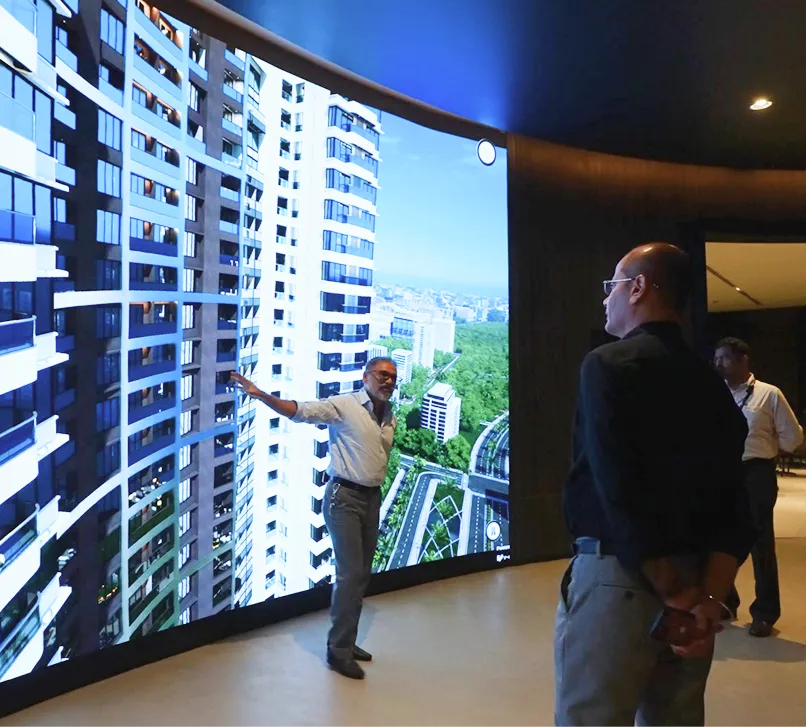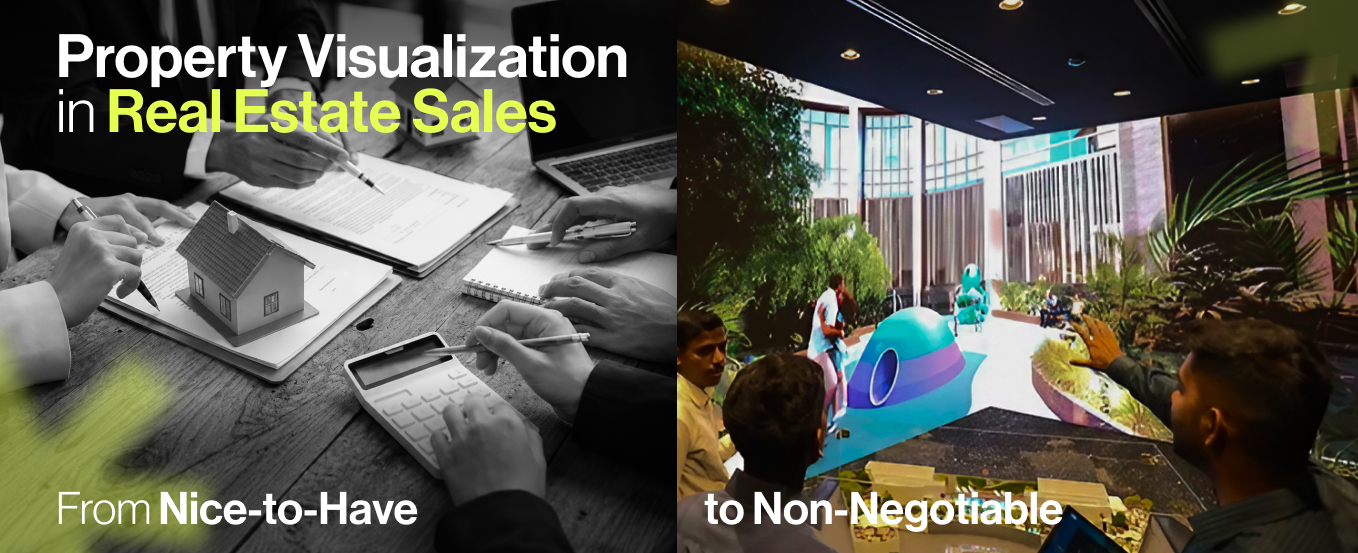
A decade ago, a good architectural render was impressive. Today, it is the minimum expected.
Buyer expectations have shifted significantly. People visiting a sales centre in 2025 have already consumed enormous volumes of visual content. They have seen high-quality property tours, photorealistic renders, and immersive content across digital channels. They arrive at your sales centre with a calibrated visual baseline.
If your in-person presentation falls below that baseline, you lose credibility before the conversation starts.
What Visualization Actually Does in the Sales Process
Visualization is not decoration. It is a decision-support tool.
When a buyer can genuinely see a property — in accurate detail, in real context, with realistic proportions and finish quality — they make faster and more confident decisions. The absence of strong visualization forces buyers into imagination. And imagination, when unsupported, fills gaps with doubt.
Every unanswered visual question is friction in the sales process. Every friction point is a reason to delay. Strong visualization removes that friction systematically.
L&T Crestoria, Panvel
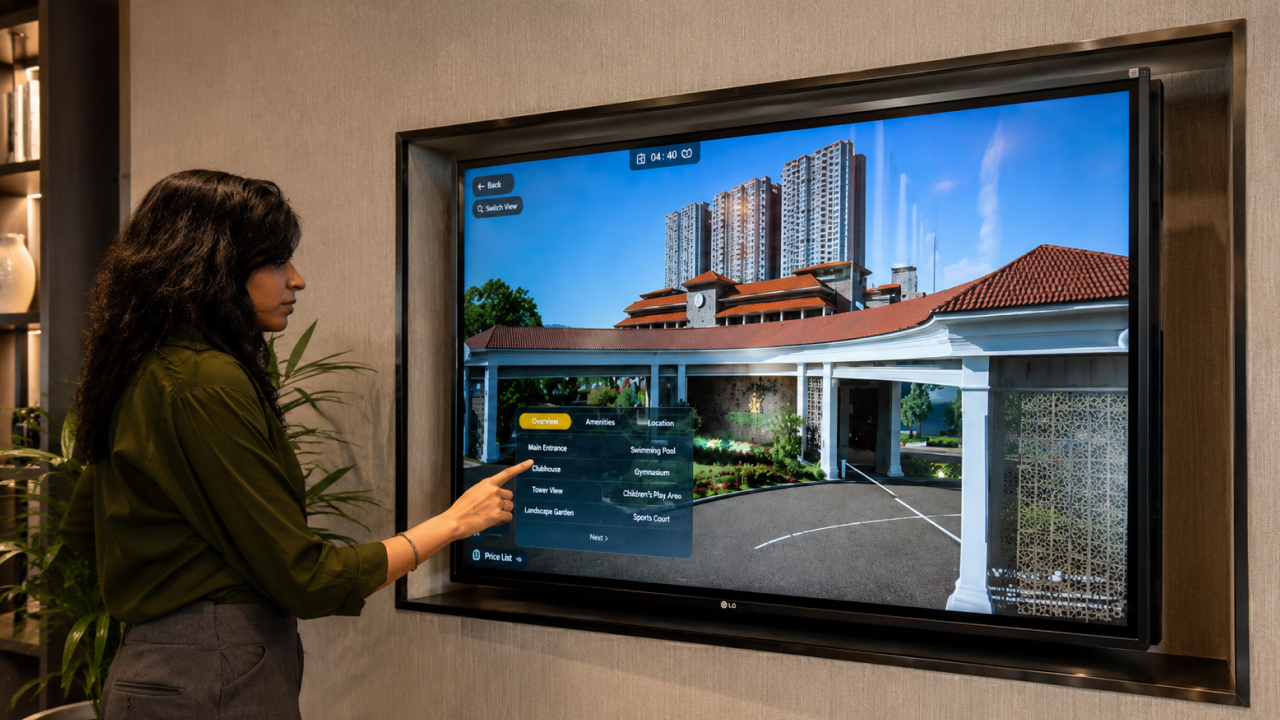
L&T Realty | Crestoria | 35-acre large-scale residential estate | Spanish and neo-classical architecture | 5 residential towers | Panvel corridor
L&T Crestoria was envisioned as a large-scale residential estate — a "life beyond Mumbai" destination within the rapidly developing Panvel corridor. The project combined layered landscapes, premium clubhouse experiences, golf putting course, retail integration, and five residential towers across 35 acres.
The core challenge was communicating scale. A 35-acre estate with layered landscape planning, ornamental architectural detailing, and a multi-dimensional lifestyle ecosystem cannot be understood through floor plans and renders. Buyers needed to experience the development as a complete world — not a collection of specifications.
Additionally, Crestoria's location within an emerging Panvel corridor required a stronger storytelling platform. Buyers needed to visualize the future lifestyle ecosystem being built — not just what existed today.
Immersive Architectural Visualization: The estate's neo-classical and Spanish-inspired architecture — with detailed façade carvings, mouldings, layered elevations, and ornamental detailing across five towers — was recreated in real-time. This was one of the earliest V-Estate deployments leveraging the Megalight system for enhanced lighting quality across estate-scale rendering. Built on Unreal Engine 5.7 with advanced Nanite optimization workflows.
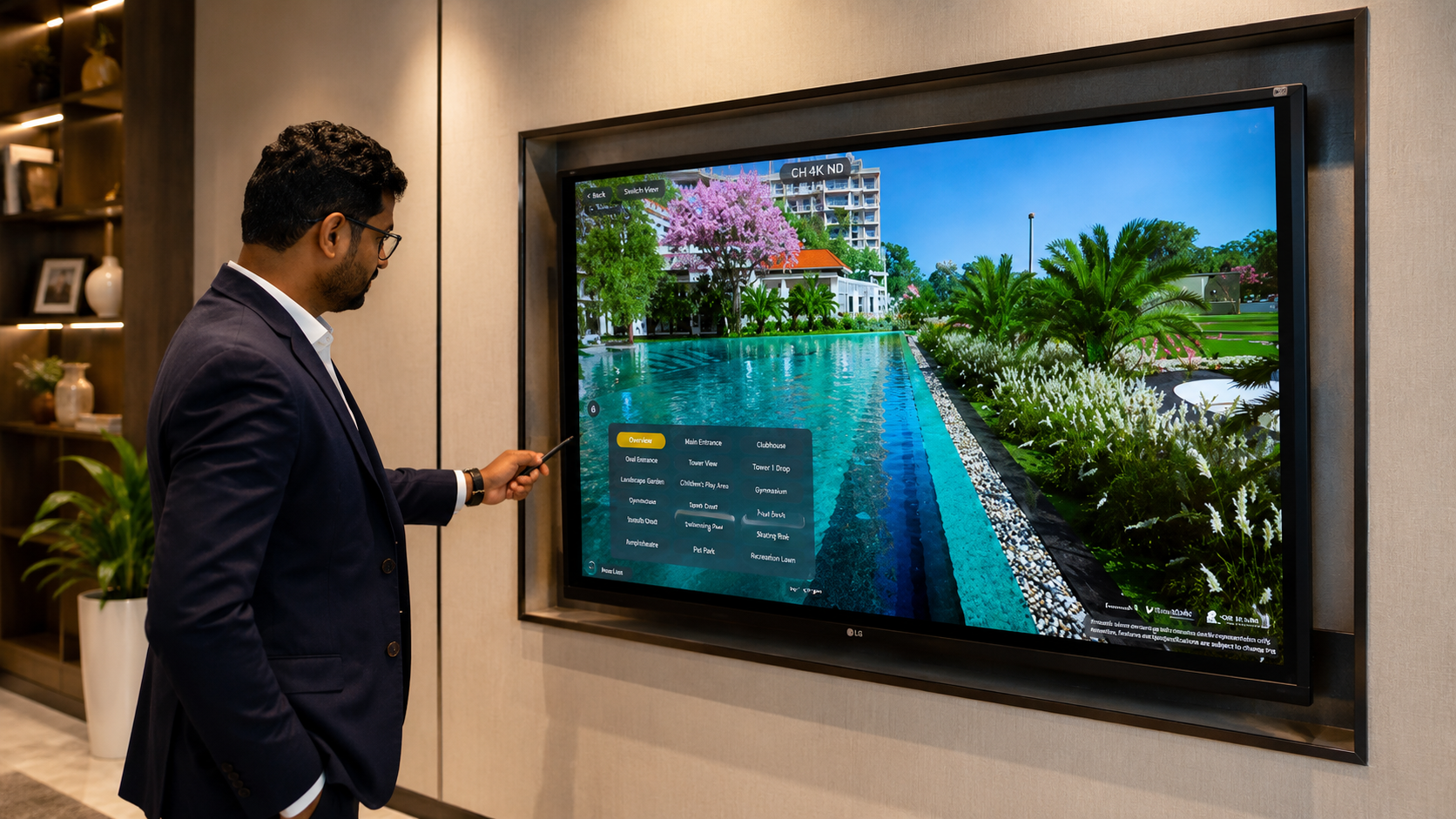
Landscape and Amenities Experience: The layered landscape — golf putting course, double-height café connected through a spiral staircase, orchard gardens, reflexology pathways, amphitheatre, pavilion seating, swimming pool decks, and outdoor fitness zones — was visualized as a continuous lifestyle ecosystem, not isolated amenity pockets. The visualization communicated movement flow, depth, layering, and openness across the estate.
Interactive Vicinity Mapping: 31 interactive touchpoints mapped across a 10+ km radius — communicating connectivity routes, retail infrastructure, lifestyle destinations, commercial developments, and social infrastructure. Panvel's growth story translated into a buyer-facing visual narrative.
Smart Sales Pods: Five dedicated sales pods, each equipped with 65-inch display systems and RTX 5090-powered rendering infrastructure, with iPad-integrated navigation and multi-device synchronized presentation capability.
The platform delivered zero-latency 4K digital twin interactions — no loading delays during high-value sales presentations.
Results:
- Enabled stronger value communication for a large-scale estate within an emerging Panvel market
- Zero-latency 4K digital twin interactions — seamless real-time exploration without loading delays
- Simplified the presentation of a highly layered development across architecture, landscapes, retail, and lifestyle within a single immersive platform
- Enhanced buyer understanding of Crestoria's long-term lifestyle vision beyond conventional brochures
- Sales team achieved immediate adoption post-training
- Established a scalable immersive sales ecosystem for upcoming project phases and future launches
The Specific Problem with Outdated Visualization Formats
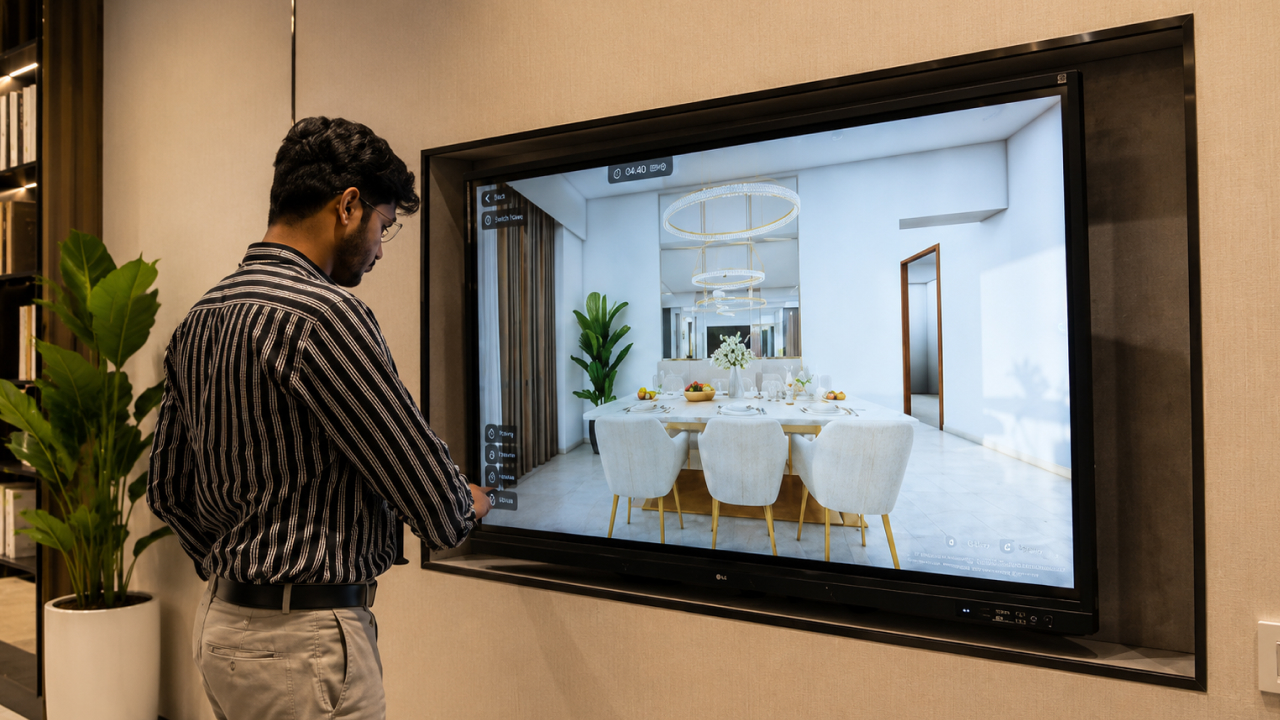
Standard renders have a fundamental structural limitation: they show one fixed moment. One lighting condition. One furniture arrangement. One perspective angle.
Real buyers do not experience property in a single fixed moment. They think about morning light in the bedroom. Evening ambiance in the living room. How the kitchen feels with their finish preference.
A static render answers one question. An immersive real-time visualization answers many — and allows buyers to formulate and answer their own questions.
Scale models communicate footprint and layout but nothing about finish texture, view depth, or spatial feel from inside a room. The gap between what static formats show and what buyers need to experience is precisely where purchase hesitation lives.
Visualization for Estate-Scale and Outskirts Market Projects
The visualization challenge is most acute for large-scale projects in emerging corridors — exactly the scenario L&T Crestoria represented.
When a project is located in a developing area, buyers are being asked to commit capital to a future lifestyle vision. The product is partly real and partly planned. The surrounding ecosystem is partly built and partly infrastructure-in-progress.
This is where immersive visualization with vicinity mapping becomes critical — not as a premium feature, but as the primary tool for buyer confidence.
Buyers who can navigate a 10+ km interactive vicinity map, see planned infrastructure, and explore the lifestyle destinations being built around the project are making an informed decision about the area's future. That is fundamentally more compelling than reading a connectivity bullet point.
The Sales Team Advantage at Scale
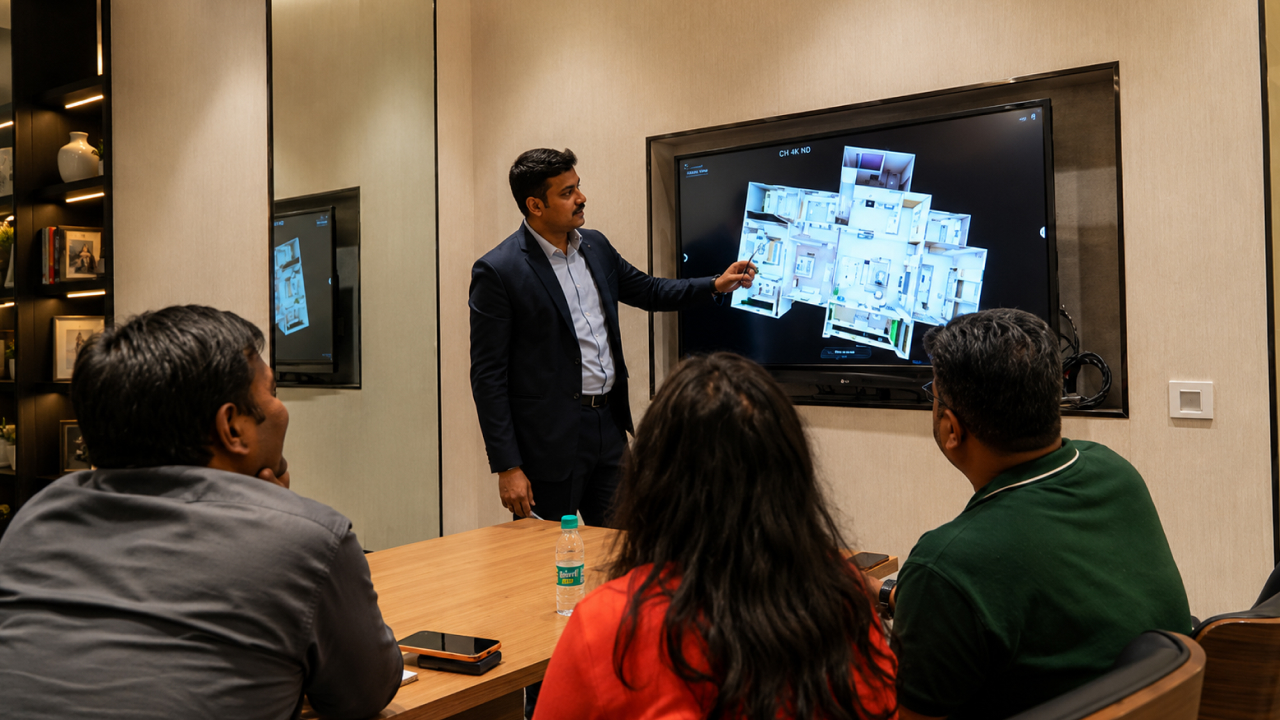
In estate-scale projects, the complexity of the presentation itself is a challenge. Multiple towers, extensive amenity pods, retail integration, and layered landscape planning create a communication burden for the sales team — and a comprehension burden for the buyer.
Immersive real-time visualization resolves both simultaneously. The sales team navigates a unified platform. The buyer sees the entire development as a coherent whole. The mental map of the estate is built visually — not assembled from descriptions.
The Bottom Line for Developers and Marketing Heads
Visualization quality is no longer a marketing budget decision. It is a sales infrastructure decision.
The developers who treat their sales experience as a core conversion tool — not a cost line — are the ones closing faster, retaining more buyers post-booking, and building stronger brand equity across projects.
If your current visualization cannot show a buyer their specific unit, at their specific floor, with their preferred finishes, in real-time — your sales environment has a gap. And in a market where buyers are visiting three to five competing projects in a single weekend, that gap has a direct cost. Audit your sales experience against what your best competitor is showing buyers today. That gap is your next conversion opportunity.