A couple sits in a well-appointed sales gallery, preparing to make one of the most significant financial commitments of their lives. Spread across the table in front of them is a glossy brochure, a set of two-dimensional floor plans, and a stylized location map. In the centre of the room sits a physical scale model encased in glass. The sales representative points to a tiny plastic balcony on the model and says, "This is where you'll enjoy your morning coffee, looking out over the city."
The fundamental problem with this scenario is that the buyers cannot feel the space. They are being shown a property, but they are not experiencing it.
For decades, real estate sales have relied heavily on the buyer's ability to imagine the final product. However, as properties become more premium and buyers become more discerning, imagination is no longer enough to close a complex sale. Shifting from static presentations to an immersive property experience is now a critical requirement for developers and sales teams who want to build genuine buyer conviction.

The Buyer's Dilemma: Trying to Live in a Floor Plan
To understand why traditional property presentations fall short, one must look at the process through the buyer's eyes. Most property buyers do not have the spatial training of an architect or a civil engineer. When they look at a 2D floor plan, a "12x14 foot" master bedroom is simply a set of numbers.
Buyers immediately begin asking themselves practical, lifestyle-oriented questions: Will our existing king-sized bed and wardrobes fit comfortably? How much natural light will this room actually receive at 4 PM? If we purchase an apartment on the 12th floor, will the neighbouring commercial tower block our view of the park?
When these questions remain unanswered—or are answered only with verbal assurances rather than visual proof—anxiety sets in. A property purchase is an emotional decision grounded in logical validation. When buyers lack a clear understanding of the space, they struggle to visualize their daily lives within it. This lack of clarity directly affects their confidence. Instead of feeling excited about their new home, they feel uncertain, which leads them to delay their decision, visit multiple competitor projects, or walk away from the table entirely.
The Developer's Challenge: Selling a Vision with Static Tools
On the other side of the table, real estate sales teams face an uphill battle. They are tasked with selling a high-value vision using tools that inherently limit their ability to communicate that vision.
During property sales presentations, representatives spend an immense amount of time and energy trying to bridge the buyer's imagination gap. When a prospective client asks about the project's connectivity to a specific business district or international school, the salesperson must rely on a distorted, out-of-scale location map that fails to convey realistic travel times or neighbourhood context. When asked to justify a premium price for a higher floor, the agent can only offer a generic architectural rendering that does not reflect the actual sightlines from that specific unit.
This limitation introduces significant friction into the sales conversation. The discussion frequently devolves from the lifestyle benefits and design quality of the property into debates over spatial dimensions, unverified views, and layout practicalities. Developers invest heavily in designing premium amenities, optimized floor plans, and strategic locations, but if the sales tools cannot effectively communicate that value, premium pricing becomes exceedingly difficult to justify. Furthermore, this problem compounds when developers rely on channel partners and brokers, who may struggle to accurately convey the developer's vision without the right tools.
Why the Traditional Property Viewing Experience Fails to Build Confidence
The gap between what a developer builds and what a buyer perceives has a direct impact on the bottom line. The traditional property viewing experience fails to build confidence because it places the burden of visualization entirely on the buyer.
When buyers are forced to piece together a mental image using a disjointed mix of brochures, material swatches, and scale models, they inherently focus on the risks rather than the rewards. This friction lengthens the sales cycle. Buyers leave the experience centre stating they "need time to think about it," which is often a polite way of saying they do not have enough clarity to commit. In a highly competitive real estate market, clarity is what separates a stalled lead from a closed transaction.
Practical Steps to Bridge the Gap: Building an Immersive Property Experience
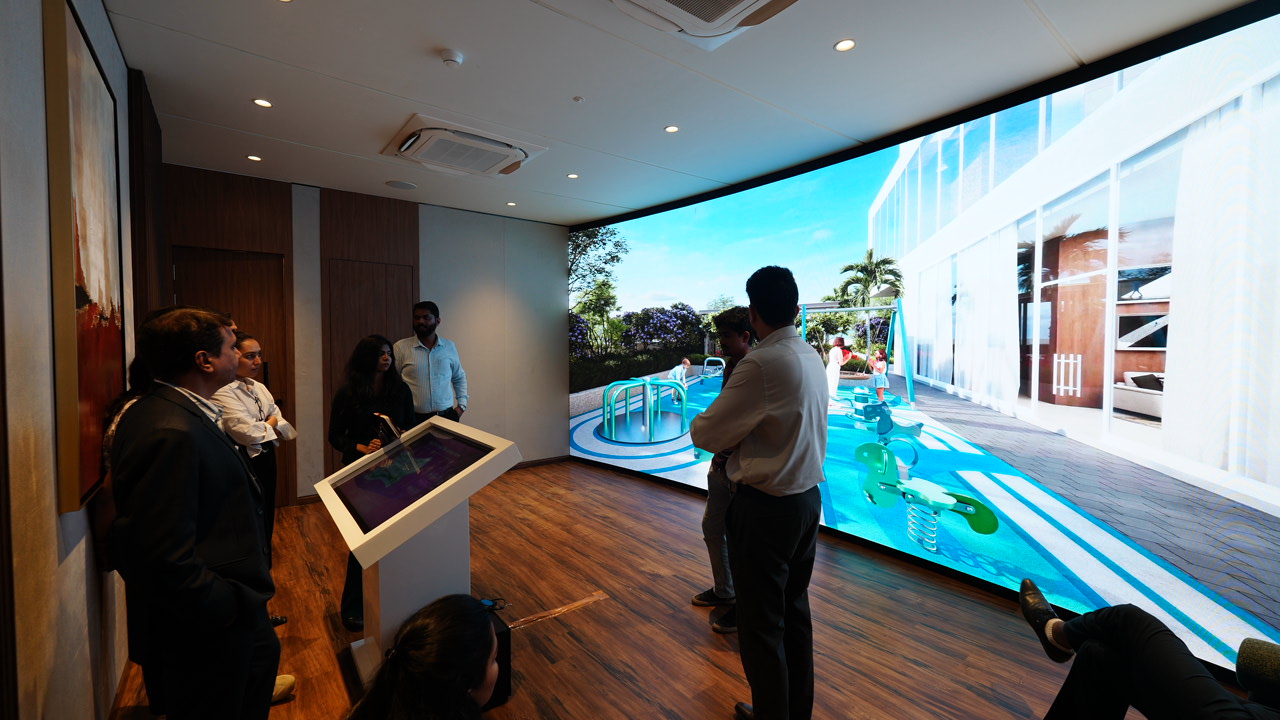
Moving from showing to experiencing requires a shift in how property data and visuals are presented. Developers and marketing heads can address this by integrating specific technologies that answer buyer questions visually and instantly.
Contextualizing the Location Before buyers care about the finishes in the kitchen, they care about the neighbourhood. Instead of static illustrations, developers can use interactive maps and connectivity mapping. This allows buyers to see the property's exact relationship with transit hubs, commercial zones, and lifestyle infrastructure in a realistic, accurate format. It transforms the location from an abstract concept into a tangible benefit.
Walking the Exact Unit Real estate 3D visualisation and interactive property walkthroughs allow buyers to navigate a unit as if they were physically standing inside it. By actively moving through a digital space, buyers can look up at the ceiling height, gauge the width of the hallways, and intuitively understand the flow from the living room to the outdoor deck. This replaces guesswork with spatial certainty.
Visualizing the Actual View One of the most effective ways to justify floor rise premiums is through accurate floor and view visualisation. By showing a buyer the exact sightline from a 10th-floor balcony versus a 25th-floor balcony, sales teams remove ambiguity. The buyer is no longer taking the agent's word for it; they are experiencing the view for themselves, making the decision to upgrade much easier.
Exploring the Lifestyle Modern residential projects are sold on their amenities as much as their private units. Interactive amenities allow buyers to explore the clubhouse, fitness centres, and landscaped gardens at their own pace. Instead of looking at a single rendered image of a swimming pool, they can navigate the pool deck and understand the scale of the community spaces.
Equipping Sales Teams and Experience Centres for Success

The physical sales gallery remains the focal point for high-value real estate transactions. However, the environment and the tools within a real estate experience centre must evolve to support this new way of selling.
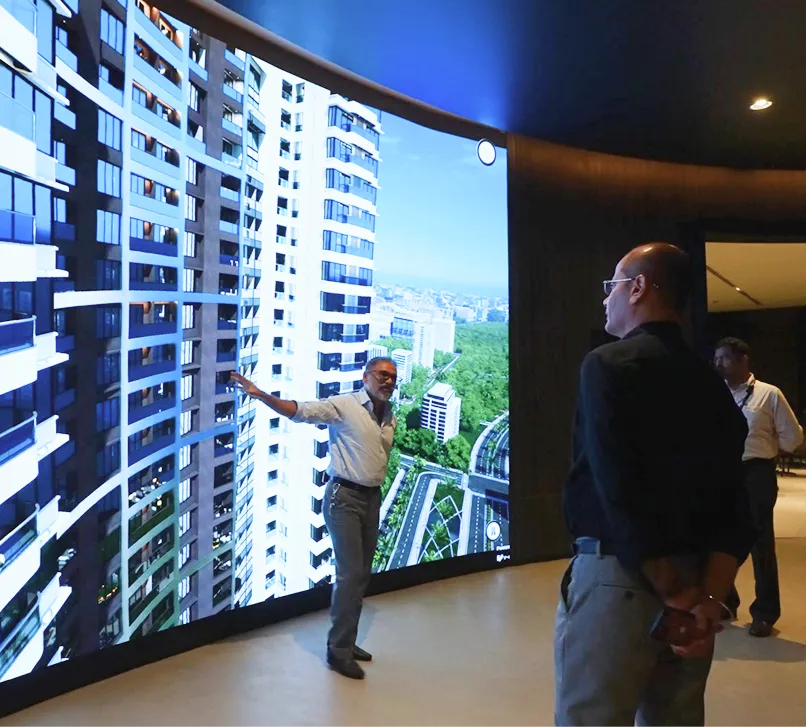
Integrating interactive sales presentations on large touchscreens allows the sales representative to act as a knowledgeable guide rather than a passive presenter. Instead of flipping through a fixed, linear slide deck, the agent can navigate the project dynamically based on the buyer's real-time cues and objections. If a buyer expresses concern about privacy, the agent can instantly pull up a 3D model of the master plan to show the distance between towers. If the buyer is interested in customization, real-time configuration tools can show them how different flooring or kitchen finishes will look in their specific unit.
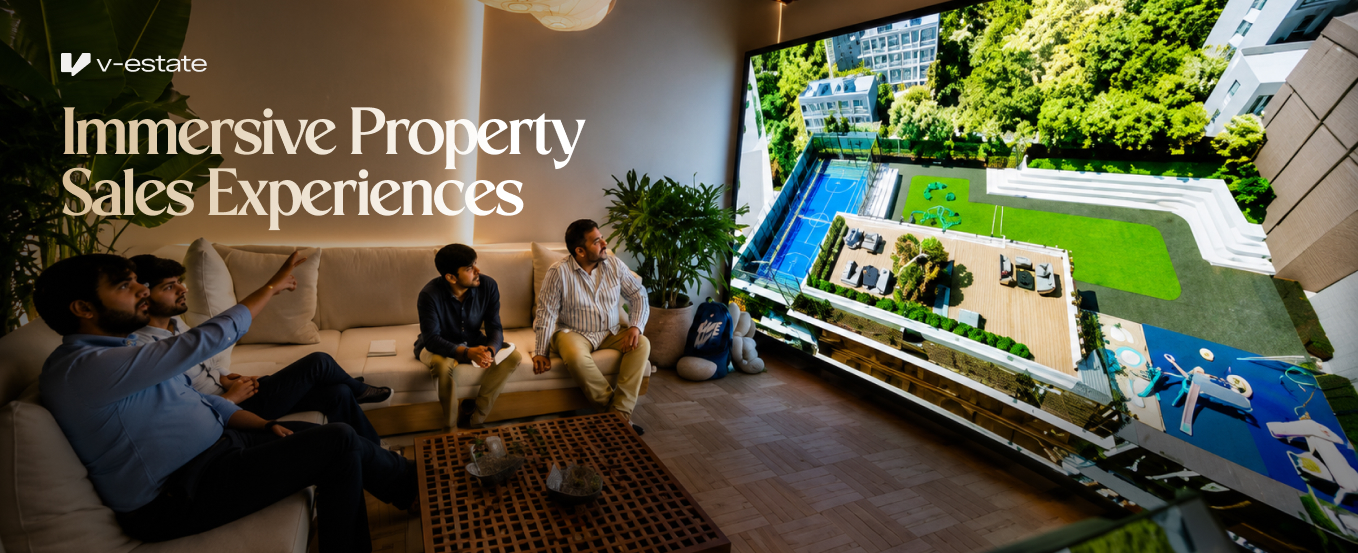
To achieve this seamlessly, developers require a unified system rather than a collection of disjointed apps. Platforms like V-Estate enable developers to consolidate these interactive elements—from digital twins to high-fidelity walkthroughs—into a single, cohesive interface. This ensures that whether a buyer is interacting with a broker via a tablet on a site visit, or sitting in front of a massive display screen in a flagship experience centre, the presentation remains consistent, accurate, and deeply engaging. By giving sales teams the ability to visually answer complex spatial questions instantly, developers empower them to handle objections gracefully and keep the momentum of the sale moving forward.
Conclusion
The transition from merely showing a property to facilitating an immersive property experience is fundamentally about transparency and trust. When buyers are provided with the visual tools they need to truly understand a space, their anxiety decreases, and their confidence in the purchase increases.
For developers and sales teams, relying on static floor plans and generic renders is no longer sufficient to meet the expectations of modern buyers. By embracing interactive walkthroughs, accurate view visualisations, and dynamic presentations, real estate professionals can reduce friction in the sales cycle, justify premium pricing, and ultimately close deals with greater efficiency.