Picture a prospective buyer at the end of a long weekend. Their dining table is scattered with glossy brochures, unrolled floor plans, and business cards from three different developers. They are trying to make one of the most significant financial decisions of their lives, yet they are struggling to remember if the balcony in Unit 402 offered better afternoon light than the terrace in Unit 802. They cannot accurately recall how the living room flow of Property A compares to Property B.
This scenario plays out daily in the real estate market. Buyers are routinely asked to process, store, and compare massive amounts of spatial and financial information. When the comparison process becomes too difficult, friction enters the buying journey. Making real estate property comparisons easier is not just an exercise in customer service; it is a critical strategy for maintaining momentum in the sales cycle and guiding buyers toward confident decisions.
The Burden of Imagination: The Buyer’s Perspective
From a buyer’s standpoint, comparing properties—especially off-plan developments—is an exercise in heavy cognitive load. A home purchase is inherently emotional, but the comparison phase is highly analytical. Buyers must weigh competing variables: square footage, layout efficiency, natural light, neighbourhood connectivity, and amenity access.
The core issue is that buyers are typically not trained architects or spatial designers. Expecting them to look at a 2D floor plan for Property A and accurately compare it to a static rendering of Property B requires a leap of imagination that many are uncomfortable making. When marketing materials are fragmented—relying on a mix of printouts, verbal descriptions, and isolated images—the buyer struggles to create an accurate mental model.
When uncertainty creeps in, confidence drops. If a buyer cannot clearly articulate to themselves why one option is superior to another, their default mechanism is to delay the decision. They ask for more time, they request another site visit, or they simply step away from the negotiation entirely.
How Comparison Friction Elongates the Sales Cycle
For real estate developers and sales teams, buyer confusion directly impacts the bottom line. Sales professionals often find themselves spending valuable hours re-explaining basic spatial differences rather than negotiating commercial terms or discussing customisation options.
When properties are difficult to compare side-by-side, the sales narrative loses its focus. A broker or sales manager might attempt to highlight the premium finishes of a specific unit, but if the buyer is still mentally stuck trying to figure out how the layout compares to a unit they saw yesterday, the message fails to land.
Furthermore, disjointed comparison materials create a perceived lack of transparency. If a developer provides rich, detailed visuals for a flagship tower but only basic sketches for a secondary tower, the buyer immediately feels they are lacking the full picture. Standardising how properties are presented and compared is essential for keeping the sales pipeline moving efficiently.
Achieving Visual Alignment for Accurate Assessment
To facilitate genuine comparisons, developers must ensure that the visual presentation of different properties is perfectly consistent. This requires strict visual alignment across all marketing assets. If a buyer is comparing two different units, the media they consume must share the same scale, lighting accuracy, and spatial orientation.
Inconsistent media throws off the buyer’s internal compass. Relying on high-fidelity rendering pipelines ensures that whether a buyer is looking at a premium penthouse or a standard two-bedroom apartment, the quality and accuracy of the representation remain uniform.
Additionally, the edit direction of property walkthroughs plays a vital role here. A well-directed visual narrative guides the buyer’s eye to the exact comparables that matter—such as the transition from the kitchen to the dining space, or the depth of the balcony. By maintaining tight visual alignment and purposeful edit direction across all project media, developers remove the visual discrepancies that often distract buyers from the actual property features.
Adding Spatial Context: Aerial Perspectives and Connectivity
Comparisons are rarely confined to the interior of an apartment. Buyers are purchasing a location, a neighbourhood, and a lifestyle. Therefore, isolating a property from its surroundings makes comparison unnecessarily difficult.
Offering dynamic aerial perspectives—capturing the fluidity, scale, and precision typical of professional FPV drone flight paths—allows buyers to understand spatial relationships immediately. When buyers can see the exact distance from a specific tower to the main entrance, the clubhouse, or the nearest arterial road, abstract concepts become concrete facts.
Interactive connectivity mapping takes this a step further. If a buyer is choosing between two different projects, an interactive map that highlights commute times, proximity to schools, and surrounding infrastructure provides an objective baseline for comparison. By layering environmental and neighbourhood data over the property visuals, sales teams can help buyers evaluate the complete context of their purchase.
Using Interactive Digital Twins to Simplify Choices
The most effective way to eliminate comparison friction is to move from static brochures to interactive environments. This is where modern real estate technology proves its value. Digital twins allow buyers to experience a side-by-side digital comparison that behaves exactly like the physical world.
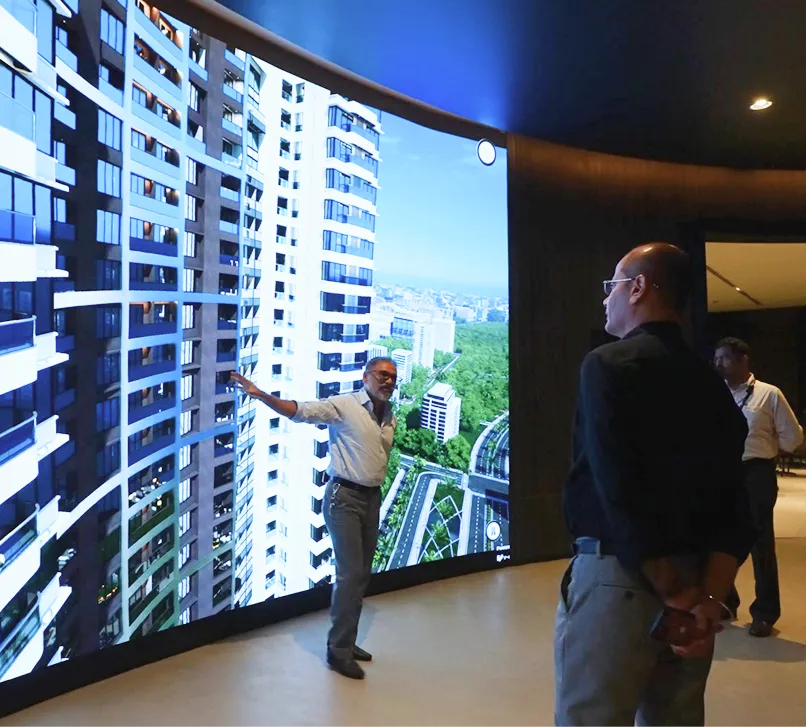
Instead of trying to cross-reference two different PDF floor plans, buyers in an experience centre can use interactive 3D visualisation to toggle between layouts instantly. They can stand in a digital representation of Unit A, check the window views, and then immediately switch to Unit B to see how the perspective changes. Real-time configuration tools allow them to swap out finishes or materials in both units simultaneously, providing a true apples-to-apples comparison.
Platforms like V-Estate are designed to handle this exact requirement. By centralising project data, V-Estate enables sales teams to present interactive property walkthroughs and digital twins that standardise the comparison process. When buyers can explore multiple properties within a single, consistent digital ecosystem, the mental gymnastics of property comparison are entirely removed, allowing them to focus on what they actually prefer.
Structuring the Sales Conversation Around Clarity
Technology provides the framework, but the sales team must guide the experience. To make comparisons easier, sales professionals should actively use interactive tools to isolate variables based on the buyer's stated priorities.
If a buyer is torn between two units and their primary concern is natural light, the sales executive can use interactive tools to simulate the sun path for both units at different times of the day. If the concern is space for a growing family, the focus can shift to toggling floor plan overlays to show the exact difference in bedroom dimensions.
By structuring the presentation around clear, visual evidence rather than subjective descriptions, the sales team shifts from selling to consulting. The buyer feels supported in their decision-making process, leading to higher trust, faster consensus among family members, and a more streamlined path to closing the sale.
Conclusion
Property comparison should never be a test of a buyer’s memory or spatial reasoning skills. When developers and sales teams rely on fragmented, static materials, they inadvertently slow down the sales cycle and invite doubt into the buyer's mind. By adopting consistent visual alignment, contextual mapping, and interactive 3D technologies, real estate professionals can fundamentally change how buyers evaluate their options. Providing a clear, engaging, and accurate comparison experience not only accelerates the decision-making process but also builds the foundation of trust required for a successful real estate transaction.
.jpeg)
%20(1).jpg)