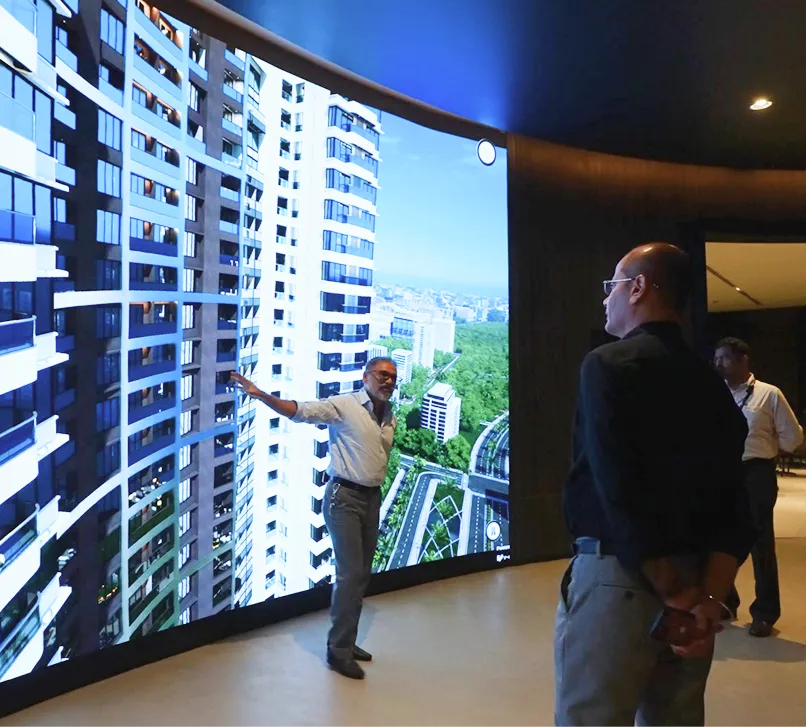
Picture a Saturday afternoon at a premium project experience centre. A prospective buyer has done their online research, visited the site, and expressed genuine interest. The budget aligns, and the location is ideal. The sales executive pulls out a beautifully designed brochure, points to a 2D floor plan, and begins explaining the layout.
Almost immediately, the buyer’s body language changes. They nod along, but their questions become repetitive. "So, where exactly is the second bedroom facing?" or "How close is this tower to the main road?" The conversation, which started with high energy, slows down to a crawl. The buyer ultimately leaves with a polite, "We need some time to think about it."
This scenario plays out daily in real estate offices worldwide. It is not a failure of the sales team, nor is it a lack of interest from the buyer. It is the direct result of property buying journey friction—an invisible barrier that stalls decision-making and extends the sales cycle.
Identifying and removing this friction is becoming a central focus for real estate developers and sales heads who want to accelerate conversions and improve the buyer experience.
What Does Property Buying Journey Friction Look Like?
Friction in real estate sales rarely looks like an outright rejection; it usually disguises itself as hesitation. It is the gap between a buyer’s desire to own a home and their ability to confidently understand what they are actually purchasing.
When buyers search for properties online, the initial phase is frictionless. They can filter by location, budget, and amenities in seconds. However, the friction spikes the moment they transition from casually browsing to actively evaluating a specific unit—especially for under-construction projects.
At this critical juncture, buyers are asked to process a fragmented collection of information: static renders, complex architectural floor plans, master plan PDFs, and verbal explanations of views and sunlight. The friction occurs because synthesizing all these disparate pieces of information requires a massive cognitive effort. When the mental effort required to understand a product outweighs the immediate comfort of making a decision, the human brain defaults to delay.
The Buyer’s Perspective: The Cognitive Overload of 2D Collateral

From the buyer’s point of view, purchasing a property is likely the largest financial commitment they will ever make. They are naturally risk-averse. They do not just want to buy square footage; they want to buy certainty.
When a buyer is presented with traditional 2D collateral, they are essentially being asked to translate an architect’s technical drawing into a lived, spatial reality. They have to mentally construct the walls, estimate the ceiling height, imagine the distance between the kitchen counter and the dining table, and guess what the view from the balcony will actually look like on the 14th floor.
This cognitive overload leads to a deep-seated anxiety. If a buyer cannot accurately visualize the space, a nagging voice tells them they might be making a mistake. What if the living room is darker than expected? What if the master bedroom feels cramped once the furniture is in? This uncertainty is the purest form of property buying journey friction. It forces buyers to seek second opinions, request multiple follow-up site visits, and delay the booking process until they feel secure—a state they may never reach using static brochures alone.
The Sales Perspective: Managing Hesitation Instead of Driving Decisions
For real estate sales teams, this friction acts as a heavy anchor on their productivity and closing ratios.
A high-performing sales professional should spend their time acting as a consultant—understanding the buyer’s lifestyle needs, negotiating terms, and building an emotional connection to the community. Instead, because of the limitations of traditional presentation materials, they are forced to act as translators. They spend the bulk of their presentation time tracing fingers over paper layouts, explaining which way is North, and trying to convince the buyer that a room will fit a king-sized bed.
When sales conversations get bogged down in spatial logistics, the emotional momentum of the purchase is lost. The sales team has to manage continuous objections rooted not in the project's quality, but in the buyer’s lack of comprehension. Furthermore, when buyers leave the experience centre to "think about it," sales teams lose control of the narrative. Following up becomes a difficult exercise in trying to recreate the enthusiasm that faded the moment the buyer looked at a confusing 2D plan.
The Ripple Effect on the Property Sales Cycle

The consequences of this friction extend far beyond a single stalled meeting. When a developer's sales process relies heavily on the buyer’s imagination, the entire business pipeline feels the impact.
First, it diminishes buyer confidence. A confused buyer is a cautious buyer. They are less likely to commit to a premium unit or an upgrade if they cannot physically perceive the value of that upgrade.
Second, it dilutes the overall property understanding. If channel partners and brokers are also struggling to explain the spatial realities of a project using flat PDFs, the project's core selling propositions—whether it is an innovative airflow design, superior natural lighting, or strategic amenity placement—fail to land with the end consumer.
Finally, it degrades the overall buying experience. Purchasing a luxury property should feel sophisticated and reassuring. When buyers feel they are blindly committing to a line drawing, the experience feels transactional and stressful, which can lead to higher cancellation rates even after an initial token advance is paid.
Eliminating Friction Through Interactive Property Visualisation

The most effective way to eliminate property buying journey friction is to remove the cognitive burden from the buyer. Developers must transition from asking buyers to imagine the property to allowing them to experience it.
This shift requires adopting technologies that provide immediate spatial context. Interactive property walkthroughs allow buyers to navigate a true-to-scale digital model of their future home, removing the guesswork out of room sizes and layouts. Interactive maps and digital twins of the master plan allow a buyer to see exactly how their specific tower connects to the clubhouse, the entrance gates, and the surrounding neighborhood.
Floor and view visualisation tools can show a buyer exactly what the sightline will be from a 5th-floor balcony versus a 15th-floor balcony, justifying floor rise premiums with visual evidence rather than verbal promises. When buyers can dynamically filter inventory based on their preferences and instantly see the results in a 3D model, the conversation shifts from confusion to exploration.
This is where platforms like V-Estate provide a practical advantage for real estate teams. By consolidating interactive maps, 3D walkthroughs, and real-time inventory configuration into a single, cohesive interface, V-Estate allows sales teams to guide buyers through a visually accurate, frictionless narrative. Instead of piecing together a mental image from six different documents, the buyer sees exactly what they are purchasing on one screen, significantly accelerating their path to confidence.
Conclusion
Friction in the property buying journey is rarely intentional, but it is deeply costly. It hides in the spaces between 2D floor plans and the buyer’s inability to visualize their future life within those lines.
By recognizing that hesitation is often just a symptom of confusion, developers and sales heads can rethink how they present their assets. Shifting from static, fragmented collateral to unified, interactive property visualisation allows buyers to understand a project instantly. When buyers understand exactly what they are getting, confidence replaces anxiety, sales teams spend less time translating and more time closing, and the entire property buying journey becomes a faster, more reassuring experience.
Ready to remove the friction from your sales process? Explore how V-Estate’s interactive visualisation platform can bring your unbuilt projects to life and help your buyers decide with confidence.