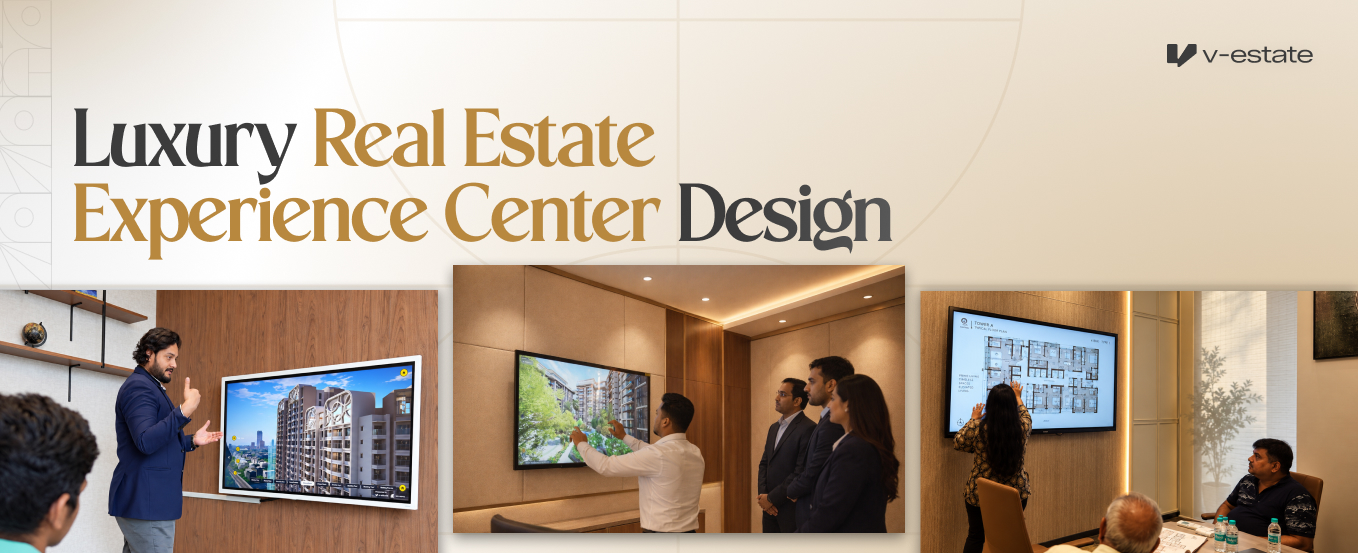
India’s residential real estate market is driving a shift towards luxury and premiumization. Developers need to showcase multiple configurations, amenities, upcoming developments, and the entire masterplan context, even when the property is under construction during sales presentations. Traditionally, this required developers to invest in physical show flats, scale models, and printed materials.
But with the evolving digital ecosystem in real estate sales, a luxury experience centre can bring all these elements together in one cohesive, immersive environment. Through technology-led interactive experiences, developers can streamline their entire buyer sales journey with an increase in buyer engagement time up to 80mins, 75% reduction in printed marketing materials, and even get 30% faster sales closures.
This is the opportunity for developers to reimagine their entire sales journey. One luxury experience centre can showcase multiple configurations, panoramic window views, visualize future connectivity and social infrastructure, and allow sales consultants to personalize their pitches, reducing dependency on traditional sales tools and creating an interactive and scalable sales environment.
What Is a Luxury Real Estate Experience Centre?
A luxury experience centre for real estate is a technology-led immersive sales environment, which helps buyers to get an understanding of the entire property that they might be looking forward to making their future investment in, with an interactive experience, even if that property is in the construction phase.
A luxury property experience centre design brings the entire development into an interactive environment through various digital solutions without any reliance on a physical show flat or scale model. Some of them are as follows:
- Interactive 3D digital twin software
- Immersive VR Walkthrough
- Immersive Motion Posters
- Panoramic Window Views
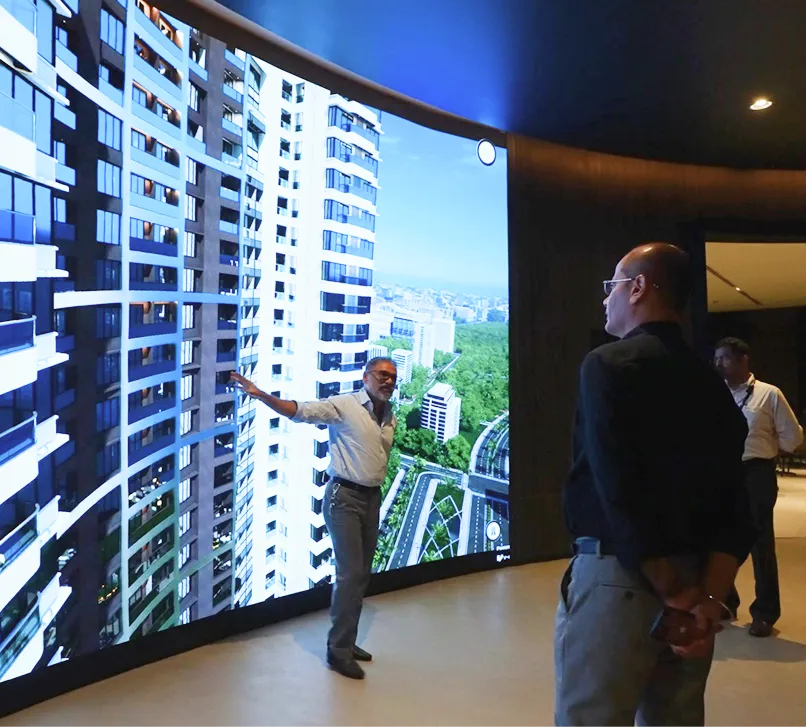
- Large-format immersive LED displays
- Touchscreens, kiosks, interactive tables, and pods
- Holographic visualization
- Anamorphic Experiences
There is a simple commercial objective behind why leading developers are adopting to invest in luxury experience centres: reducing the imagination gap that the developer was trying to sell and buyers were trying to understand earlier via brochures and floor plans.
How Leading Developers Are Rethinking the Costs of Building Showflats
The conventional showflat is designed with the purpose of tangibility and physical representation. But nowadays luxury developments are progressively built around scale, complexity, and choice. That makes the traditional methods more difficult to justify to the buyers.
One Project Can Personify Multiple Configurations
A luxury apartment can have multiple configurations, towers, different floor levels, views, and orientations.
It becomes extremely capital intensive for developers to build an exact representation for every configuration. Hence, a digital sales environment can represent them all within the same footprint.
Physical Spaces Accommodate Hidden Opportunity Cost
In a real estate sales centre, a physical showflat occupies a lot of space for showcasing one single configuration.
That same space can be utilized to create a digitalized experience centre, which can accommodate more sales pods, immersive zones, and an interactive user journey, allowing buyers to explore multiple configurations, amenities, and the entire master plan through one immersive environment.
For example, L&T Realty eliminated the entire need for showflats investing in a complete digital experience centre, while Rustomjee Bay View saw an increase in buyer engagement time from 20 mins to 50 mins with an immersive experience centre. This tells how developers can repurpose their sales centre space more efficiently to improve their sales journeys.
Digital Assets Can Scale and Evolve
There is a defined lifespan and purpose for a physical show apartment.
But digital assets can continuously evolve with projects. More floors and configurations can be added if the project scale gets bigger. Views can be updated. Additions for new amenity spaces can be easily added. The same assets can support channel partner conferences, remote buyer engagement, marketing and PR collaterals, etc.
This makes digital property visualization an infrastructure for real estate sales.
Digital Showflat For Luxury Homes Gives Complete Context Of The Development
A premium homebuyer experience is not just about looking at the apartment interiors with a physical showflat. It goes far beyond it.
Luxury buyers need to understand:
- How does tower orientation affect the apartment experience?
- What are the connectivity options and surrounding neighborhood that has to be offered around the property?
- What are the exact amenity spaces I would have?
- What will the exact window views be from my balcony?
- How will my apartment direction affect vaastu?
A luxury property experience centre can answer all these questions of the buyer with one connected digital journey.
Sales Gallery Can Become a Conviction-Led Decision Environment
With the adoption of digitalized experience centres in real estate, buyers can seamlessly evolve from discovery to evaluation.
Architecture, views, amenities, configurations, and personalized product discussions can all be connected into one immersive sales environment.
This approach is particularly relevant in suburban micro-markets, where developers need to communicate connectivity, lifestyle infrastructure, and the value of upcoming developments before buyers can experience them firsthand.
How V-Estate Replaced the ShowFlat Model with a Digitalized Luxury Experience Centre for L&T Realty
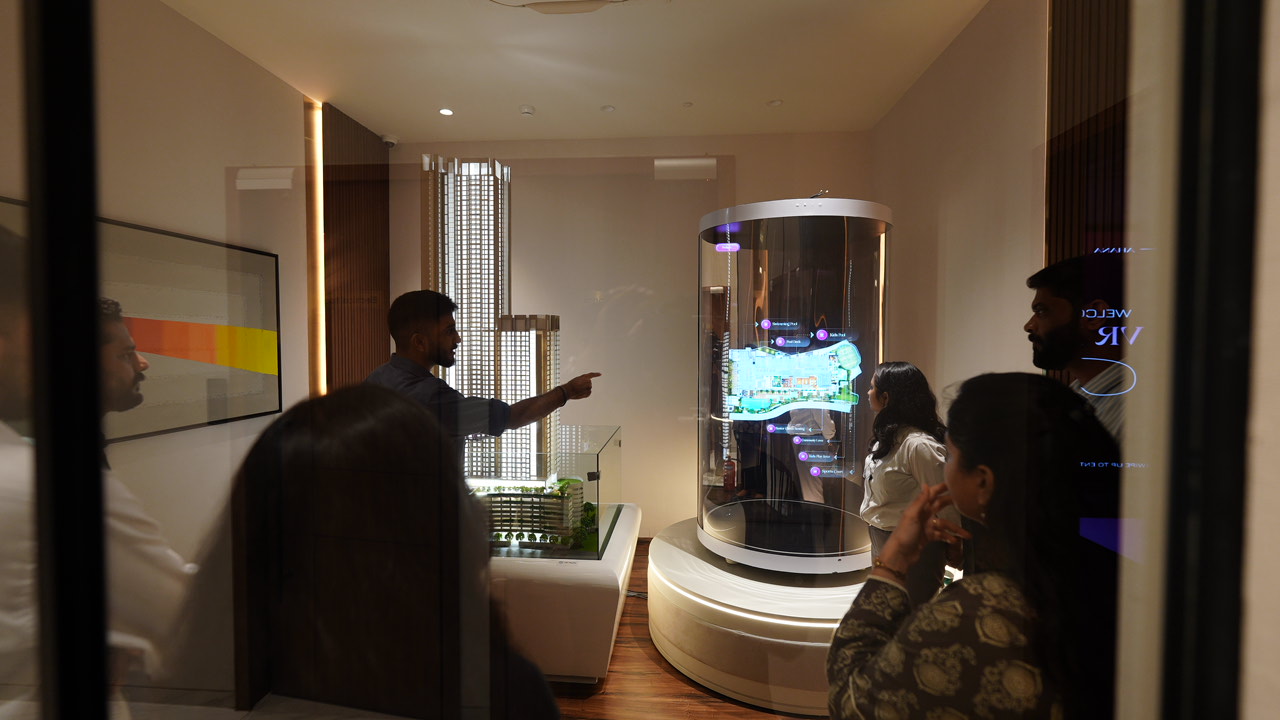
L&T Realty collaborated with V-Estate to engineer the 1st complete digitalized luxury experience centre for the Ahana Project located in Malad, Mumbai, excluding multiple configurations, showflats and all conventional sales methods.
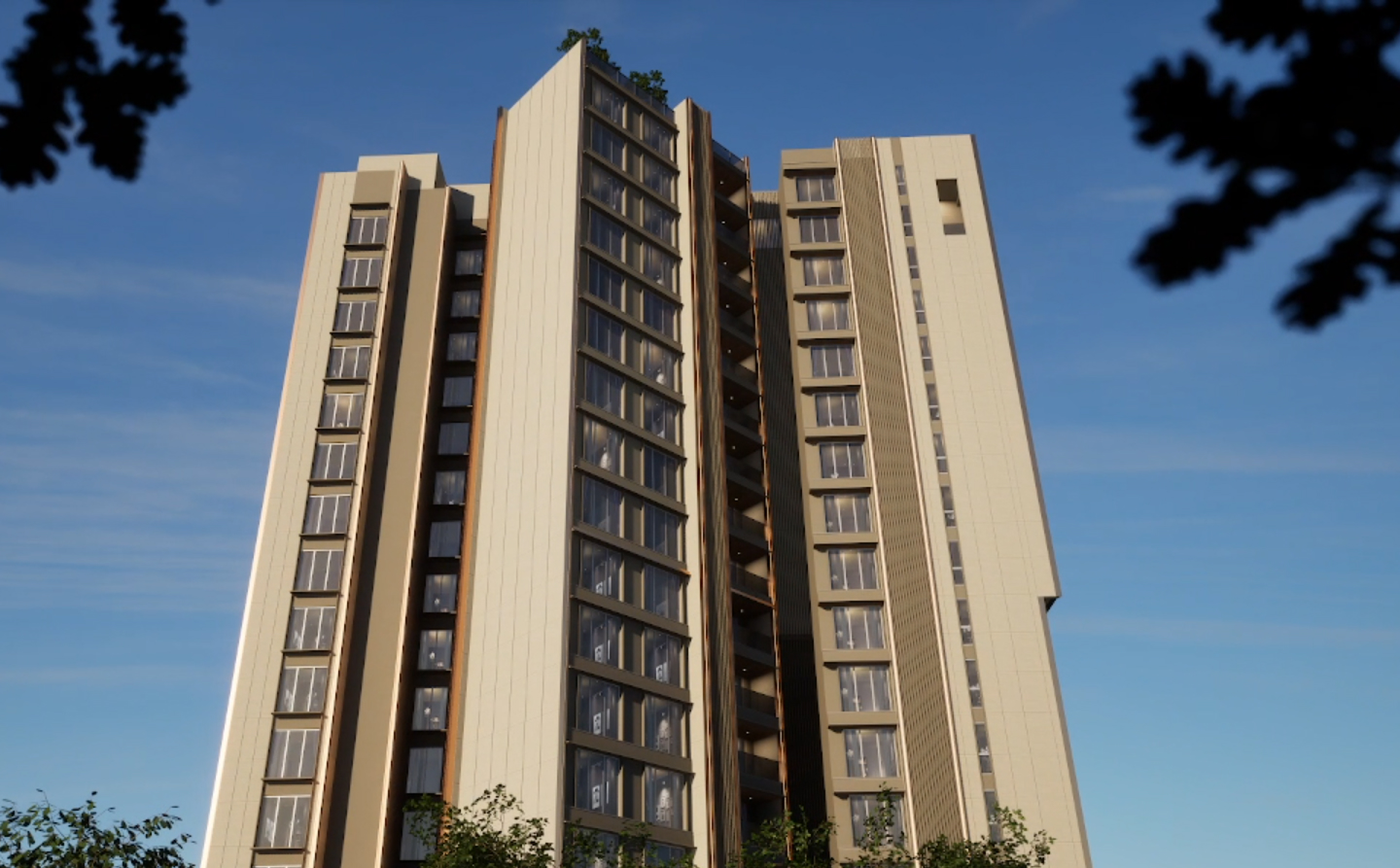
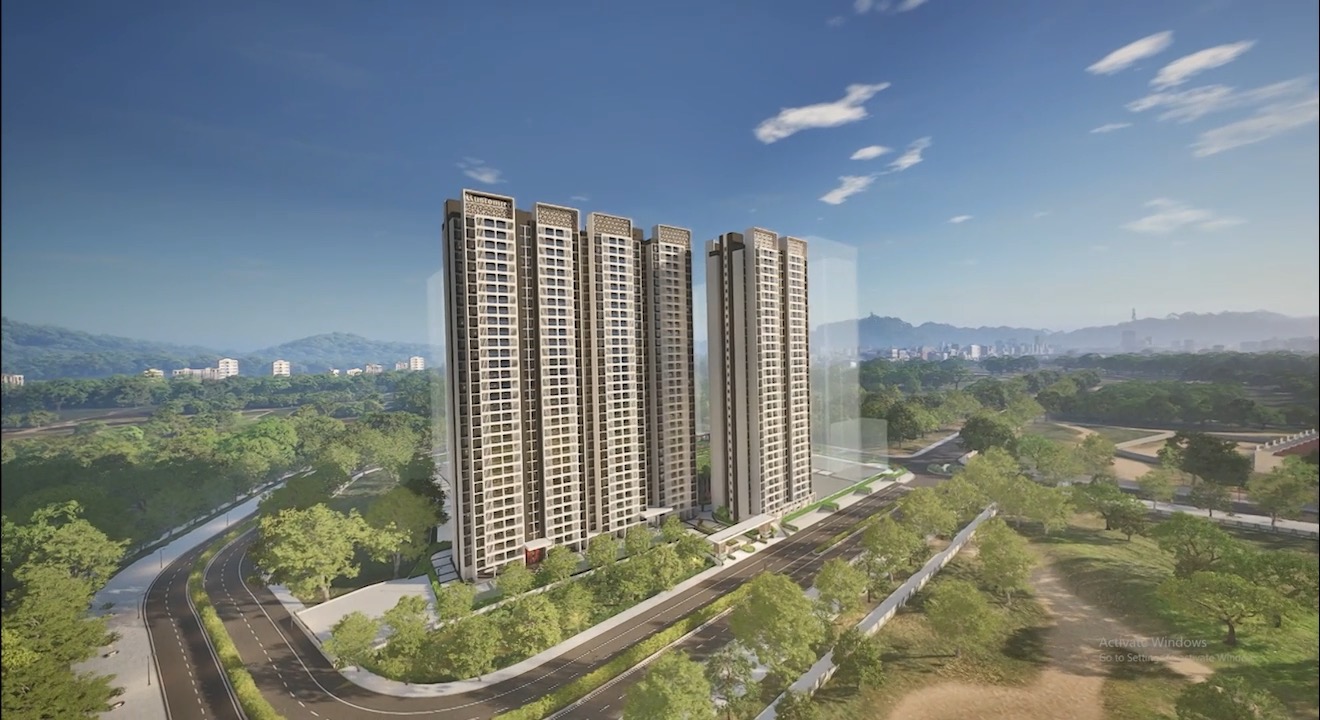
Ahana’s proposition lies around premium residences, strong connectivity, and a comprehensive lifestyle offering, inclusive of 2, 3, and 4 BHK residences, three levels of amenities, and 15,000+ sq. ft. of integrated retail.
L&T’s entire objective for this project was to communicate all of this without creating any physical replica of the apartment or using any conventional methods like AV rooms or static brochures or floor plans.
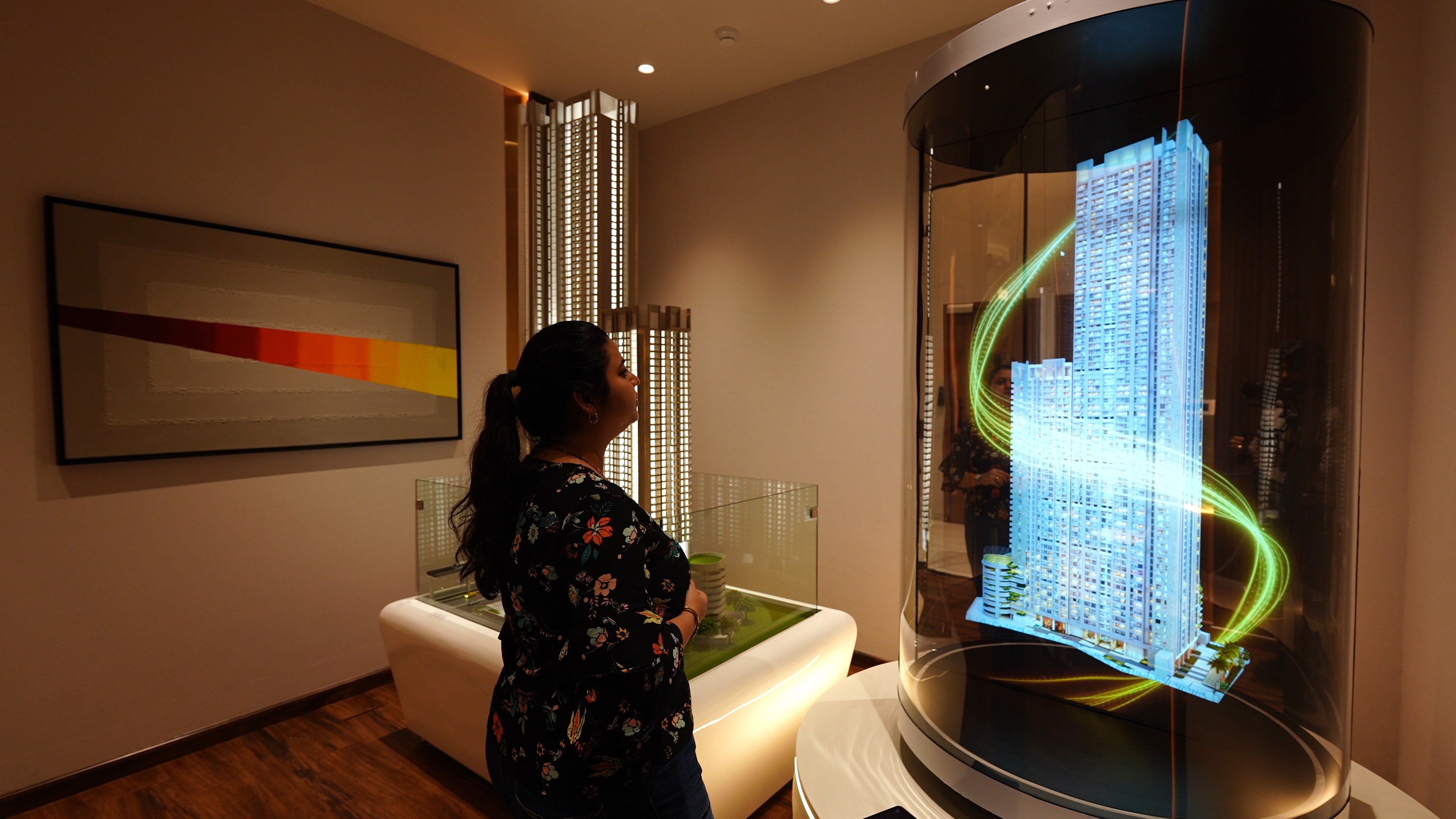
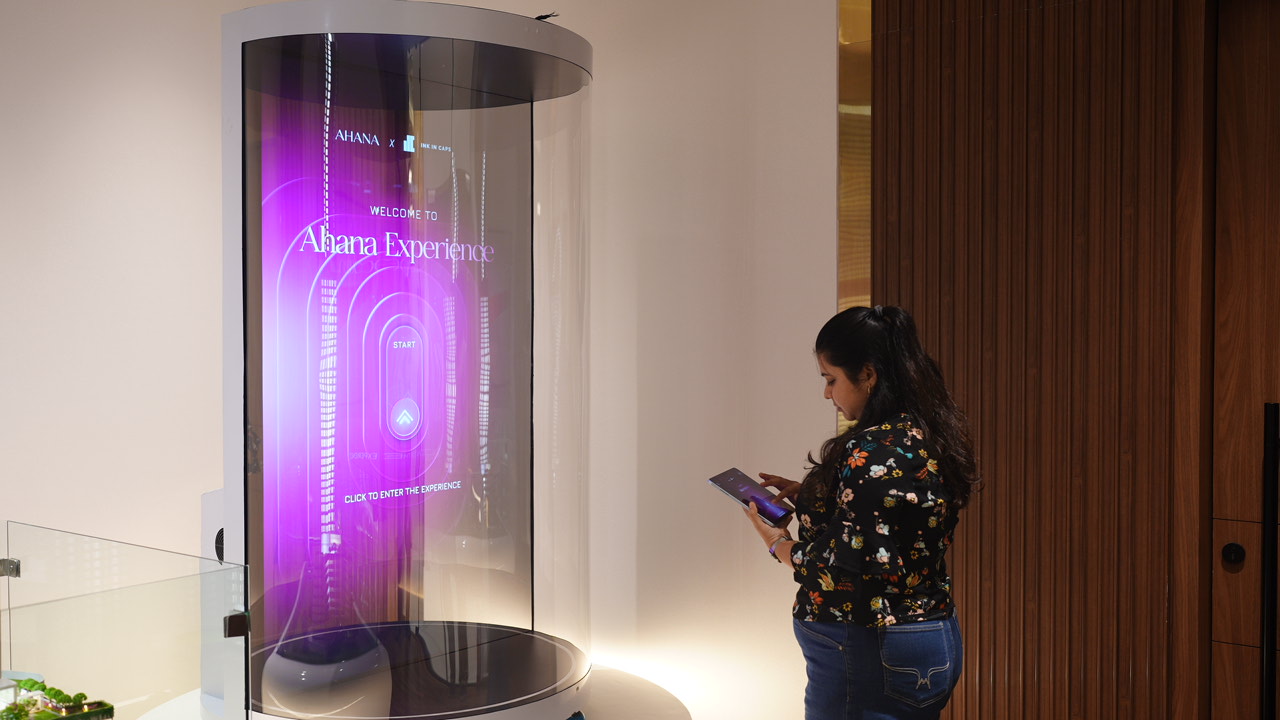
Zone 1: Architectural Holographic Visualization
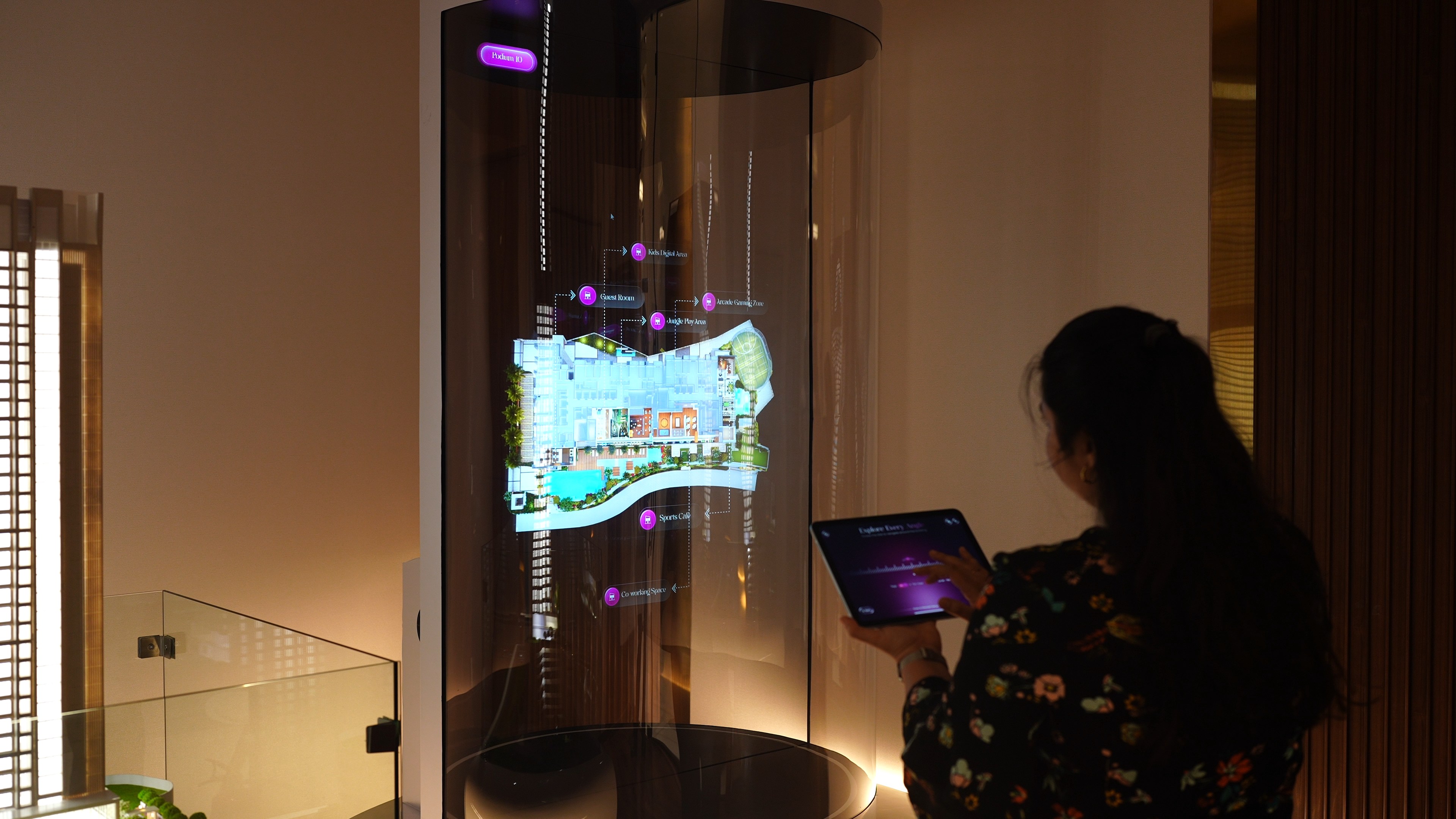
The journey begins with Holotube, a digital alternative to the static scale model.
Business Value: Buyers can explore the project's facade, ground floor, and podium-level amenities through a 360° interactive experience, making architectural details easier and interactive to communicate.
Individual amenity placements are also visualized, giving sales consultants an intuitive way to explain where key spaces sit within the development before moving buyers into deeper lifestyle exploration. Hence, it is allowing the developers to present the overall project more dynamically, improving buyer understanding.
Technical Implementation:
- Custom Unity-based application driving a 265+ image sequence for 360° horizontal rotation.
- Sub-millisecond dialler control through an 11-inch iPad Pro, connected via local WebSocket architecture.
- Motion particles reveal sequences and animated architectural callouts designed in After Effects.
- Interactive UI enabling real-time navigation and control of the HoloTube experience.
Zone 2: Immersive Motion Posters
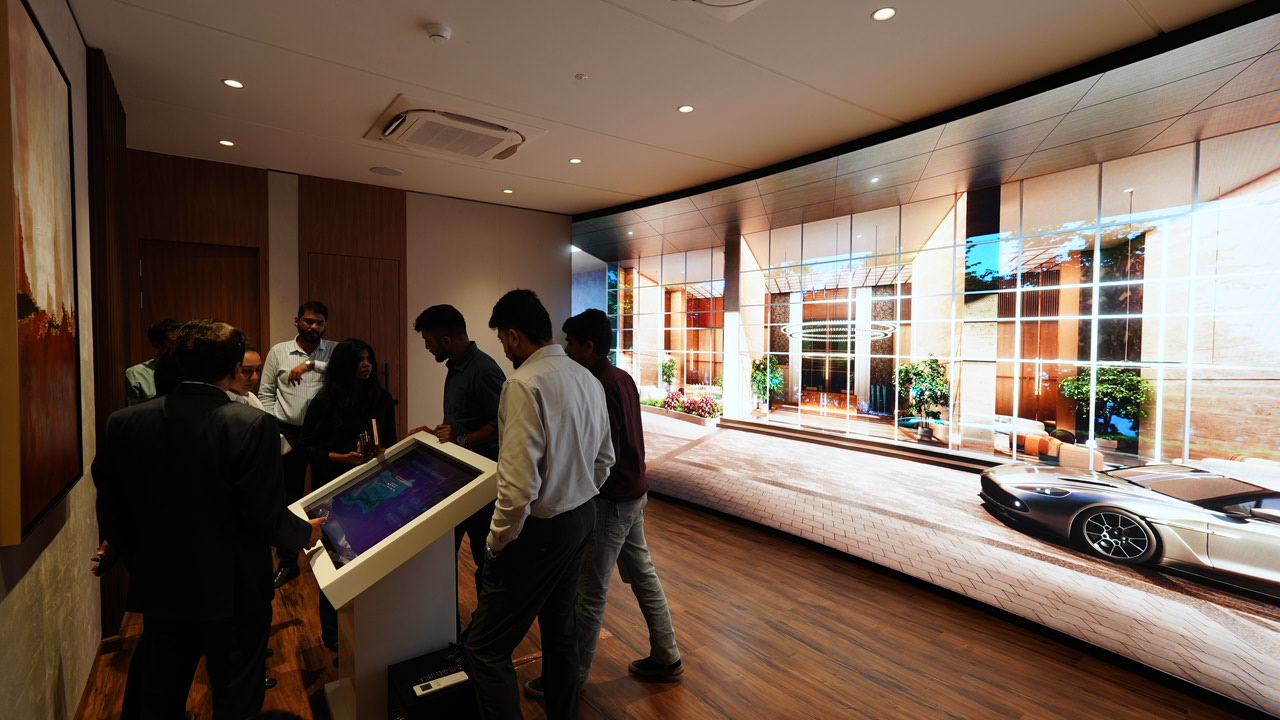
With the second zone, the buyer journey moves into an immersive amenity experience through motion posters, featuring approximately 15 key amenity spaces.
Business Value: Buyers could engage for approximately 20-30 minutes exploring these amenity spaces through large-format presentations, making such recreational spaces feel more immersive and tangible. This helps sales teams to communicate the project value through showcasing the amenities in a more engaging manner. And most importantly, it replaces the need for physical printed mock-ups or brochures.
Technical Implementation:
- Unreal Engine used for motion-poster content and 3ds Max for 360° VR environments.
- Sound design, soothing background music, and ambient environmental sounds added to enhance each amenity experience.
- Visual consistency maintained across both rendering pipelines for a cohesive experience.
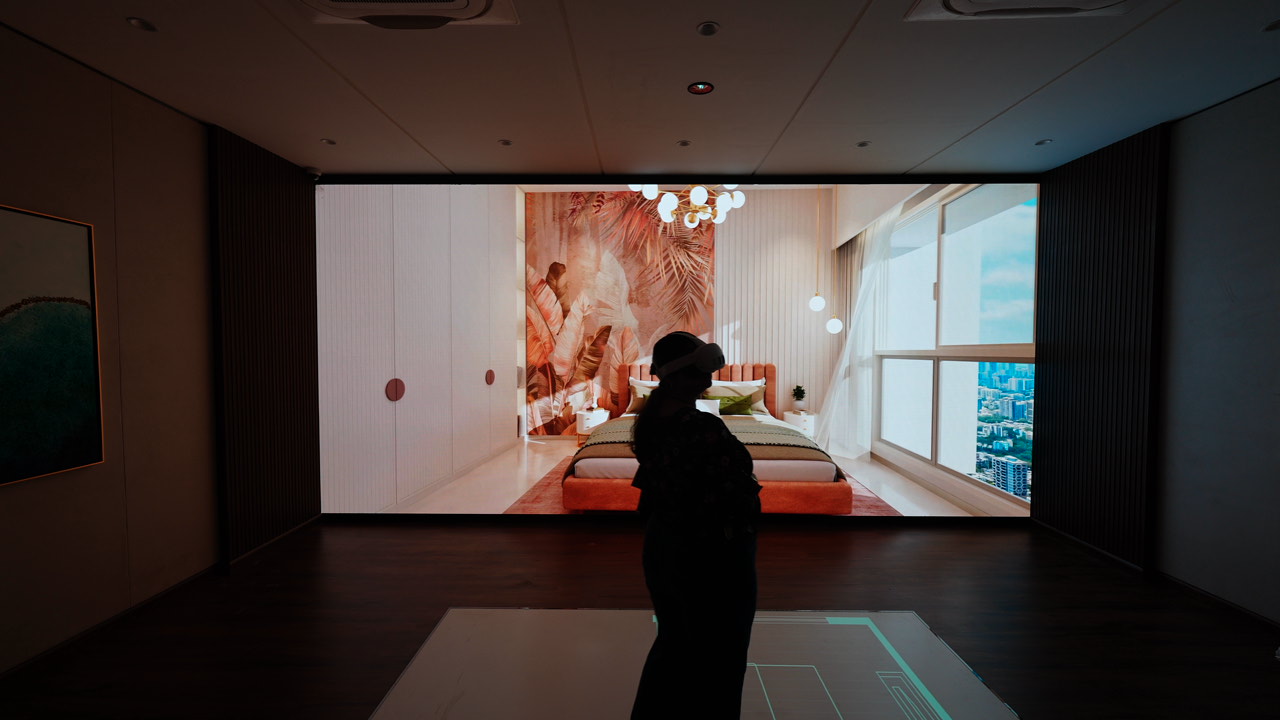
Zone 3: VR Showflat Experience
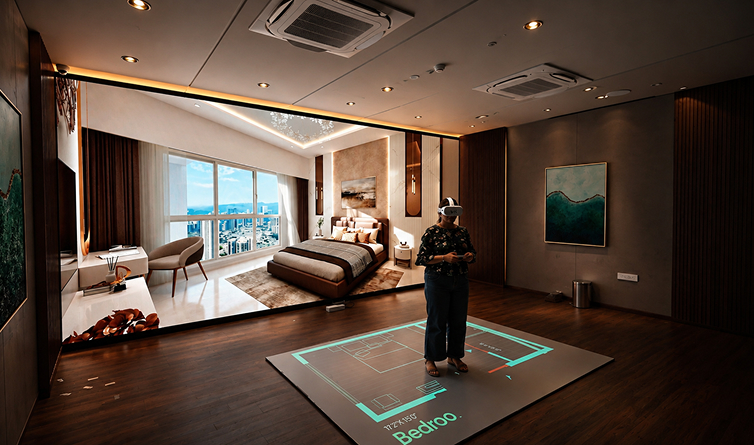
The VR experience addresses one of the significant challenges of building one physical showflat: it can only represent a limited apartment configuration.
With the VR experience created for Ahana buyers, they could step into a visual representation of the residence and explore all 4-direction views: North, South, East, and West.
Business Value:
This acquainted the buyers to completely understand the scale, depth, and spatial experience of an apartment, eliminating the entire need to construct physical interiors for multiple configurations.
The experience enabled sales consultants to cater to high-visitor volumes during peak footfall times over the weekend, allowing several demonstrations together. supporting high velocity sales.
The immersive experience guided all age groups to easily understand the apartment layout, interior spaces, and window views from all directions in an accessible format in real time.
Technical Implementation:
- Multi-client socket server synchronizing Meta Quest VR headsets, an 11-inch iPad control console, an auxiliary LED screen, and 9 ft × 7 ft floor projection mapping.
- 16K stereoscopic rendering pipeline in 3ds Max: delivering true optical depth perception while eliminating standard mono-lens distortion.
- Custom Unity shaders and post-processing layers optimized to replicate high-end PC color grading and dynamic range on mobile VR chipsets.
- Dynamic 4-directional window views across North, South, East, and West, mapped onto 360° spherical plates.
- 8 enterprise VR headsets, with 4 active units and 4 hot-swappable backup units for uninterrupted demonstrations.
Zone 4: Smart Discussion Rooms
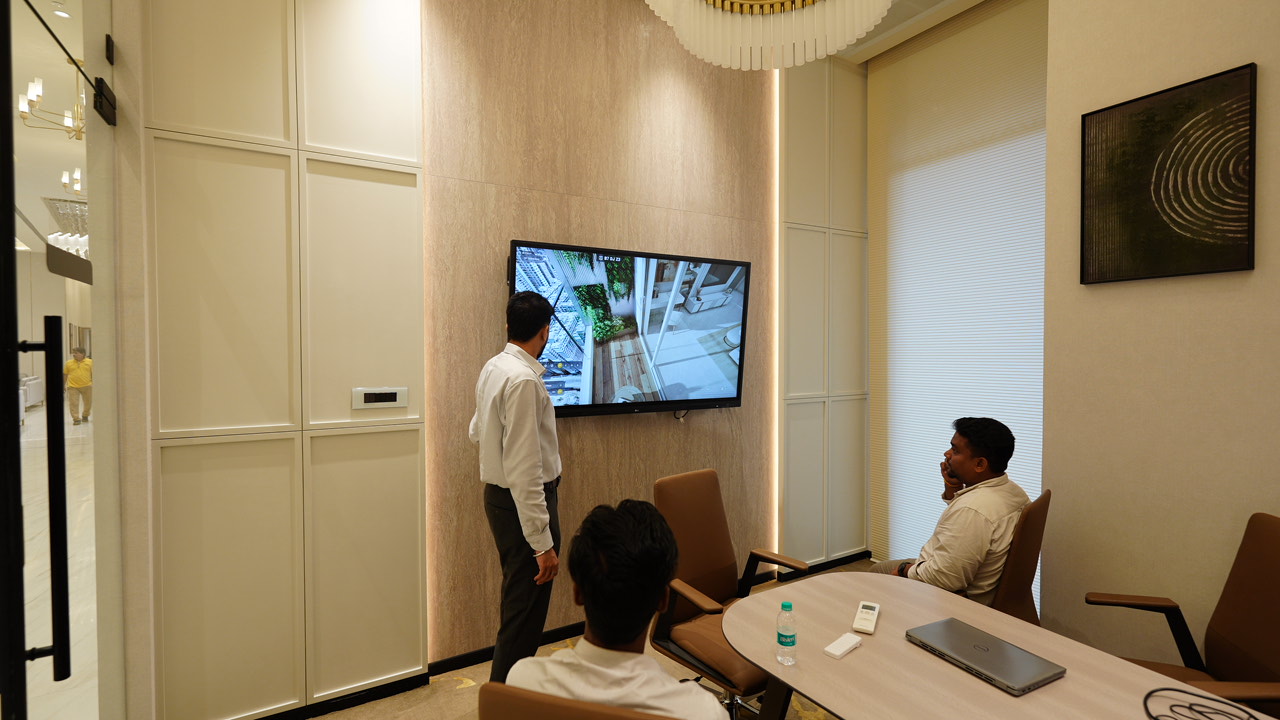
The final stage brings the buyer into the smart discussion rooms, wherein V-Estate’s interactive sales software takes the conversation from project-level understanding to in-depth residential exploration.
The interactive sales software allows sales consultants to showcase the entire property photorealistically in detail, covering exteriors, interiors, amenities, and vicinity.
A key addition is the four-directional view experience, allowing consultants to switch between North, South, East, and West-facing views and give buyers a clearer understanding of the outlook from their selected residence.
The software follows a customized Ahana sales flow, beginning with vicinity to lead the sales story with Ahana’s connectivity and location value and progressing through the project's key lifestyle and residential information.
Technical Implementation:
- 65-inch interactive touchscreens deployed across the sales pods for seamless buyer presentations and navigation.
The Takeaway
For developers the opportunity is far beyond removing the cost of constructing one show flat. It is about rethinking the entire sales infrastructure.
A luxury real estate experience centre gives the opportunity to consolidate multiple physical and digital sales assets into one scalable environment. It can represent multiple configurations and specifications and keep on communicating the entire development, adapting accordingly if the project keeps evolving.
This becomes a strategic decision for developers as the housing market continues to grow towards high-value transactions rather than being a random technological experiment.
Moreover, the future of the premium home buying experience may require fewer physical replicas and a focus on more smart and intelligent digital representation of sales journeys in the real estate industry.
One digital luxury experience centre can potentially sell multiple configurations, towers, and lifestyles without creating physical representations.
That is where the economics of traditional showflats will begin to evolve.
Ready to rethink your entire sales journey with a digital home-buying experience? Book a strategic consultation with V-Estate to explore more.