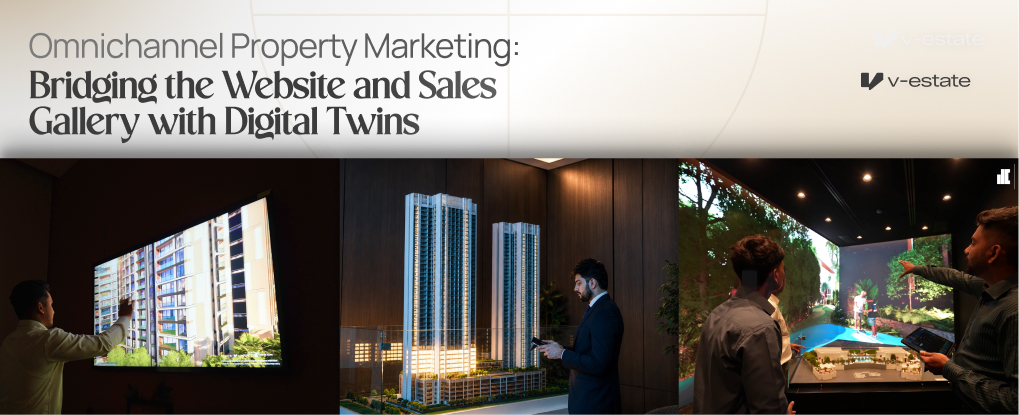
Buying a home rarely begins with a visit to the sales gallery anymore. It often starts late at night, with a buyer comparing floor plans, checking the neighbourhood on a map and trying to imagine what life in the property might actually feel like. But when that same buyer finally walks into the sales gallery, the experience can feel disconnected from everything they have already explored online.
That disconnect is exactly where digital twins in real estate can make a meaningful difference.
The purpose is not simply to put impressive 3D graphics on a large screen. A well-designed digital twin creates a common visual language for the project: one that helps buyers understand the property before the visit and allows the sales consultant to take that understanding much further once they arrive.
For developers, this can turn property marketing from a collection of separate touchpoints into one connected sales experience.
Why Digital Twins in Real Estate Matter in an Omnichannel Buyer Journey
Property discovery is already heavily digital.
A KPMG report on digital interactions in real estate found that 47% of respondents began their home-buying journey by looking for properties online, while 73% used online search during research.
But buying a home rarely ends online.
Especially for premium and under-construction developments, buyers still want to visit the project, meet a consultant, understand the surroundings, compare units and get comfortable with what they are actually purchasing.
This creates a difficult question for developers:
How do you make the digital research journey and the physical sales-gallery journey feel like parts of the same experience?
A digital twin can become that bridge.
Instead of showing one set of renders on the website, another presentation in the gallery and a separate brochure during the sales discussion, the project can be represented as an interactive spatial environment.
The buyer moves from reading about the project to exploring it.
Where a Digital Twin in Real Estate Solves the Traditional Sales-Gallery Problem
Static sales material is useful, but there are questions it struggles to answer.
A floor plan can tell a buyer the dimensions of a room. It cannot easily communicate how that room feels.
A brochure can mention a view. It cannot naturally demonstrate how the view changes between floors.
A location map can show a metro station. It does not always help a buyer intuitively understand the relationship between the development and the neighbourhood.
A digital twin in real estate can bring those questions into one environment.
Depending on the project data available, buyers can explore:
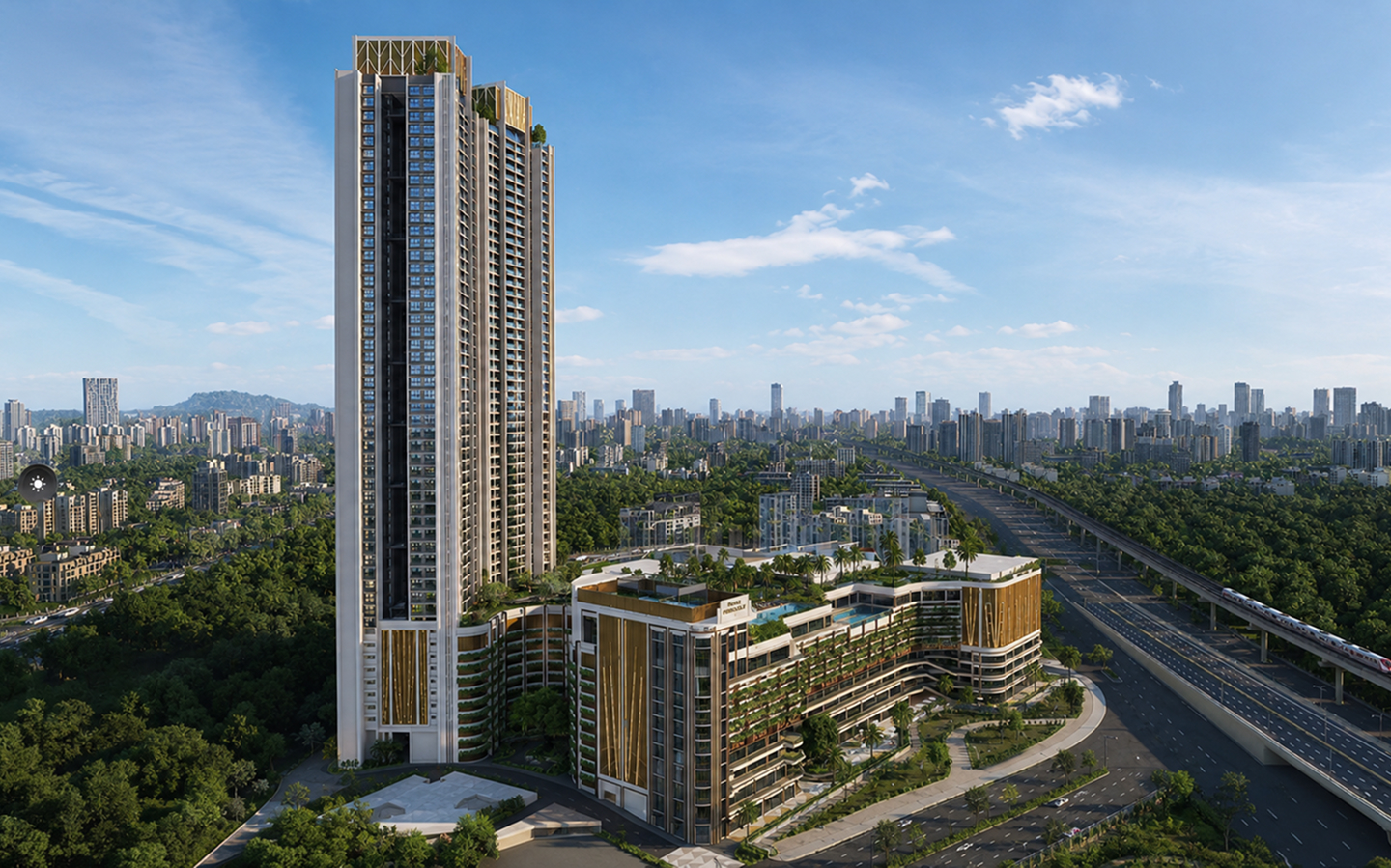
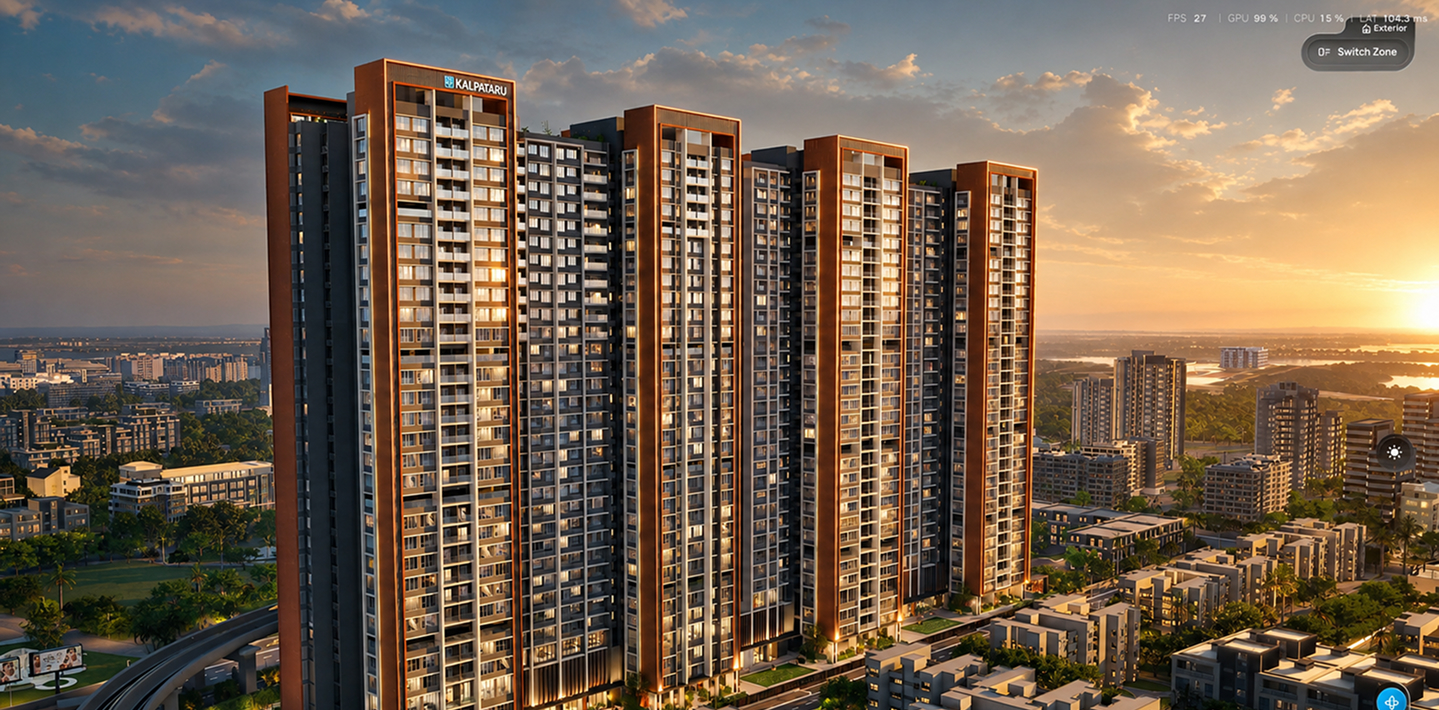
- Tower and façade architecture
- Individual apartment configurations
- Amenities and common areas
- Floor-specific or orientation-specific views
- Natural lighting at different times
- Surrounding landmarks and infrastructure
- Project connectivity and vicinity
- Different towers, wings or unit types
- Interior layouts and spatial relationships
V-Estate's digital twin platform, for example, is designed around architectural representation, neighbourhood context, interactive property discovery and omnichannel accessibility. Buyers can navigate the development while sales teams can filter and present information according to the conversation.
The important distinction is that the technology supports the salesperson rather than trying to replace them.
A Real Estate Digital Twin Should Continue the Conversation, Not Restart It
Think about a buyer arriving after already considering a particular 3 BHK.
The inefficient approach is:
Welcome → generic project presentation → brochure → amenities → model → eventually discuss the 3 BHK.
A better journey is:
Welcome → understand the buyer's preference → open the relevant part of the project → explore the exact configuration → examine views, amenities and locality → discuss the shortlist.
This is where V-Estate's interactive sales software becomes relevant.
Its interactive environment is designed to let consultants move from project-level storytelling into interiors, exteriors, amenities, vicinity, lighting and unit-specific views rather than following a rigid slide presentation. V-Estate states that its Spaci deployments currently support 7,000+ hours of daily demos, 18,000+ enhanced journeys and 43+ active sales pods.
For an omnichannel strategy, that flexibility matters more than simply having another screen in the gallery.
How Digital Twin Technology Fits Into the Property Sales Journey
The most useful implementation begins with the buyer's questions rather than with the technology.
A practical journey could look like this:
1. Discovery before the visit
The buyer encounters the project online and understands its architecture, configurations, location and core proposition.
2. Project orientation at the sales gallery
Instead of repeating everything already available online, the consultant introduces the overall development spatially—its towers, access points, amenities and relationship with the surrounding area.
3. Personalised exploration
Once the consultant understands the buyer's needs, the experience becomes specific.
For example:
- Which configuration suits the family?
- Which tower is preferred?
- Which floor is being considered?
- What does that orientation face?
- Where is the clubhouse?
- How does the apartment relate to the podium?
- What surrounds the project?
4. Validation during the sales discussion
The technology then becomes a reference point while the consultant addresses doubts, compares choices and progresses towards a decision.
This is a far more natural sales conversation than moving repeatedly between PDFs, videos, brochures and static renders.
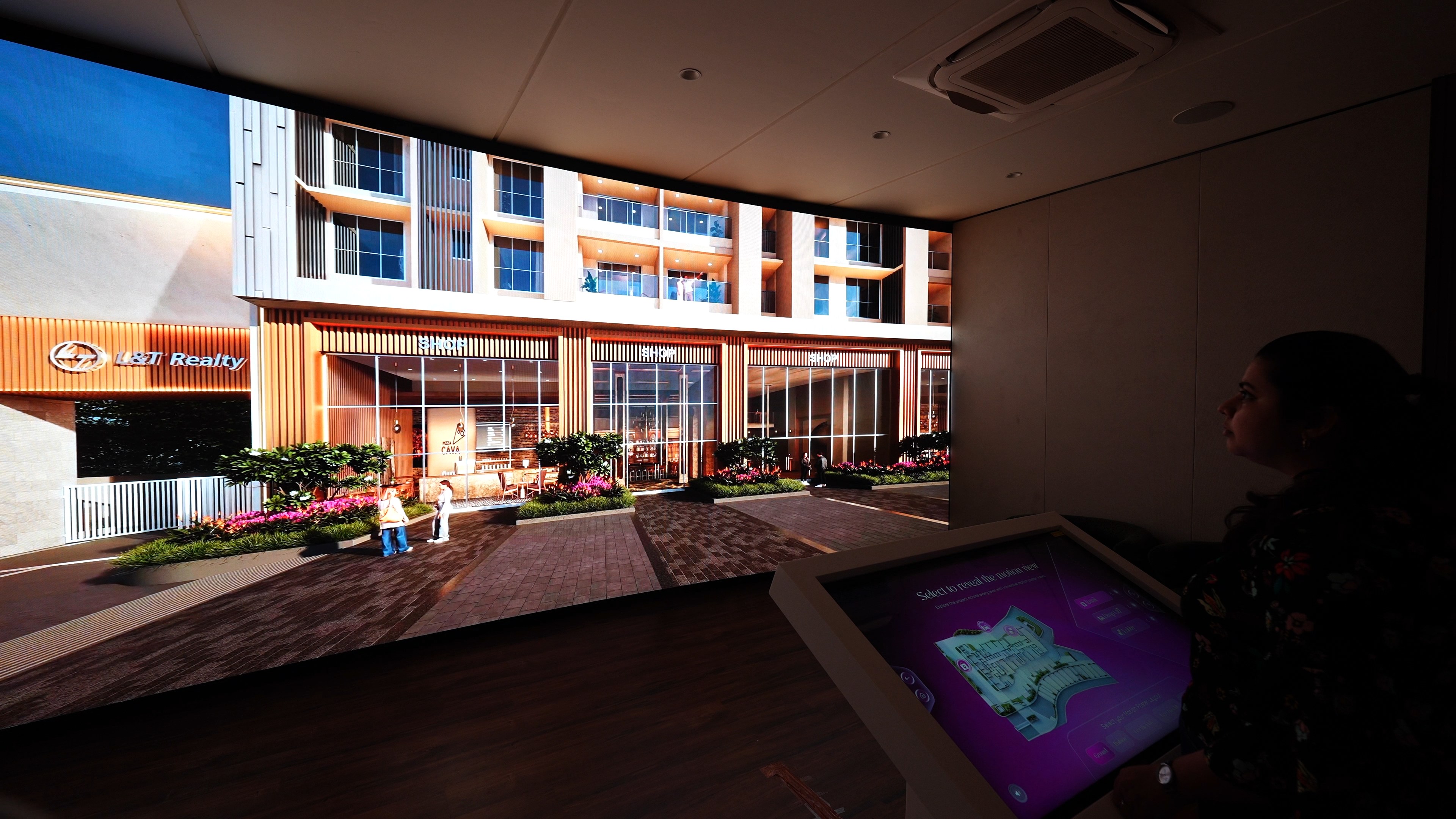
L&T Ahana: Solving a Sales Challenge Without a Physical Show Flat or Scale Model
The L&T Ahana digital real estate experience centre provides a useful example because the challenge was unusually demanding.
L&T Realty wanted to communicate a development centred around connectivity, premium residences and a broad lifestyle offering, including 2, 3 and 4 BHK homes, three levels of amenities and more than 15,000 sq. ft. of integrated retail.
But there was a major constraint:
The experience centre had no conventional physical show flat or scale model.
The buyer therefore needed to understand architecture, amenities, scale, space, finishes, apartment orientation and views largely through digital experiences.
V-Estate designed the journey as a sequence rather than one oversized technology demonstration.
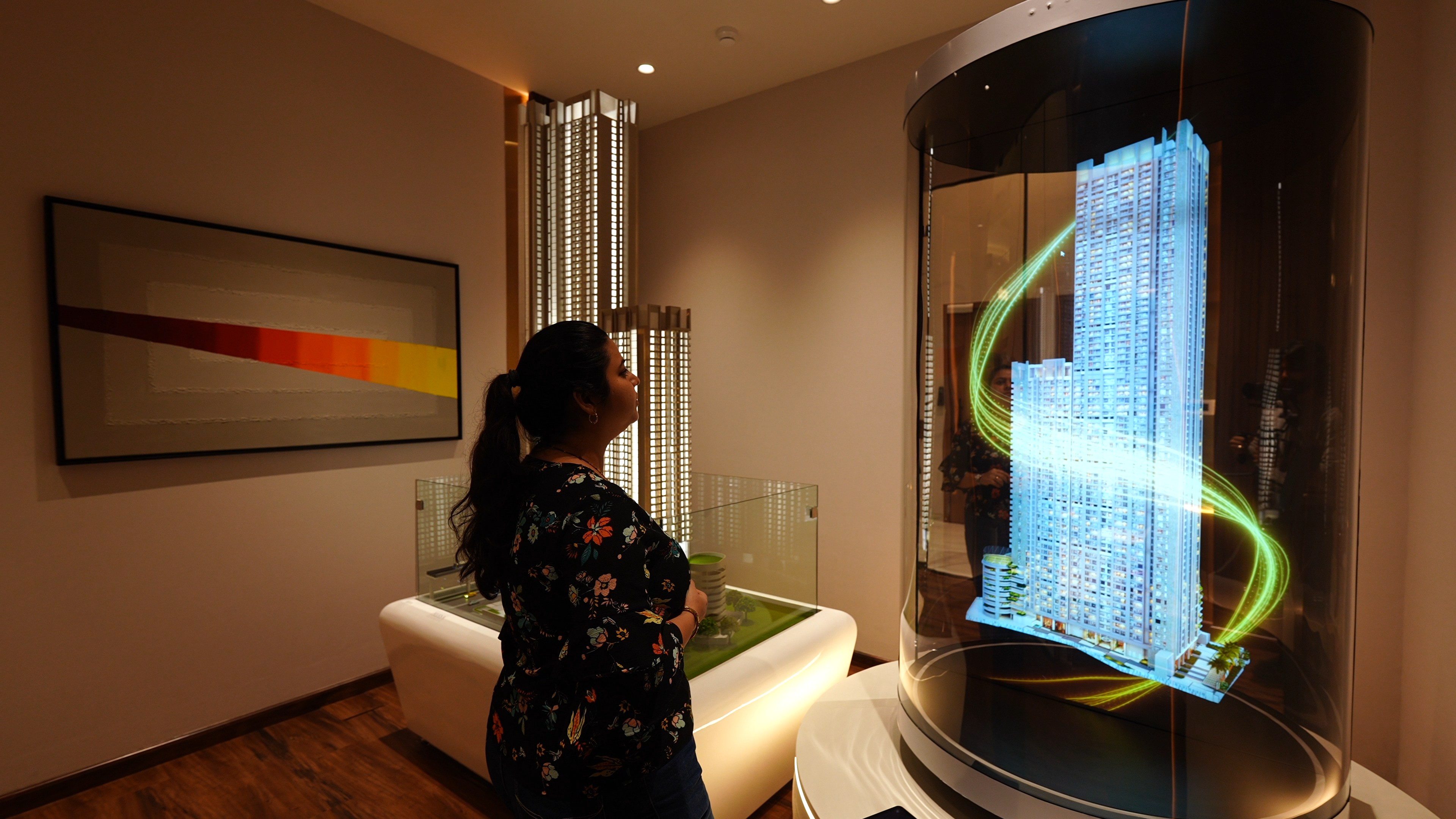
1. Holographic architectural orientation
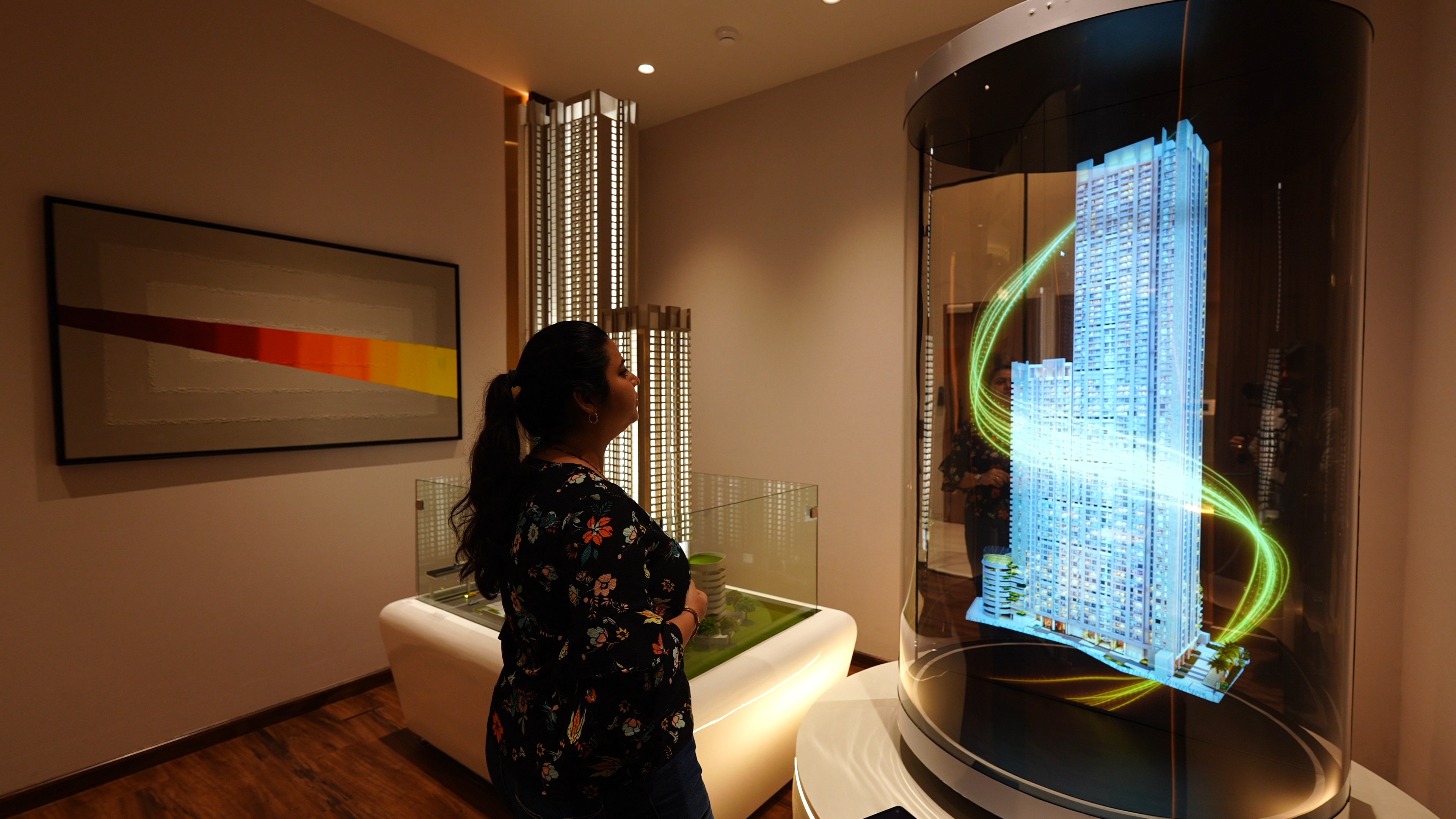
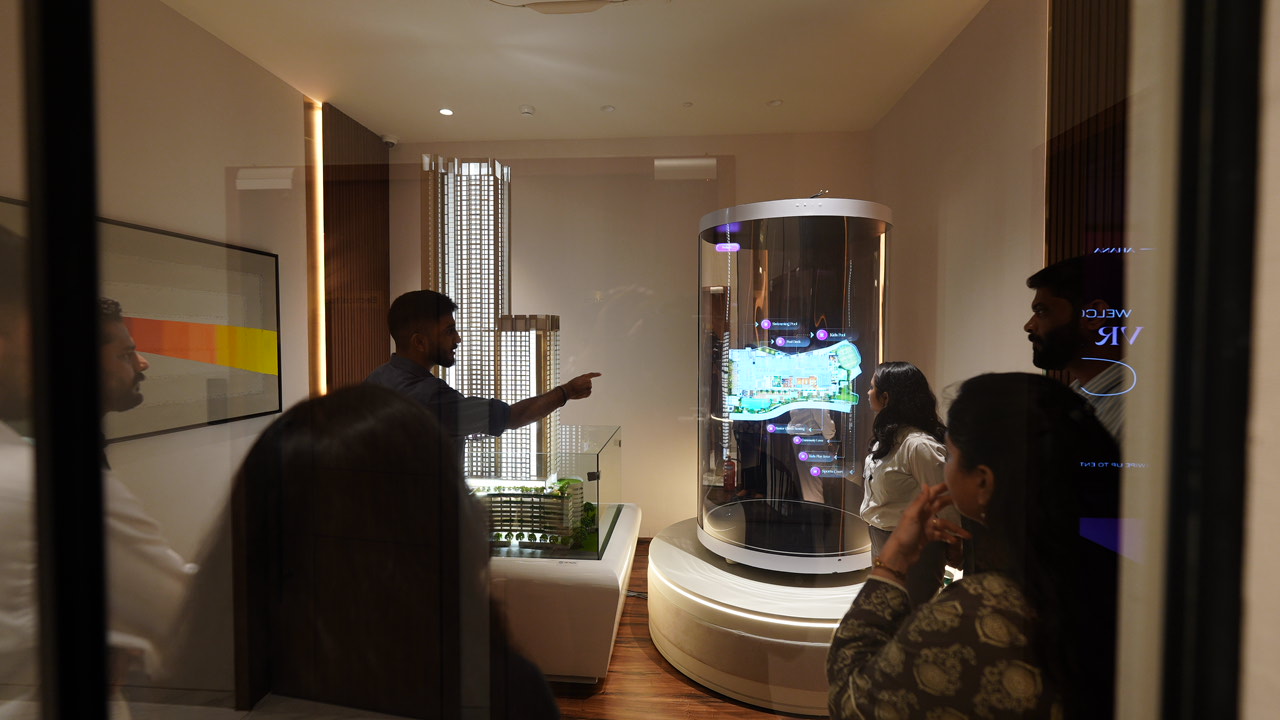
A HoloTube became a digital alternative to the conventional scale model.
It presented the façade, ground level, podium and amenity locations using a custom Unity application, a 265+ image sequence, an 11-inch iPad Pro controller and local WebSocket-based communication.
The buyer first understood the project as a whole.
2. Immersive amenity exploration
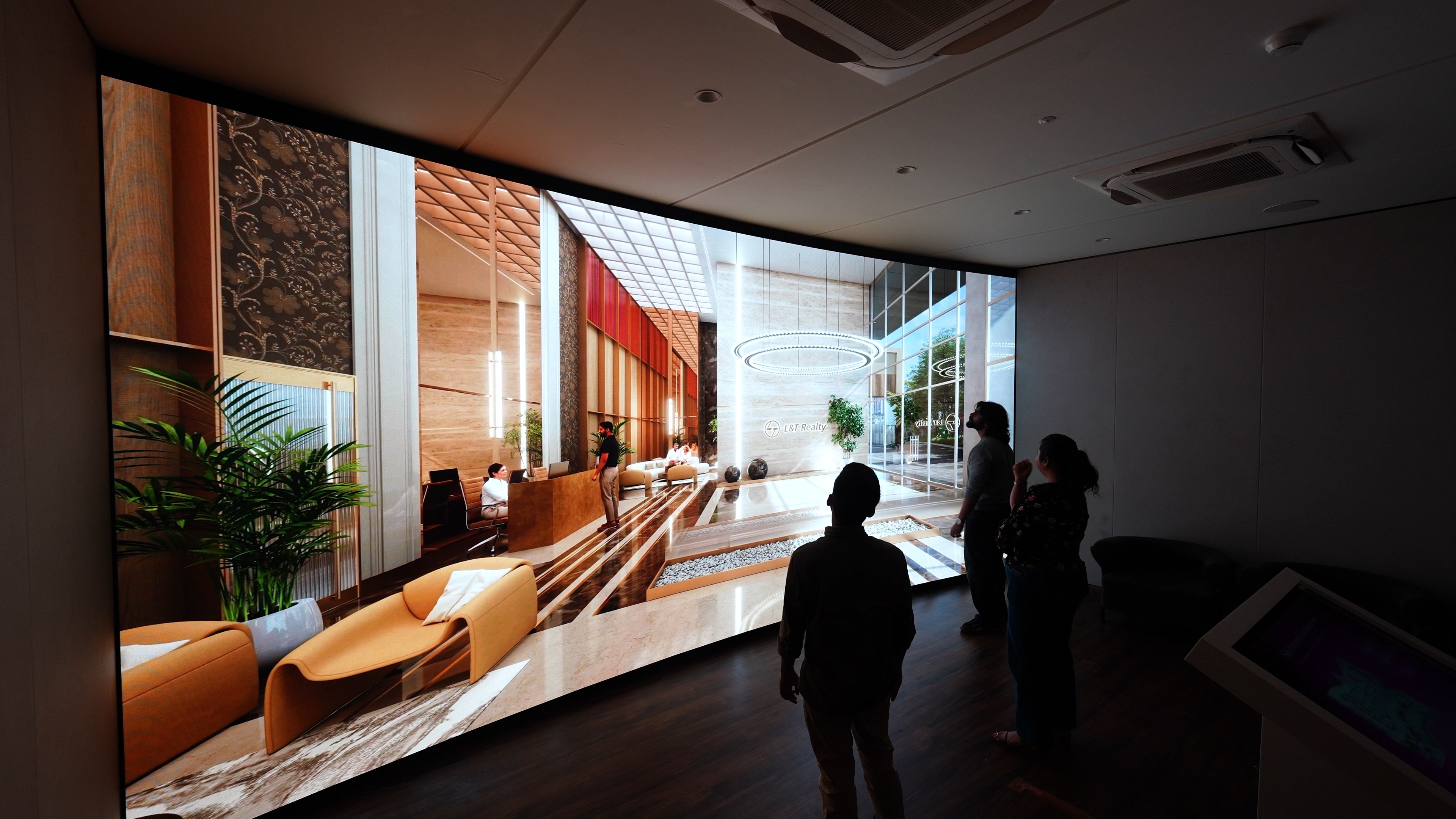
Around 15 amenities were then presented through large-format motion content rather than being reduced to small brochure images.
The technical pipeline included Unreal Engine, 3ds Max, 16K rendering and environmental sound design.
3. VR as the digital show flat
The next problem was more personal: What will the home actually feel like?
A VR experience allowed buyers to understand depth and scale more directly while also viewing the outlook towards the north, south, east and west.
The setup synchronised Meta Quest headsets, an iPad control console, an auxiliary LED display and 9 ft × 7 ft floor projection, supported by 16K stereoscopic content.
4. The sales conversation becomes specific
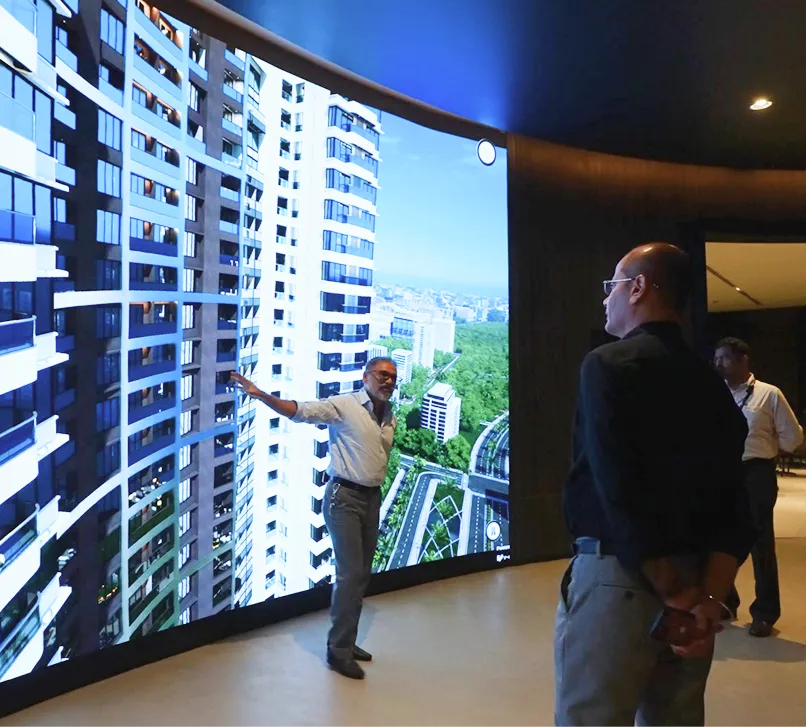
Finally, buyers entered smart discussion rooms equipped with V-Estate's interactive sales software.
65-inch touchscreens allowed consultants to explore residences across the towers, while a 5 km interactive vicinity map helped explain the project's connectivity before moving into amenities, interiors and apartment-specific directional views.
This is the real value of omnichannel property marketing: each interaction answers the next question instead of repeating the previous one.
What Were the Verified Results?
The Ahana case study reports:
- 100+ VR demonstrations during the opening weekends
- 100% participation in the VR experience, including senior buyers
- Zero physical show-flat requirement
- 30+ minutes of buyer engagement with the immersive amenity experience
- 15+ amenities visualised
- Four directional apartment views covering north, south, east and west
Internal project feedback also indicated that the VR experience gave buyers a stronger understanding of the finished residence.
That matters because property assessment itself carries significant weight in brand perception: KPMG's India CX Report 2025 found that 44% of residential real-estate customers considered the property-assessment experience the most impactful stage in shaping their overall perception of a brand.
Which Projects Benefit Most from a Digital Twin Platform?
Not every development needs the same level of visualisation.
A digital twin platform becomes particularly valuable when:
- The project is being sold before completion.
- Multiple towers and unit combinations need explanation.
- Floor-specific views influence purchase decisions.
- The physical show flat cannot represent every configuration.
- Amenities are a major part of the value proposition.
- Location and connectivity require more than a conventional map.
- Buyers include NRIs or customers who begin their journey remotely.
- Premium pricing demands stronger product understanding.
The more complex the development, the more useful a navigable project model can become.
What Developers Should Plan Before Deploying Digital Twin Technology
Technology alone will not fix a fragmented sales process.
Before implementing digital twin technology, developers should establish:
Accurate source material: Architectural models, plans, finishes, landscaping, views and vicinity information need to be reliable.
A defined sales journey: Decide what buyers should understand first, second and third.
Hardware planning: Touch displays, high-performance systems, VR devices and networking need to match the experience.
Sales-team training: Consultants must know how to navigate the system conversationally rather than turning it into another presentation deck.
Content governance: Design changes, inventory information and approved project details need a clear update process.
There are limitations too. High-fidelity digital twins require preparation, production time, appropriate hardware and disciplined source-data management. Academic research also notes that digital-twin adoption in the built environment remains relatively early and continues to face implementation challenges.
So the goal should never be technology for its own sake.
The goal is better understanding.
Digital Twins in Real Estate Should Make a Complex Purchase Feel Clearer
A homebuyer does not arrive at a sales gallery asking to see technology.
They arrive wondering:
Is this the right home?
Will my family be comfortable here?
What will I see from my window?
How far is the metro?
Does this floor make sense?
Can I actually picture myself living here?
The best digital twins in real estate help a sales team answer those questions with greater clarity.
That is the opportunity for developers: not simply digitising the sales gallery, but connecting every stage of property discovery into one coherent experience.
Bring Your Project Into One Connected Sales Experience
If your website tells one story, your sales gallery tells another and your consultants have to bridge the gap manually, the problem is not a lack of marketing material. It is a lack of continuity.
V-Estate helps developers turn architectural data into interactive property experiences designed for real-world sales conversations from digital twins and 3D walkthroughs to complete physical experience-centre activations.
Make the next site visit more than a presentation. Make it the moment the buyer finally understands the property.