Market visibility no longer depends on marketing budget alone. Buyer confidence drives purchase decisions. Smaller developers now compete by delivering clear, predictable offline sales experiences that eliminate uncertainty and accelerate conversions.
The Market Reality for Smaller Developers
Three constraints limit growth for emerging developers:
Brand recognition gaps. Established players dominate buyer recall. New entrants struggle to build trust quickly.
Lower footfall per project. Fewer site visits mean fewer opportunities to convert interest into contracts.
Rising acquisition costs. Each qualified lead costs more. Marketing spend grows without proportional return.
Traditional tactics no longer work. Print ads, static brochures, and weekend open houses fail to answer fundamental buyer questions. Modern buyers demand specific answers before committing time or money.
What Buyers Actually Need Before They Commit
Purchase decisions stall when buyers cannot visualize outcomes. Three critical gaps block conversions:
Visual uncertainty. Static renders and floor plans do not show actual sightlines, window views, or spatial proportions.
Contextual gaps. Buyers cannot assess daylight behavior, amenity proximity, or surrounding infrastructure development.
Personalization limits. Sample flats offer one fixed design. Buyers cannot test alternate finishes or furniture layouts.
Without answers to these questions, prospects defer decisions. They visit competitor projects with better visualization tools or larger marketing budgets.
The Offline Activation Advantage
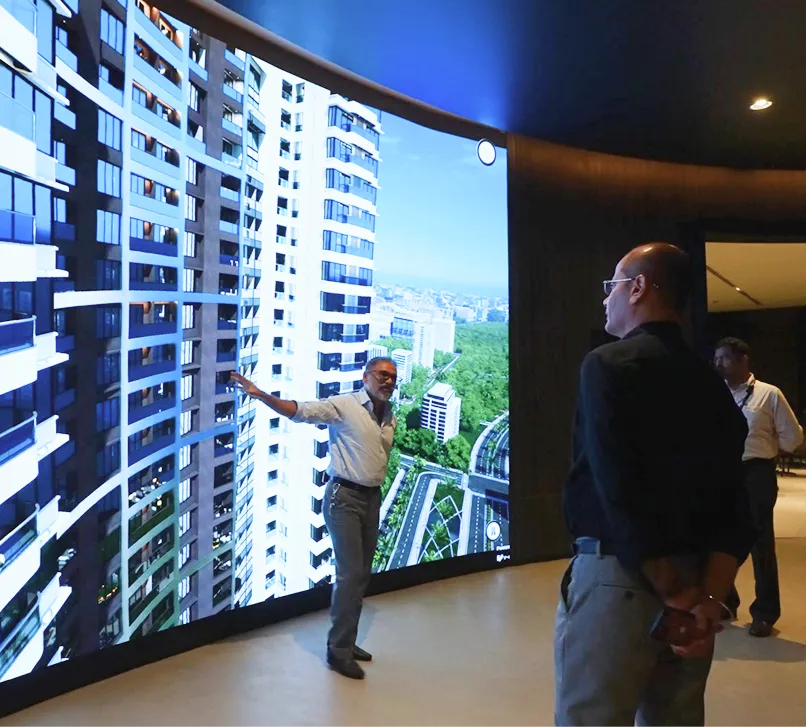
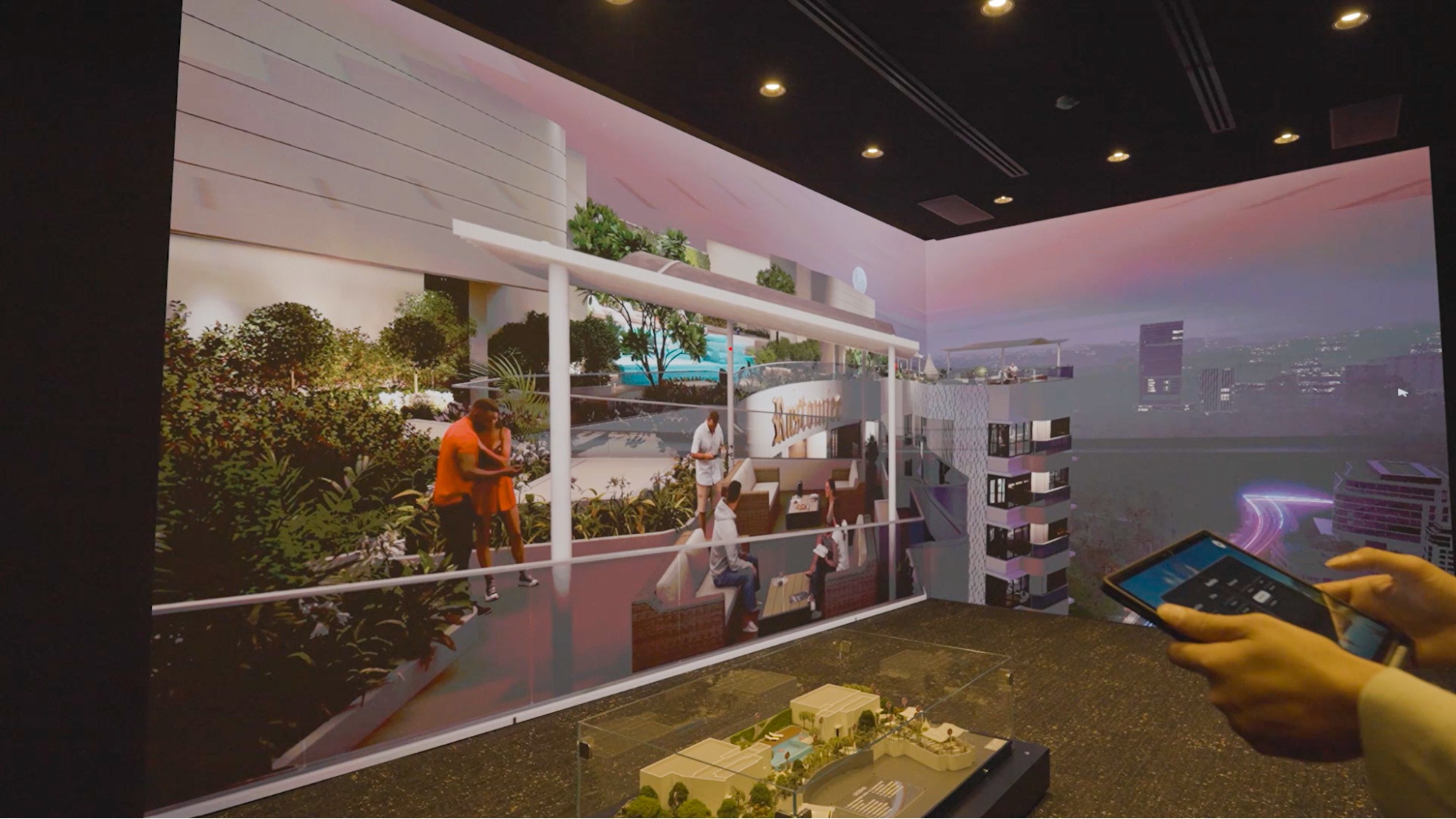
Experience-led selling converts passive interest into active decision-making. An immersive, buyer-controlled activation placed inside a sales center or showroom removes guesswork.
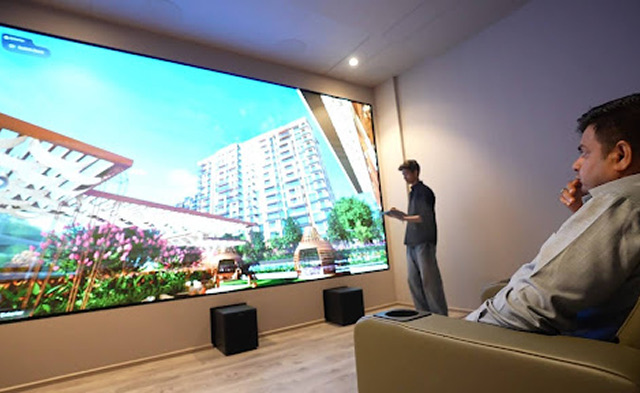
This approach targets decision confidence directly. Prospects interact with photorealistic property representations, test customization options, and explore amenities at their own pace. Sales teams guide without pressuring. Buyers leave with clarity, not confusion.
V-estate operates as an offline activation tool. It recreates complete property environments inside controlled sales spaces. No internet dependency. No device switching. One continuous experience.
The Core Problem This Solves
Leads arrive curious but uncommitted. They need high confidence before investing time in site visits or documentation.
Traditional sales tools—printed brochures, scaled models, sample flats—provide limited context. Buyers cannot see their specific unit view, test finish options, or understand amenity layouts.
Result: Extended sales cycles. Lower conversion rates. Higher lead wastage.
An immersive offline activation removes friction. Buyers form judgments faster. Sales teams capture intent signals earlier. Follow-up becomes data-driven rather than speculative.
How V-estate Functions as a Sales Enablement Tool
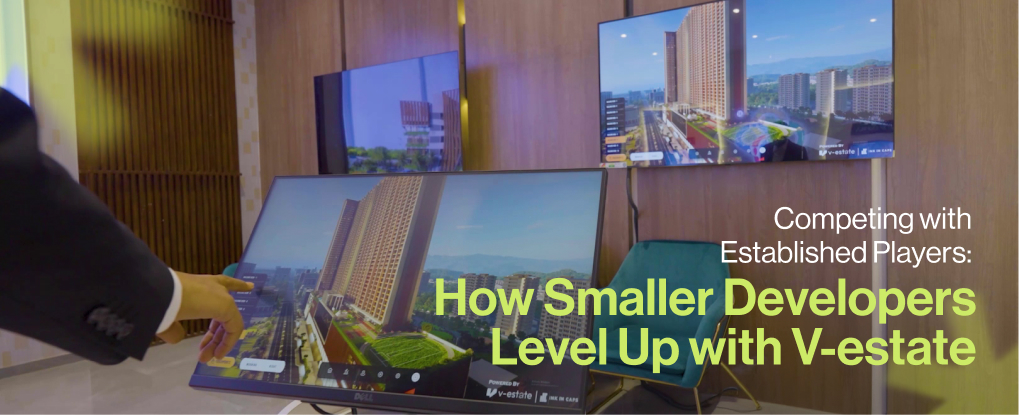
V-estate delivers photorealistic 3D virtual show flats inside developer showrooms. Buyers control the experience using simple interfaces. Sales executives guide when needed but do not interrupt exploration.
Key capabilities include:
Accurate window views. Exact sightlines from each unit showing real surrounding context.
Real-time finish customization. Swap wall colors, flooring, fixtures, and furniture instantly to test preferences.
Amenity mapping. Visual overlay of existing infrastructure plus upcoming projects for connectivity planning.
Dynamic lighting and weather simulation. View the same unit at different times of day and seasons to understand natural light behavior.
Guided navigation with buyer control. Sales teams set starting points. Buyers explore freely without restrictive scripting.
Lead behavior analytics. Track which features buyers engage with, how long they spend in each area, and where interest drops.
Offline-first architecture. Full functionality without internet dependency ensures consistent performance inside showrooms.
Measurable Business Outcomes
Properly implemented offline activations generate quantifiable improvements:
Higher visit-to-sale conversion. Qualified prospects convert faster when visualization gaps close.
Shorter sales cycles. Buyers form purchase decisions in fewer interactions.
Lower cost per qualified lead. Marketing spend efficiency improves as lead quality rises.
Improved buyer retention. Accurate expectation-setting reduces post-purchase dissatisfaction.
Data-driven follow-up. In-tour behavior signals inform personalized sales outreach.
Measure baseline metrics before implementation. Compare visit-to-conversion rates, average days-to-contract, and marketing cost-per-lead after activation rollout.
Implementation Steps for Development Teams
Define priority units and target buyer segments. Focus activation design on high-value inventory first.
Prepare required assets. Gather floor plans, elevations, facade details, and approved finish palettes.
Select installation location. Sales suite, experience center, or temporary mall activation space.
Design buyer journey flows. Create scripted demo paths for sales staff and self-guided exploration modes for prospects.
Integrate analytics tracking. Capture session duration, feature engagement, and content drop-off points.
Train sales teams. Equip staff to manage buyer-led experiences and interpret behavioral signals.
Run pilot activation. Test for 4–6 weeks on one project. Compare performance against baseline metrics.
Strategic Fit for Marketing and Sales Leaders
This is not a digital marketing replacement. V-estate functions as a sales enablement layer that converts marketing-generated interest into signed contracts.
Use offline activations to:
Differentiate small projects during competitive launch windows. Stand out when larger competitors dominate traditional channels.
Reduce dependence on expensive physical staging. Virtual show flats eliminate build-out costs and allow unlimited design variations.
Standardize buyer experiences across locations. Ensure consistent quality regardless of which sales executive conducts the tour.
Credibility and Disclosure Standards
Maintain factual communication during buyer interactions:
Present simulations as representations, not guarantees. Clearly state any assumptions used in view generation or amenity timelines.
Use analytics for follow-up optimization, not deterministic predictions. Behavior signals inform outreach strategy but do not guarantee buyer intent.
Disclose simulation limitations upfront. Build trust through transparency rather than overselling capabilities.
Next Steps for Decision-Makers
Assemble a cross-functional pilot team including sales, marketing, and operations stakeholders. Start with one project and one showroom location.
Measure conversion lift, buyer feedback quality, and sales cycle duration. If results show improved decision velocity and lead quality, expand activation across future launches.
Request an implementation brief detailing required assets, typical deployment costs, and an 8-week rollout timeline. Convert this concept into operational milestones with measurable pilot outcomes.
Market leadership no longer requires the largest budget. It requires the clearest path to buyer confidence. Offline activation tools level the playing field for developers ready to compete on experience quality rather than brand legacy alone.
.jpeg)
.jpg)
%20(1).jpg)