.jpg)
Let's be honest. For decades, the real estate sales journey has been stuck in a rut. You walk into a sales gallery, see a static, lifeless scale model, flip through a glossy brochure, and then get escorted to a sample flat. It's a predictable, often uninspiring, process. You're asked to make the biggest purchase of your life based on 2D renders and a 3D model that feels more like a toy than a home.
In a hyper-competitive market like Mumbai, this "sameness" is a liability. Especially in a micro-market like Chandivali, where every developer is fighting for the same customer's attention.
The Nahar Group, a titan of Mumbai real estate with over 35 years of legacy, faced this exact challenge. They weren't just building another project; they were launching Chandivali Valley, a sprawling, multi-tower, master-planned development. More importantly, their project had a soul: a unique, Balinese-inspired lifestyle built around a massive, adjacent Miyawaki forest.
How could they possibly convey this scale, this feeling, this lifestyle with a brochure?
They couldn't. So they didn't.
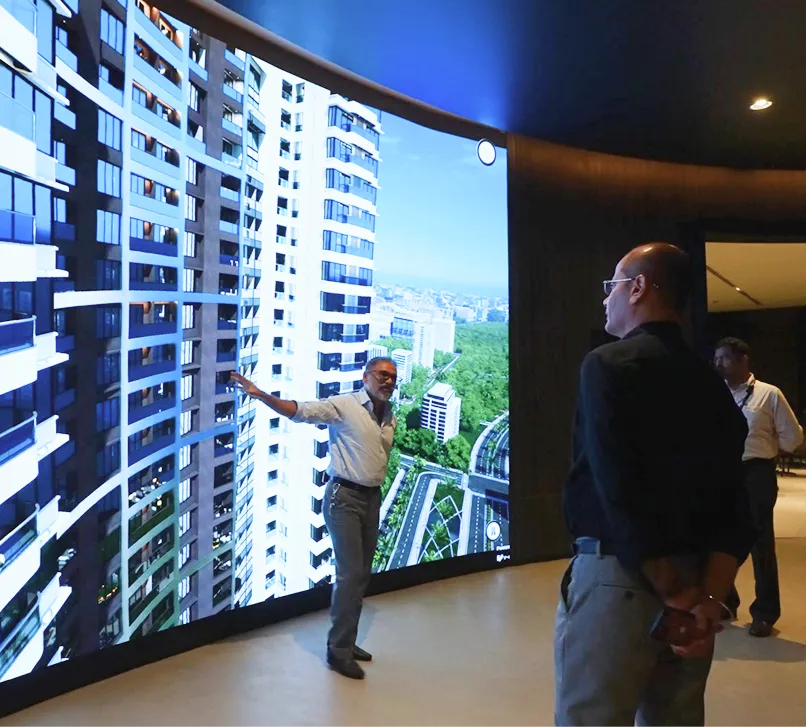
Instead of building a traditional sales gallery, they built a time machine. A portal. They became the first in the Chandivali market to scrap the old playbook and build their entire sales journey around a breathtaking, 13.5-foot-wide immersive AV experience.
This isn't just a case study about a big screen. It's a story about how a legacy brand used cutting-edge technology to champion transparency, evoke emotion, and fundamentally reimagine the customer journey from the ground up.
The "Why?" - A Market Ripe for Disruption
To understand what Nahar did, you first have to understand the problems they were trying to solve. This wasn't a gimmick; it was a strategic solution to three core challenges.
1. The "Experiential Void" The Chandivali micro-market was a sea of traditional sales galleries. No one was innovating. No one was offering a truly unique, memorable experience. This "experiential void" was a massive opportunity. The Nahar Group, with its deep legacy, aimed to not just participate in the market but to define it. They wanted to be the pioneers, the ones who would set a new standard.
2. The "Scale & Complexity" Challenge Chandivali Valley isn't a single building. It's a holistic, large-scale development with multiple towers, intricate landscaping, and a complex topography (the project itself is on a hilltop). A physical scale model, no matter how detailed, would fail to capture the true scale and the relationship between the towers, the amenities, and the surrounding environment. How do you show a customer the view from the 20th floor of a tower that doesn't exist yet? How do you make them feel the expanse of the land parcel?
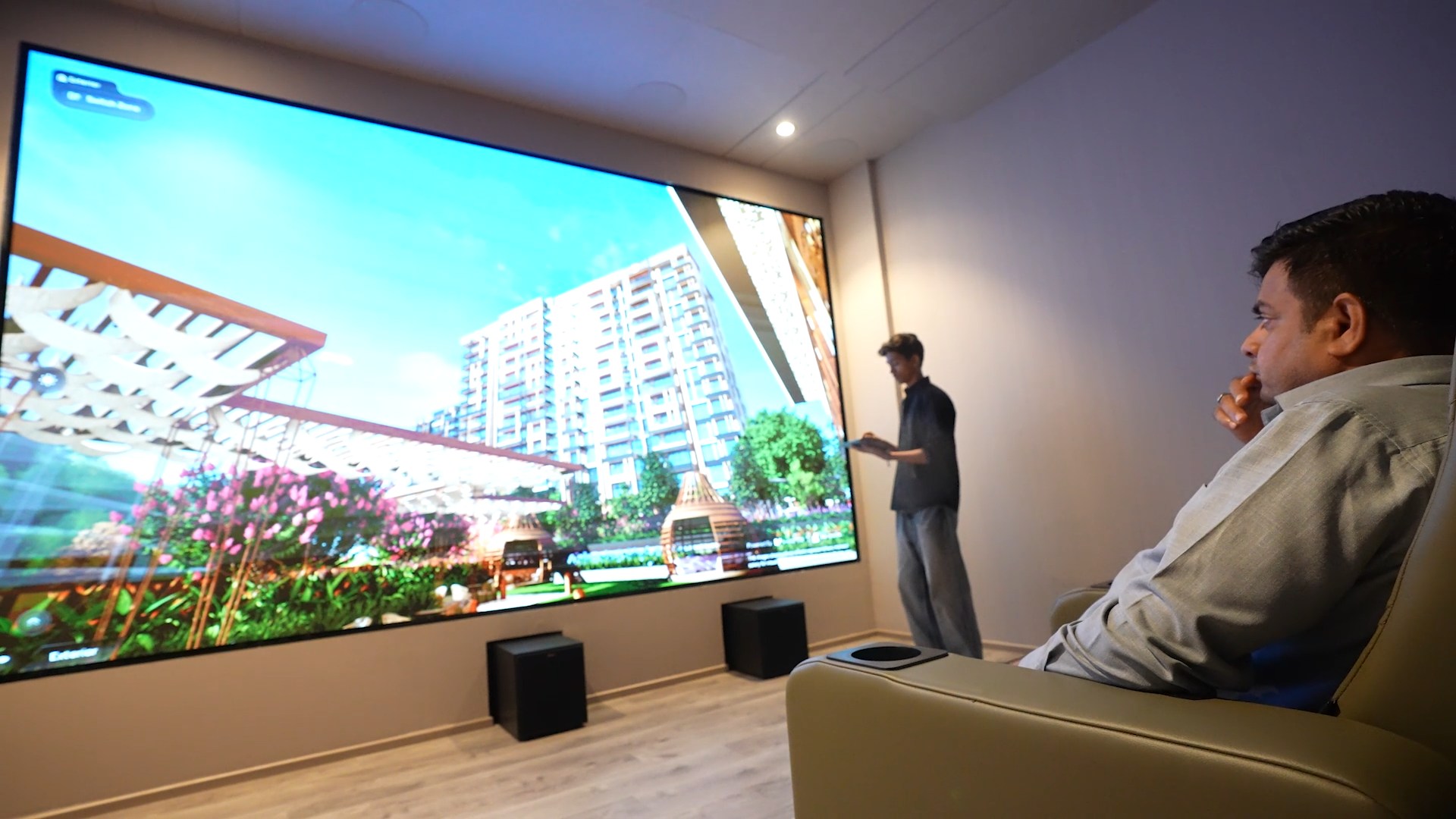
3. The "Hidden USP" Dilemma The project's biggest USP was its connection to nature, specifically the adjacent Miyawaki forest: a dense, man-made forest that's part of Nahar's own property. This is the "soul" of the project. It's the promise of a Balinese lifestyle, of waking up to greenery, of having a forest a short walk away.
A brochure can't sell this feeling. A 2D render can't do it justice. You can't tell a customer about this; you have to show them. You have to make them feel it. The goal, as stated by the team, was "transparency and a holistic understanding." They needed to transport customers from a sales gallery into that forest.
The Solution: A 13.5-Foot Portal to Chandivali Valley
Nahar's answer was to build a dedicated, state-of-the-art AV room as the centerpiece of the entire sales gallery. This wasn't an afterthought; it was the main event.
Let's talk about the hardware, because it's the engine that makes the magic possible.
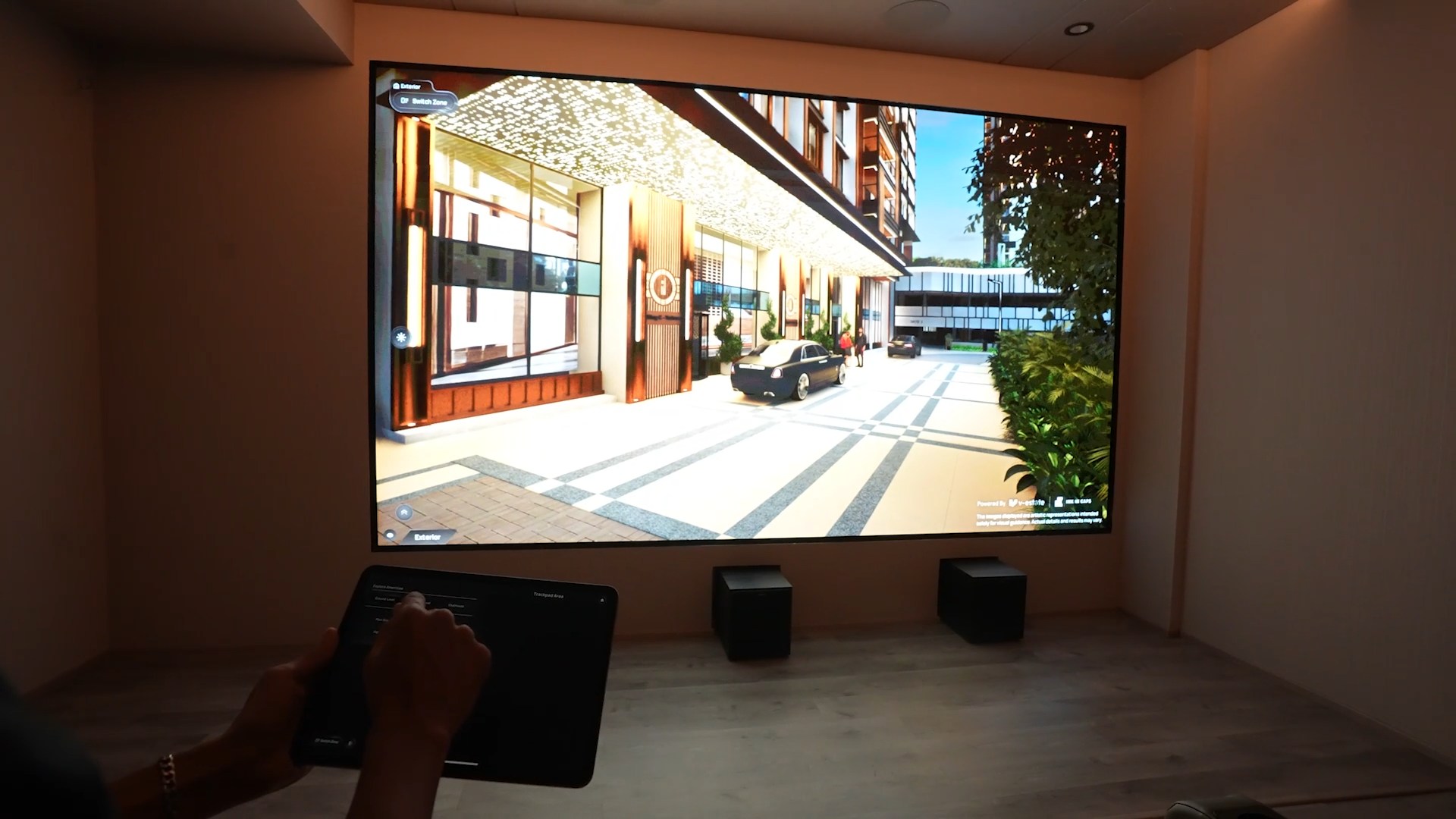
The Screen: A colossal 13.5-foot by 8.3-foot LED panel. This isn't a TV; it's a wall. It fills the visitor's field of vision, creating a truly immersive, 1:1 scale experience.
The Quality: A 1.8 pixel pitch. In human terms, this means the image is incredibly crisp, sharp, and photorealistic. There are no blurry edges, no "video game" feel. When you look at the screen, you're looking at a reality.
The "Brain": The experience is powered by a beast of a PC. We're talking a top-of-the-line 5090 graphics card, 65GB of RAM, and a liquid-cooled Intel i7 processor. This isn't for playing a video; this system is rendering the entire Chandivali Valley in real-time. This power is essential for the level of detail, dynamic lighting, and optimization required.
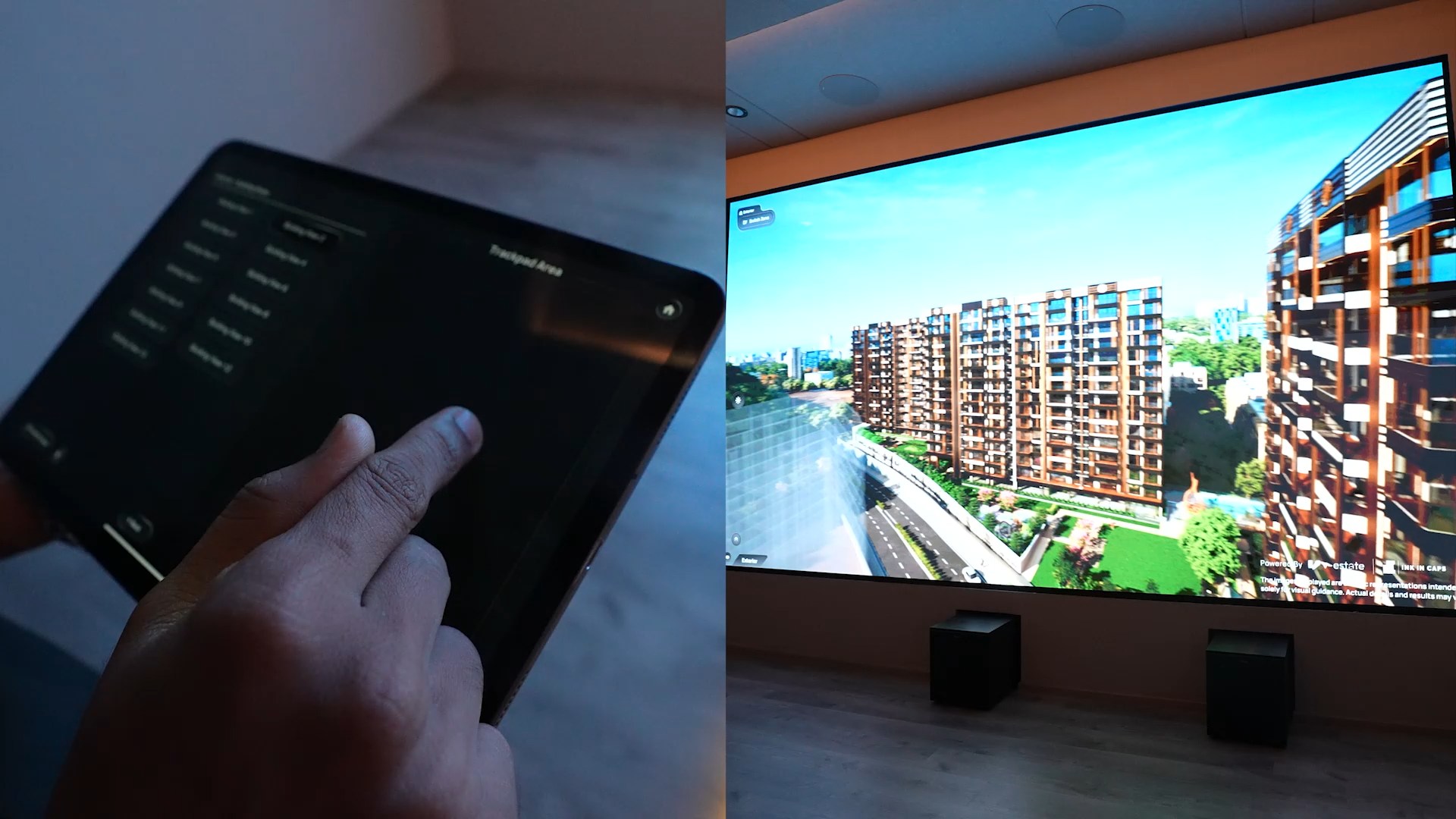
The "Wand": The entire, complex experience is controlled seamlessly from an iPad. The salesperson isn't a fumbling operator; they are a "conductor," guiding the customer on a curated journey with the tap of a finger.
Rewriting the Sales Playbook: The New 4-Step Journey
This is where Nahar's genius truly shines. They didn't just add a new toy. They fundamentally re-structured the entire customer journey around it.
The old model: Meet -> Scale Model -> Sample Flat -> Discussion. The Nahar model:
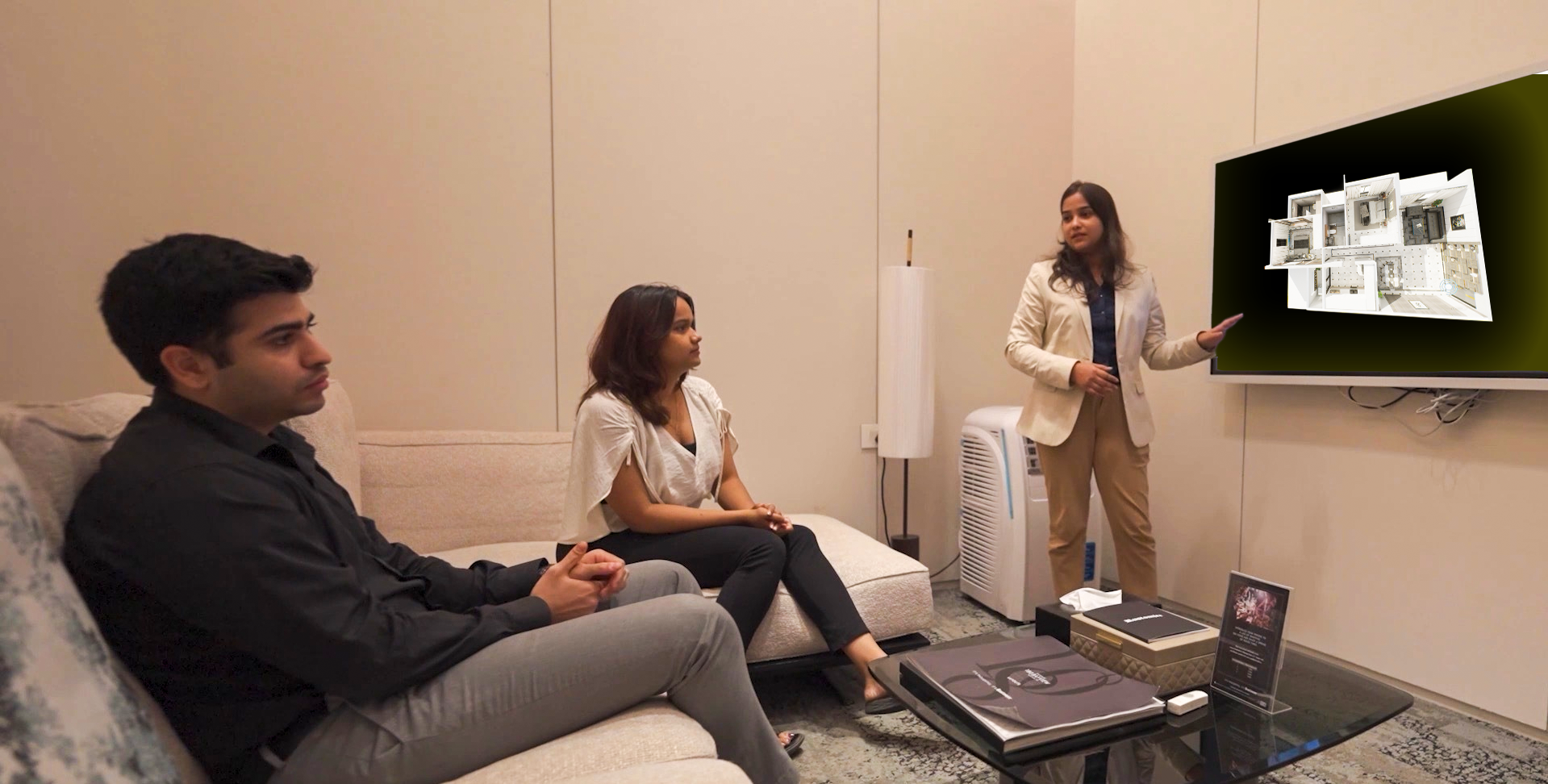
Step 1: The Immersion (The AV Room) This is now the first and mandatory stop. After a brief meet-and-greet, customers (often in small groups) are ushered into the AV room. Before they've seen a physical model or a sample flat, they are transported to Chandivali Valley. They fly over the entire project, swoop down to the Miyawaki forest, explore the podium-level amenities, and see the exact view from a 20th-floor balcony.
This first step does all the emotional heavy lifting. It establishes the "wow" factor, answers the big-picture questions about scale and lifestyle, and builds an emotional connection to the project.
Step 2: The Context (The Scale Model) Now, when the customer goes to the physical scale model, it's not a cold introduction. It's a familiar landscape. They can point and say, "Oh, that's the tower we saw, and there's the forest!" The model now serves as a tool for spatial confirmation, not for initial discovery.
Step 3: The Tactile (The Sample Flat) Next, they visit the 3BHK sample flat. But again, the context is different. In the AV room, they already saw the view from the window. Now, as they stand in the physical room, they can connect the digital to the physical. The experience feels whole.
Step 4: The Conversation (The Discussion Rooms) By the time the customer sits down in one of the eight discussion rooms, the entire conversation has changed. The sales team isn't wasting time with the basics ("What is the project? Where is it?"). The AV experience has already done that.
The conversation is now, "Which tower did you like best?" "That view from the 22nd floor was incredible, wasn't it?" "Let's talk about the 3BHK that faces the forest." It shifts the dialogue from a "hard sell" to a "guided discovery."
.jpg)
The Digital "How": Building a World from Scratch
Creating an experience this realistic, this vast, and this smooth is a monumental technical achievement. This isn't something you buy off the shelf. It was a painstaking collaboration between Nahar and a "trifecta" of elite design partners: Hafiz Contractor (Architecture), GSA - Green Space Alliance (Landscaping), and Studio West (Interiors).
The development team faced three critical, project-defining challenges.
Challenge 1: The Topography
The project isn't built on a flat plane. It's on a hilltop. This created a nightmare of elevation changes. The team couldn't just "place" buildings. They had to digitally model the entire hill and surrounding area to ensure every ground level, every ramp, and every building's entry point was perfectly accurate. This was a major undertaking that a traditional render farm would simply gloss over.
[Image 34 from 'nahar exp center mp4.mp4' - A stunning aerial render from the software, showing all three towers, the complex facade, the dense surrounding greenery, and the challenging topography.]
Challenge 2: The "Living" Facade
The core facade of the buildings wasn't a simple "copy-paste" job. The unique, high-end design changed on a per-floor basis. This meant the modeling team had to meticulously craft each floor's unique geometry. It was an enormous, detail-oriented task that was critical for achieving true architectural realism.
Challenge 3: The Unsung Hero: Optimization
This is the magic you don't see. The project's two biggest assets: the Miyawaki forest and a specific Heritage Tree: were also its biggest technical hurdles.
The Forest: How do you render a forest in real-time? The sheer number of trees, leaves, and blades of grass (the "poly count") would crash even the most powerful PC.
The Heritage Tree: A single, beautiful "hero" tree in the project had an absurdly high poly count, all by itself.
The team had to go in and manually rebuild and optimize these assets. They meticulously lowered the poly count of the tree, leaf by leaf, without losing any of the visual quality. This optimization is the unsung hero: it's what allows the salesperson to fly through a dense forest on a 13.5-foot screen with zero lag.
The Secret Weapons: Unreal Engine's Power
To pull this off, the team turned to Unreal Engine, the same tool that powers the world's most realistic video games. They leveraged two key features:
Lumen (Dynamic Lighting): This is the "magic" behind the realism. Lumen is an advanced system that calculates how light bounces in real-time. It's why the sun filtering through the Miyawaki forest leaves feels warm. It's why the reflections in the swimming pool look wet. It's the difference between a static "render" and a living, breathing "reality."
PCG (Procedural Content Generation): How do you "plant" a million blades of grass? You don't. You design an algorithm to do it for you. The team used PCG to dynamically and algorithmically "paint" the landscape with dense, organic, and realistic grass and foliage. It's the only way to create the lush, Balinese feel of the Miyawaki forest at such a massive scale.
The Result: 100% Adoption, 100% Uptime
The impact was immediate. The sales team, all 25 of whom were trained on the tool, was "extremely happy." Finally, they had a tool that could show everything they had been struggling to tell. It's now a mandatory, non-negotiable part of their sales process.
And the technology? It's been rock solid. Thanks to an Annual Maintenance Contract (AMC) that includes an on-site team member, the system has had 100% uptime since launch. Any minor hiccup is resolved in minutes, ensuring that this critical sales tool is always ready.
The Future of Proptech is Experiential
The Nahar Chandivali Valley story is more than a successful case study. It's a blueprint for the future of real estate.
It proves that investing in a high-fidelity, immersive experience is not a cost: it's a strategic investment in transparency, customer emotion, and brand leadership. It demonstrates that when you have a complex project with a powerful, emotional story, the best way to tell it is to let your customers live it.
Nahar didn't just sell apartments; they sold a vision. They sold the feeling of standing on a balcony overlooking a private forest. And they did it by building a portal.
The age of the glossy brochure is over. The future of real estate is, and must be, experiential.