.jpg)
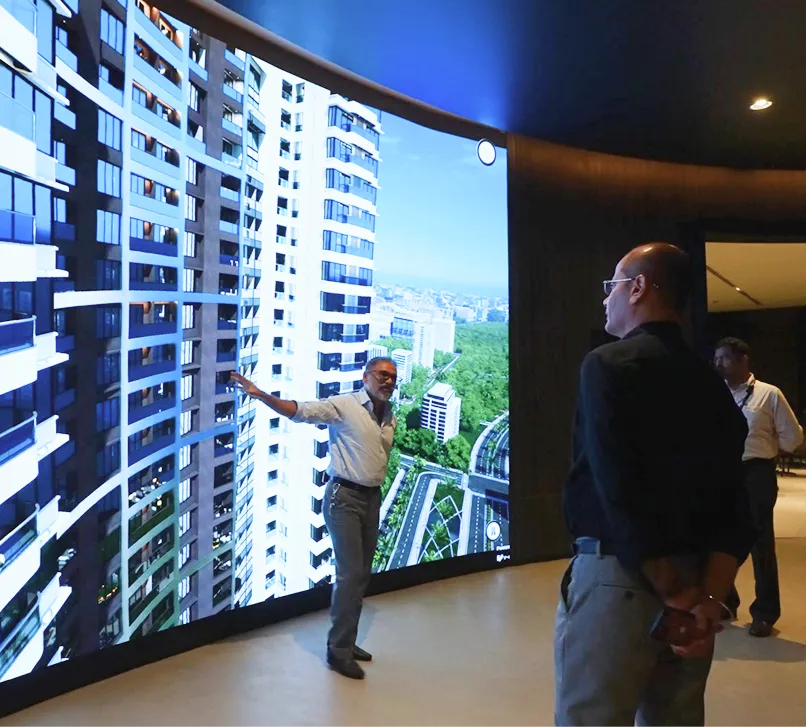
The Chandivali market in Powai, Mumbai, had a problem. Despite being home to multiple real estate developments, sales galleries offered little beyond brochures and physical scale models. Buyers walked in expecting clarity—about views, elevations, amenities, and what life would actually feel like in these towers. Instead, they got promises and projections.
Nahar Realty recognized this gap. For their Chandivali Valley project, they needed more than traditional marketing collateral. They needed a way to show customers exactly what they were buying before construction was complete—not through renders that look detached from reality, but through an experience that felt tangible, honest, and complete.
This is where real-time visualization stepped in, not as a gimmick, but as a functional answer to a business problem: how do you build trust when the product doesn't exist yet?
The Trust Problem in Pre-Launch Real Estate
Real estate purchases are high-stakes decisions. Buyers commit substantial capital based on incomplete information—floor plans, static renders, and verbal descriptions from sales teams. The disconnect between expectation and reality often surfaces only at possession, leading to dissatisfaction, delays in closing, and erosion of brand equity.
For developers, this trust deficit manifests as longer sales cycles, higher dependency on channel partners, and difficulty in commanding premium pricing. Marketing becomes defensive rather than confident. Sales teams spend more time managing objections than closing deals.
Nahar's challenge was compounded by the unique characteristics of Chandivali Valley. The project wasn't just another tower cluster—it sat adjacent to a Miyawaki forest on elevated terrain, with non-overlapping tower orientations designed specifically for unobstructed views. Communicating this complexity through traditional methods would have been nearly impossible. Buyers needed to see the elevation differences, understand the forest proximity, and experience the view corridors from specific apartments.
The solution required a shift from "telling" to "showing"—and that showing had to be accurate, detailed, and immediately accessible to every walk-in customer.
Building the Transparency Layer: Real-Time Visualization as a Sales Tool
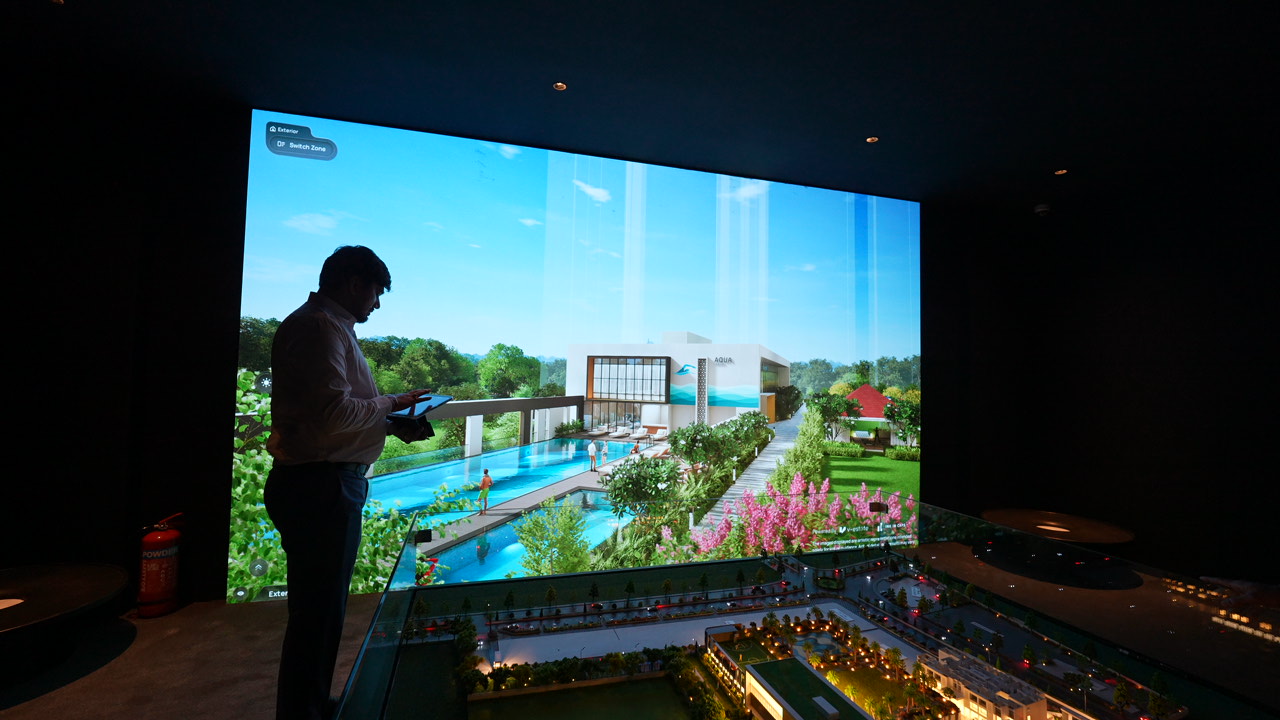
V-estate was deployed at Chandivali Valley as the first mandatory touchpoint in the customer journey. Before viewing the physical scale model or sample flat, every visitor was taken to the AV room—a 13.5-foot by 8.3-foot LED panel displaying the project in photorealistic detail, controlled via an iPad interface.
This wasn't a passive video walkthrough. Sales executives could navigate the environment in real-time, responding to customer questions by zooming into specific towers, switching between day and night lighting conditions, or moving the camera to show views from different floor levels. The entire project—towers, podium, landscaping, roads, and the adjacent forest—was rendered with high fidelity using Unreal Engine 5.4.
What made this effective wasn't just visual quality. It was the ability to answer the questions buyers actually ask:
"Which tower has the best morning light?"
"How close is the forest, and will my view be obstructed?"
"What does the elevation look like from the road level versus the podium?"
"Can I see what the amenity deck looks like at sunset?"
These questions are nearly impossible to answer convincingly with static images or verbal descriptions. Real-time visualization made them simple to address, on the spot, with the customer in control of what they wanted to see.
The Technical Reality: Why Execution Matters More Than Features
Implementing V-estate at Chandivali Valley wasn't straightforward. The project's geography introduced modeling challenges that standard real estate visualizations don't encounter.
The plot wasn't a typical rectangular layout—it had a complex, almost triangular configuration with significant elevation differences between the road and building levels. Modeling the roads alone required extensive iteration to ensure they appeared seamless with the building structures. The towers themselves featured unique core façades with changing elevation designs per floor, adding complexity to the modeling process.
Then there was the forest. Unlike projects where natural surroundings are distant enough to be abstracted, the Miyawaki forest was directly adjacent—almost touching the site. This proximity demanded high-detail modeling of trees, grass, and terrain. The development team built a custom Procedural Content Generation system from scratch to handle the grass realistically, balancing density and performance without sacrificing visual quality.
A heritage banyan tree at the center of the podium posed another challenge. The initial model had an extremely high polycount that would have crippled real-time performance. The team reconstructed it entirely, reducing the polycount while preserving the structure's visual integrity.
Lighting was the most persistent bottleneck. The environment outside—particularly the mountain views visible from the podium—was so visually compelling that it competed with the building amenities for attention. Camera angles had to be adjusted repeatedly to balance both elements, ensuring the visualization highlighted the project's architecture without undermining the natural surroundings that were a core selling point.
These aren't cosmetic issues. They're technical constraints that, if mishandled, break immersion and undermine trust. A sluggish interface, unrealistic textures, or inaccurate spatial relationships would have signaled to buyers that the tool was just marketing polish—not a reliable representation of the actual project.
From Implementation to Adoption: Training Sales Teams to Use the Tool
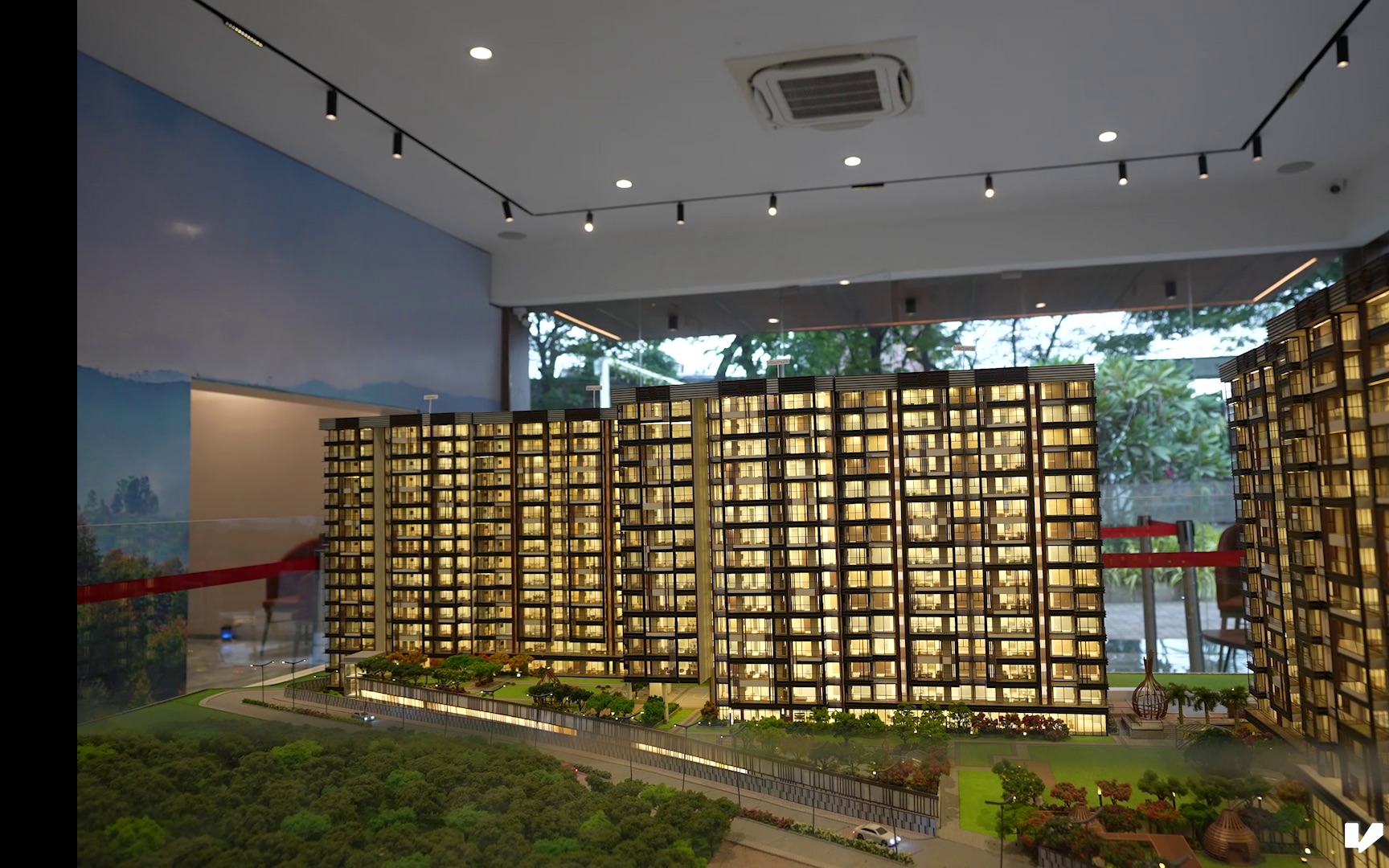
Technology is only as effective as the people operating it. Nahar trained approximately 25 sales executives across closing, sourcing, and channel partner teams on how to use the system. Training covered not just navigation, but troubleshooting—how the iPad connects to the high-spec PC, what to do if the display lags, and how to structure the presentation based on customer priorities.
The immersive experience became the foundation of the sales pitch, not an add-on. Executives learned to consolidate multiple families into a single AV room session, guiding them through the project systematically before moving to the physical scale model, sample flat, and discussion rooms.
This structured approach had two effects. First, it standardized the customer experience, ensuring every buyer received the same level of detail regardless of which executive handled them. Second, it shifted the sales conversation from speculative to concrete. Instead of describing what the project "will be like," executives could show it, frame by frame.
Sales teams responded positively. The level of detail they could convey—down to window views and lighting conditions—made closing conversations easier. Customers left with fewer unanswered questions, which reduced follow-up cycles and increased conversion confidence.
Operational Stability: Why Reliability Determines ROI
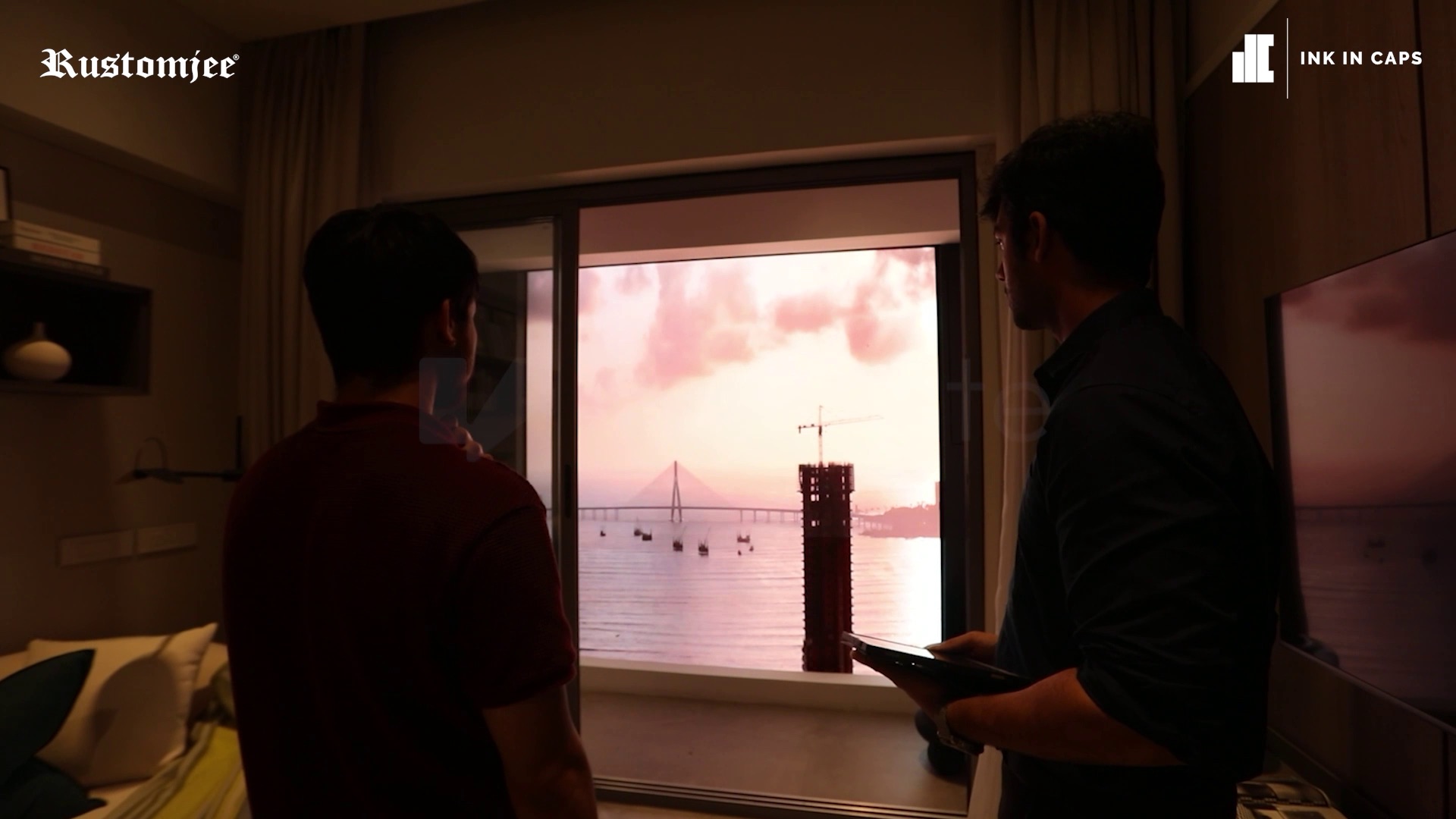
V-estate's value extended beyond the initial deployment. The system was backed by a comprehensive Annual Maintenance Contract, with a dedicated team member stationed on-site 24/7 whenever the sales office was operational. This ensured that any technical issues—connectivity drops, display glitches, or software bugs—were resolved immediately without disrupting the customer experience.
Since launch, the system has remained operational with minimal downtime. This reliability matters more than most developers realize. A visualization tool that works 95% of the time is effectively useless—the 5% downtime happens during critical customer visits, creating a negative impression at the worst possible moment.
Nahar's approach treated V-estate as mission-critical infrastructure, not experimental marketing technology. The result was a tool that sales teams trusted and customers experienced consistently, reinforcing rather than undermining the project's positioning.
The Business Impact: Transparency as Competitive Differentiation
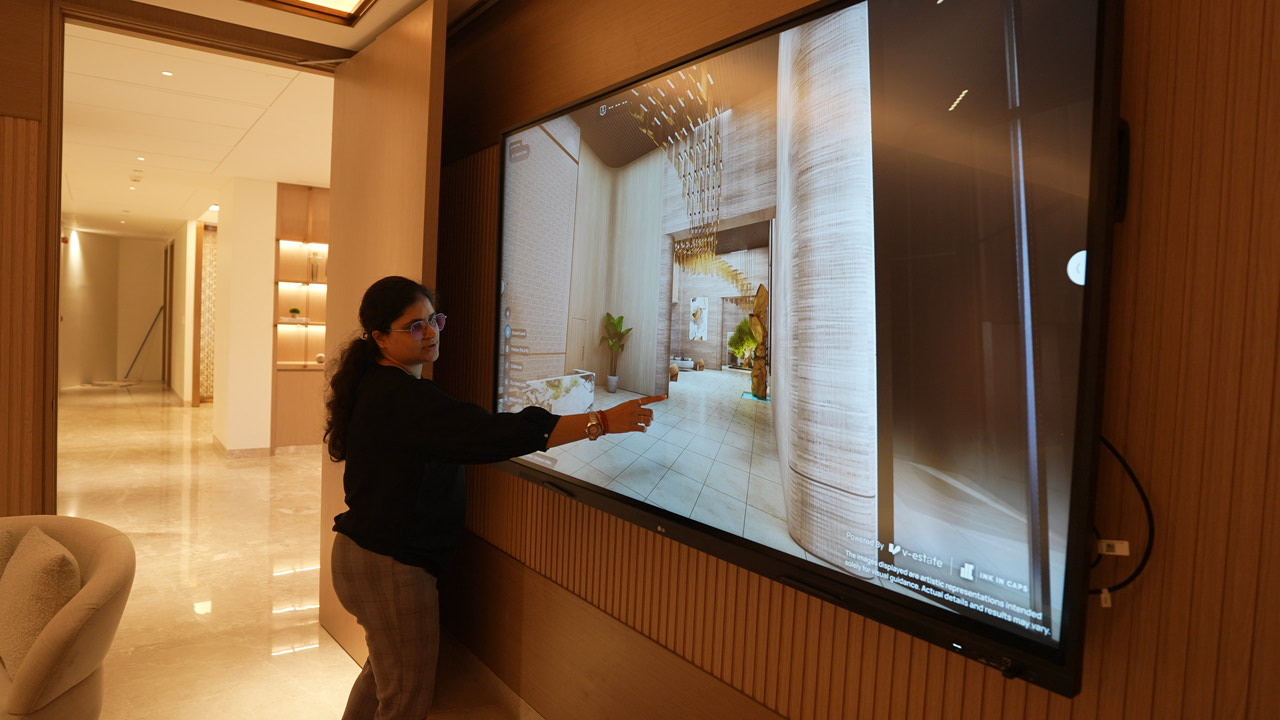
Chandivali Valley's use of real-time visualization delivered tangible business outcomes. Nahar became the first developer in the micro-market to offer this level of experiential innovation, creating immediate differentiation in a competitive landscape.
The transparency enabled by V-estate addressed the core trust deficit in pre-launch sales. Buyers could see—accurately and comprehensively—what they were committing to. This reduced perceived risk, shortened decision cycles, and allowed Nahar to command premium pricing justified by the clarity of the offering.
Marketing shifted from defensive reassurance to confident demonstration. Instead of managing skepticism about elevations, views, or amenity placement, sales teams could show exactly how each element was designed and positioned. The conversation moved from "trust us" to "see for yourself."
Customer satisfaction improved measurably. Post-experience feedback indicated that buyers felt more informed and confident in their purchase decisions. This wasn't subjective—customers explicitly valued the ability to explore the project interactively rather than passively receiving information.
For Nahar's broader portfolio in the region, Chandivali Valley set a new standard. The success of the immersive experience center influenced how the company approached subsequent projects, embedding real-time visualization as a core component of the sales infrastructure rather than a one-off experiment.
Why This Approach Works: Lessons for Developers
The Chandivali Valley case demonstrates several principles that apply across real estate developments:
Transparency drives conversion. Buyers who understand what they're purchasing convert faster and with higher satisfaction. Real-time visualization eliminates ambiguity, reducing friction in the decision process.
Technical execution matters. Visual quality, performance stability, and accurate spatial modeling determine whether the tool builds or erodes trust. Compromises in any of these areas undermine the entire value proposition.
Sales adoption is non-negotiable. Tools that sales teams don't trust or can't operate effectively become liabilities. Training, reliability, and integration into the sales process are as important as the technology itself.
Context-specific customization is essential. Generic visualizations don't work for complex projects. Chandivali Valley's unique geography—the forest proximity, elevation differences, non-overlapping towers—required custom modeling and optimization. Standard templates would have failed to communicate the project's core differentiators.
Operational support sustains value. Without robust maintenance and on-site support, even well-designed systems degrade. Nahar's commitment to 24/7 availability ensured the tool remained functional throughout the sales cycle.
Conclusion: Trust as a Measurable Outcome
Designing for transparency isn't about aesthetics or marketing narratives. It's about giving buyers the information they need to make confident decisions, presented in a format that matches the complexity of the product.
For Nahar Realty, V-estate transformed how customers engaged with Chandivali Valley. The immersive experience center became the anchor of the sales journey—not because it was impressive, but because it was accurate, comprehensive, and accessible.
Real estate developers face increasing pressure to differentiate in saturated markets while managing buyer expectations in pre-launch scenarios. Real-time visualization offers a direct solution: show the project as it will exist, with enough detail and control to answer customer questions before they're asked.
The result isn't just better marketing. It's stronger buyer trust, faster conversions, and a sales process built on clarity rather than persuasion. For developers ready to move beyond traditional collateral, the path forward is clear—if they're willing to invest in execution, not just technology.