Premium buyers don't make decisions in the dark. They arrive informed, comparison-ready, and time-conscious. When your sales environment fails to match that standard, momentum stalls — and stalled momentum in a premium launch is expensive.
Inventory visibility is no longer a backend function. It is a front-line sales asset.
Premium Buyers Expect Clarity Before Commitment
The premium segment operates differently. A buyer evaluating a ₹3 crore or ₹10 crore unit is not browsing — they are deciding. Every gap in information extends the sales cycle. Every moment of confusion creates doubt.
The decision gap in most premium launches looks like this:
Buyer asks which units are available
Sales executive checks manually or calls internally
Buyer waits, loses focus, reconsiders
This sequence repeats across site visits. It costs conversions.
The core problem is not the product. It is the presentation of availability.
Static Inventory Displays Are Actively Hurting Sales
Most premium project setups still rely on printed floor plans, static availability boards, or Excel-based unit trackers. These tools were built for a different era of selling.
In a fast-moving launch environment, static displays create three operational failures:
First — they show outdated information. A unit blocked at 11 AM still appears available at 3 PM.
Second — they create dependency. Sales teams spend more time coordinating than closing.
Third — they reduce buyer confidence. When a buyer catches an inconsistency, trust erodes.
Inventory accuracy is a credibility issue, not just an operational one.
Real-Time Availability Changes the Buyer's Decision Environment
When inventory status is visible in real time, the buyer's role in the conversation shifts. They move from passive listener to active explorer.
Buyers who can see live unit status:
Compare floor positions without waiting for answers
Understand demand signals organically — they see what's moving
Shortlist faster because confusion is removed
This is authentic urgency. Not scripted. Not manufactured. When a buyer watches a preferred stack reduce in availability, the decision timeline compresses naturally.
Visibility drives velocity. That is the marketing value.
Unit-Level Detail Is Where Decisions Are Made
Premium buyers evaluate specifics. Floor height. View corridor. Sunlight exposure. East versus west-facing. Corner unit positioning.
These are not minor preferences. For buyers at this ticket size, they are the decision.
Live inventory tools that integrate unit-level detail allow buyers to:
See exact status of preferred floors
Evaluate adjacent options within the same stack
Understand premium positioning against standard units
This removes the back-and-forth. It removes the follow-up calls. It puts the buyer in control of their own discovery.
Experience Centres Need to Evolve Beyond Visual Display
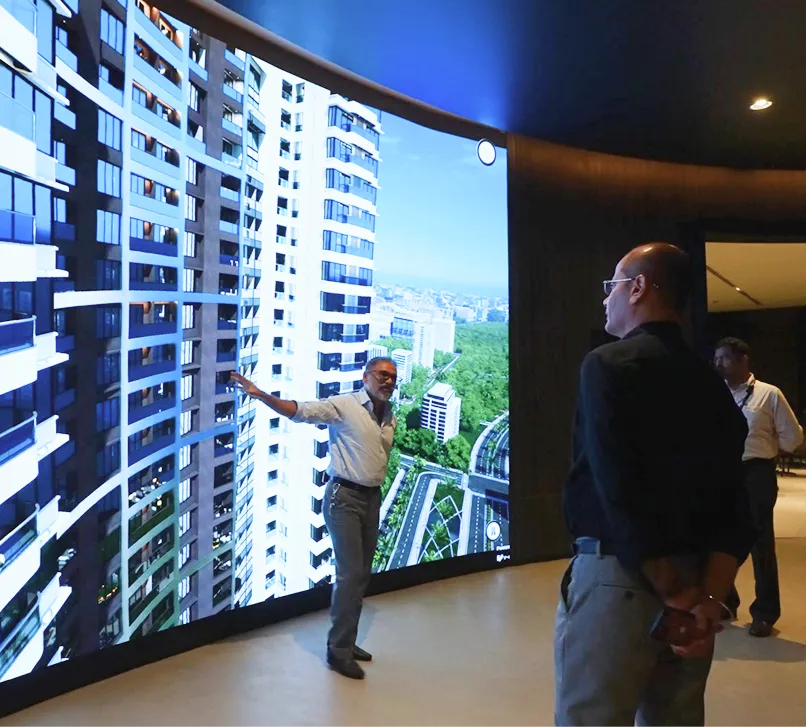
Offline experience centres remain the most powerful sales touchpoint in premium real estate. The format, however, needs upgrading.
Modern buyers expect the offline environment to match the quality of research they have already done online. When they walk into your experience centre, they have seen the renders. They have studied the master plan. They are there to confirm and commit — not to be introduced.
An effective experience centre setup for premium launches combines:
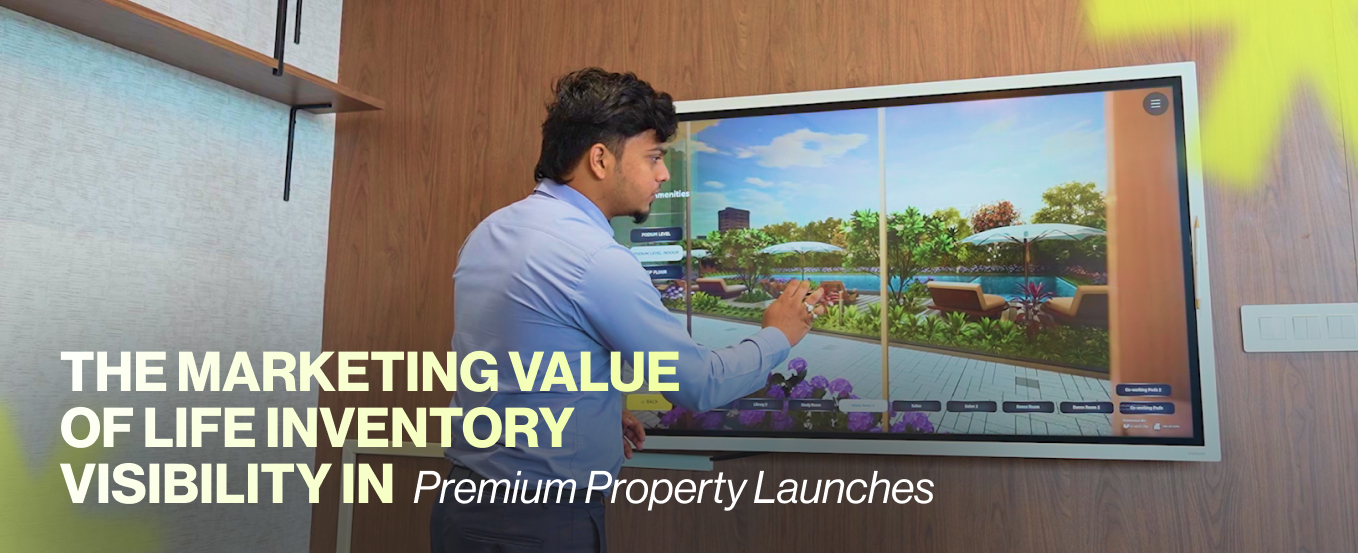
Interactive unit-level exploration tied to real availability
Visual inventory mapping within the master plan
Photorealistic representation of what living in the unit actually feels like
V-estate enables exactly this at the offline touchpoint. It integrates live inventory visibility with immersive 3D exploration — all within the experience centre environment. Buyers interact with the property rather than simply viewing it. They explore unit interiors, assess views, adjust lighting conditions, and check availability — without switching tools or waiting for answers.
This is not a digital brochure. It is a decision-ready environment.
Channel Partner Coordination Becomes Frictionless
Inconsistent inventory data across channel partners is one of the most common causes of booking delays. A CP working from a two-hour-old availability update can create miscommunication that takes days to resolve.
When all channel partners access the same live inventory layer:
There is no version mismatch
Booking decisions move faster
Developer credibility with the CP network strengthens
Shared data is a coordination infrastructure, not just a convenience.
The Business Case Is Direct
The impact of live inventory visibility on a premium launch is measurable:
Conversion rates improve because buyers reach decision-readiness faster.
Sales cycles shorten because information delays are eliminated.
Channel partner performance increases because coordination friction disappears.
Buyer trust strengthens because the data is consistent, visible, and real.
These are not abstract benefits. They show up in booking velocity, follow-up reduction, and per-phase revenue.
The Standard Is Shifting
Premium real estate buyers are not getting less demanding. The developers and marketing heads who recognise that inventory visibility is a sales tool — not an administrative function — will outperform those who treat it as backend infrastructure.
If your experience centre is still running on static displays and manual updates, the gap between your product quality and your sales environment is costing you deals.
V-estate brings live inventory, photorealistic unit exploration, and real-time customisation into a single offline experience — built specifically for how premium buyers actually decide.
The buyers are ready. The question is whether your sales environment is.