Real estate developers lose deals in the communication gap.
A buyer sits across the table. The project looks promising on paper. But they cannot picture the view from the 14th floor at dusk. They cannot feel the morning light in the master bedroom. They leave undecided. That decision delay costs weeks — sometimes the entire sale.
This is not a product problem. It is a communication problem.
And interactive visualization systems exist precisely to close that gap.
The Real Problem: Static Presentations Cannot Do the Job Anymore
Modern real estate projects are layered. Township developments carry 50+ amenity touchpoints. High-rise towers offer floor-specific views. Customization options run into hundreds of combinations.
Brochures cannot carry that weight.
2D renders flatten perspective. PDF walkthroughs feel passive. Physical scale models age poorly and show only one version. Buyers walk into showrooms with high expectations — and walk out with unresolved questions.
The result is a longer sales cycle, more follow-ups, and fewer confident closings.
Marketing heads spend weeks re-explaining the same project details. Sales teams rework pitches for every client profile. Developers watch leads go cold because the experience never matched the vision.
The fix is not better brochures. The fix is a system that puts the buyer inside the project.
Photorealistic 3D Virtual Show Flats: The Precision Advantage
A buyer needs to see the property — not imagine it.
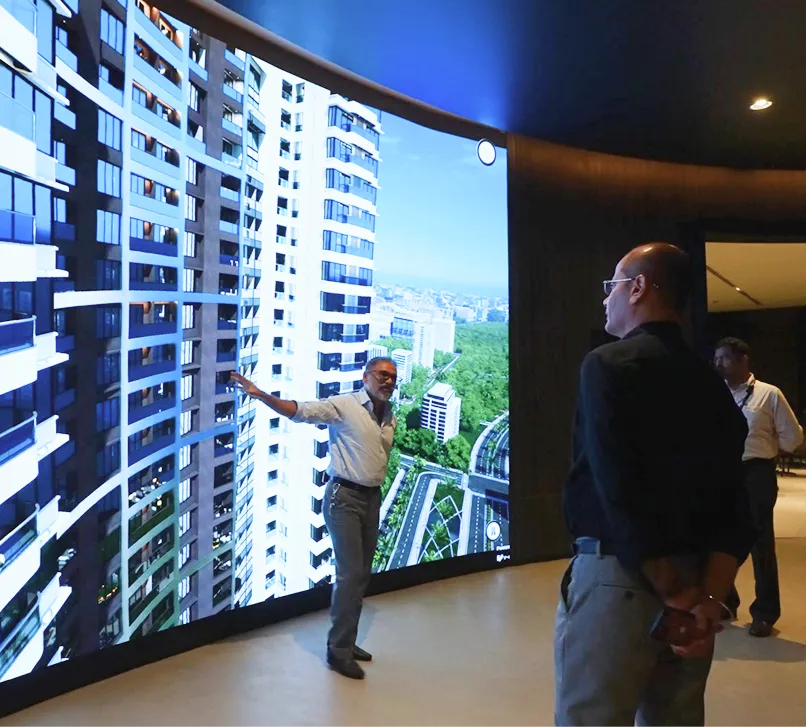
Photorealistic 3D virtual show flats deliver that precision. Every spatial detail renders at full fidelity. The window view from a specific unit. The way afternoon light falls across the kitchen counter. The exact ceiling height in the living room.
This is not generic visualization. It is unit-specific, view-accurate, and spatially honest.
Buyers stop guessing. Confidence builds faster. Sales teams spend less time explaining and more time closing. That shift alone compresses decision timelines significantly.
For developers working across multiple towers or configurations, the same system scales. One platform handles the entire project inventory — without rebuilding assets from scratch.
Dynamic Controls Change the Buyer Conversation
Static visuals answer one question. Dynamic controls answer a hundred.
Lighting and weather simulation lets buyers view the property at dawn, noon, peak afternoon, and evening. Rain conditions. Clear summer days. Winter light. Buyers evaluate the property across every relevant scenario — not just one flattering render.
This removes a major objection before it forms.
Paint finishes swap in real time. Furniture layouts shift with drag input. Fabric textures preview on actual upholstery shapes. Buyers do not have to imagine — they interact.
For marketing heads, this is a measurable advantage. Session data tracks which finishes get selected most. Which views hold attention longest. Which configurations get shared with families. That behavioral data directly informs campaign decisions.
Amenity Mapping: Selling the Neighborhood, Not Just the Unit
Buyers do not purchase apartments. They purchase a lifestyle within a location.
Schools, hospitals, transit routes, retail clusters — these factors drive final decisions as much as the unit itself. Traditional presentations handle this with a printed map or a static infographic.
Interactive amenity showcases do it differently.
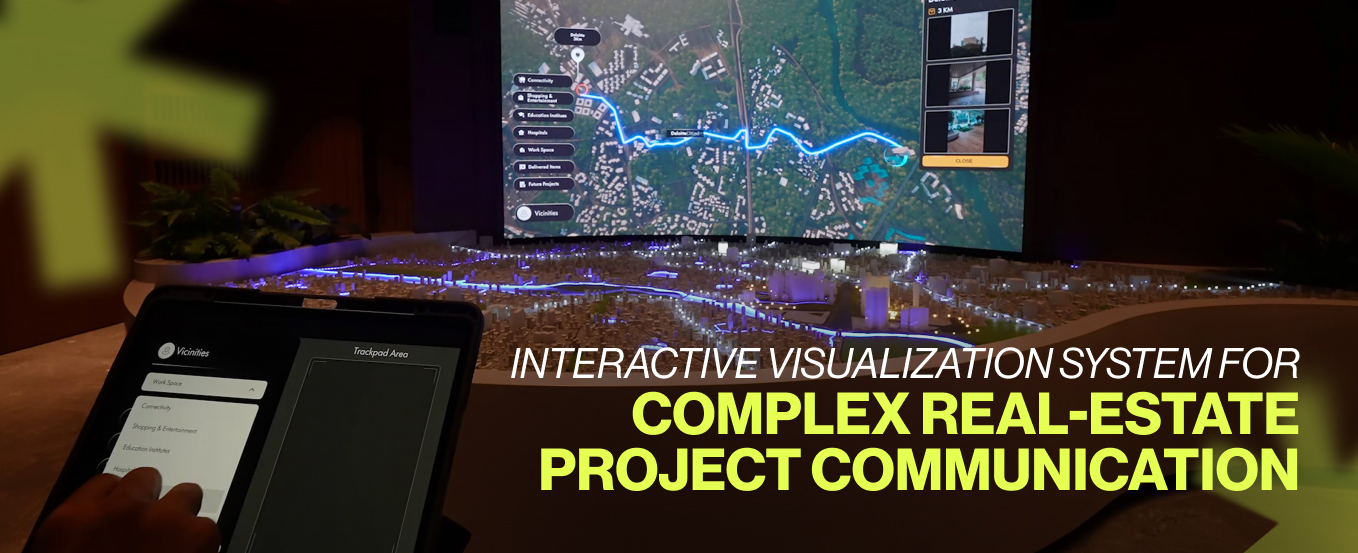
Nearby facilities appear in 3D overlays. Current projects and upcoming infrastructure layer onto the same view. Travel time calculations run in real time. A buyer can see that the nearest metro is an 8-minute walk. The school district boundary sits two streets away. The weekend market is within cycling distance.
This transforms a location pitch into a lifestyle demonstration.
Developers working in emerging corridors or new township zones benefit most from this. Buyers who hesitate on location can now evaluate it with full context — not optimistic claims.
Offline Activation: The Field Advantage That Changes Everything
Here is where most digital tools fail real estate teams.
Sales presentations happen in showrooms, site offices, investor meets, trade exhibitions, and off-site client locations. Internet connectivity is unreliable at most of these. Cloud-dependent tools stall, freeze, or simply refuse to load.
Offline activation solves this completely.
The entire system installs locally — on a laptop or dedicated kiosk. No Wi-Fi dependency. No loading delays. Full functionality, anywhere.
Sales agents guide immersive walkthroughs in basement showrooms. Developers demo to investors in industrial zones with zero signal. Marketing events run without technical risk.
The reliability factor directly protects lead quality. A disrupted demo breaks buyer immersion and momentum. An offline system eliminates that risk entirely.
The Measurable Outcomes Developers Care About
Beyond experience quality, the numbers matter.
Faster client onboarding. Buyers who interact with full-context visualizations ask fewer repeated questions. Onboarding time drops sharply.
Reduced physical mockup costs. One comprehensive digital system replaces staged show flats, physical material boards, and printed finish catalogues.
Higher conversion rates. Immersive, personalized sessions convert at significantly higher rates than passive presentations. Buyers who visualize their specific unit, with their preferred finishes, at their preferred time of day — decide faster.
Shorter sales cycles. When buyers leave a session with clarity rather than questions, follow-up rounds decrease. Internal alignment between developers, architects, and sales teams also tightens when everyone references the same visual system.
For Marketing Heads and Development Teams
The communication problem in real estate is structural — not accidental.
Interactive visualization systems are not a luxury add-on. They are operational infrastructure for developers managing complex projects with demanding buyers and compressed timelines.
Static presentations had their era. That era is over.
Buyers expect to see exactly what they are purchasing — at full resolution, with real customization, within their actual lifestyle context. Teams that meet that expectation close faster. Teams that do not lose ground to those who do.
The system exists. The capability is proven. The only remaining question is deployment.