.jpg)
Hundreds of residential listings found that properties marketed with a 3D virtual walkthrough sold up to 31% faster and closed at prices up to 9% higher than comparable listings without one. Another report suggests that listings with virtual tours received 87% more views. These are not soft engagement metrics. They are commercial outcomes, measured against matched properties in the same markets.
The numbers point to a straightforward truth: buyers who can genuinely experience a project before committing move faster and with more confidence than buyers who can only view it.
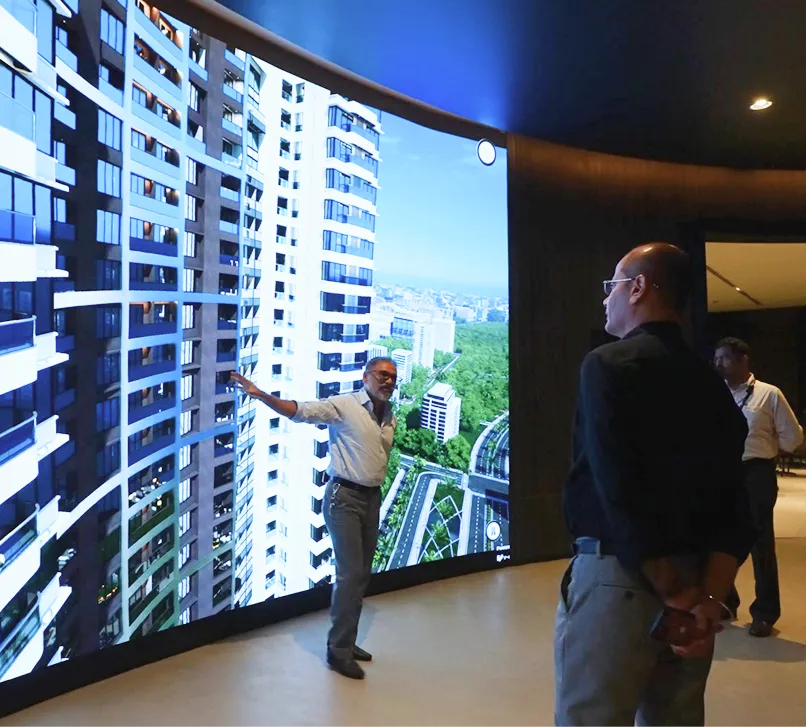
Interactive property walkthroughs aim to bridge the operational gap between viewing and experiencing. Not just through better visuals, but through a structured, evidence-driven sales environment that confidently answers every question a buyer brings in during a single visit.
Why Traditional Sales Environments Fail the Modern Buyer
The modern real estate buyer arrives informed. They have done the research, compared the options, and shortlisted based on what they found online. What they cannot resolve online is the lived reality of the project.
That resolution must be implemented on the ground. And most sales environments are not built for it.
The typical setup fails buyers in predictable ways:
Static renders show a finished product but cannot simulate standing inside it
Floor plans communicate dimensions but not spatial experience
Location maps describe connectivity but cannot make it feel real
Sales executives explain amenities but buyers cannot interact with them
The result is a buyer who leaves with unanswered questions and the vague intention to think it over. That period of reflection is when competitors step in and deals are lost.
Interactive property tours solve these issues by replacing passive viewing with active exploration. The buyer does not observe the project. They inhabit it.
That is not a subtle distinction. It is the difference between a buyer who says they'll think about it and one who asks when they can sign. And it is a difference that shows up directly in follow-up rates, decision timelines, and how many revisits a sales team has to manage before getting to a close.
What a Well-Built Interactive Walkthrough Actually Delivers
The word "interactive" gets used loosely in real estate sales. A touchscreen kiosk is not an interactive walkthrough. A looping video on a large screen is not an interactive walkthrough.
A genuine 3D property visualisation experience has specific qualities that boost buyer confidence:
Real-time responsiveness:
The buyer makes a selection and the environment responds instantly
Floor changes, amenity views, and vicinity exploration happen in the moment, not on a a pre-recorded path
The sales executive navigates based on what the buyer is curious about, not a scripted sequence
Depth of environment:
The surrounding context is as important as the unit itself
Infrastructure, greenery, road networks, and neighbourhood character need to be present and believable
A project shown in isolation without its environment leaves buyers unconvinced
Structural reliability:
A system that lags or crashes once loses the room permanently
Consistent frame rates, zero downtime, and seamless performance are not technical achievements; they are the baseline for buyer trust
High footfall environments demand 24/7 stability, not showroom-condition performance
Layered storytelling:
The experience should move a buyer through a sequence: location, project vision, unit reality, and closing
Each stage builds on the last, reducing ambiguity progressively until doubt has nowhere to go
When these qualities are present together, 3D property visualisation software stops being a presentation aid and becomes the primary instrument of conviction.
The sales executive is no longer explaining the project. They are guiding a buyer through an experience the buyer is already inside. That shift changes the dynamic of the conversation entirely. Questions become more specific. Objections become fewer. And the distance between a first visit and a signed agreement shortens measurably.
Designing the Experience for Volume Without Losing Depth
One challenge that separates a well-engineered project walkthrough service from a standard deployment is the question of scale.
A tool that works beautifully in a one-on-one consultation often collapses under high footfall. A launch weekend with 200 families per day is an entirely different operating environment than a quiet weekday consultation.
The best interactive property tour software is designed for both. The key is a structured, repeatable customer flow:
Stage one: orientation — short, high-impact storytelling that establishes location and vision quickly
Stage two: exploration — IoT-enabled model interaction and 3D environment walkthroughs that let buyers engage at their own pace
Stage three: resolution — private discussion rooms where specific questions are answered with visual precision and deals are closed
This three-stage architecture ensures every buyer, regardless of whether they arrive on a quiet Tuesday or peak launch day, moves through the same quality of experience. The system handles the volume. The sales team handles the relationship.
This division of responsibility is what makes high footfall launches manageable without sacrificing the depth of conversation that luxury and aspirational buyers expect. Real estate virtual tour software engineered for scale does not water down the experience. It standardises it.
Rustomjee Dombivali: Premium Experience for an Affordable Housing Launch
Rustomjee's Dombivali project presented a specific and demanding brief, one that tested the technology, the deployment strategy, and the speed of execution under real pressure. An affordable housing launch in a price-sensitive market, three competing projects launching simultaneously nearby, and a brand known for premium positioning that could not be compromised.
The site had no physical construction at launch. Buyers would arrive to see empty land. The experience centre had to communicate everything the project stood for.
The additional constraints made the challenge sharper:
Expected footfall of 190 to 210 families per day during peak launch weeks
A large-scale green zone environment with heavy foliage that posed serious rendering performance risks
Infrastructure changes on site mid-deployment requiring a full network re-engineering within 72 hours
A sales team of 25+ executives who needed to be trained and operating confidently from day one
The need for a reusable framework that could be adapted for future Rustomjee developments
This request was not a brief for a demonstration piece. It was a brief for a production-grade sales engine, one that had to perform on day one and keep performing for months without interruption.
How the Experience Centre Was Built
V-estate designed a four-stage guided journey, engineered to move 30 families per hour across 10 parallel discussion pods without queue delays or quality compromise.
Stage 1: AV Theatre
A 5-minute film divided into two acts: 2 minutes on transport links and location benefits, 3 minutes on project vision and lifestyle story
Established the location narrative before a single floor plan was shown
Gave buyers the context to understand why the project existed, not just what it contained
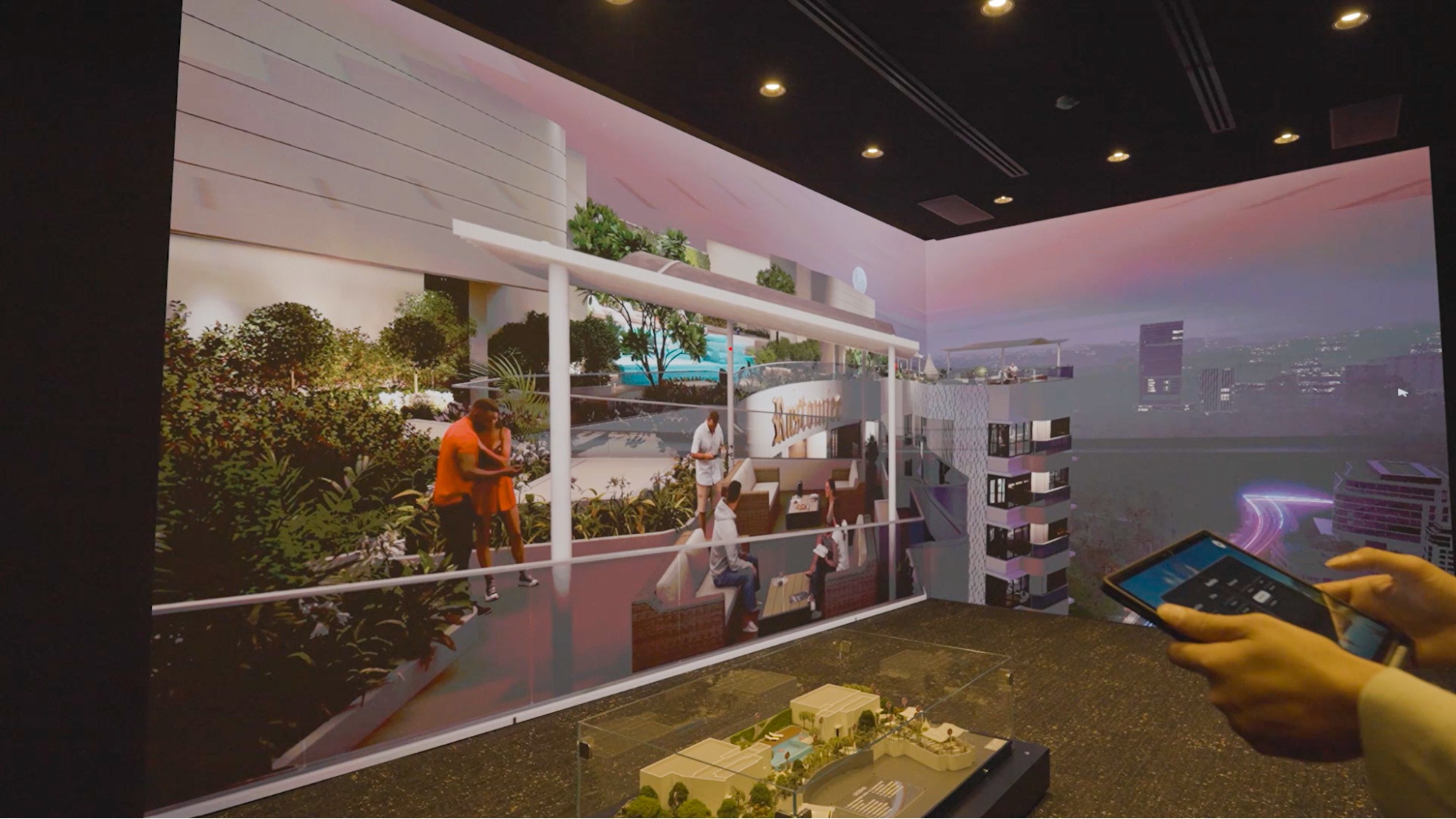
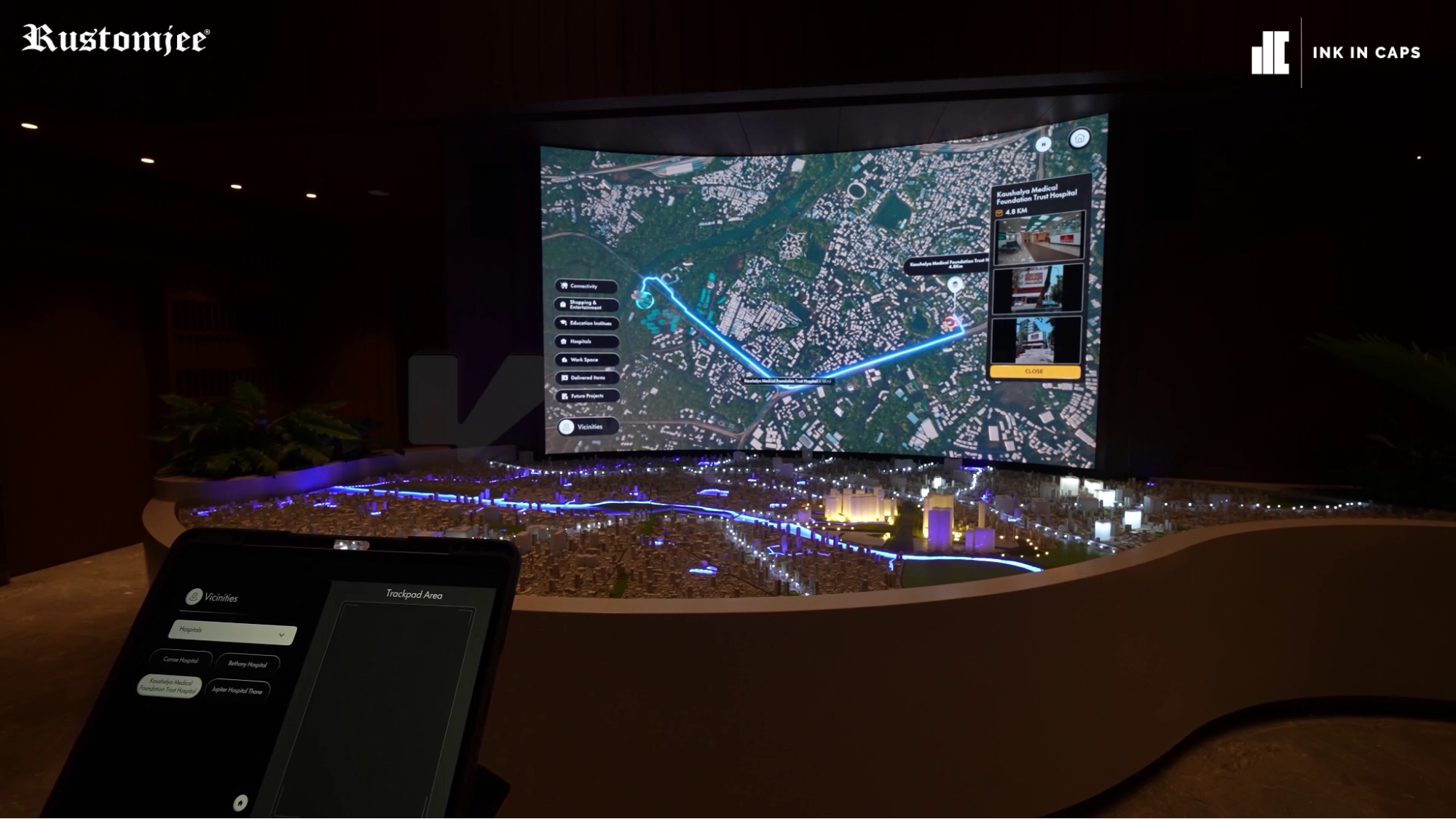
Stage 2: IoT Scale Model
28 interactive touchpoints connected live to a large display screen
Buyers touch an amenity on the model and watch it illuminate on screen in real time
33 amenities shown with full real-time interaction
Spatial comprehension of the master plan improved significantly, reducing time spent on verbal explanation
Stage 3: Sample Flat with Real Window Views
A fully built sample flat on site
Window displays using 360 degree drone footage showing the actual view from the unit
Buyers saw exactly what they would see from their windows, removing one of the most persistent sources of pre-purchase doubt
Stage 4: Discussion Rooms with Property Walkthroughs
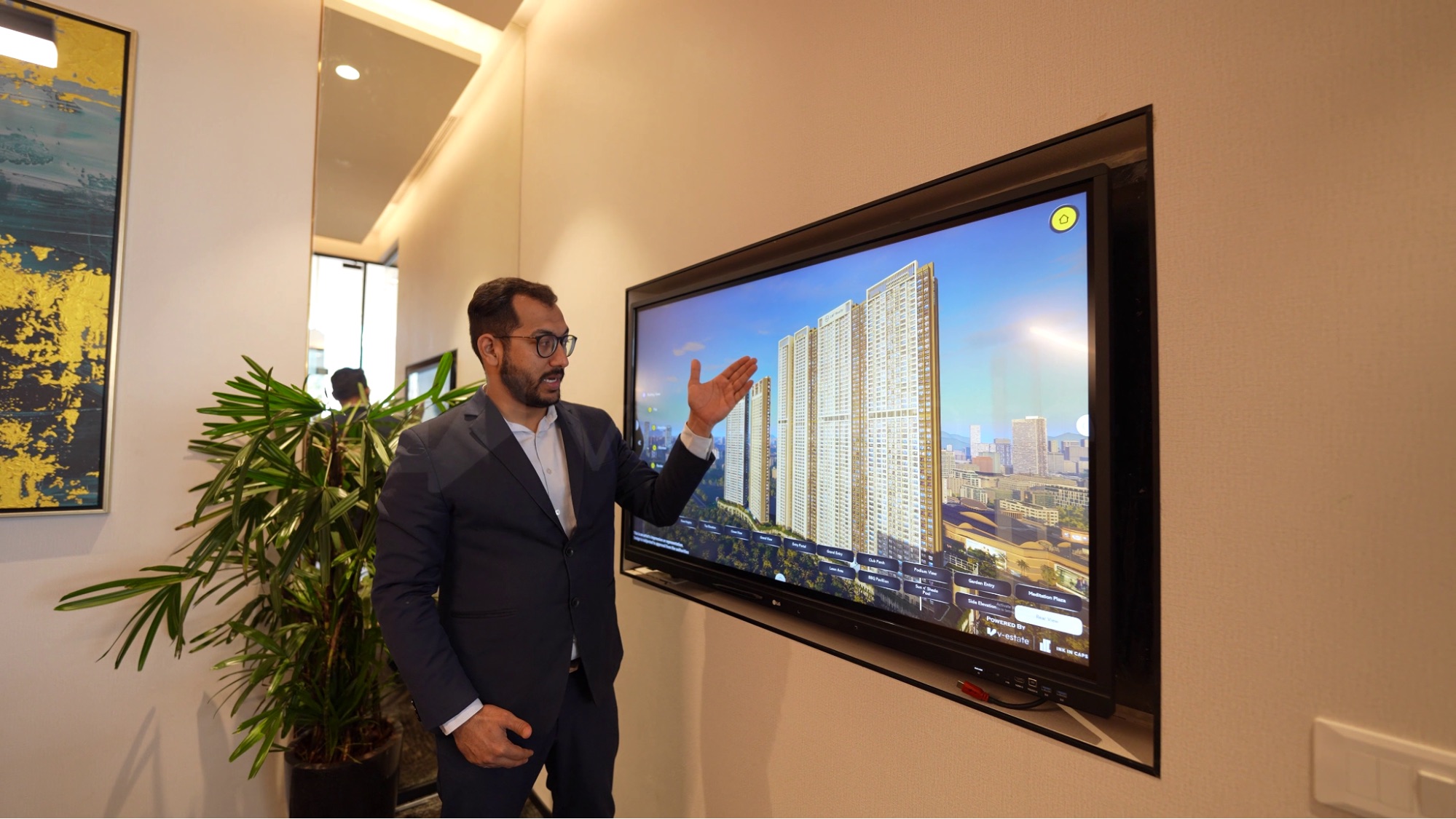
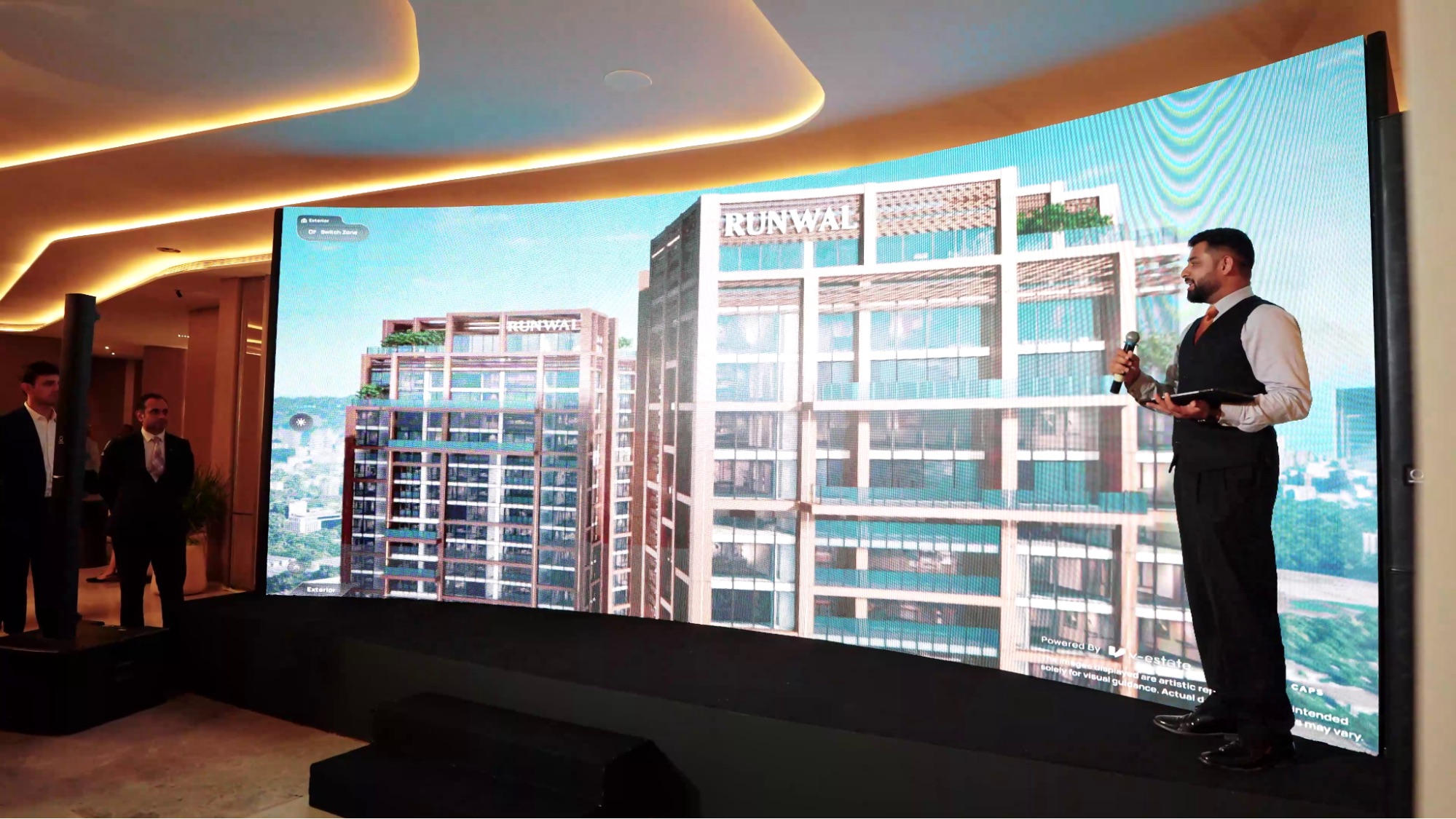
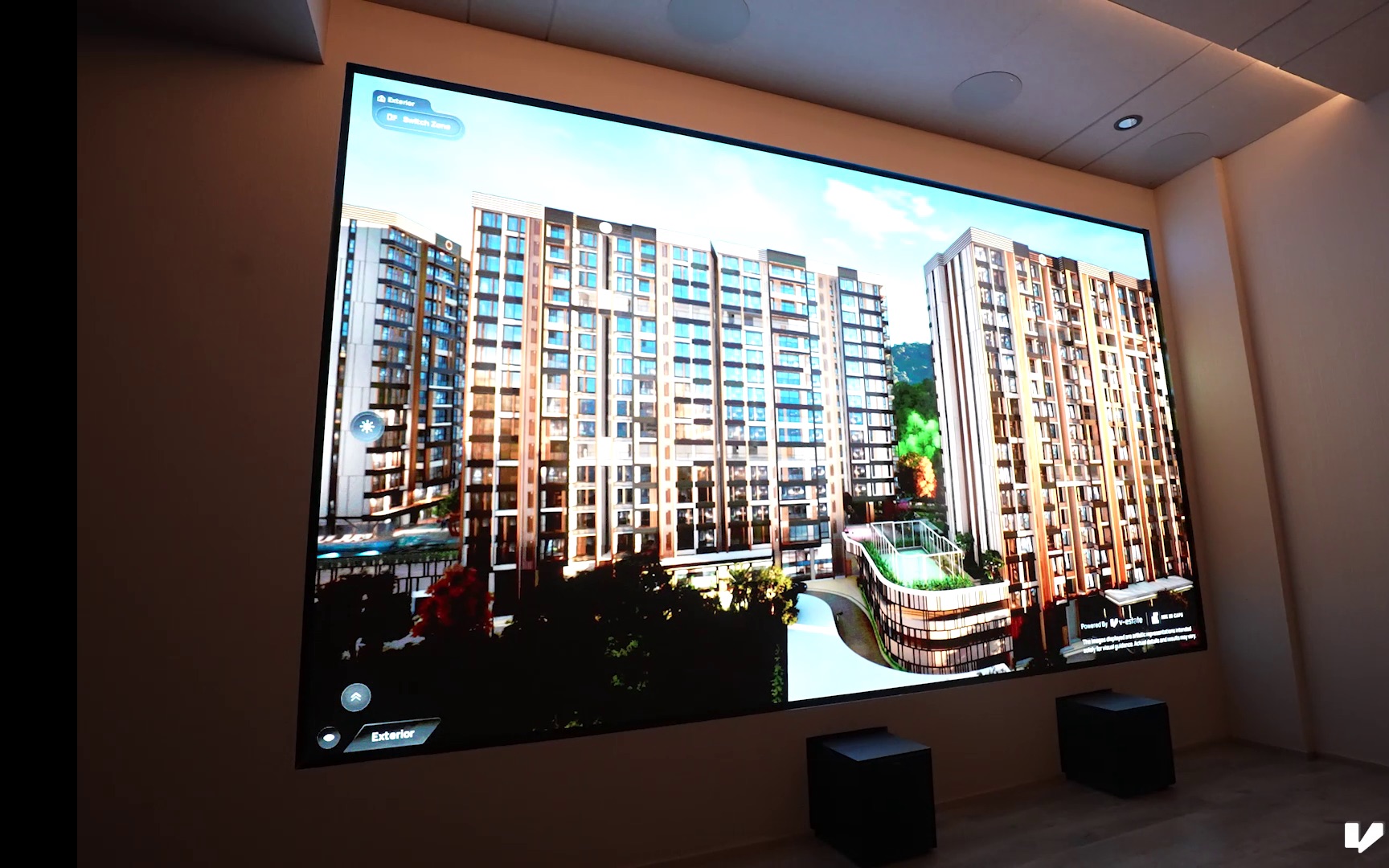
10 private discussion rooms each equipped with 65-inch screens and property walkthrough software
Hallways, the master plan, tower placement, amenities, podiums, and balconies all presented with visual clarity
Designed as the conversion stage: open, transparent, evidence-driven
The technology underneath this experience was equally deliberate. Unreal Engine 5.4 with Procedural Content Generation painted millions of foliage instances across the green zone site, maintaining 30 to 35 FPS under continuous load.
A redundant dual-server architecture with seamless failover over Cat6 made sure that there was no downtime during the six months of live operation. Custom display adaptation tools resolved aspect ratio and projection anomalies across large-format screens without manual intervention.
When infrastructure changed on site mid-deployment, the network topology was re-engineered and redeployed within 72 hours. The sales launch did not pause.
What the Results Showed
The outcomes confirmed what the engineering was built for.
190 to 210 families handled per day during peak launch weeks with no queue delays or system slowdown
100% operational uptime sustained across 6 months of continuous live operation
Shorter decision cycles, with real-time visualisation, eliminate ambiguity on layouts and finishes
Reduced repeat visits, as buyers left with enough clarity to decide without returning for clarification
25+ sales executives fully trained and operating independently from day one
Reusable framework delivered, with standardised toolkits and environment pipelines ready for future Rustomjee developments
The throughput metric is worth pausing on. Delivering 190 to 210 families per day, across a 7-hour operational window, without queue delays, without system slowdown, and without compromising the quality of individual buyer conversations is an expected result. It is an engineering outcome. The experience was designed for exactly this load and delivered precisely against it.
And it ran for 6 months of continuous live operation without a single system failure. In a sales environment, reliability is crucial because one crash during a critical presentation can permanently damage a sales team's confidence in the tool. It is the commercial foundation everything else rested on.
The Closing Perspective
Buyers arrive at your sales centre having been shortlisted, compared, and researched. What they cannot find online is certainty. That certainty is either built in the room or not at all.
A 360 virtual tour real estate experience tied to a physical IoT model, guided by a trained sales executive, and engineered for zero downtime across months of high footfall operation is no longer a differentiator. In competitive markets, it is the baseline.
The Rustomjee Dombivali case shows what happens when every element of that experience is built with precision: buyers stay longer, ask better questions, and leave having decided.
Interactive property walkthroughs enhance the presentation of a project. They systematically eliminate every reason a buyer might have to leave without making a decision.
Reduce your sales cycle by 30% and get faster conversions with our interactive property walkthroughs. Book a demo at V-Estate.