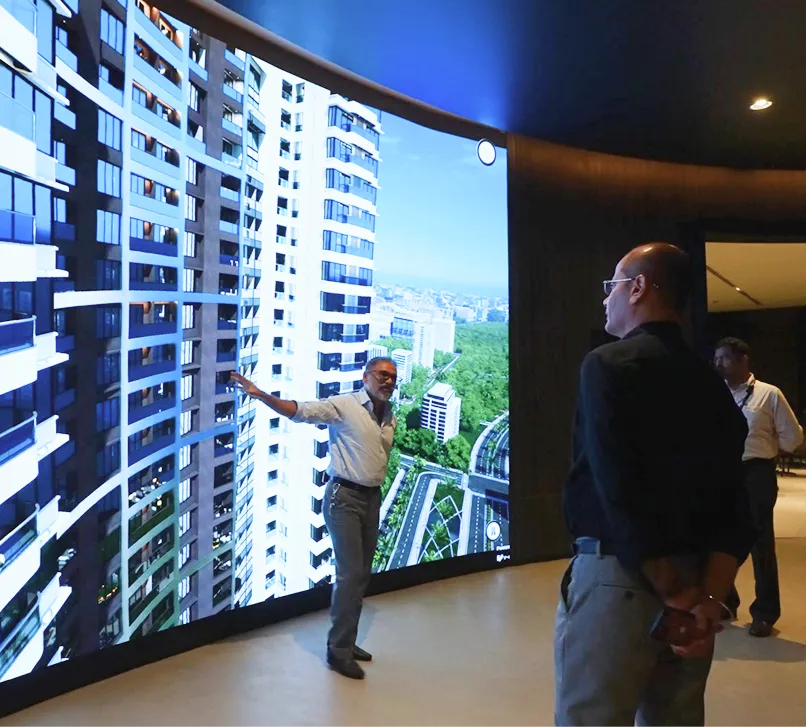
Real estate has always had one fundamental challenge: how do you help buyers experience a property before they can physically step into it?
Brochures, scale models, show flats, and CGI have traditionally filled that gap. But as developments become larger and more complex, buyers need to understand more than an apartment. They need to see the architecture, amenities, views, connectivity, and surrounding environment as one connected proposition. This is where emerging technologies in the real estate sales business are changing the way properties are presented, explored, and understood.
How Interactive Technology Is Changing Real Estate Sales
Technology is moving beyond being a visual enhancement in the sales gallery. It is becoming part of the sales journey itself.
Instead of relying on multiple disconnected assets, developers can bring different layers of a project into a single interactive environment. A buyer can move from the masterplan to a tower, explore an amenity, step into an apartment, and understand its views, all within the same experience.
This shift is being driven by technologies such as
- Digital twins and real-time 3D visualization
- Spatial computing and VR
- Immersive content and large-format visualization
- Interactive vicinity and connectivity mapping
The value comes from how these technologies work together to make complex property information easier to explore.
Digital Twins: Bringing the Entire Property Experience Together
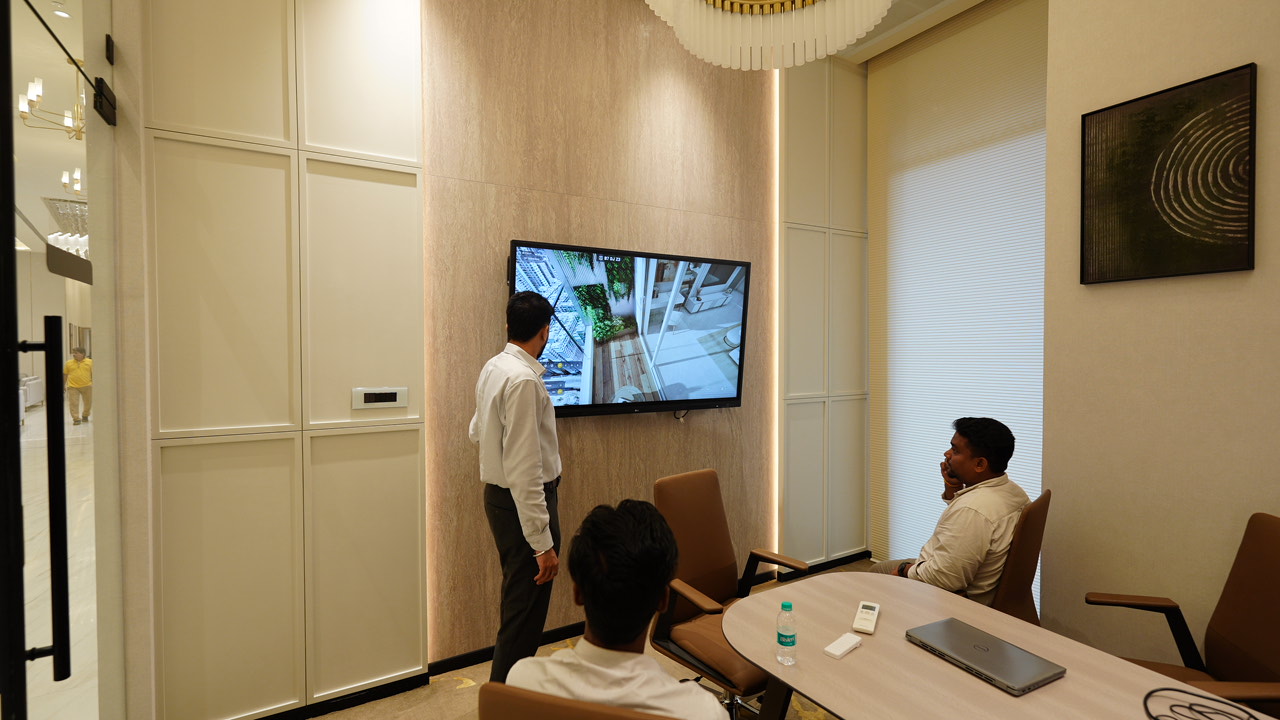
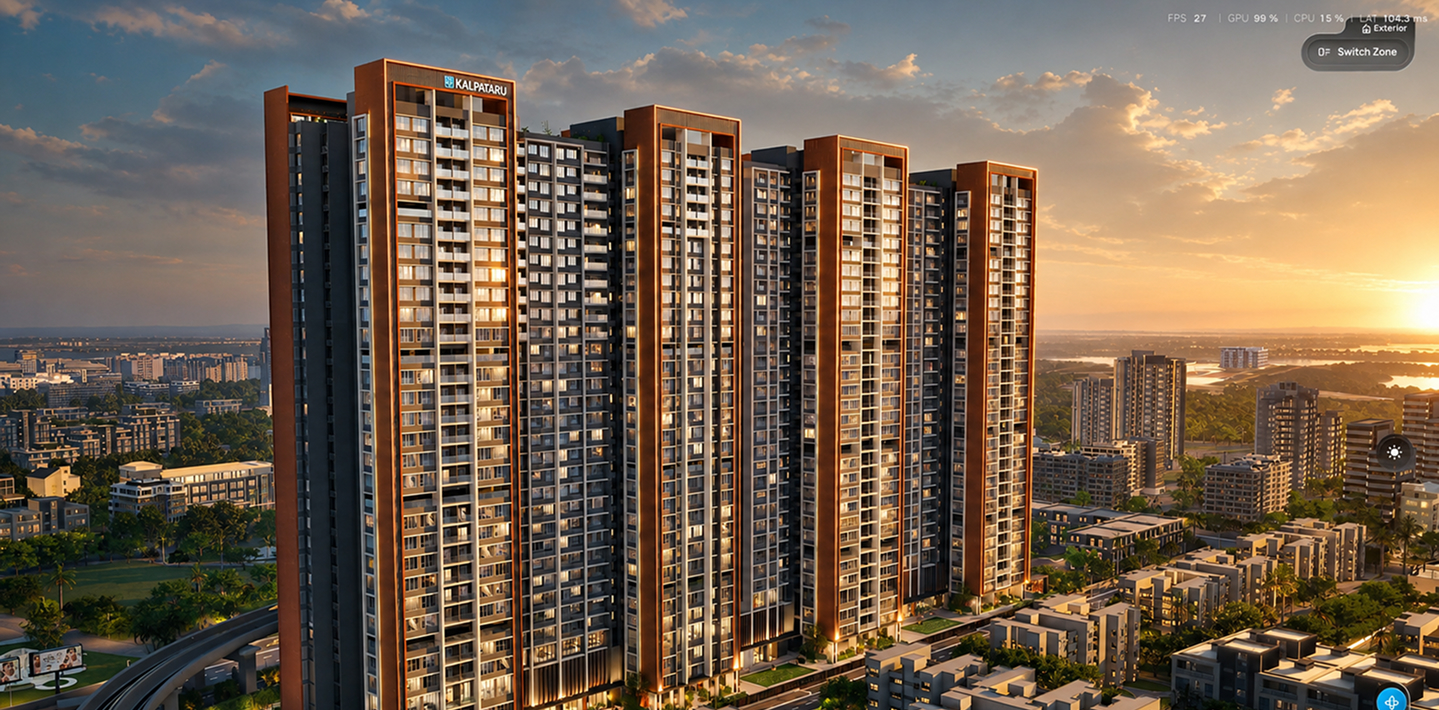
A digital twin in property development can bring different layers of a project into one interactive digital environment.
For a residential or commercial development, this can include the architecture, masterplan, amenities, apartments, views, surrounding infrastructure, and future development.
A buyer can explore:
- 3D architectural visualization: Understand towers, façades, layouts, and spatial relationships.
- Interactive amenities: Explore lifestyle spaces and understand their scale and placement.
- Vicinity mapping: See connectivity, infrastructure, landmarks, and key destinations around the project.
- Apartment exploration: Navigate configurations, interiors, and individual residences.
- Panoramic views: Compare views based on tower, wing, floor, or apartment orientation.
- Dynamic environments: Experience different lighting and time-of-day conditions.
The strength of a digital environment lies in this connection. Buyers do not have to move between a brochure, a map, a video, and a separate apartment visualization.
They can explore the project as one connected experience.
For sales teams, this also creates more flexibility. The consultant can follow the buyer's interests instead of taking every prospect through the same fixed sequence.
Spatial Computing and VR: Experiencing the Unbuilt
While digital twins help buyers understand the larger property ecosystem, spatial computing in real estate addresses a different challenge: helping people understand physical space before it exists.
Personalised VR in real estate allows buyers to step inside a digital representation of an apartment and experience its layout, scale, depth and views more directly.
This becomes particularly valuable when a project does not have a physical show flat.
Instead of asking buyers to imagine the finished residence from a floor plan or render, VR gives them a way to experience the space more intuitively.
The technology can also make apartment-specific details easier to communicate, such as
- Room proportions and spatial flow
- Interior finishes
- Window views
- Apartment orientation
- Different configurations
- Relationship between indoor and outdoor spaces
This is where VR moves from being an impressive technology demonstration to becoming a practical sales tool.
L&T Ahana: Building a Completely Digitalized Experience Center
L&T partnered with V-Estate to create its first completely digitalized experience centre for L&T Ahana, Malad.
The challenge was straightforward but significant.
There was no conventional physical show flat or conventional sales tools.
Yet buyers still needed to understand Ahana's architecture, premium residences, amenities, views, and connectivity. The project also had multiple propositions to communicate, including its location along the Western Express Highway, proximity to Kurar Metro, 2, 3, and 4 BHK residences, three levels of amenities, and more than 15,000 sq. ft. of integrated retail.
The solution was a connected digital buyer journey combining HoloTube, immersive motion posters, VR, and V-Estate’s interactive sales software.
Each technology had a specific role within the overall experience.
Zone 1: Holographic Architecture Visualization
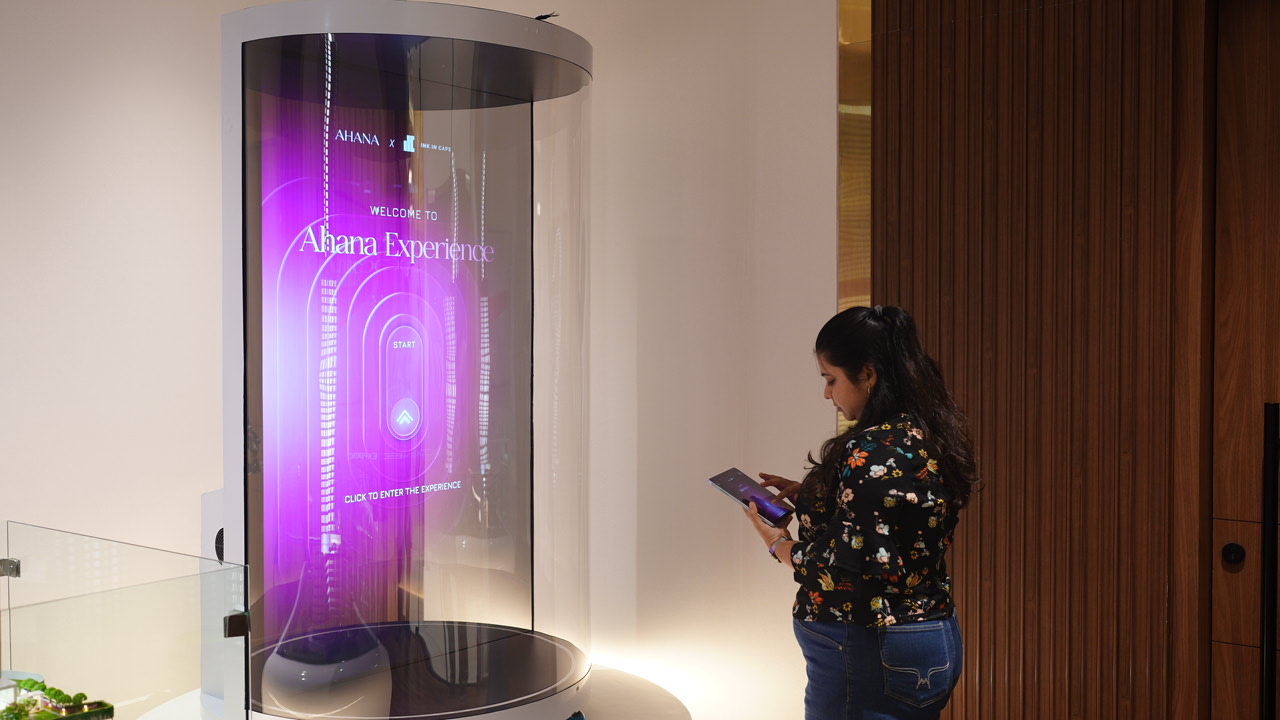
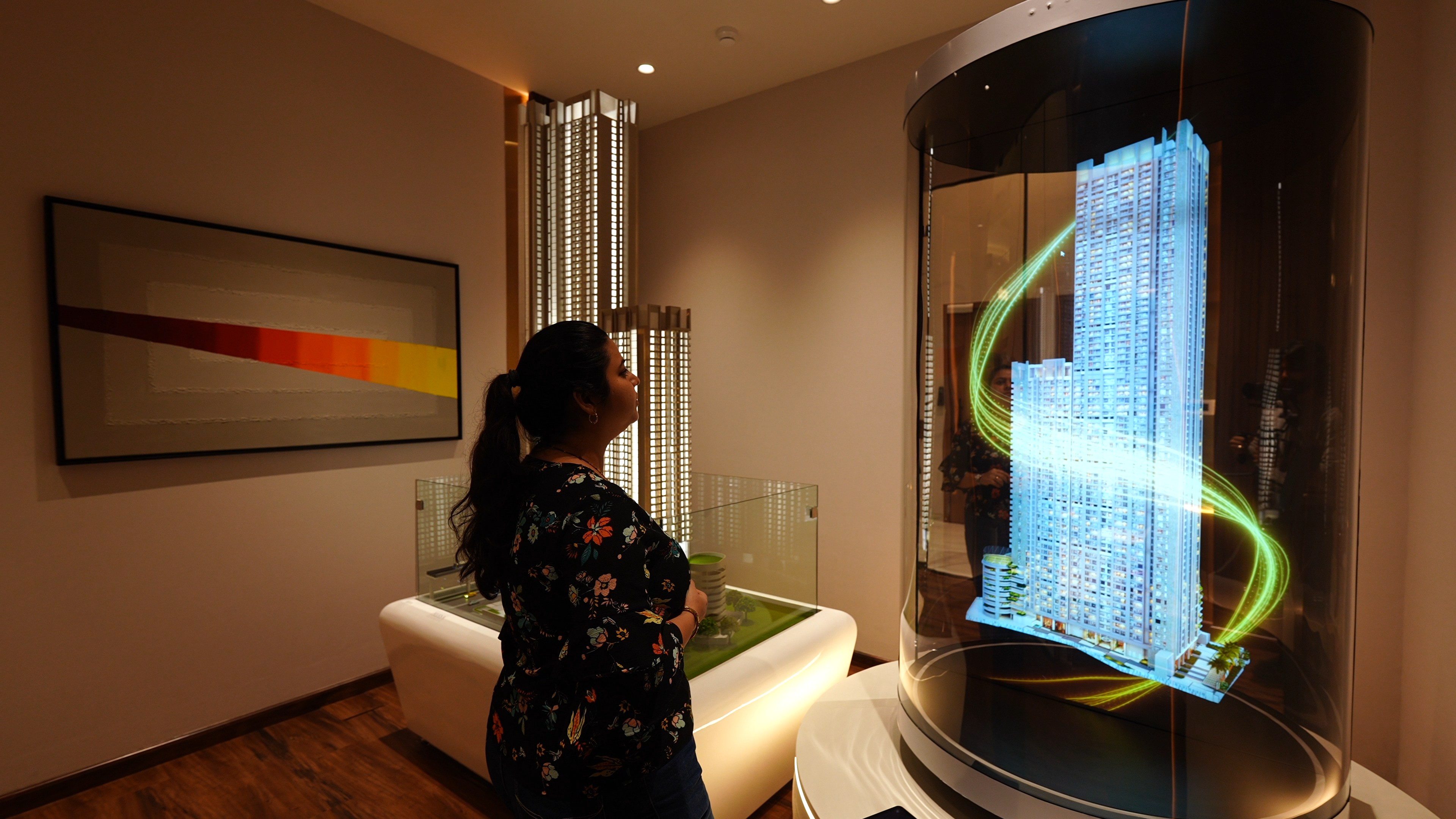
The journey starts with HoloTube, designed as a digital alternative to a conventional scale model.
It presents the project's complete façade while allowing consultants to explore the ground floor, podium, and podium-level indoor amenities. Individual amenity placements can also be visualized, giving buyers an initial understanding of how the development is organized.
The system uses a custom Unity application driving a 265+ image sequence for 360° horizontal rotation.
An 11-inch iPad Pro provides sub-millisecond dialler control through a local WebSocket architecture, while motion particle reveals and animated architectural callouts add information to the visual experience.
The result is a concise architectural overview that establishes the project before buyers move into deeper exploration.
Zone 2: Immersive Motion Posters
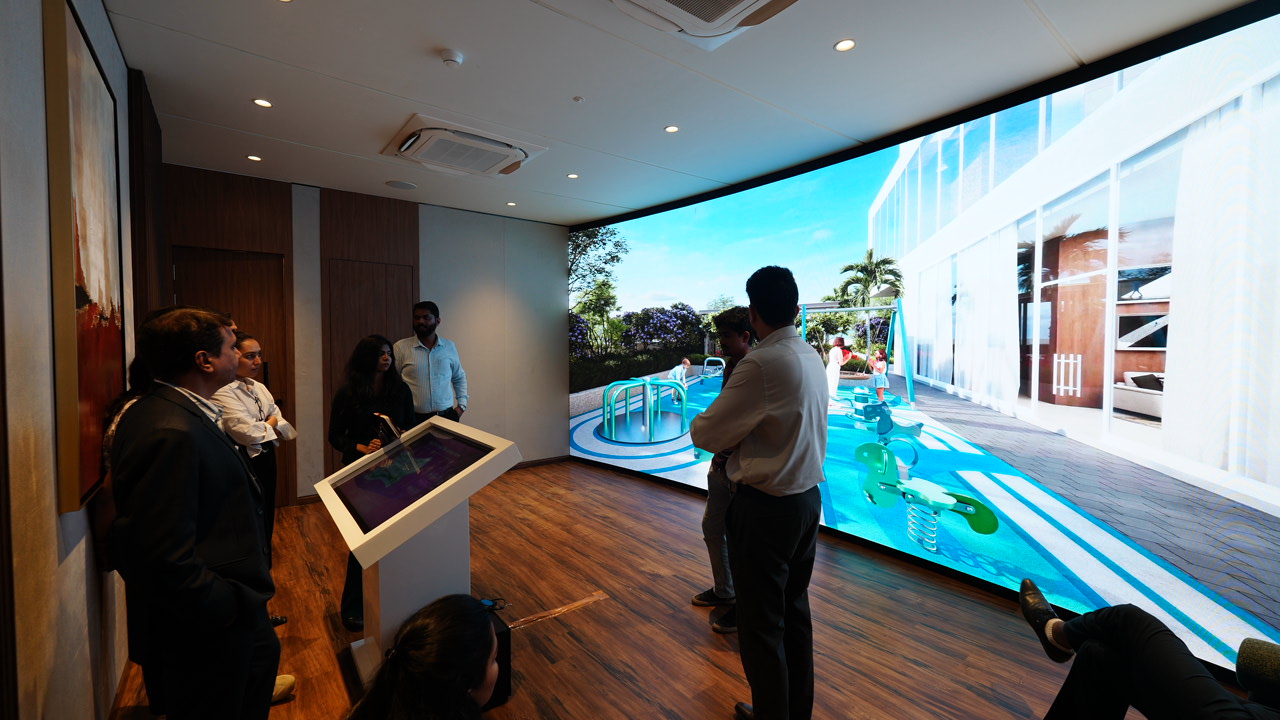
The next stage focuses on the lifestyle offering.
Approximately 15 key amenities are showcased through large-format immersive motion posters. Instead of presenting amenities as static images, cinematic content gives buyers a stronger sense of scale, atmosphere, and context.
The experience allowed buyers to spend approximately 20–30 minutes exploring spaces such as recreational areas, courts, and business facilities.
Unreal Engine was used for motion-poster content, while 3ds Max was used for the 360° VR environments. A 16K rendering pipeline supported the high-fidelity visuals.
Sound design, background music, and ambient environmental sounds were also incorporated to complement each amenity experience.
The objective was to help buyers understand the lifestyle offering as a collection of spaces they could experience, rather than features they simply read about.
Zone 3: VR Show Flat Experience
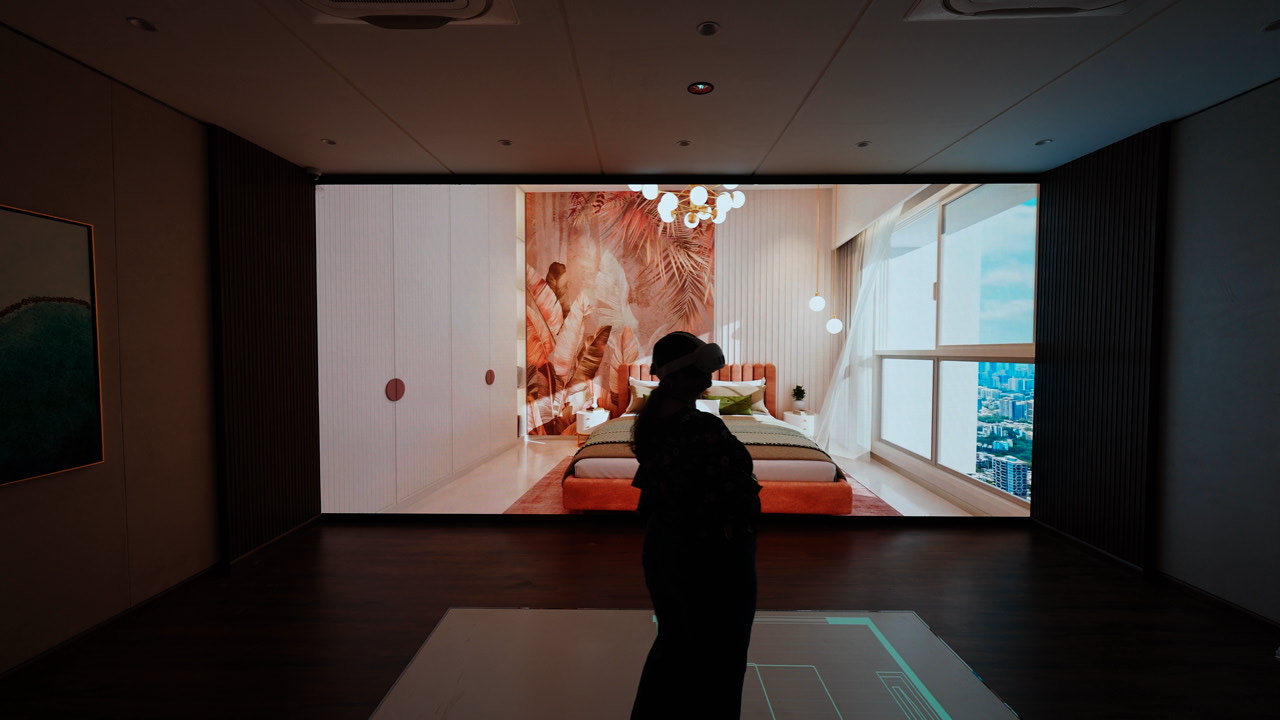
Without a physical show flat, one of the biggest challenges was helping buyers understand the scale, depth, and spatial experience of the apartment.
The VR experience addressed this by allowing buyers to step inside a virtual representation of the residence.
An important addition was the ability to explore four directional views: North, South, East, and West.
This gave buyers a clearer understanding of what different apartment orientations could look towards, making the discussion around a specific residence more tangible.
The system synchronized Meta Quest VR headsets with:
- An 11-inch iPad control console
- An auxiliary LED screen
- 9 ft × 7 ft floor projection mapping
A 16K stereoscopic rendering pipeline was used to deliver depth perception, supported by custom Unity shaders and post-processing layers optimized for mobile VR chipsets.
The setup included 8 enterprise VR headsets, with 4 active units and 4 hot-swappable backup units to support uninterrupted demonstrations.
Zone 4: Smart Discussion Rooms
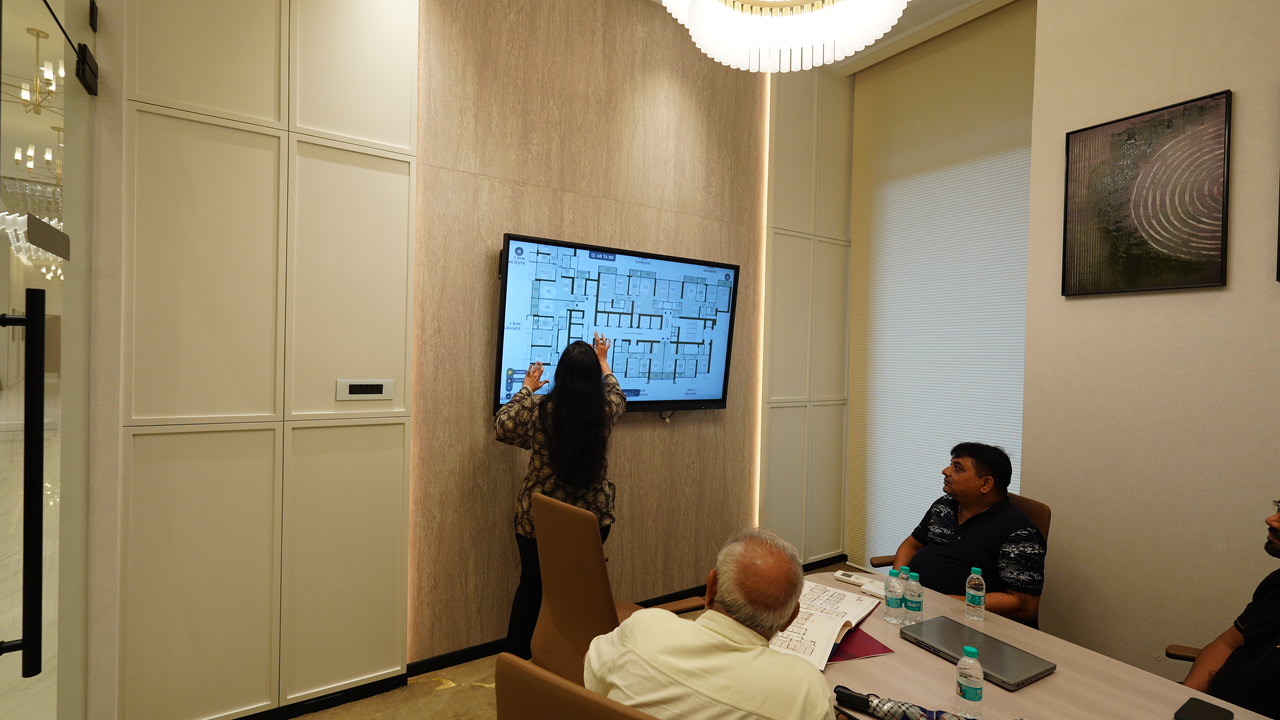
The final stage brings the experience into the actual sales conversation.
V-Estate's interactive sales software was deployed across 65-inch interactive touchscreens in dedicated sales pods.
The software brings together project- and residence-level information, including:
- Tower A with 60+ floors and 2, 3, and 4 BHK residences
- A second tower of approximately 35–45 floors, predominantly comprising 4 BHK residences
- 5 km interactive vicinity mapping
- Amenities and lifestyle information
- Apartment interiors and configurations
- North, South, East and West-facing views
The consultant can begin with Ahana's connectivity story, move into the project and amenities, and then narrow the discussion down to a specific residence.
The four-directional view experience adds another layer of personalization. Consultants can switch between different orientations based on the apartment being discussed, giving buyers greater clarity around the outlook from their selected residence.
The experience therefore connects the broader location story with the project, lifestyle, and individual apartment within one sales environment.
What the Digital-First Approach Achieved
The experience was tested through actual buyer interaction, with key outcomes including:
- 100+ VR demos conducted across the opening weekends
- 100% VR adoption across participating buyer demographics, including senior citizens
- Zero physical show flat requirement
- 30+ minutes of buyer engagement through immersive amenity exploration
- 15+ amenities visualized through large-format motion content
- 4 directional views integrated into the apartment experience
Internal feedback also indicated that VR helped communicate the apartment product more effectively and gave buyers a stronger understanding of the finished residence.
The project demonstrated that digital technology can take on a much larger role in a sales centre when the experience is designed around the actual information buyers need.
What This Means for Real Estate Developers
The relevance of real estate immersive sales tech goes beyond creating visually impressive experiences.
The right technology can address practical sales challenges:
When the project is still under construction
Digital environments can help buyers experience the finished product before physical spaces are available.
When there is no physical show flat
VR and immersive visualization can provide buyers with a more direct understanding of the residence.
When the development is complex
Digital twins can bring architecture, amenities, residences, views, and surroundings into one connected environment.
When location is a key proposition
Interactive vicinity mapping can make connectivity and surrounding infrastructure easier to demonstrate.
When buyers have different priorities
Interactive sales software allows consultants to adapt the journey instead of following one standard presentation.
This is where proptech innovation 2026 becomes commercially relevant. Technology is increasingly being used not simply to enhance marketing but to improve how a property is explained and experienced during the sales process.
The Strategic Takeaway
The evolution of real estate technology is ultimately changing the role of the sales gallery.
The traditional model is built around showing buyers information.
The emerging model gives them a way to explore that information.
A buyer can start with connectivity, move into the development, explore amenities, step inside an apartment, compare views, and then discuss a specific configuration with the consultant.
The sales team remains central to the process. Technology simply gives them a more flexible environment in which to have the conversation.
L&T Ahana demonstrates how this can work in practice. HoloTube, immersive motion content, VR, and interactive sales software came together to create a completely digitalized experience center, allowing the project to be communicated without a physical show flat or scale model.
As emerging technologies in the real estate sales business continue to develop, their real value will come from how effectively they help buyers understand complex properties and make more informed decisions.
The future is not simply about showing buyers what a property could look like.
It is about giving them the ability to see it, explore it, and experience it before it exists.
From digital twins and holograms to VR and interactive sales software, V-Estate helps developers turn complex property propositions into immersive, technology-led sales experiences.
Book a strategic demo and explore what V-Estate can build for your next project.
%20(1).jpg)