Pricing a premium property is straightforward. Defending that price in a room with a skeptical buyer — that is where most sales teams lose ground.
The challenge is not the price tag. The challenge is the gap between what a property is worth and what a buyer believes it is worth at the moment of decision. That gap is a communication problem. Not a product problem.
The Real Reason Buyers Resist Premium Pricing
Buyers do not reject price. They reject uncertainty.
When a buyer cannot visualize the finished product — the view from their specific floor, the feel of the living room at 6 PM, the quality of the finish in person — their brain defaults to doubt. And doubt, in real estate, always translates to negotiation pressure or delay.
Brochures describe. Renders illustrate. But neither format answers the questions that actually drive purchase decisions.
"Will my furniture fit here the way I imagine?" "What does the view actually look like from this unit?" "How does this balcony feel in the evening?"
These are emotional questions. Static presentations cannot answer them.
Price Justification Is a Confidence Problem
High-net-worth buyers and serious investors are not simply comparing square footage and price-per-square-foot. They are comparing confidence levels.
The developer who gives a buyer certainty — about the layout, the finish quality, the lifestyle, the view depth — wins. Even at a higher price point.
This is why experience-led selling consistently outperforms specification-led selling. When you replace a printed brochure with an immersive property experience, you shift the buyer's frame of reference. They stop comparing your project against a competitor on paper. They start comparing how they felt inside your project versus how they felt elsewhere.
That emotional anchor is what justifies price.
Mehta Marquina 1978, Goregaon
Project: Mehta Group | 38-floor mixed-use development | 1.2-acre land parcel | Goregaon, Mumbai
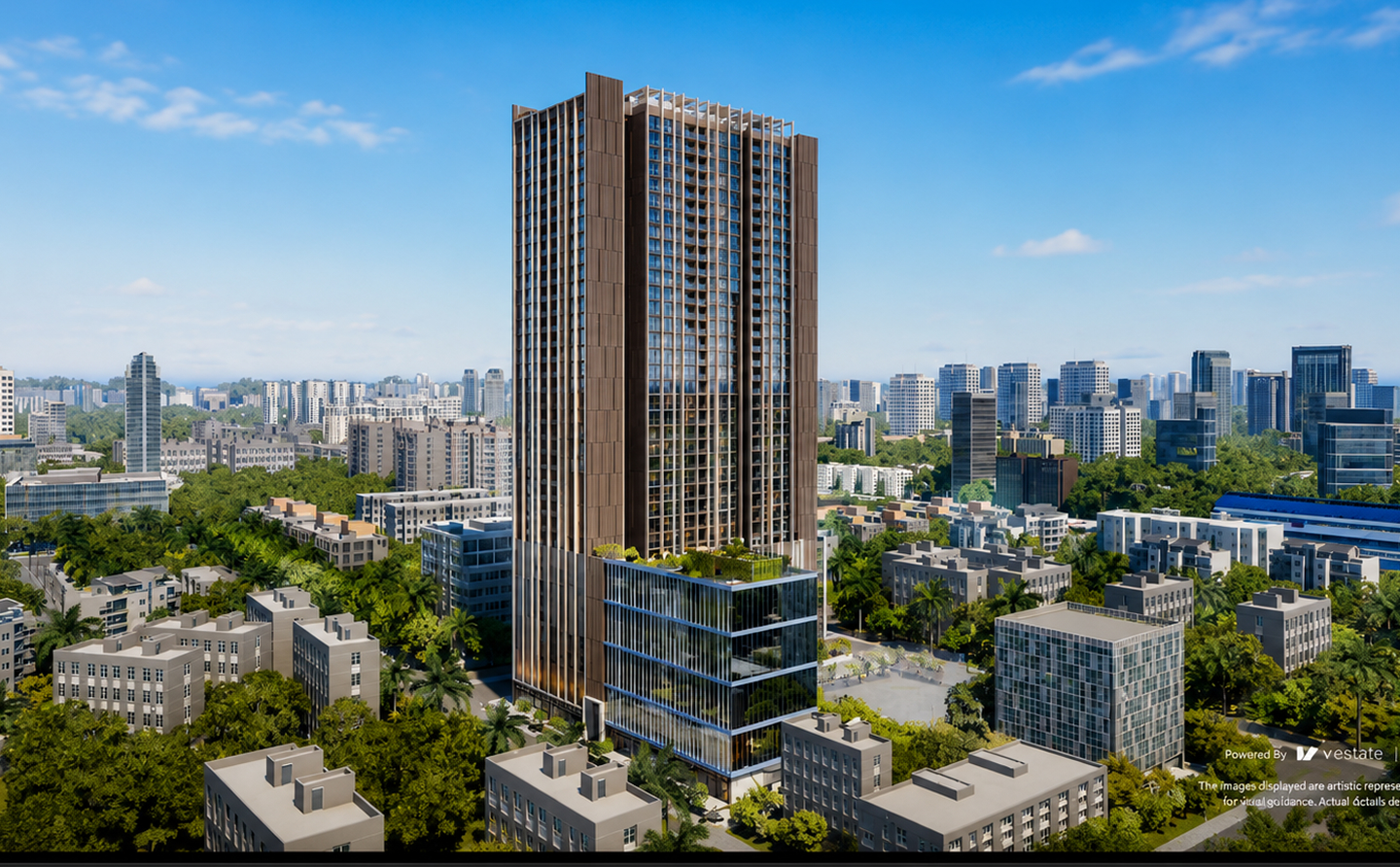
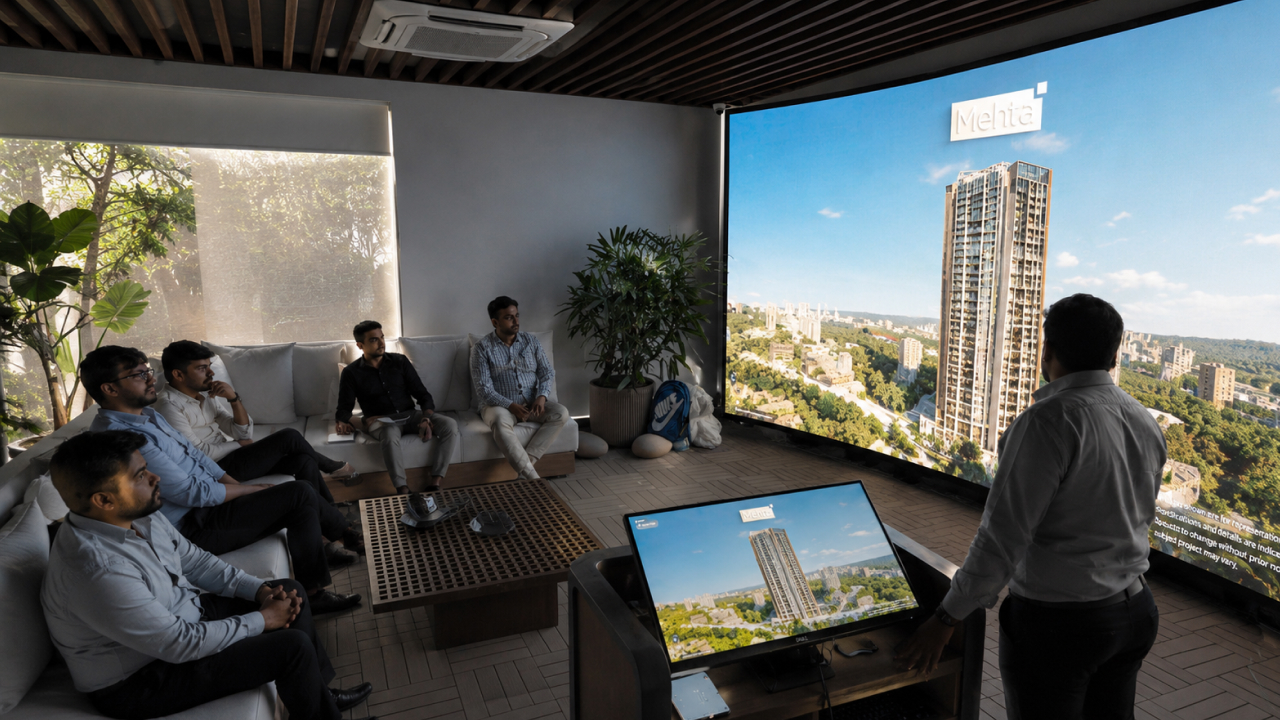
Mehta Group partnered with V-Estate to create an immersive visualization ecosystem for Mehta Marquina 1978 — a 1.2-acre mixed-use development featuring a 38-floor commercial tower and premium residences.
The core challenge was communicating two distinct buyer personas simultaneously: residential lifestyle buyers and commercial ecosystem investors. Traditional sales tools — brochures, scale models, static renders — could not bridge that gap effectively.
Corporate Architectural Visualization: The commercial tower's international architectural language — inspired by New York, Paris, and European business districts — was recreated in photorealistic real-time. The platform showcased 22 interactive vicinity touchpoints covering metro connectivity, highways, business districts, restaurants, educational institutions, healthcare, and lifestyle landmarks.
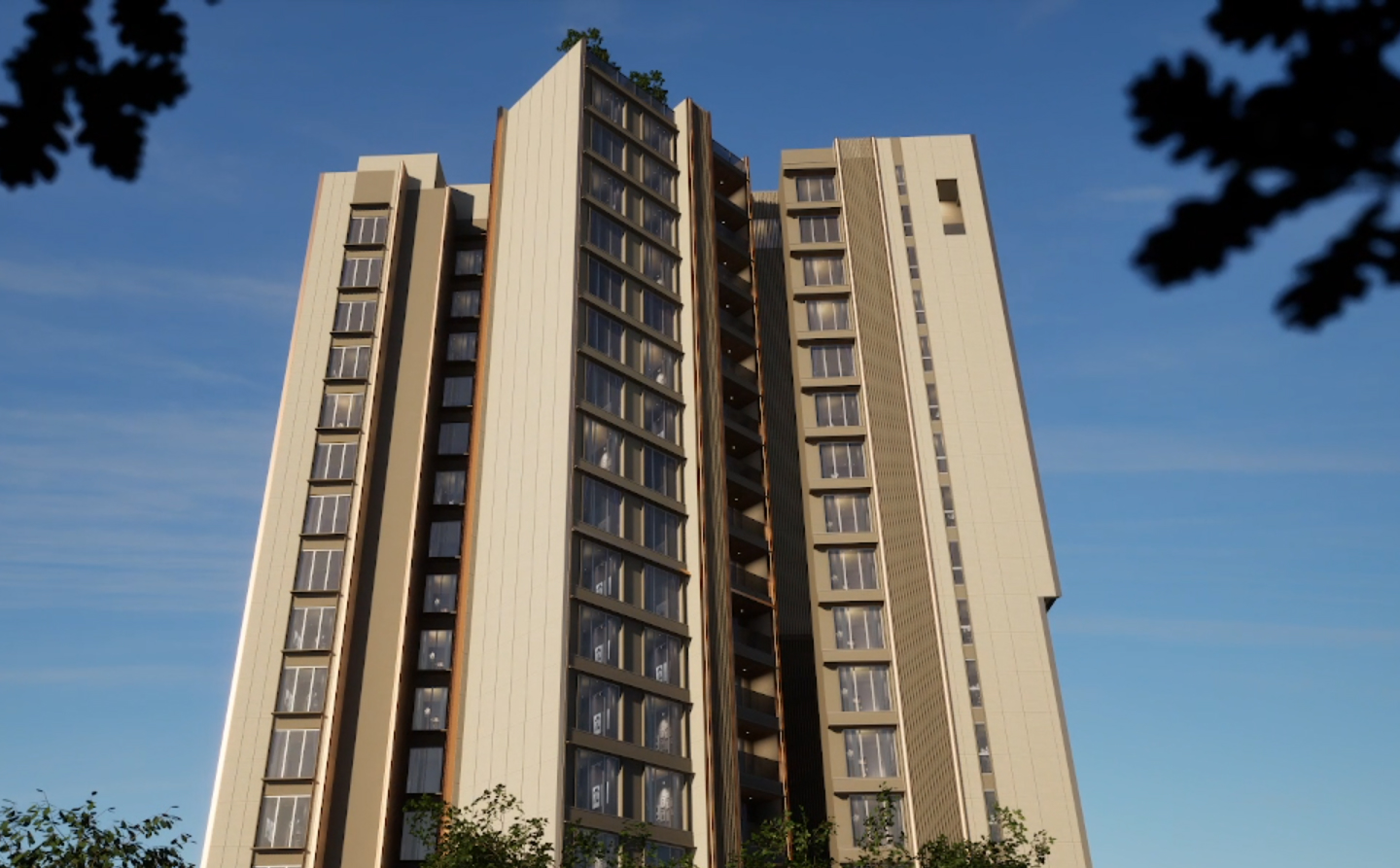
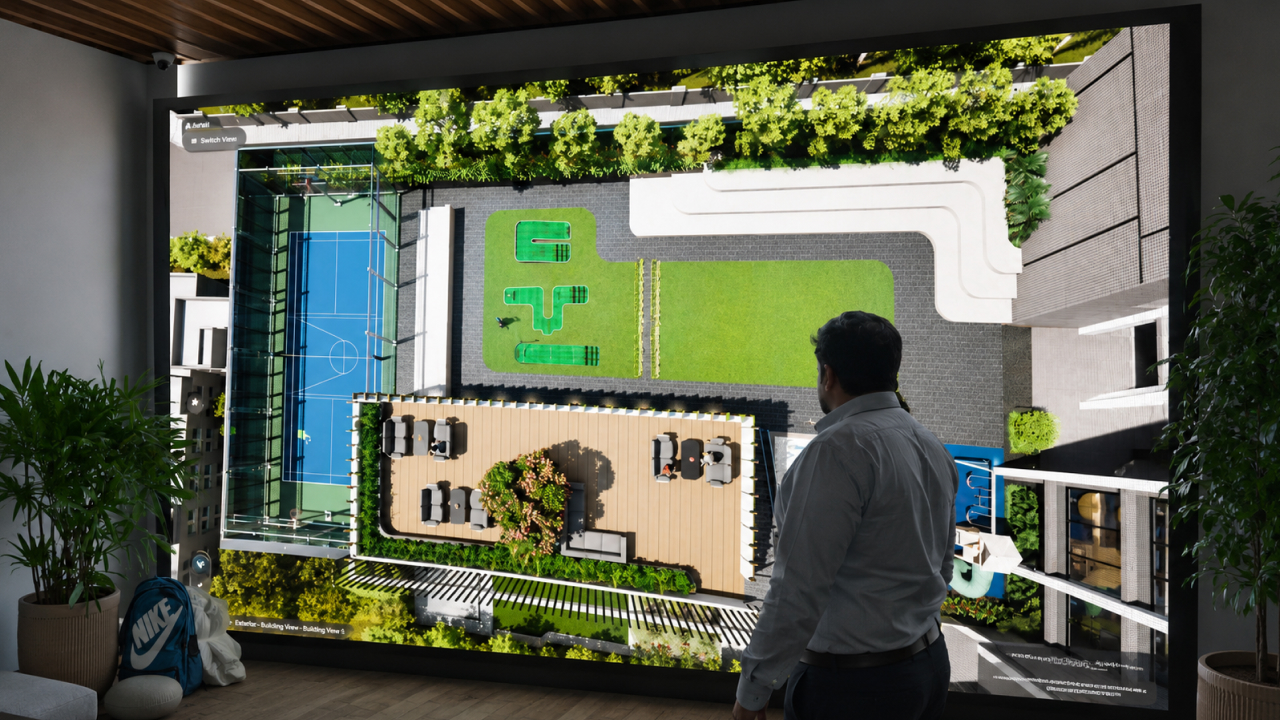
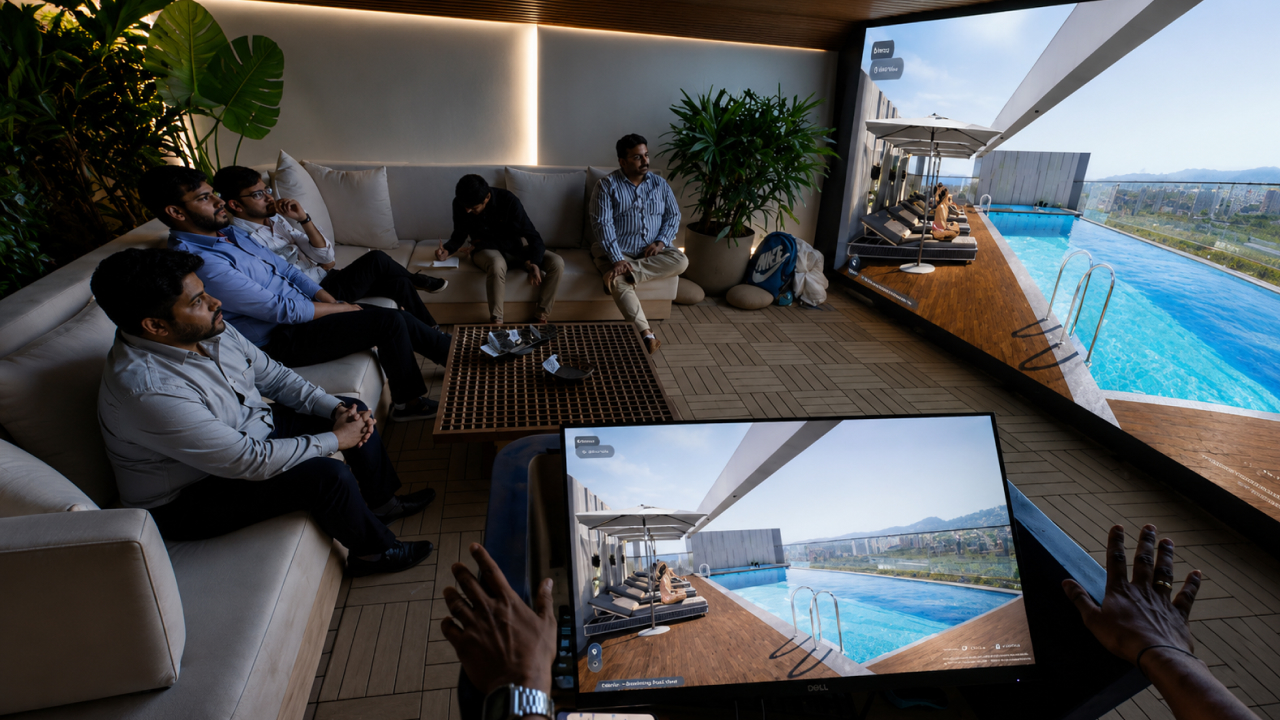
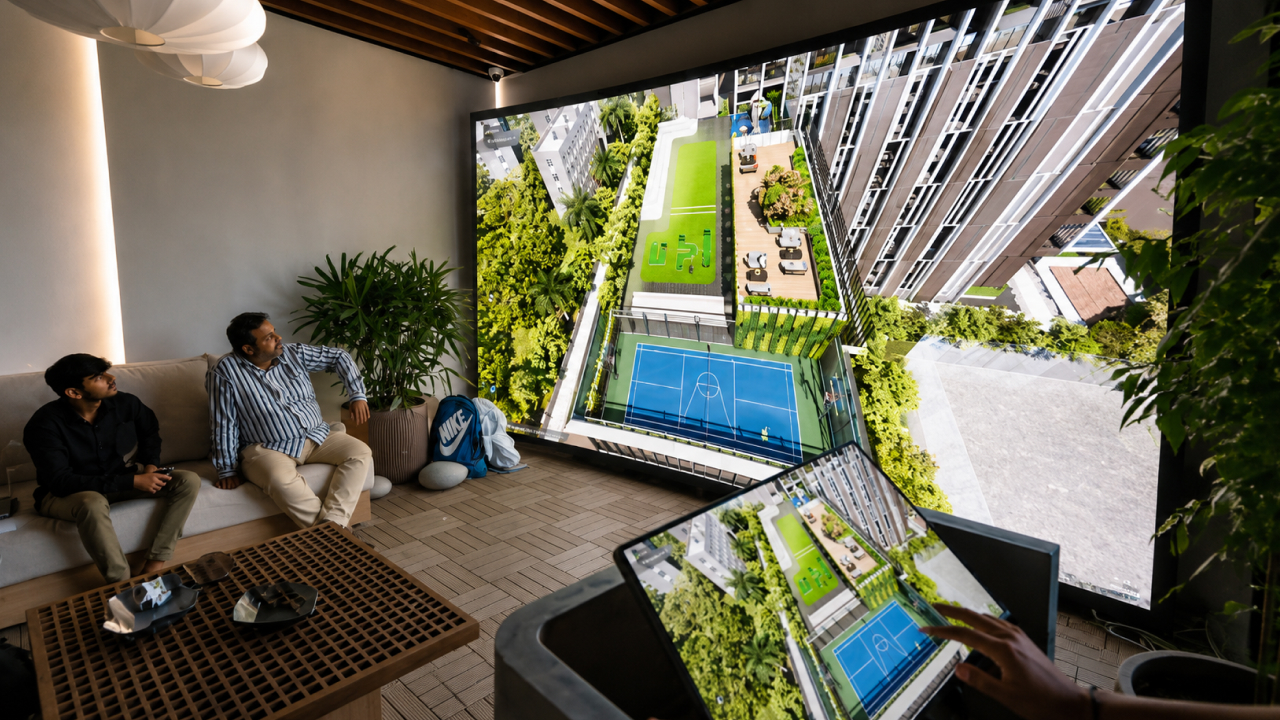
Residential Architectural Visualization: 31 interactive amenity touchpoints — rooftop lap pools, aqua gym, yoga decks, mini golf, working pods, pet park, amphitheatre — communicated lifestyle depth that no brochure page could replicate.
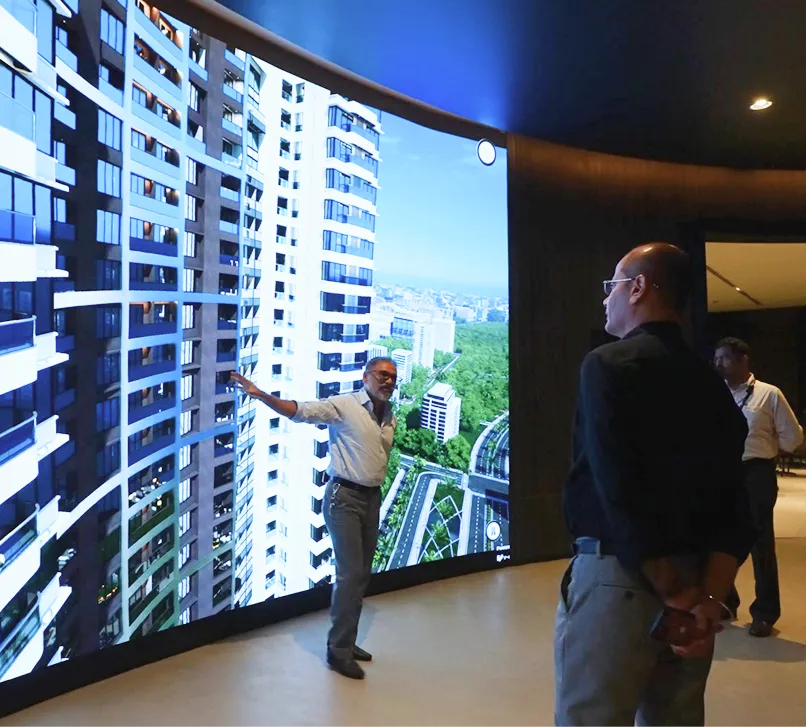
Interactive Discussion Room: A large-format LED display, interactive kiosk setup, and iPad-assisted controls enabled sales teams to move seamlessly between architecture, layouts, amenities, connectivity, and views during personalized buyer sessions.
One-Click 4K Render Feature: Teams could instantly generate photorealistic renders from the live platform for presentations and marketing collateral — directly during buyer discussions.
Results:
- 600+ interactive customer demonstrations conducted every month through the immersive experience centre
- 180+ marketing-ready visuals generated directly from the live V-Estate platform using One-Click 4K Render
- Became Mehta Group's first experiential PropTech deployment — transforming how the project was presented to buyers and channel partners
- Jay Mehta and Harsh Mehta, Managing Partners, appreciated the platform's photorealism, dynamic lighting simulations, and ability to enhance buyer understanding
The outcome was clear: buyers who experienced the project through this immersive ecosystem arrived at decisions faster. They were not being persuaded. They were self-convincing — because they had already experienced the product.
What Proving Looks Like vs Promising
Most real estate marketing runs on promises. "Premium finishes." "Stunning views." "World-class amenities." These phrases have been on every project brochure for two decades. Buyers have become immune to them.
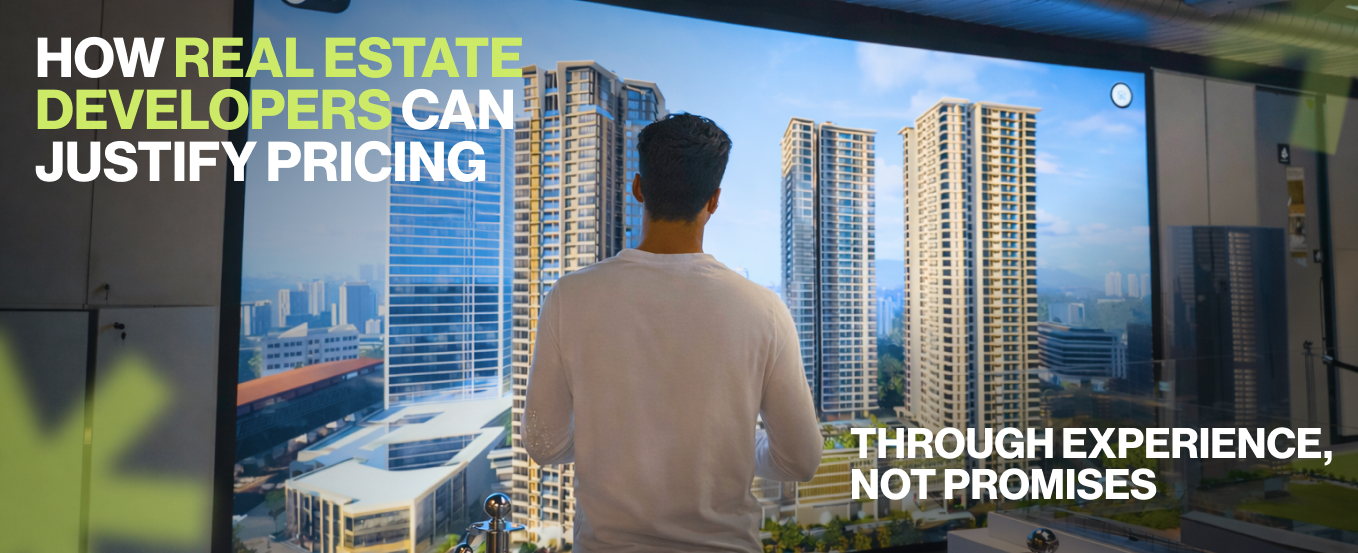
Proof is different. Proof is standing inside a photorealistic representation of your apartment. Proof is watching natural light shift from morning to evening in real time. Proof is choosing between two kitchen finish options and seeing the space transform instantly.
When you move from promising to proving, price resistance softens. Because the buyer is no longer being asked to trust your marketing copy. They are trusting their own experience.
The Sales Team Advantage
Sales teams operating with static presentations spend significant time managing objections — price pushback, layout doubts, finish quality concerns.
Sales teams operating with immersive visualization tools spend that same time closing.
The shift is not about selling harder. It is about creating the right environment for buyers to reach their own conclusions — with confidence.
Immersive offline visualization tools directly support price justification by replacing verbal promises with visual proof — allowing buyers to experience finish quality, views, and spatial reality before committing.
In Mumbai's competitive residential micro-markets — Goregaon, Thane, Panvel, Sewri — where multiple projects compete at overlapping price points, the sales experience quality is now a primary differentiator.
The Bottom Line for Developers and Marketing Heads
Price is not the problem. Perception of value is.
When buyers can experience a property before it is built — with real visual depth, real customization options, real finish accuracy — the conversation changes entirely. They are no longer buying on faith. They are buying on evidence.
That shift changes everything downstream: conversion rates, sales velocity, negotiation dynamics, and referral quality.
If your sales process is still built on brochures, renders, and verbal assurances — you are asking buyers to trust promises. The developers closing faster are giving buyers something better: proof. If your project deserves premium pricing, your sales experience should reflect that. Start by evaluating what your buyer actually experiences from the moment they walk through the door.