.jpg)
The real estate industry has been talking about "digital transformation" for years. But when you walk into most experience centers, you still see the same setup: a scale model gathering dust, a few brochures, and a sales executive trying to explain views that don't exist yet.
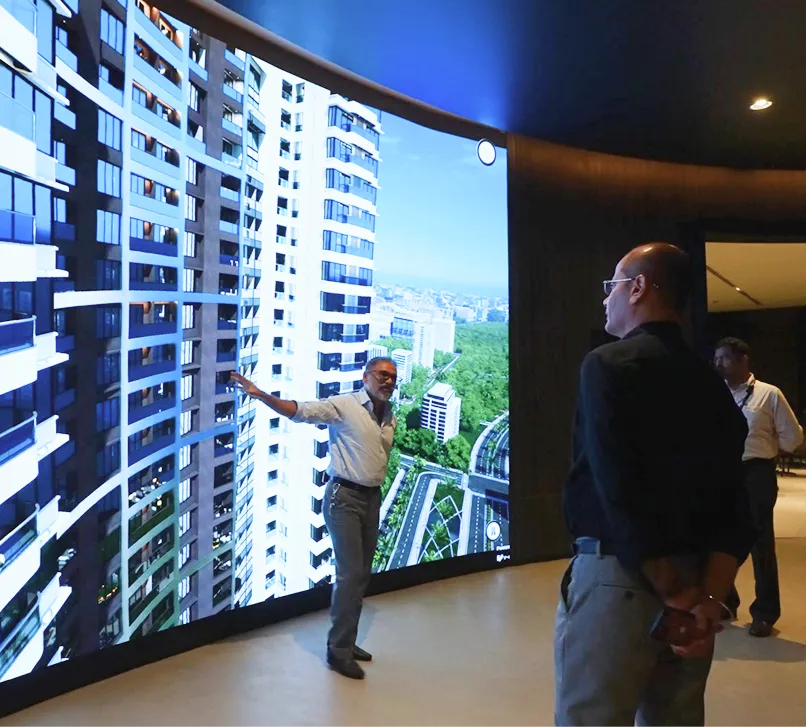
Nahar Realty's Chandivali Valley project took a different approach. They made their AV room the mandatory first touchpoint—not an optional add-on, not something customers see after they've already toured the model. The immersive visualization became the foundation of the entire sales journey.
This wasn't about adding technology for technology's sake. It was about solving real problems that affect conversion rates, customer confidence, and sales efficiency.
The Problem: Transparency Gaps in High-Stakes Purchases
Chandivali is a micro-market that hadn't seen much innovation in how projects are presented. Customers were making decisions worth crores based on floor plans, artist impressions, and verbal descriptions. The gap between what's promised and what's delivered has always been the industry's credibility problem.
For Nahar, the challenge was specific. They had a unique product—towers positioned so none overlooked each other, a Miyawaki forest on an adjacent hilltop, a heritage banyan tree on the podium—but explaining these features through traditional methods wasn't cutting it. How do you convey the feeling of "living in a valley" when the building doesn't exist yet?
The transparency issue becomes even more critical when you're dealing with complex site conditions. Chandivali Valley sits on a hilltop with significant elevation changes. The roads curve around the structure. The plot isn't a standard rectangular shape. These aren't details that translate well in a sales pitch or a static rendering.
Why the AV Room Became the First Step
Most developers treat digital tools as supplementary. The customer sees the model first, maybe tours a sample flat, and if they're still interested, someone might pull up a visualization.
Nahar flipped this sequence. Every customer, without exception, starts their journey in the AV room. A 13.5-foot by 8.3-foot LED panel with 1.8 pixel pitch delivers the visualization, controlled through an iPad by the sales executive.
This decision wasn't arbitrary. It was based on a simple realization: if you can show customers the complete project—the location context, the tower orientation, the views from specific floors, the landscaping plan, the amenity layout—before they see anything physical, you set expectations accurately from the start.
The immersive presentation consolidates information that would otherwise take multiple conversations to convey. One sales executive can handle multiple families in a single session. The experience is standardized, which means every customer gets the same level of detail regardless of which executive they meet.
What Makes This Different from Standard Visualizations
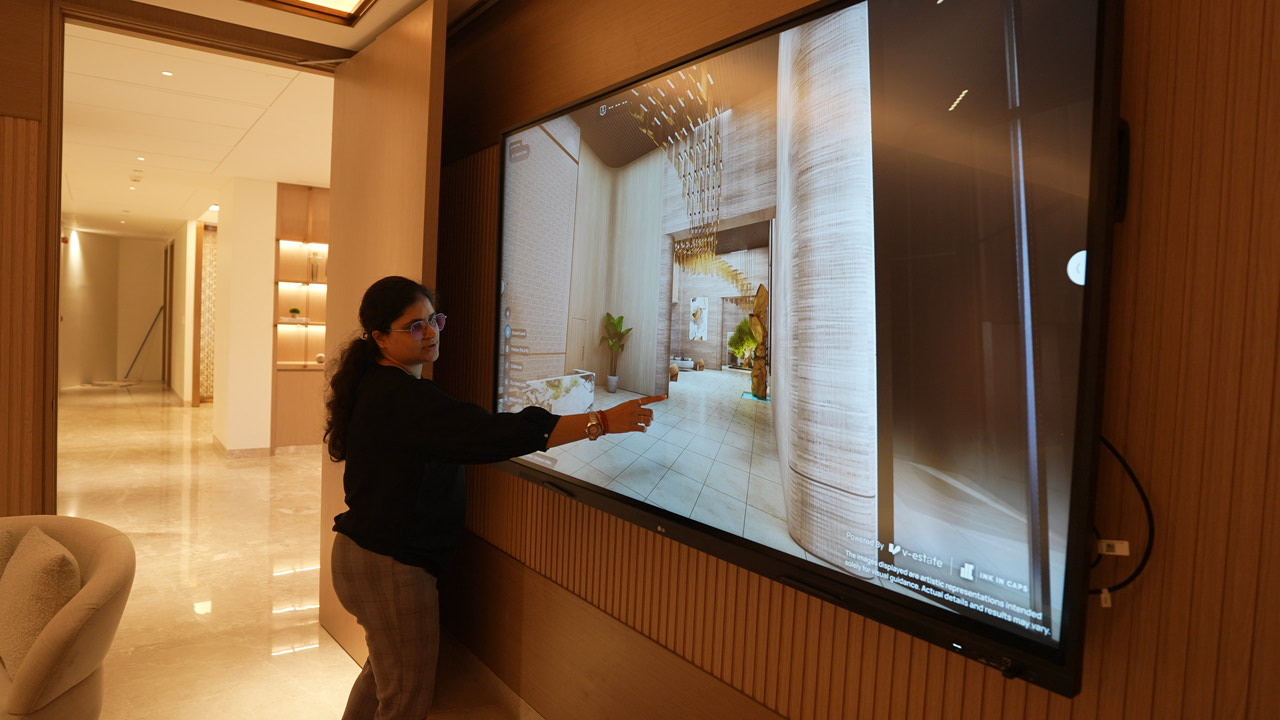
There's a difference between showing customers a video walkthrough and giving them an interactive exploration tool. V-estate, the platform Nahar deployed, isn't about passive viewing. It's about control.
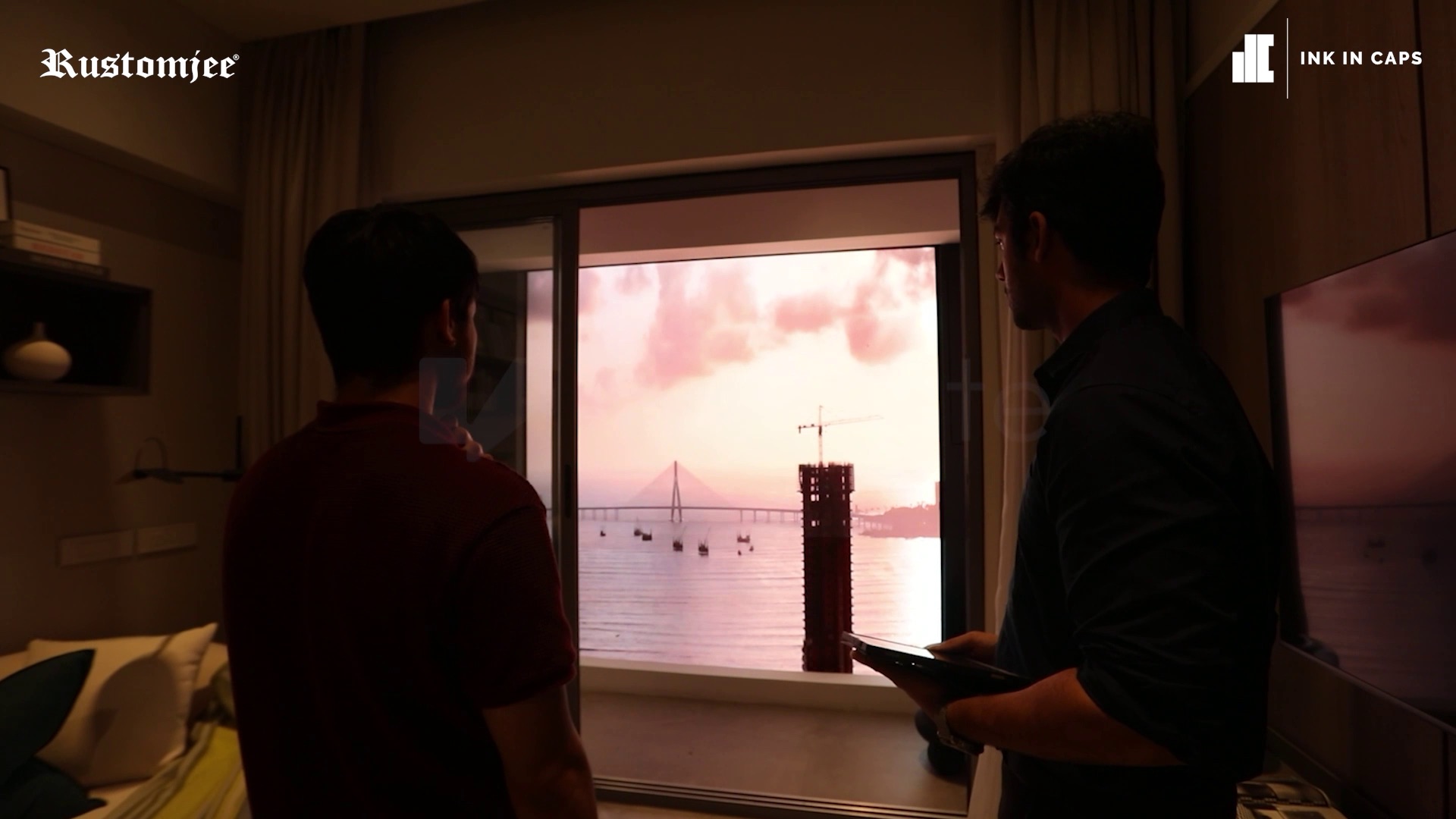
Customers decide which apartment they want to see. They control the viewpoint to understand what they'll see from their balcony—not a generic view, but the actual sightlines from the specific unit they're considering. They can see how natural light enters at different times of day. They can understand the relationship between their tower and the neighboring forest.
For Chandivali Valley, this level of control was essential because the site's complexity is also its selling point. The proximity to the Miyawaki forest meant customers needed to see how close the greenery actually is. The non-overlooking tower design needed to be demonstrated, not described. The heritage tree's position in the podium required spatial understanding that floor plans don't provide.
The technical execution behind this matters. The project was built in Unreal Engine 5.4, chosen for stability. The team developed a custom procedural content generation system specifically for realistic grass rendering—because when a forest is your primary differentiator, you can't use generic foliage assets.
The heritage banyan tree presented its own challenge. High polygon count models look great but kill performance in real-time applications. The team rebuilt the entire tree structure, optimizing the geometry without losing visual quality. These aren't minor technical details—they're the difference between a smooth, convincing experience and one that feels like a placeholder.
The Four-Stage Journey Design
After the AV room presentation, customers move through three additional touchpoints:
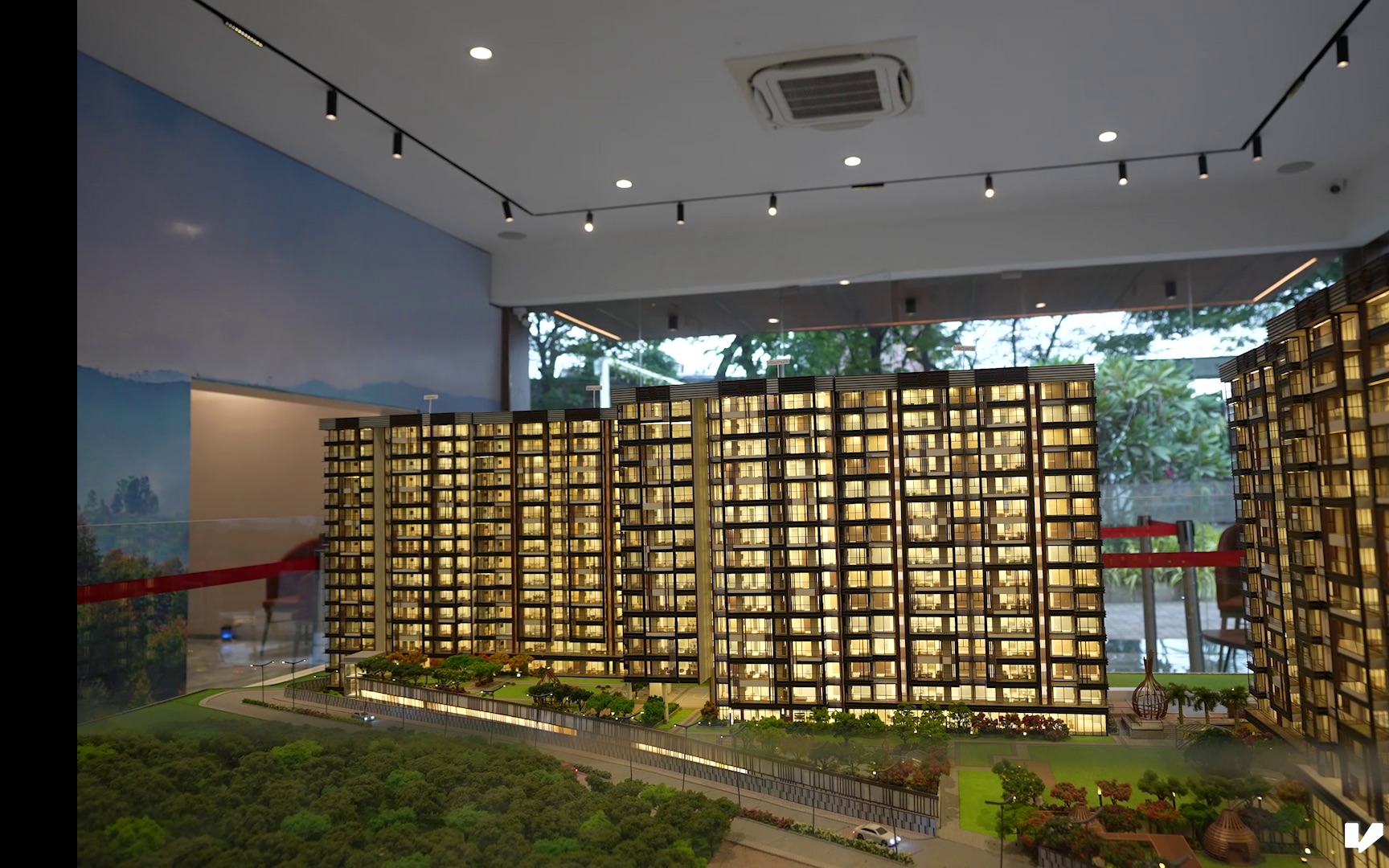
The physical scale model—now viewed with context from the digital presentation
The sample 3BHK flat on-site—where they can validate what they saw digitally
Curated discussion rooms—where decisions get made
This sequence is deliberate. The digital experience sets the foundation. The physical elements confirm and reinforce. By the time customers reach the discussion room, they've already understood the project comprehensively.
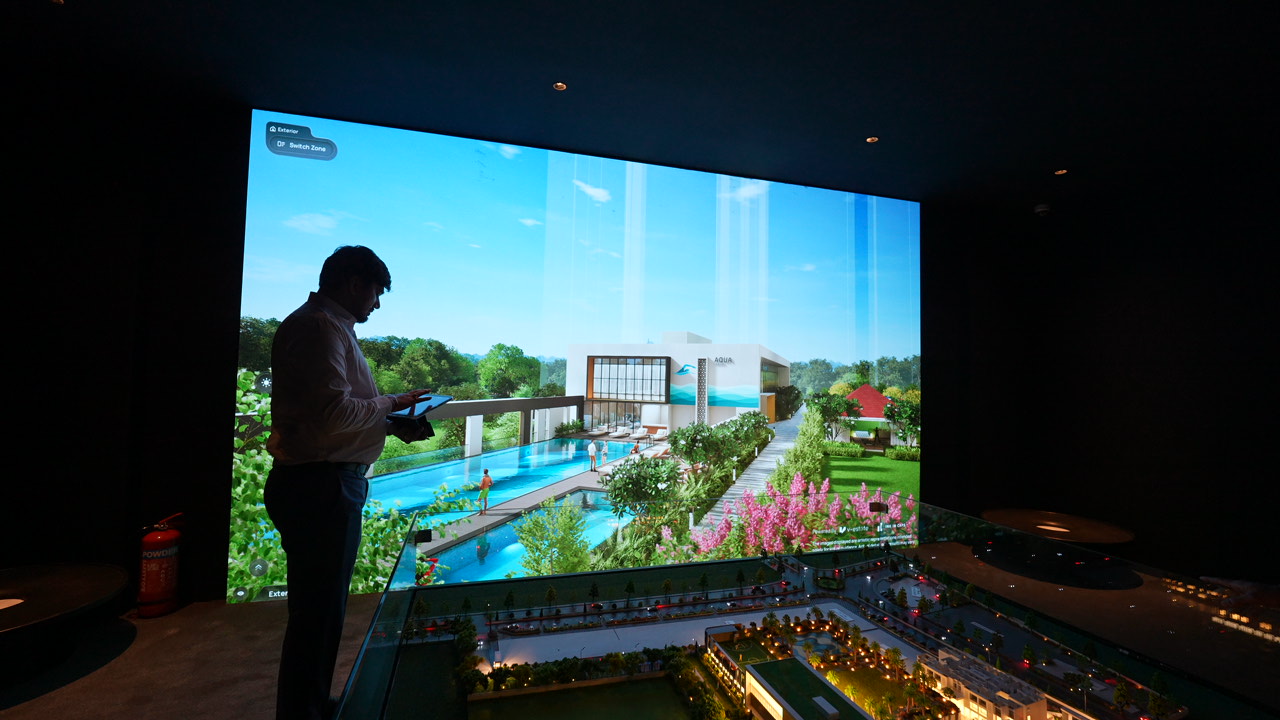
Compare this to the traditional approach where customers see physical elements first and digital later (if at all). In that model, the digital becomes a tool for clarification or persuasion. In Nahar's model, the digital establishes understanding, and the physical elements serve as validation.
This shift has operational implications. Sales executives aren't spending time explaining basic project details repeatedly. The visualization handles that. Executives can focus on addressing specific concerns, discussing customization options, and closing.
Solving Real Operational Problems
Twenty-five sales executives were trained on the system—not just how to operate it, but how to troubleshoot basic issues and understand the underlying technology. This wasn't optional. When your entire sales process depends on a technology platform, your team needs confidence in it.
The system has remained operational since launch, supported by onsite maintenance whenever the sales office is active. Reliability isn't a luxury in this application—it's fundamental. If the AV room goes down, your first touchpoint fails, and your entire journey breaks.
The deployment itself took longer than standard installations—one and a half to two months—because the interior design of the AV room had to be completed around the technology specifications. The team installed the frame first, let the interior designers work, then installed the LED panels. This coordination ensured the physical space supported the digital presentation properly.
These are the operational realities that don't make it into marketing materials but determine whether a technology implementation actually works.
The Design Complexity Behind the Experience
Creating this level of visualization for a real project with complex geometry isn't straightforward. Chandivali Valley's challenges included:
Elevation management: The building sits significantly higher than ground level. Modeling roads that appear seamless with the structure required extensive time.
Site geometry: The triangular plot shape complicated the entire modeling process compared to standard rectangular sites.
Changing facades: The tower elevation design changes per floor, adding modeling complexity.
Environmental proximity: The Miyawaki forest isn't a distant backdrop—it's adjacent to the project. This proximity required detailed environmental modeling that's typically not necessary when natural features are farther away.
Glass and reflection work: The tower design places glass internally rather than on standard exterior facades. Enhancing these reflections required significant post-process adjustments.
Lighting became the major performance constraint. The team had to optimize extensively while maintaining visual quality. When you're showing customers something that doesn't exist yet, visual credibility is everything.
The visualization also needed to showcase the work of Nahar's design partners—Hafeez Contractor for architecture, Green Space Alliance for landscaping, Studio West for interiors. These firms created the physical design; the visualization had to represent it accurately.
Why This Matters for Other Developers
The Chandivali Valley approach isn't just about having better technology. It's about restructuring the sales journey around comprehensive information delivery.
Most developers add technology at the edges—a virtual tour on the website, a VR headset in the corner of the experience center. These implementations treat digital as supplementary rather than foundational.
V-estate enables a different model. The platform handles the heavy lifting of spatial understanding, view visualization, and project comprehension. This frees your sales team to focus on relationship building and decision facilitation rather than repeated explanations of basic project details.
For projects with complex geometries, unique environmental features, or innovative design elements, this approach solves a specific problem: how do you convey what makes your project special when the customer is standing in an empty plot looking at excavation work?
The platform's capabilities—photorealistic rendering, customization options (paint colors, furniture layouts), dynamic lighting and weather controls, detailed window views, amenity showcases—aren't features for the sake of features. They're tools for reducing the uncertainty that delays purchase decisions.
The Business Case
Nahar's implementation demonstrates measurable outcomes:
Sales efficiency: One executive handling multiple families simultaneously in the AV room increases throughput without increasing headcount.
Consistent messaging: Every customer receives the same comprehensive presentation, eliminating variability in information delivery.
Reduced decision time: Customers understand the project completely before seeing physical elements, which means fewer clarification cycles.
Team satisfaction: The sales team reported enthusiasm for using the tool because it makes their job easier, not harder.
The investment isn't trivial—hardware, software licensing, content development, training, maintenance. But compared to the cost of customer acquisition in competitive markets, or the revenue impact of even small improvements in conversion rates, the economics work.
Implementation Considerations
If you're evaluating this approach for your project:
Start with use case clarity: What specific problems in your sales process would comprehensive visualization solve? If you're selling standard product in a mature market with straightforward geometry, you might not need this level of implementation.
Plan for integration: The AV room needs interior design coordination. Hardware specifications matter. iPad control systems need reliable connectivity. These aren't afterthoughts.
Budget for content quality: Generic assets don't work when customers are making high-stakes decisions. The visualization needs to accurately represent your specific project, which means custom modeling and optimization.
Train your team properly: Technology adoption fails when users don't understand or trust the tools. Your sales executives need confidence in the system.
Maintain actively: Plan for onsite support during active sales periods. Downtime in your primary touchpoint breaks the entire journey.
V-estate provides the platform, but success depends on how you deploy it within your specific operational context.
What Developers Should Take Away
The Nahar case isn't about impressive technology for its own sake. It's about solving the fundamental challenge of conveying complex spatial information before the physical product exists.
An AV-first customer journey works when your project has genuine differentiators that are difficult to communicate through traditional methods. It works when you're willing to restructure your sales process around comprehensive information delivery. It works when you invest in quality execution—both technical and operational.
The result isn't just customer satisfaction scores. It's faster decision-making, more efficient sales operations, and higher confidence in what's being purchased.
That's the value proposition. Not digital transformation as buzzword, but as operational improvement with measurable business impact.