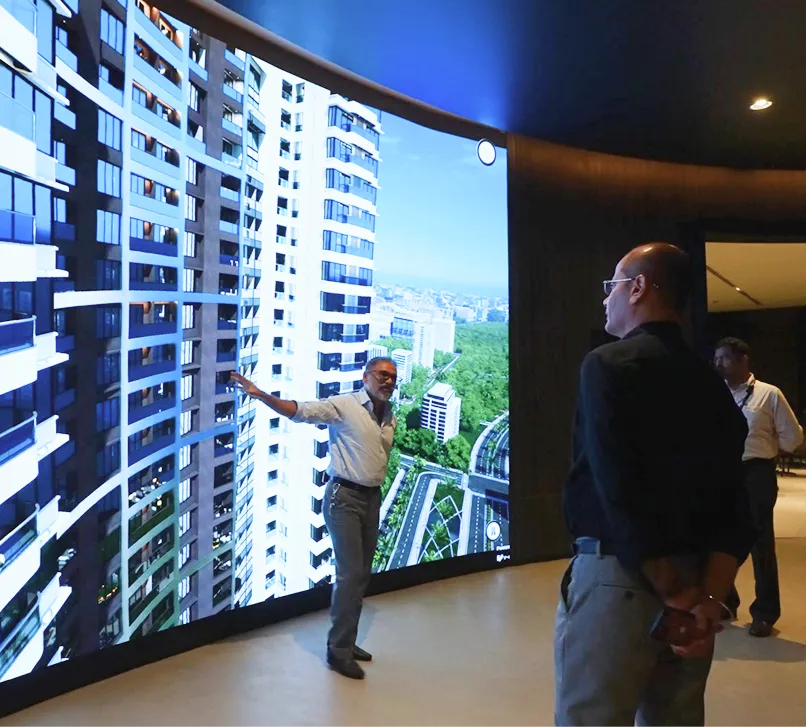
.jpg)
Homebuyers today want more than floor plans; they want to experience a home. But in a competitive luxury market, "experience" is not just a buzzword—it's a critical sales tool.
The Mumbai luxury housing segment, which saw ₹12,300 crore in sales in the first half of 2024 alone, runs on justifying its premium. For a developer, the challenge is clear: how do you effectively communicate the value of a view, a location, or an architectural choice to a discerning buyer in a 30-minute meeting?

The L&T Realty experience centre for their Island Cove project at Mahim provides a masterclass. They solved a core business problem: selling a premium based on scenic advantages—the Bandra-Worli Sea Link and lush mangrove landscapes.
They did it by blending a physical sales gallery with a powerful, offline-first immersive software. This isn't just about 3D walkthroughs; it's about building a high-velocity conversion engine. This is the story of how to solve real-world selling problems at scale.
The Problem: When "The View" Doesn't Fit in a Brochure
Traditional real estate sales have three core friction points, especially in the luxury segment:
Failure to Justify the Premium: The price difference between the 10th and 40th floor is the view. A render in a brochure cannot adequately communicate this multi-crore value proposition. This creates hesitation and long deliberation cycles.
Inefficient Use of Time: High-intent windows (weekend open houses) are short. If an agent spends 20 minutes describing how sunlight behaves in an apartment, everyone loses.
Expectation Mismatch: Buyers can't test finishes, understand sight-lines, or see how a specific apartment feels. This static, one-size-fits-all approach (the single show flat) fails to personalize the journey.
These problems lead to longer sales cycles, more follow-up work, and lower close rates. The goal is to turn those high-intent weekend hours into predictable outcomes.
The L&T Island Cove Solution: An Objective-Driven Experience
L&T Realty's objective for Island Cove was measurable:
Show the View That Matters: Effectively demonstrate the premium value of the sea link and mangrove views.
Reduce Cognitive Load: Let visitors self-navigate core questions about unit size, light, and finishes.
Enable On-the-Spot Decisions: Allow buyers to test layouts and get a tangible sense of scale without flipping through brochures.
Shorten the Funnel: Empower agents to focus on closing, not just explaining.
A successful build addresses each objective. Here’s how.
How Immersive Visualization Solves the Value Problem—Module by Module
An integrated setup delivers these outcomes not as a collection of features, but as a structured, module-driven journey.
Interior Unit & True-to-Site Views: This is the core. We created high-resolution 3D show flats that behave like real flats, recreating finishes, reflections, and textures. But critically, we mapped the true-to-site window view. Buyers could stand in a virtual living room and see the actual view of the Bandra-Worli Sea Link from that specific floor, accurately simulating the sight-line and premium they were paying for.
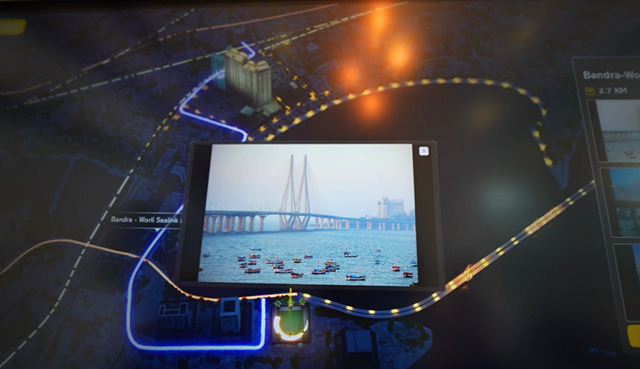
Exteriors & Dynamic Lighting: This module highlights the architectural excellence and allows buyers to see the building from various angles. We combined this with dynamic lighting and weather controls. A buyer can see their chosen apartment at noon, at golden hour, or even during a monsoon evening. This removes anxiety and builds emotional buy-in.
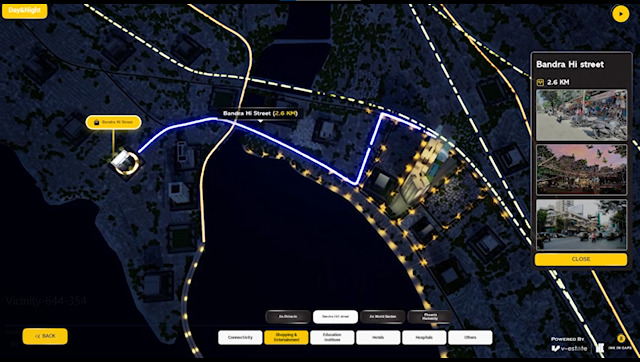
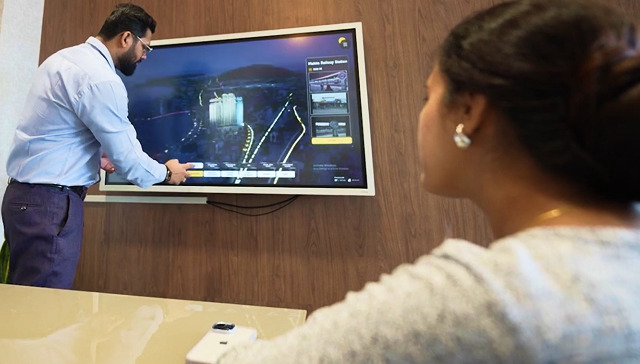
Amenity & Vicinity Mapping: This module serves as an interactive, spatially accurate map. It showcases all project amenities (pool, gym, common areas) and maps strategic location advantages—proximity to schools, hospitals, and highways. For a busy decision-maker, seeing is believing.
On-demand Customization: To increase personal investment, we let buyers toggle paint, flooring, and even furniture layouts in real-time. This simple interaction moves the conversation from "if" to "how," as buyers begin to mentally "own" the space.
Where V-estate Fits: The Difference Between a "Tool" and a "System"
V-estate is not a web pop-up. It's an interactive, offline-first sales activation embedded in the physical sales environment. This matters. In a controlled experience centre, you own the context and guarantee performance.
Here's how we solved L&T's problems:
Offline-First Activation: The system runs locally in the sales gallery, meaning it's fast, reliable, and doesn't depend on unpredictable internet.
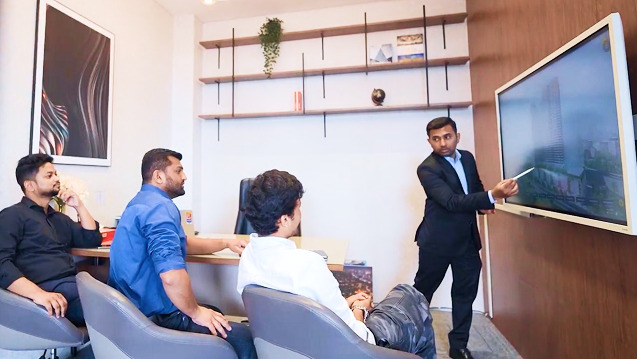
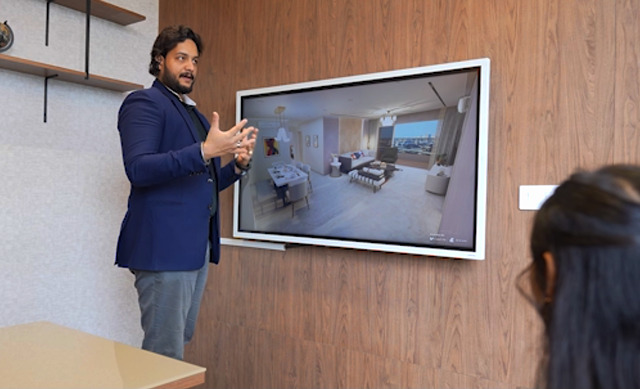
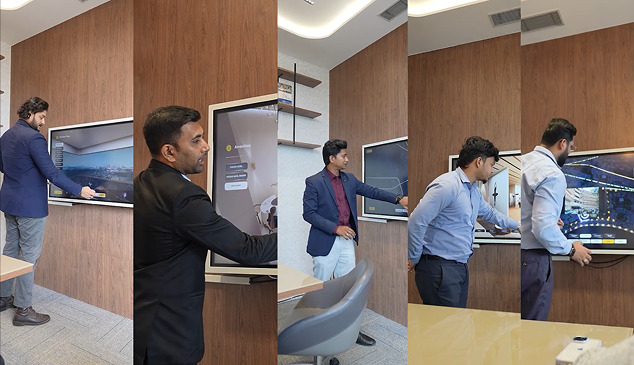
A Tangible, Guided Experience: This isn't just a link. It's a 55" 4K touchscreen TV displaying real-time rendered visuals. The sales representative guides the entire journey using a connected iPad, steering the conversation productively.
Total Environment Control: We integrated the software with the main LED screen in the waiting area, creating an immersive atmosphere from the moment a client enters.
Global Reach: Crucially, we provided a mirrored web-based platform that delivers the same high-fidelity experience. This allowed the sales team to engage international and remote clients effectively, walking them through the property from thousands of miles away.
This is the key distinction: it's an end-to-end conversion system, not just a pretty 3D model.
Strategic Business Validation: The L&T Mandate
When an experience centre is done well, the metrics are predictable. But the ultimate proof comes from the client's actions.
The V-Estate platform's success at Island Cove led to tangible business outcomes:
Essential Sales Tool: It was adopted as the primary, essential sales tool for all buyer engagement at the project.
International Reach: The web version proved critical in expanding international and remote buyer engagement.
Measurable Sales Boost: The enhanced, high-clarity buyer experience led to a measurable lift in sales velocity.
The most significant validation? L&T Realty was so impressed with the results that they endorsed V-Estate as the mandated software for all future project launches.
This company-wide adoption is the ultimate proof that moving from "explanation" to "demonstration" delivers a massive, measurable ROI.
Common objections and how to address them
1. “This sounds expensive.”
High-quality visualization is an investment that reduces variable costs (agent hours, repeat visits) and shortens cashflow timelines. L&T Realty saw the ROI and mandated it for all future projects. The better question is: what is the cost of a lost sale because you failed to communicate the value of your premium?
2. “Our buyers won’t use it.”
Buyers appreciate control, and agents appreciate a powerful tool. The UI is deliberately simple—a few buttons on an iPad to switch rooms, finishes, and views. The agent guides the experience, making it seamless.
3. “We already have a physical show flat.”
A static show flat is necessary, but it can’t replicate every unit type, every view, or every time of day. You pair the tangible (the physical flat) with the variable (the digital experience) to answer every possible buyer question on the spot.
4. “We don’t want to rely on internet connectivity.”
We agree. That's why the primary V-estate model is an offline activation. It runs on local hardware in the centre, avoiding downtime risk entirely.
Final Takeaway: The Disciplined Advantage
Immersive visualization—when executed as a robust, integrated system inside a sales centre—shifts real estate selling from explanation to demonstration.
For projects like L&T Island Cove, where views and lifestyle sell the premium, this approach turns browsing into commitment. It empowers agents, reduces friction for buyers, and delivers a clear, measurable, and disciplined advantage.
If you are responsible for sales effectiveness, consider your experience centre not as a brochure, but as your primary conversion engine.