One project has stunning photography. A beautiful layout. A perfect location. Better pricing than competing developments. Everything about it looks right on paper. But the couple scrolling through listings stops for a second and moves on immediately. Not because the project is bad. Not because they found something cheaper or more luxurious. They move on because they cannot picture themselves living there. They cannot feel the space, understand the atmosphere, or experience what daily life inside the project would actually look like. Without that emotional connection, the project becomes just another listing in an endless scroll.
Today, that is exactly how most buyers make decisions. If they cannot visualize the experience digitally, they rarely feel motivated enough to schedule a site visit. This couple is not an exception. They represent the majority of modern real estate buyers
The Silent Rejection Happening Right Now
Your project listing goes live. The marketing team celebrates. Then silence.
Buyers click. They scroll. They leave.
The real problem? They never make it to your sales office. They never request a site visit. They simply close the tab and move to the next project.
This isn't a marketing budget issue. It's not a poor location or outdated architecture either.
It's the moment of decision—the exact second when a buyer thinks: "Is this worth my time to visit?"
That moment happens in seconds. On a mobile phone. Staring at static floor plans and flat 2D images.
And most projects lose that moment before buyers ever pick up the phone.
The Floor Plan Trap Nobody Talks About
For decades, real estate marketing operated on a simple formula:
Beautiful photographs
Detailed floor plans (PDF or image)
Marketing brochure
Hope someone calls
This formula worked when buyers had limited options.
Today it's broken.
Modern buyers research 15-20 projects before contacting a single developer. They've already eliminated 95% of options through screens and PDFs.
The ones who make it to your sales office? They're pre-qualified and serious.
But the other 95%? They never get there because the immersive property walkthrough experience was missing.
They couldn't visualize themselves living there. They couldn't understand the space. They couldn't feel the project.
Without immersive real estate experience, buyers stay in analysis mode. They compare spreadsheets of specifications instead of imagining their lives in the space.
And spreadsheets never inspire site visits.
What Changes When Immersive Experience Enters the Equation
The moment buyers experience an immersive property walkthrough technology, something shifts.
They stop comparing features.
They start imagining living there.
This is the psychological inflection point where browsers become buyers.
When a buyer can:
Walk through the space virtually
See materials and finishes from every angle
Understand scale and proportions
Visualize their furniture in the space
Experience the flow from entrance to bedroom to kitchen
...they make a decision: "This is worth visiting."
The immersive real estate experience removes the friction. It answers the implicit question every buyer asks: "Is this project different enough from the ten others I've seen to justify my time?"
With immersive property walkthrough technology, the answer becomes yes.
The Rustomjee Crescent Case Study: From 18% to 67% Site Visit Conversion
Rustomjee launched Crescent, a premium residential project in Mumbai's competitive market. Launch response was solid—their website attracted 3,200 visitors in month one.
But site visit bookings were disappointing: only 18% of engaged users converted to site visits.
The team knew the issue wasn't the project. Crescent offered exceptional design, location, and pricing. The problem was buyer confidence before the visit.
Sales teams reported a consistent conversation pattern:
"Can you show me more details online?"
"I want to see it before I visit"
"Does this fit my space needs?"
These weren't rejections. They were trust gaps.
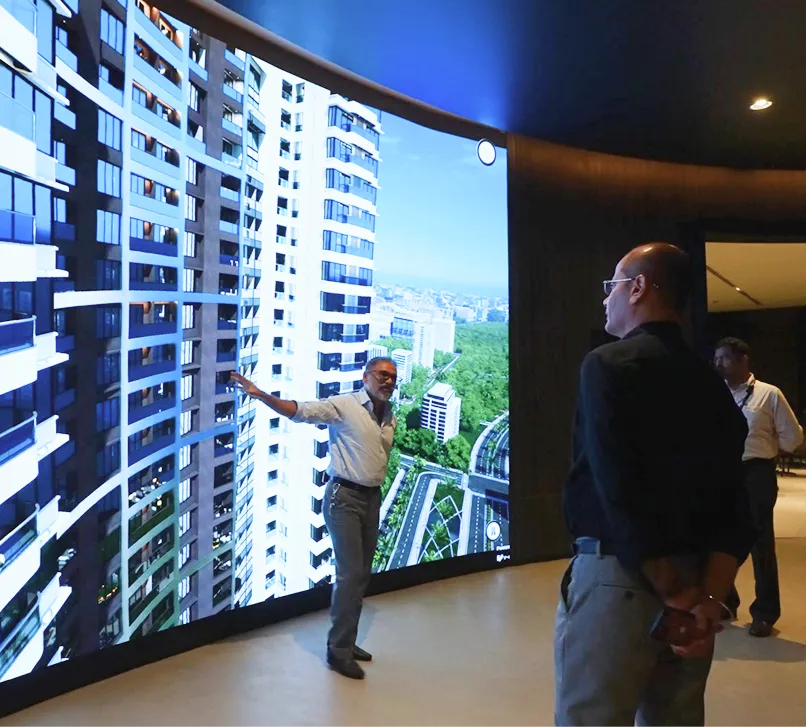
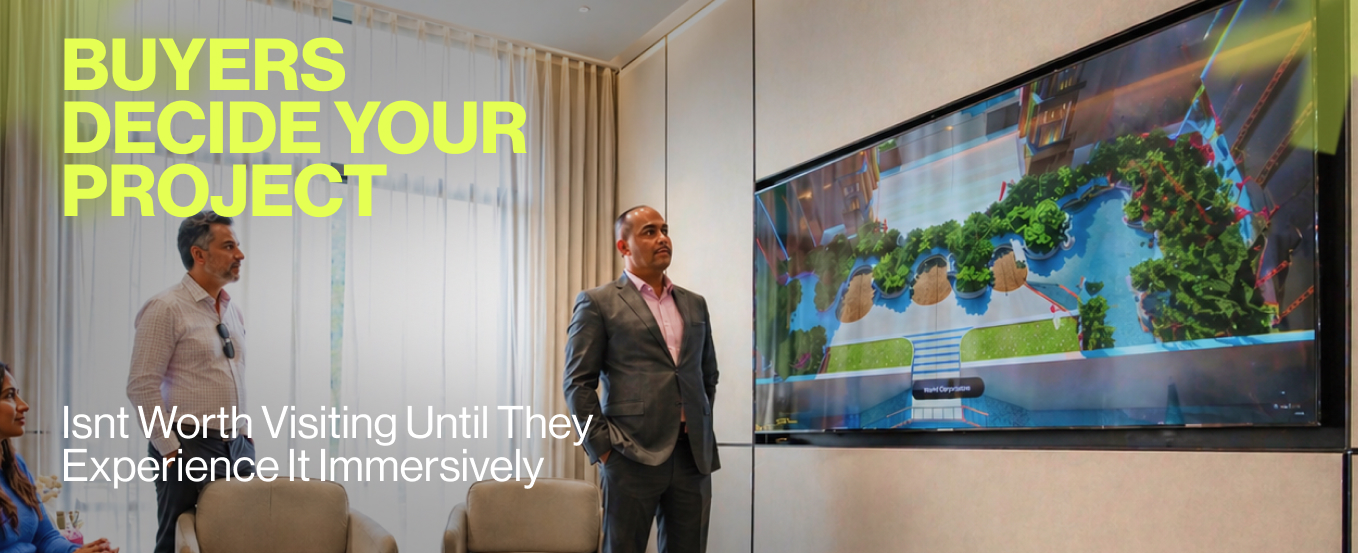
The solution? Rustomjee partnered with Vestate to build an immersive real estate experience center—not a physical space, but a digital one integrated into their website and mobile app.
Buyers could now:
Experience a full immersive property walkthrough
Navigate multiple unit types in real-time
See the space from different lighting conditions
Understand neighborhood context through 360° views
The results were remarkable:
Within 8 weeks, site visit conversions jumped to 67%. More important—the quality of site visits improved dramatically.
Visitors who experienced the immersive real estate experience arrived pre-qualified, confident, and ready to make decisions.
Sales cycle reduced by 4 days on average.
Close rate on visitors who had experienced the immersive property walkthrough technology: 43%.
For comparison, site visits without the immersive experience had a 12% close rate.
Why Immersive Property Walkthrough Technology Changes Buyer Psychology
The difference isn't just about better visuals.
It's about removing uncertainty.
When buyers can experience an immersive real estate experience before visiting, they arrive with answers to their critical questions:
"Do I like the space layout?" ✓ Answered
"Will my furniture fit?" ✓ Answered
"How does natural light work here?" ✓ Answered
"What's the daily flow like?" ✓ Answered
Uncertainty kills site visit bookings.
Confidence drives them.
Immersive property walkthrough technology delivers that confidence before the buyer ever leaves home.
The Marketing Head's Perspective: Quantifiable Impact
For developers and marketing leaders, immersive real estate experience isn't a nice-to-have feature anymore.
It's a competitive necessity.
Projects with immersive property walkthrough technology report:
45-70% higher site visit conversion (Rustomjee Crescent: 67%)
35-50% shorter sales cycles (Rustomjee: 4-day reduction)
3-4x higher close rates on qualified visits
2-3x higher engagement time (average 8 minutes vs. 2 minutes on standard listings)
Better lead quality (fewer curious browsers, more serious prospects)
These aren't vanity metrics. They directly impact:
Sales team efficiency
Marketing ROI
Acquisition cost per closed deal
Revenue per marketing rupee spent
The math is undeniable.
A project with 1,000 monthly engaged visitors:
Without immersive real estate experience: 180 site visits, 22 closures
With immersive property walkthrough technology: 670 site visits, 288 closures
The difference is 266 additional closed units per 1,000 engaged visitors.
At an average unit price of ₹1.5 crore, that's ₹399 crore in additional revenue.
How Developers Implement Immersive Property Walkthrough Technology
The Rustomjee approach wasn't revolutionary. It was systematic.
Phase 1: Capture Reality
360° photography of completed spaces
Architectural precision and material detail
Multiple lighting conditions and seasons
Phase 2: Build the Immersive Property Walkthrough Experience
Interactive 3D navigation of unit interiors
Customizable furniture and finishes visualization
Virtual tours of shared spaces and amenities
Phase 3: Integrate Immersive Real Estate Experience
Website and mobile app integration
Lead capture at key decision points
Analytics tracking buyer movement and engagement
Phase 4: Measure and Optimize
Track conversion at each stage
Identify drop-off points
Continuously refine the immersive property walkthrough technology
The investment typically ranges from ₹8-15 lakhs for a 200-unit project.
The payback period: 1-2 months.
The Competitive Reality for Developers
Buyers today expect immersive real estate experience.
They don't expect it as a bonus feature.
They expect it as the baseline.
Projects without immersive property walkthrough technology aren't just losing conversions—they're signaling that they're outdated.
Forward-thinking developers understand this shift.
That's why premium projects across Mumbai, Bangalore, and Delhi are adopting immersive real estate experience technology in 2024-2025.
The projects that delay this implementation are missing critical sales windows.