The traditional real estate sales funnel operated on simple principles. Generate leads. Qualify prospects. Present information. Handle objections. Close sales. The process was linear, predictable, and largely controlled by sales teams.
This model is breaking down. Today's property buyers navigate their own paths. They research extensively online. They comparison-shop across multiple options. They delay engagement with sales teams until late in their journey.
THE TRADITIONAL FUNNEL IN CRISIS
Traditional funnels relied on information asymmetry. Developers held product information. Customers needed access. Sales teams controlled information flow to guide prospects toward purchase.
That asymmetry has evaporated. Property information is abundant online. Customers access floor plans, pricing, specifications, and neighborhood data before contacting developers. They arrive informed and often skeptical.
The traditional funnel stages no longer align with customer behavior:
• Awareness happens through digital channels, not developer marketing
• Interest develops through independent research, not sales presentations
• Consideration involves comparing multiple options, not single-brand focus
• Intent emerges gradually through self-directed exploration
• Evaluation occurs before sales team engagement
• Purchase follows prolonged consideration, not triggered by sales pitches
The misalignment creates inefficiency. Sales teams spend time on basic information delivery rather than value creation. Marketing efforts fail to influence key decision stages. Conversion rates suffer.
HOW EXPERIENCE-LED CONVERSION RESHAPES THE FUNNEL
Experience-led conversion acknowledges customer-driven journeys. Instead of forcing customers through linear stages, it provides tools for self-directed exploration. It creates experiences that customers value regardless of where they are in their decision process.
The approach shifts from funnel to ecosystem. Customers engage when and how they choose. They explore properties independently. They gather information at their own pace. They involve sales teams when ready.
This ecosystem model serves modern buyer behavior better. It respects customer autonomy. It provides value throughout extended journeys. It supports conversion when customers decide.
EXPERIENCE TOUCHPOINTS THROUGHOUT THE CUSTOMER JOURNEY
Experience-led conversion introduces specific touchpoints that serve customers at different journey stages:
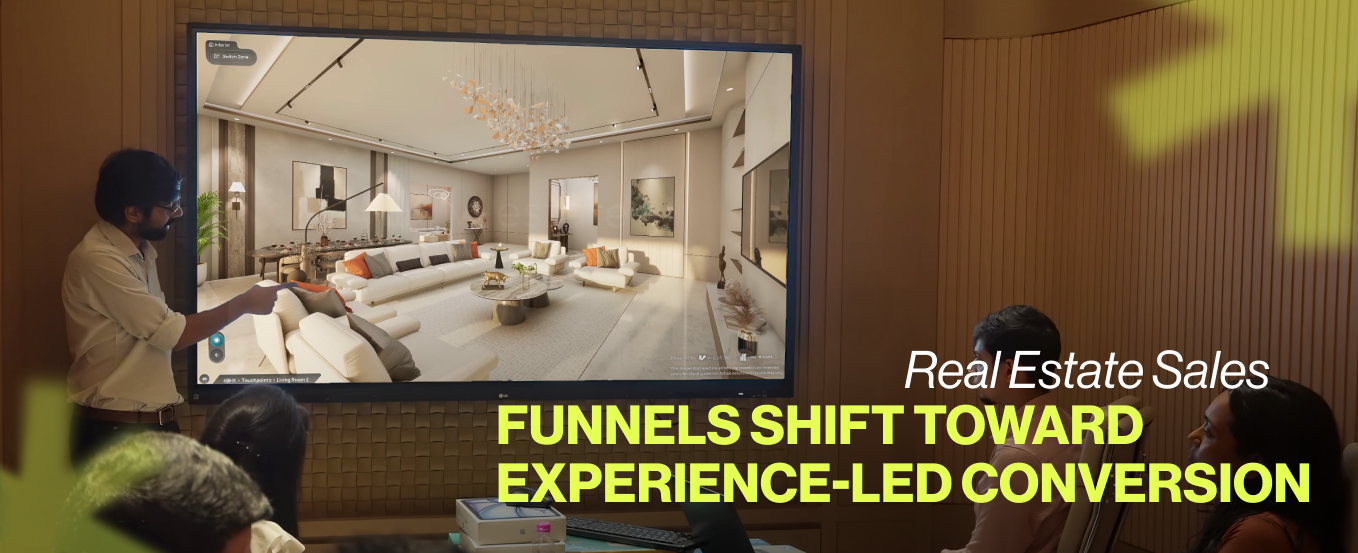
Early-stage exploration allows customers to experience properties before committing to site visits. They navigate spaces virtually. They understand layouts and configurations. They assess fit with their needs before investing time in visits.
Active consideration provides deeper exploration. Customers test different options within projects. They compare unit types. They experience amenities. They validate initial impressions.
Late-stage decision support enables final confirmation. Customers revisit spaces virtually. They check specific details. They confirm views, orientations, and spatial relationships.
Post-purchase reinforcement creates ongoing engagement. Customers can revisit their selected properties. They track construction progress. They maintain connection to their future homes.
THE ROLE OF PHYSICAL EXPERIENCE CENTERS
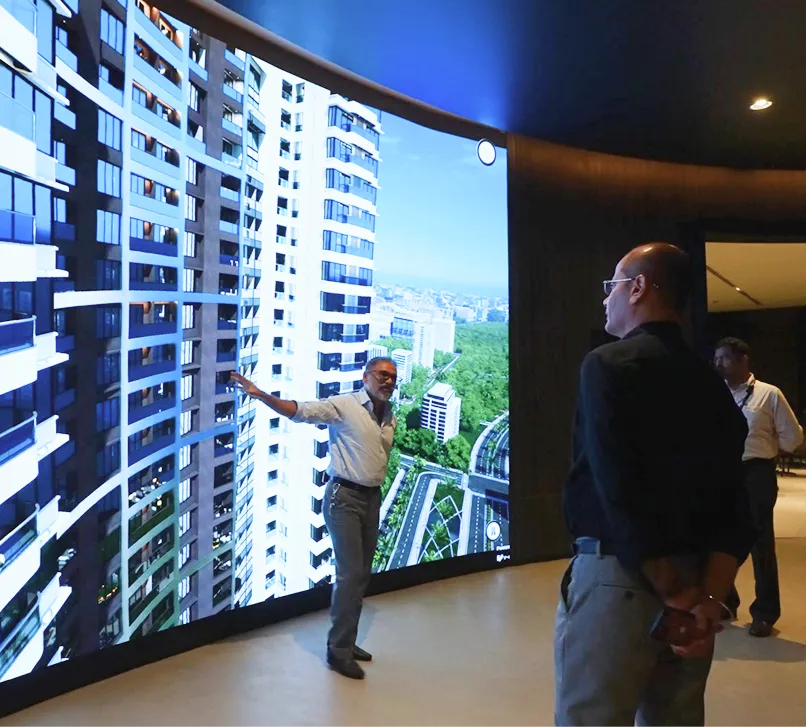
Physical sales environments remain crucial in experience-led conversion. Experience centers, sales lounges, and site offices provide locations for immersive engagement.
These spaces serve multiple functions:
• Showcase capabilities through interactive stations and large-format displays
• Facilitate social exploration as families and groups experience together
• Enable sales team support through guidance and consultation
• Create brand impressions through physical environment design
• Provide social proof through visibility of other engaged customers
The physical environment frames the digital experience. Technology enables exploration while the space creates atmosphere and context.
SALES TEAM EVOLUTION IN EXPERIENCE-LED FUNNELS
Sales roles change fundamentally when funnels become experience-led. The shift from presentation to facilitation requires new skills and approaches.
Sales teams become experience guides rather than information providers. They observe customer interactions. They identify preferences through behavior. They provide context and interpretation. They address specific questions that emerge during exploration.
The timing of sales team engagement shifts later. Customers self-educate through experiences. They involve sales personnel when they reach specific questions or are ready for detail discussion.
This shift improves sales team efficiency. Less time wasted on basic information delivery. More time focused on high-value consultation. Better conversion through targeted engagement.
MEASURING EXPERIENCE-LED FUNNEL PERFORMANCE
Traditional funnel metrics—lead volume, conversion rates, sales cycle duration—remain relevant but insufficient. Experience-led approaches require additional measurements:
• Engagement depth—how extensively do customers explore properties?
• Session quality—do customers return for multiple exploration sessions?
• Feature interaction—which aspects attract most attention?
• Customization activity—do customers experiment with options?
• Social engagement—do customers explore in groups?
These metrics provide insight into customer behavior and intent. They enable optimization of both experiences and sales approaches.
IMPACT ON CONVERSION EFFICIENCY
Experience-led funnels deliver measurable improvements in conversion efficiency:
Higher-quality prospects reach sales teams. Self-selection through exploration means sales personnel engage with customers who have genuine interest and understanding.
Better-qualified leads emerge naturally. Customers who invest time in exploration demonstrate serious intent. Their specific interests become clear through interaction patterns.
Improved conversion rates occur at multiple stages. More explorers convert to visitors. More visitors convert to prospects. More prospects convert to bookings.
Shortened sales cycles result from better-informed customers. Decisions that once took weeks now take days. The reduction creates sales team capacity for more prospects.
IMPLEMENTATION CONSIDERATIONS FOR DEVELOPERS
Adopting experience-led conversion requires planning across multiple dimensions:
• Technology infrastructure must support seamless experiences. Interactive displays, intuitive interfaces, and reliable performance are non-negotiable.
• Physical space design should facilitate both individual and group exploration. Multiple stations allow concurrent customer engagement. Private areas support serious decision discussions.
• Staff training is critical. Sales teams must understand observation and facilitation. They need skills in interpreting customer behavior and adapting their approach.
• Content creation requires investment. Photorealistic 3D environments, accurate representation, and comprehensive options demand expertise and resources.
• Marketing integration ensures alignment. Messaging should highlight experience availability. Promotions should encourage exploration visits.