Booking rate — the percentage of site visitors who convert to reservations — represents the single most critical metric in real estate sales performance. Marketing generates leads. Sales teams nurture prospects. Site visits create opportunities.
But bookings pay the bills.
Improving booking rates delivers exponential impact. Small conversion increases multiply through the sales funnel. More bookings from the same traffic. Better return on marketing investment. Higher sales team productivity.
Experience-driven sales strategies consistently improve booking rates. They create the engagement and confidence that drive conversion decisions.
The Booking Rate Challenge
Typical real estate booking rates vary by market, product type, and sales approach. However, most developers operate below optimal conversion levels.
Common booking rate barriers include uncertainty where customers lack confidence in decisions, emotional disconnection where properties feel like investments rather than homes, comparison shopping where prospects explore multiple options before deciding, decision postponement where customers delay commitments to think more, and family disagreement where partners or family members reach different conclusions.
These barriers manifest during site visits — the critical conversion moment. If visits fail to address them, booking opportunities disappear.
How Experience-Driven Strategies Address Barriers
Experience-driven sales create immersive property exploration. Customers engage with spaces rather than viewing them. They form emotional connections through interaction. They gain confidence through comprehensive information.
The approach specifically targets booking barriers. Uncertainty reduces as customers experience properties thoroughly. Emotional connection grows through active engagement and visualization. Comparison shopping diminishes as experiences create differentiation. Decision postponement decreases as confidence enables faster commitment. Family consensus emerges through shared exploration experiences.
The Experience-Booking Connection
Experience-driven strategies improve booking rates through specific mechanisms.
Active engagement creates investment. Customers who spend time exploring properties feel ownership in the process. They commit time and attention. This investment predisposes them toward booking.
Comprehensive understanding reduces doubt. When customers experience properties thoroughly, questions get answered. Uncertainty diminishes. Confidence increases.
Emotional visualization supports decision-making. Customers see themselves living in spaces. They imagine daily routines. They feel the lifestyle.
Social validation emerges in group exploration. Families explore together. They discuss what they see. They reach consensus through shared experience.
Real-World Booking Rate Improvements
Developers implementing experience-driven sales strategies report consistent booking rate improvements. 30–50% increases in conversion from site visit to booking are common. There is a reduction in follow-up visits required before booking — many customers decide after a single comprehensive experience. Spontaneous bookings during site visits increase rather than after deliberation. Upsell rates improve as customers appreciate premium features through direct experience.
These improvements compound across sales operations. Better conversion means fewer visits needed per booking. Sales teams handle more prospects. Marketing cost per acquisition decreases.
Implementation in Physical Sales Environments
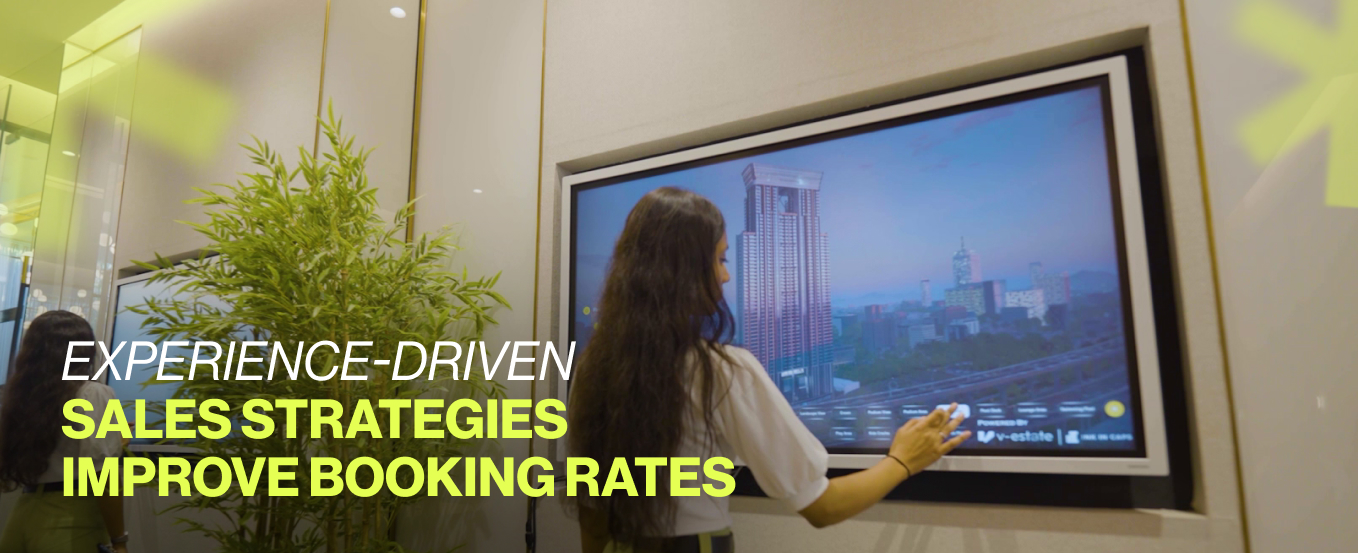
Experience-driven strategies rely on technology integrated into physical sales spaces. Experience centers, sales lounges, and site offices house interactive capabilities.
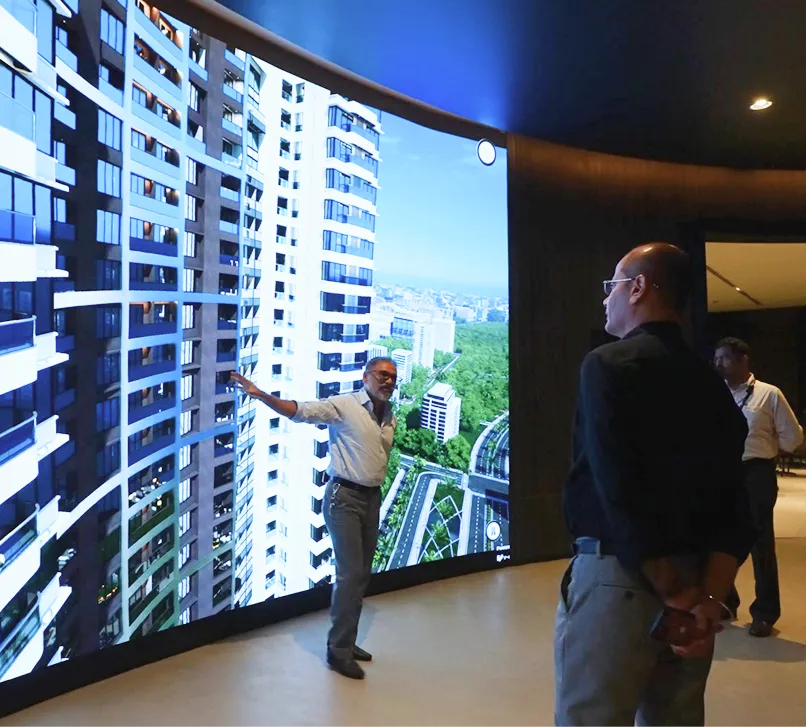
The physical setup matters. Technology should be accessible but not intrusive. Large-format displays enable group viewing. Interactive stations allow individual exploration. Private areas support decision discussions.
Sales team facilitation is crucial. Personnel guide experiences without controlling them. They observe customer interactions. They identify preferences and concerns. They provide targeted information at decision moments.
The combination of capability and facilitation creates booking momentum.
Key Experience Components That Drive Bookings
Not all experiences drive bookings equally. Specific capabilities prove most impactful.
Photorealistic 3D environments create accurate representations. Customers see exactly what they will receive. Visual accuracy builds trust and reduces post-booking cognitive dissonance.
Real-time customization enables personalization. Customers test configurations that match their needs. They see furniture arrangements, color schemes, and finish options. Personal connection strengthens.
Environmental simulation provides context. Customers experience properties at different times. They understand natural light patterns. They assess views and surroundings.
Interactive amenity exploration demonstrates lifestyle. Customers see how they will use pools, gyms, gardens, and common areas. Lifestyle visualization supports emotional connection.
Location context shows connectivity. Customers appreciate neighborhood features, transportation access, and nearby amenities. Context supports practical decision-making.
The Role of Sales Teams in Experience-Driven Booking
Sales teams remain essential in experience-driven strategies. Their role evolves from presenters to experience facilitators.
Facilitation techniques that improve booking rates include observation — watching customer interactions to identify preferences and concerns; timing — intervening at decision moments rather than throughout exploration; validation — confirming customer observations and decisions; scarcity — highlighting limited availability when interest signals emerge; and urgency — creating momentum when customers show positive response.
The most effective sales approach is often minimal. Let customers explore. Step in when they show intent. Address specific concerns. Support decision-making rather than driving it.
Measuring Experience Impact on Booking Rates
Tracking specific metrics reveals experience effectiveness:
Visit-to-booking conversion rate the primary success metric
Exploration depth time spent, areas visited, features interacted with
Return visit rate do customers come back for additional exploration?
Group decision rate do families book together or require separate visits?
Feature preference correlation which explored features most often lead to booking?
These metrics guide experience optimization. They reveal what drives booking decisions. They inform sales team training.