Most buyers walk out undecided. Not because the property failed them. Because the presentation did.
Developers spend crores on construction. Then hand buyers a brochure. Or a basic 3D walkthrough that loads slowly and crashes mid-demo. The gap between what a property is and what a buyer feels — that gap is where deals die.
V-Estate closes that gap. Offline. Completely.
The Real Problem in Real Estate Sales Centres
Experience centres exist. Most of them underperform.
Buyers enter. They see scale models. They watch flat renders on a screen. A sales executive points at a floor plan and explains what the view will look like — someday. Buyers nod. They leave.
Follow-up calls go unanswered. The lead goes cold.
The architecture of a traditional experience centre is built for display, not decision-making.
Developers track footfalls. Rarely conversion rate per visit. Rarely time-to-decision. Rarely buyer confidence score. These numbers matter. They don't move unless the centre design changes.
Experience Centre Architecture Built Around Buyer Stages
Buyers move through a predictable sequence. Awareness. Evaluation. Commitment. Every real estate marketer knows this funnel. Few design their physical space around it.
V-Estate's offline setup maps directly to these three stages.
The centre is not a showroom. It is a structured decision journey. Rooms and stations align to each phase. Buyers progress naturally. No aimless wandering. No information overload upfront.
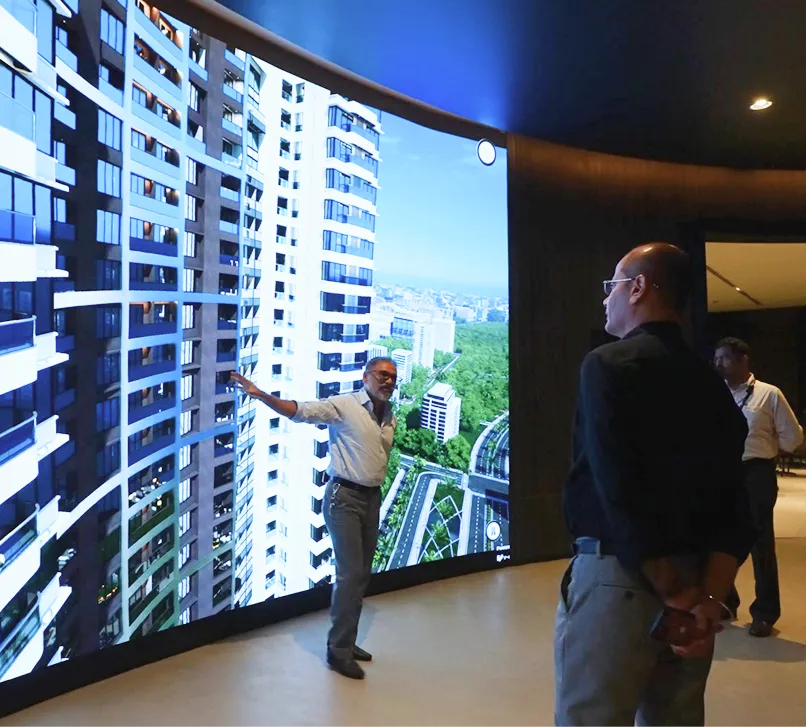
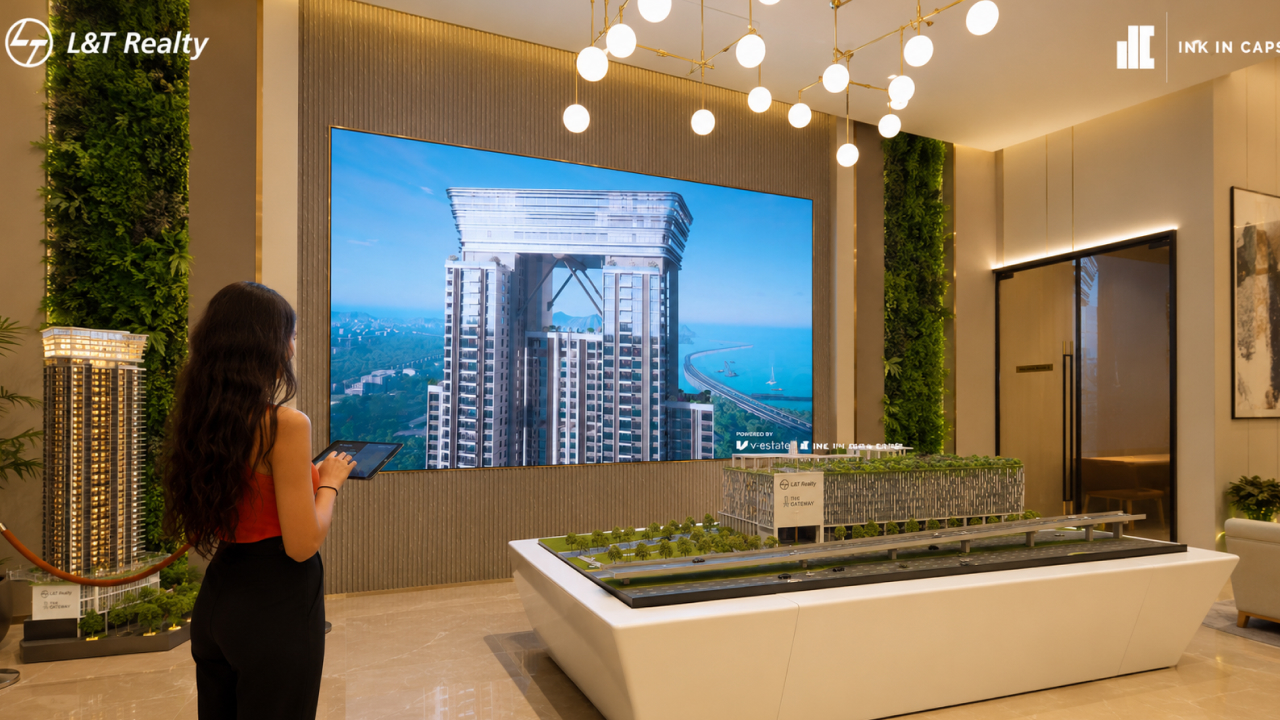
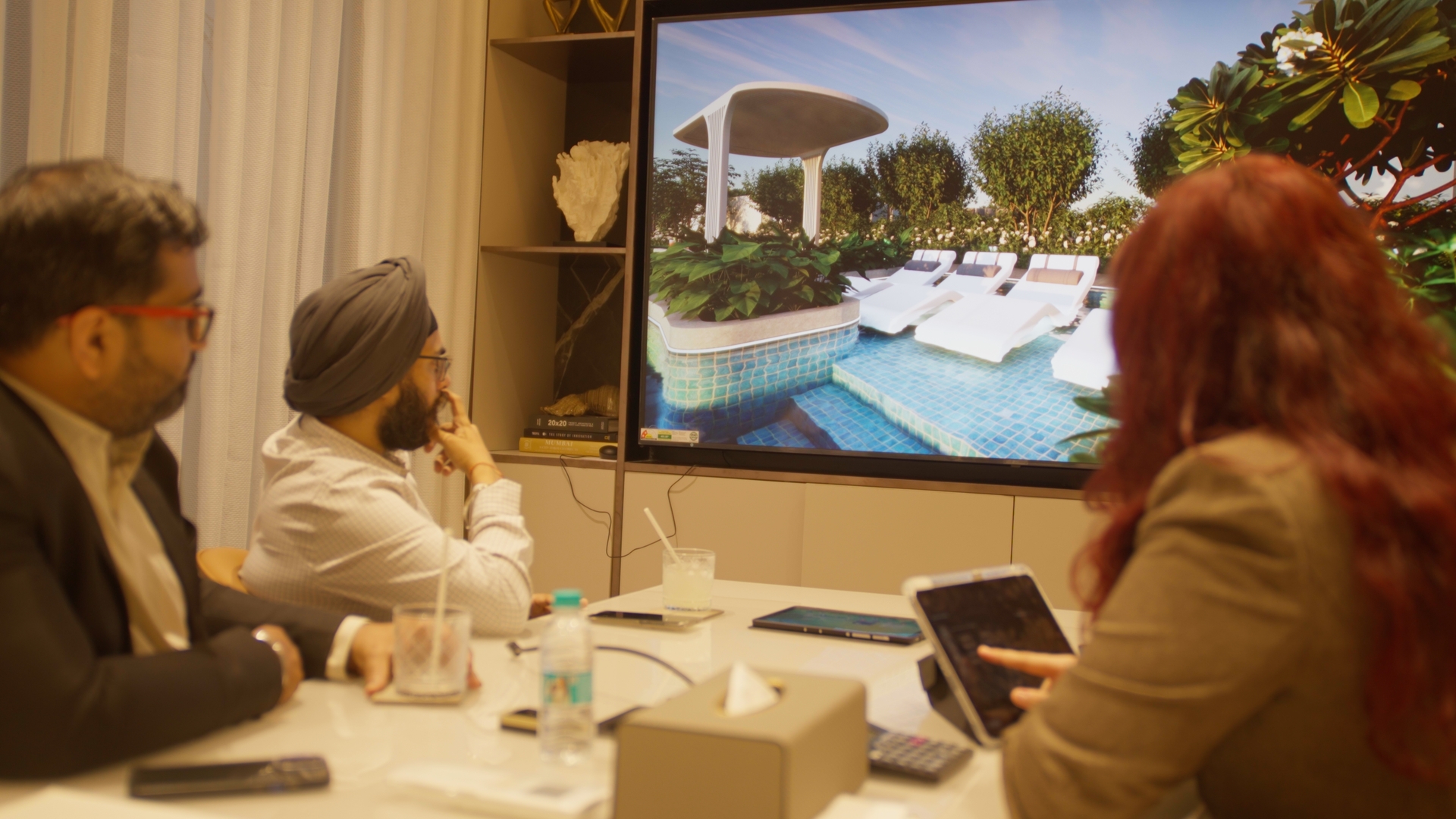
Stage one: Awareness. Large-format displays introduce the project. Nearby amenities appear on interactive maps. Current and upcoming developments layer in. Connectivity, convenience, lifestyle — all visible at a glance. Buyers orientate themselves before going deeper.
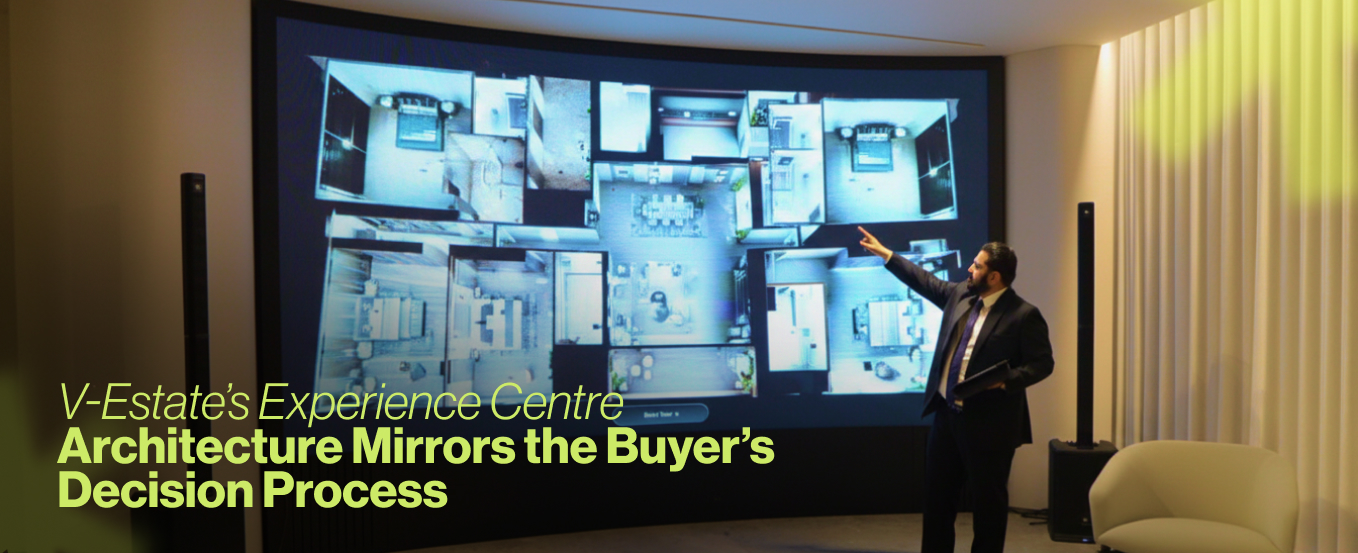
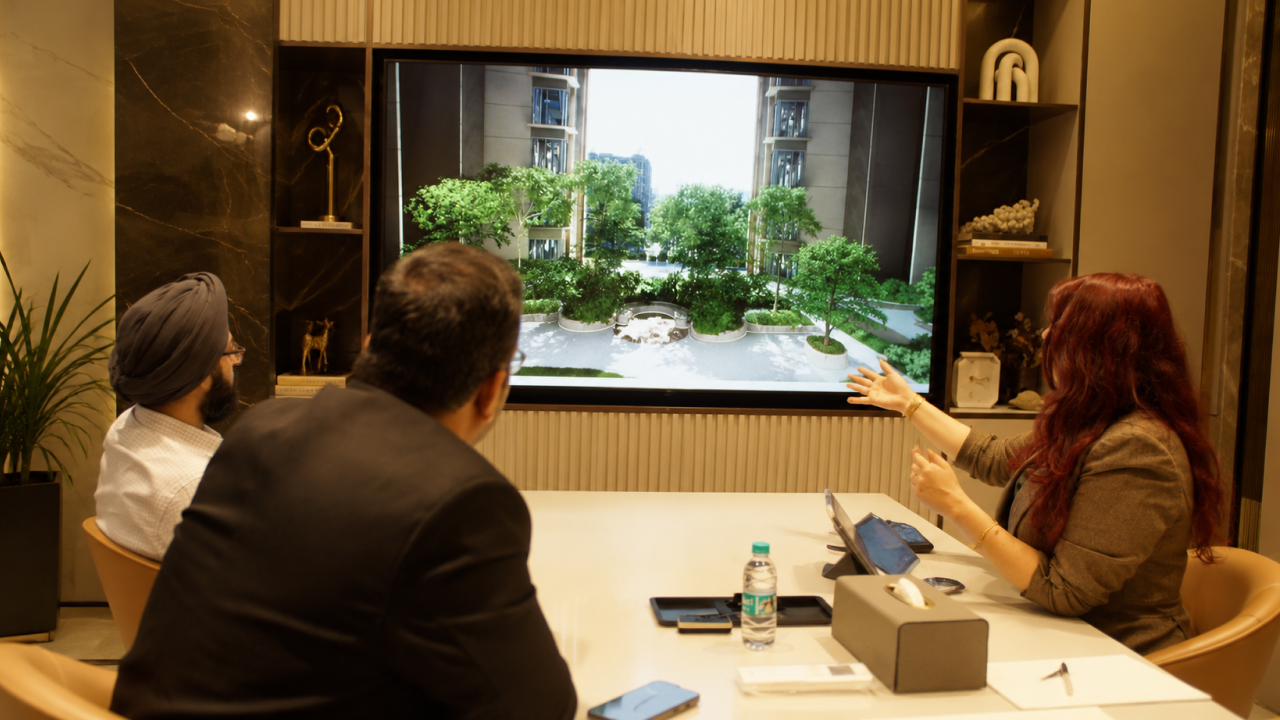
Stage two: Evaluation. This is where most sales centres fail. V-Estate replaces static renders with photorealistic 3D virtual show flats. Buyers step inside the property — virtually. Not a generic walkthrough. A precise, lifelike representation built to exact specifications.
Window views render accurately. A buyer sitting in the living room sees the actual skyline, the actual tree line, the actual road distance. That evening coffee moment — light angle, shadows, outside movement — all of it visible before a single brick is laid.
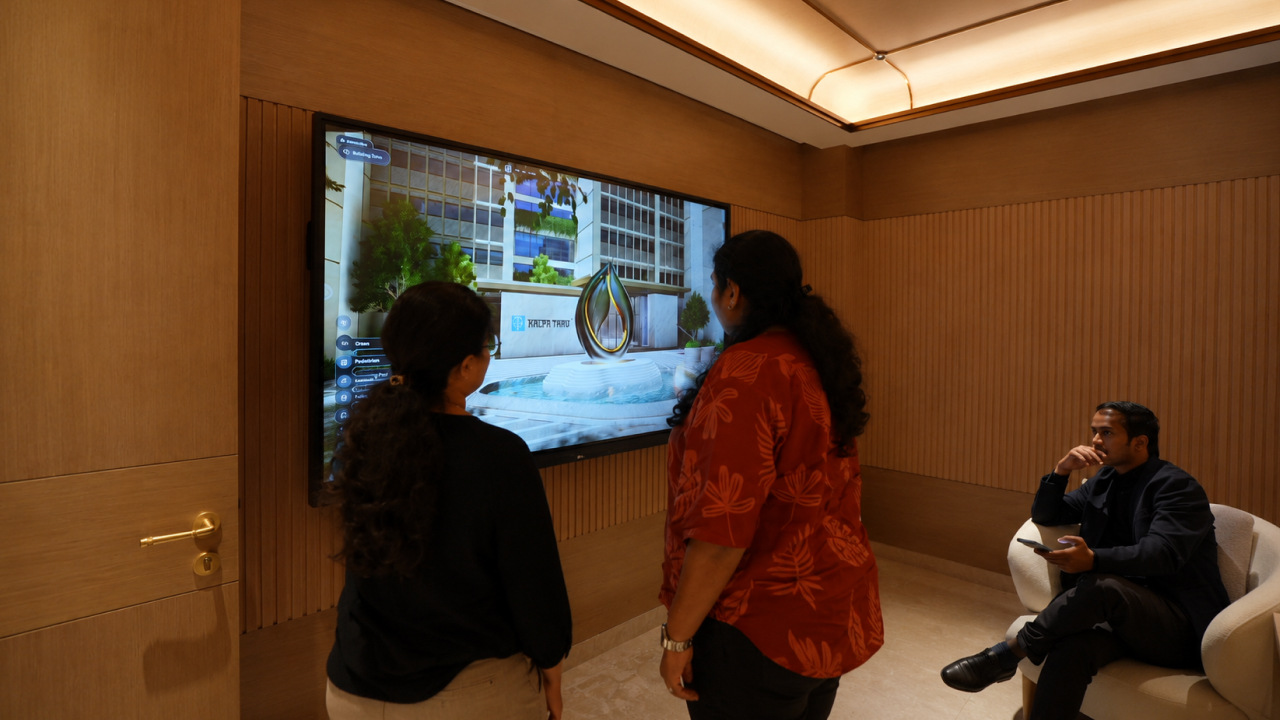
Stage three: Commitment. Customisation tools activate. Wall colours shift in real time. Sofa sets swap. Flooring changes. Dynamic lighting simulates morning, afternoon, and late evening. Weather controls toggle between clear skies and heavy monsoon rain. Buyers test the property across seasons, across moods, across their own lifestyle preferences.
This is not demonstration. This is ownership rehearsal.
Offline Activation — the Operational Advantage Developers Miss
Most interactive sales tools depend on internet connectivity. That is a structural weakness.
High-footfall expos. Remote project sites. Unstable venue networks. Any connectivity issue breaks the experience — and breaks the buyer's trust in the developer.
V-Estate runs fully offline. Local hardware powers every session. Projectors, touchscreens, controllers — no cloud dependency. No bandwidth bills. No crash risk during peak traffic hours.
Setup takes hours, not weeks. Maintenance stays minimal. Updates push via USB. One centre setup serves hundreds of buyers. Scalable from boutique agencies to large developer expos.
Marketing heads gain operational certainty. Sales teams run sessions without tech anxiety. The centre performs on Day 1 the same as Day 300.
This matters more than most developers account for in planning. The reliability of the experience is the brand signal.
Customisation Features That Convert Hesitation Into Confidence
Generic presentations bore buyers. They've seen enough renders. Enough model flats. Enough "artist impressions."
Personalisation is what moves them.
V-Estate's customisation layer puts control in the buyer's hands. Live. In the experience centre. With a sales consultant present.
Paint the wall beige. Switch it to grey. Move it to white. Watch the room change. Pull in the sectional sofa. Swap to a modular set. Adjust the lighting to evening. Pull the weather to overcast.
Buyers stop imagining. They start deciding.
Window view customisation addresses one of the most persistent buyer objections — "I don't know what I'll actually see from my unit." V-Estate removes that objection entirely. The view outside unit 2104 is not approximate. It is accurate.
Developers using this approach report measurable reductions in post-visit objections. Buyers return fewer follow-up calls with concerns about orientation, floor selection, or view obstruction. The centre answered those questions already.
Lead quality improves. Conversion timelines shorten.
Data the Marketing Head Actually Needs
Most experience centres generate footfall data. Nothing deeper.
V-Estate's offline setup logs session metrics. Time spent in each zone. Customisation choices made most frequently. Floor plans reviewed longest. Units shortlisted.
Marketing heads gain a direct line into buyer preference patterns.
Which configurations attract the most interest? Which amenities drive the longest engagement? Which unit types generate the fastest shortlisting?
These are product development signals. Pricing inputs. Campaign targeting data. Developers who track this move faster — on inventory decisions, on launch sequencing, on sales team briefings.
The experience centre stops being a cost centre. It becomes a market intelligence asset.
Relevance to Developers Planning Their Next Launch
The economics are clear.
Physical models depreciate. Site visits require logistics. Digital-only tools drop engagement mid-session. Offline immersive setups carry the full buyer journey — in one controlled environment.
Time saved on repetitive demos. Costs reduced on model construction and maintenance. Buyer satisfaction measurable through session data. Sales team efficiency up because buyers arrive at the conversation pre-informed.
V-Estate does not replace the sales team. It arms them better.
Buyers leave the centre with a clear mental image of their property. The sales consultant moves straight to unit selection and pricing — not re-explanation.
That shift alone compresses the sales cycle.
The buyer's decision process has always followed the same path. Awareness. Evaluation. Commitment. The experience centre that mirrors this path — precisely, immersively, offline — is the one that closes faster.
Connect with V-Estate to explore an offline demo aligned to your upcoming project launch.