Pre-selling property represents one of the most challenging scenarios in real estate marketing. Customers must commit substantial investments based on promises rather than tangible assets. They must visualize completed buildings from construction sites. They must imagine finished spaces from architectural drawings.
The difficulty creates genuine market friction. Pre-sales conversion rates typically lag ready-property sales. Sales cycles extend longer. Customer hesitation persists throughout the process.
Digital property experiences are changing this dynamic. They bridge the gap between under-construction reality and customer expectations. They enable confident decision-making before physical completion.
The Pre-Sales Challenge
Pre-selling serves important business purposes. It improves cash flow. It validates market demand. It reduces completion risk. It allows customer input during construction.
However, pre-selling traditionally meant asking customers to accept significant uncertainty. They cannot walk through finished apartments. They cannot experience actual spaces. They cannot verify views, natural light, or spatial relationships.
The burden of imagination falls entirely on customers. They must interpret 2D floor plans. They must extrapolate from sample show flats. They must trust marketing materials to represent reality.
Many struggle with this burden. The uncertainty creates hesitation. They postpone decisions. They seek alternatives in ready properties. They demand discounts to compensate for risk.
How Digital Experiences Address Pre-Sales Limitations
Digital property experiences create virtual representations of under-construction properties. They are not simple 3D models or basic walkthroughs. They are comprehensive, interactive environments that replicate completed spaces.
Photorealistic quality ensures customers see accurate representations. Materials, finishes, and fixtures appear as they will in reality. Spatial proportions feel correct. The virtual matches the actual.
Interactive capability allows exploration. Customers navigate spaces naturally. They move room to room at their own pace. They understand flow and circulation. They experience spatial relationships.
Customization options enable experimentation. Customers test different interior configurations. They compare furniture arrangements. They switch between finish options. They personalize the experience.
Environmental context provides realism. Customers see window views as they will exist. They experience natural light patterns at different times. They understand the property within its surroundings.
Redefining the Customer Journey in Pre-Sales
Traditional pre-sales journeys follow a linear pattern. Marketing generates leads. Sales teams contact prospects. Site visits occur. Presentations happen. Decisions follow — often after extended consideration.
Digital experiences transform this journey. The process becomes more fluid and customer-driven.
Initial engagement through digital previews allows customers to explore properties remotely before site visits. First site visits become more productive as customers arrive with baseline understanding and specific questions. Exploration sessions focus on validation and detail rather than basic orientation. Decision-making accelerates as confidence grows through comprehensive information.
The journey becomes more efficient at every stage. Customer time is used better. Sales team effort focuses on high-value activities.
Impact on Sales Velocity and Conversion
The most significant impact of digital experiences in pre-sales is reduced decision time. Customers who can explore properties virtually reach decisions faster.
Sales cycles compress dramatically. The reduction from weeks to days is common across implementations. The compression comes from better understanding and reduced uncertainty.
Conversion rates improve. More pre-sales inquiries convert to bookings. The improvement stems from increased confidence and emotional connection.
Deal size increases. Customers who experience properties virtually often upgrade their selections. They appreciate premium features through direct experience. They justify higher investments based on better understanding.
Customer satisfaction rises. Pre-sales buyers report higher satisfaction when their expectations align with reality. Post-handover complaints decrease.
Implementation in Physical Sales Environments
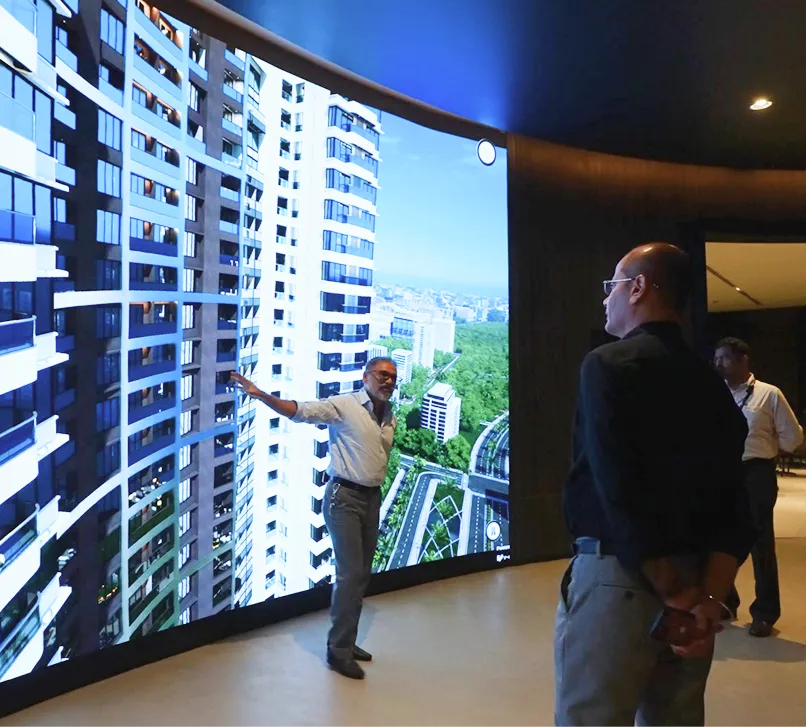
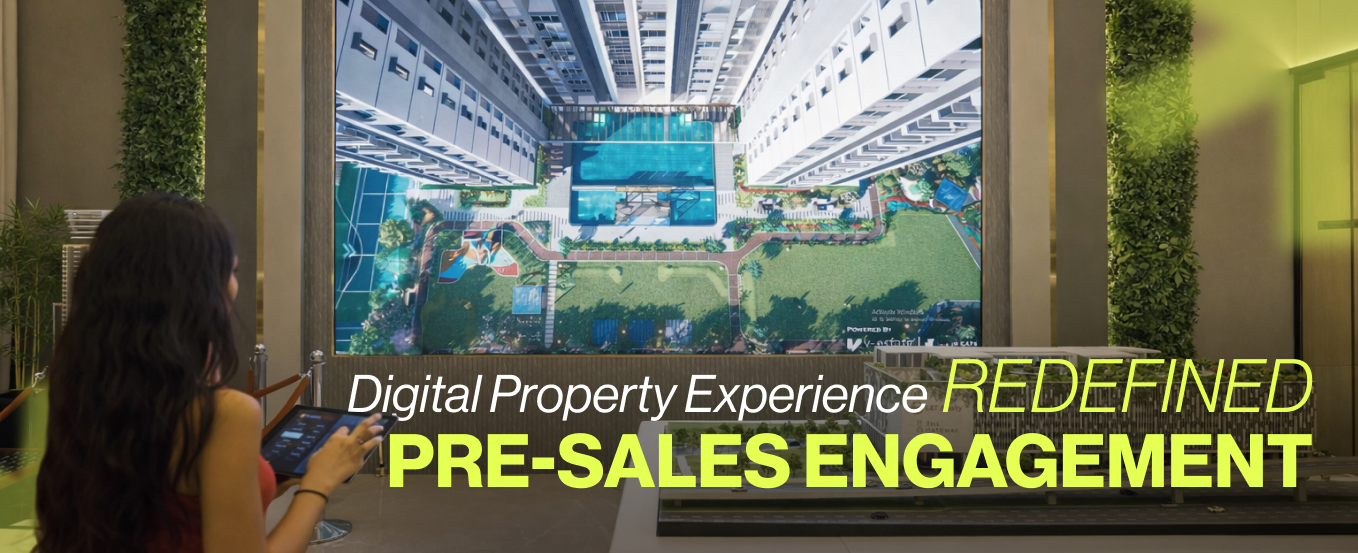
Digital property experiences integrate into physical sales infrastructure. Experience centers, sales lounges, and site offices house the technology.
The setup varies by project scale. Large pre-sales launches may warrant dedicated experience centers with multiple interaction stations. Ongoing pre-sales might integrate capabilities into existing sales infrastructure.
Sales teams play crucial roles. They facilitate rather than present. They observe customer interactions. They identify preferences through behavior. They provide targeted information based on observed interests.
The combination of digital capability and human expertise creates powerful pre-sales experiences.
Addressing Specific Pre-Sales Scenarios
For township launches, digital experiences help customers understand master plans and phasing. They can visualize completed neighborhoods before construction begins. They appreciate amenity placement and connectivity.
For luxury pre-sales, personalization becomes possible. High-net-worth customers expect bespoke experiences. Interactive customization allows exploration of premium options, material upgrades, and unique configurations.
For off-plan sales, digital experiences reduce perceived risk. Customers see exactly what they will receive. Spatial uncertainty eliminates. View confirmation happens before booking.
Overcoming Implementation Barriers
Cost represents the most common concern. Pre-sales budgets already stretch across marketing, infrastructure, and sales commissions. Additional technology investment requires justification.
The justification exists in improved conversion efficiency. Better conversion rates mean lower customer acquisition costs. Shorter sales cycles free sales team capacity. Higher deal values increase revenue per transaction.
Content creation complexity creates hesitation. Developing photorealistic 3D environments requires expertise. However, the investment creates reusable assets. The same content serves across marketing channels and customer touchpoints.
Sales team adoption affects success. Personnel comfortable with traditional methods may resist change. Training and early wins drive adoption. When sales teams see conversion improvements, enthusiasm follows quickly.
Measuring Success in Pre-Sales
Digital experience implementation should track specific metrics:
Lead-to-visit conversion — do more prospects convert to site visits?
Visit-to-booking conversion — do more site visits result in bookings?
Sales cycle duration — has decision time reduced?
Average transaction value — are customers selecting higher-value options?
Customer satisfaction scores — do buyers report better understanding?
These metrics provide clear ROI assessment. They guide optimization and refinement
Competitive Advantages in Pre-Sales Markets
Pre-sales markets are intensely competitive. Multiple developers launch similar products simultaneously. Differentiation becomes difficult.
Digital experiences create memorable differentiation. Customers remember interactive exploration long after forgetting brochures. The impression influences decisions and recommendations.
The advantage compounds in markets with limited pre-sales track records. When customers cannot see completed examples, exploration quality becomes the primary differentiator.
Early adopters establish market leadership. They become known for innovative approaches. They attract serious buyers who appreciate thorough information. They build reputations that strengthen across projects.
Strategic Timing Considerations
Digital experiences deliver maximum impact when implemented before major pre-sales launches. The capability becomes a launch differentiator from day one.
Retrofitting existing pre-sales operations also delivers value but requires change management. Sales teams must adapt mid-cycle. Marketing materials need updating. Customer expectations require recalibration.
Phased implementation represents a balanced approach. Start with select projects or phases. Learn from initial deployments. Scale based on results and experience.
The Future of Pre-Sales Engagement
The trajectory is clear. Digital property experiences will become standard in pre-sales. Customer expectations will rise. Competitive pressure will increase.
Early adopters gain advantages that persist. They establish reputations for transparency and customer-centricity. They build operational capabilities that competitors struggle to replicate quickly.
The technology will continue evolving. Capabilities will expand. Quality will improve. Implementation will become more efficient.