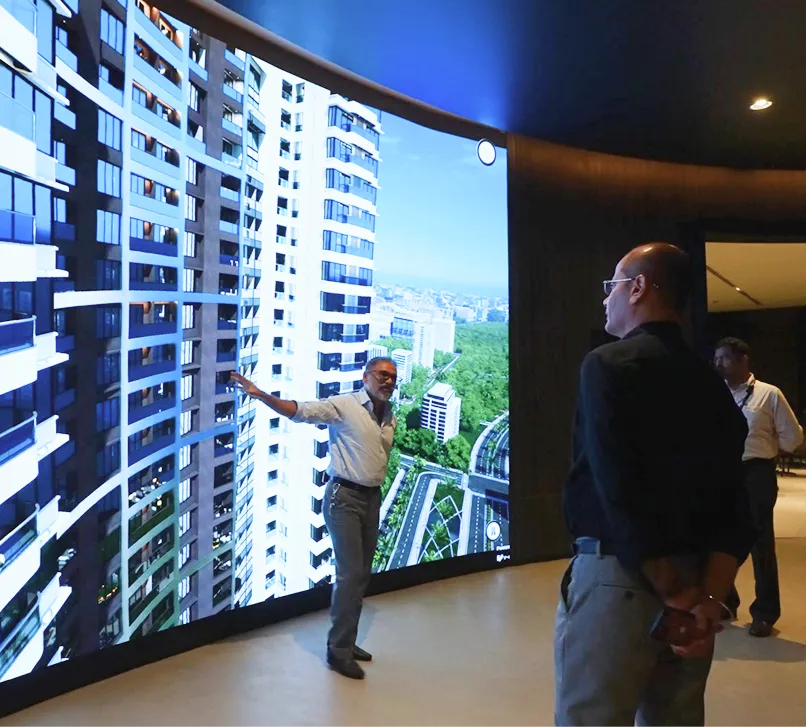
Real estate showrooms face a critical gap. Buyers stand before flat screens or printed brochures, yet struggle to visualize themselves in the space. Two-dimensional renderings fail to communicate scale, light, and spatial relationships. Physical models sit static, unchanged. Sales presentations feel disconnected from what buyers actually want to see.
The result: 60% of prospects never return after initial viewings. Developers invest ₹5-10 lakh per weekend activation, yet qualified leads remain flat. Marketing teams exhaust themselves customizing each pitch for different buyer segments. Sales cycles stretch longer than necessary.
The core issue isn't complexity. It's disconnection. When digital content lives separately from physical spaces, buyers hesitate. They imagine rather than experience. Confidence erodes.
Curved LED Screens: The Foundation for Immersive Retail
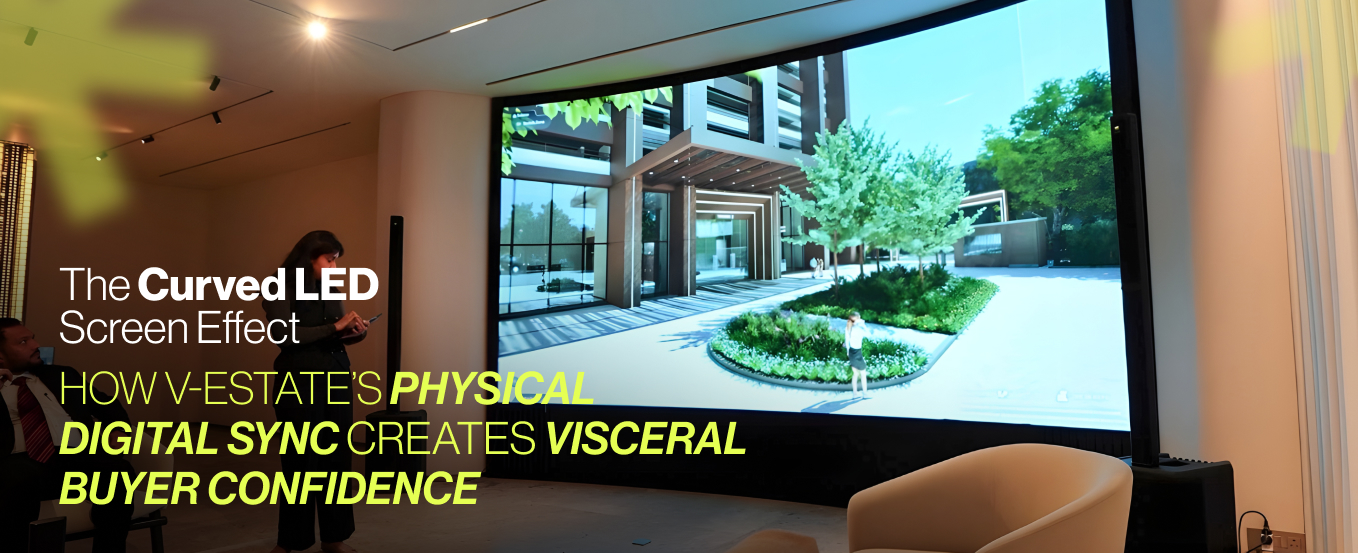
Curved LED displays dominate premium real estate showrooms across India's metro markets. These wraparound screens create 180-degree visual environments, placing buyers at the center of the display rather than in front of it.
The technical advantage runs deep:
180-degree immersion pulls eye movement inward, extending dwell time by 25% compared to flat screens
8K resolution capability delivers photorealistic detail without pixelation
1000+ nit brightness maintains clarity in daylight showroom conditions
800R curvature radius optimizes viewing angles across crowd flows
Yet hardware alone produces diminishing returns. After 30 seconds, static content loops bore audiences. Buyers revert to phones. Sales momentum stalls. The screen becomes wallpaper rather than a conversion tool.
The Physical-Digital Sync Gap: Where Conversion Actually Fails
Most real estate activations treat physical and digital elements as separate experiences. Physical scale models demonstrate proportions. Digital renders show finishes and views. Buyers mentally bridge the gap themselves.
This creates friction. Buyers ask questions like:
How does the 3D render translate to the actual unit dimensions?
Will the amenity placement match these digital overlays?
Can I see how different design choices affect natural light?
Sales representatives then rebuild trust manually, spending 15-20 minutes per buyer clarifying misalignments. In a 2-hour activation window, this limits meaningful conversations to 6-8 prospects.
The cost implications compound. Custom model modifications run ₹30,000-50,000 per change. Digital renders require external designers. Coordination between teams introduces delays and inconsistencies.
V-Estate's Offline Physical-Digital Synchronization
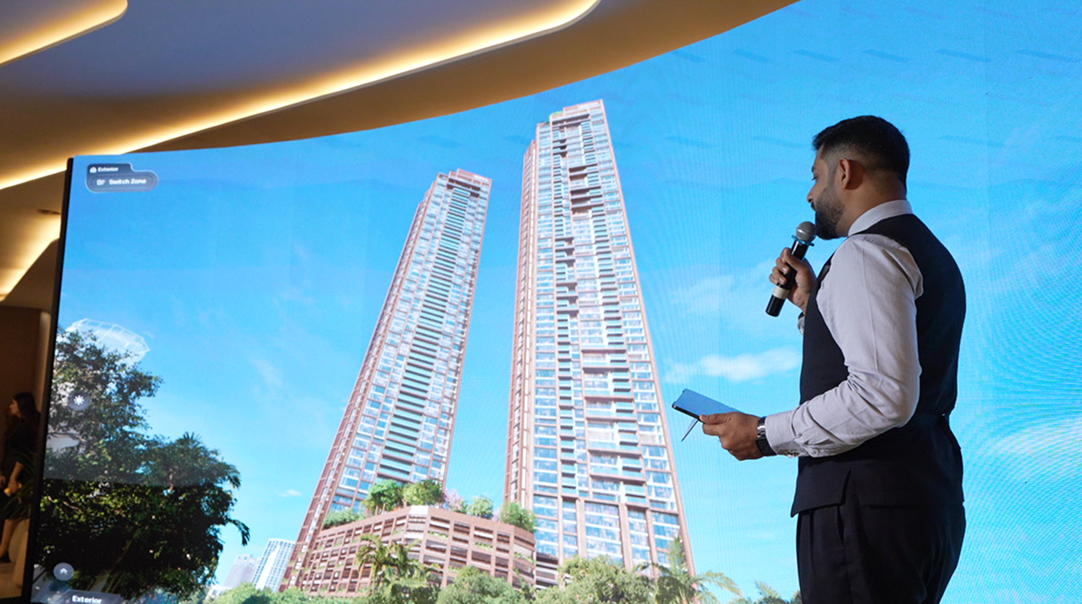
V-Estate eliminates the gap through real-time synchronization between digital interface and physical display—entirely offline. No cloud dependency. No internet reliability concerns.
The architecture:
Photorealistic 3D environments render locally on standard 16GB tablets
Live LED integration outputs 4K video at 60Hz directly to curved screens
Touch-driven customization allows instant property modifications
Offline data capture logs buyer interactions without server transmission
Sales representatives control the experience directly. Changes apply in real time. Paint colors shift instantly. Furniture arrangements rotate 360 degrees. Lighting transitions from dawn to dusk. Window views update based on property orientation and time selection.
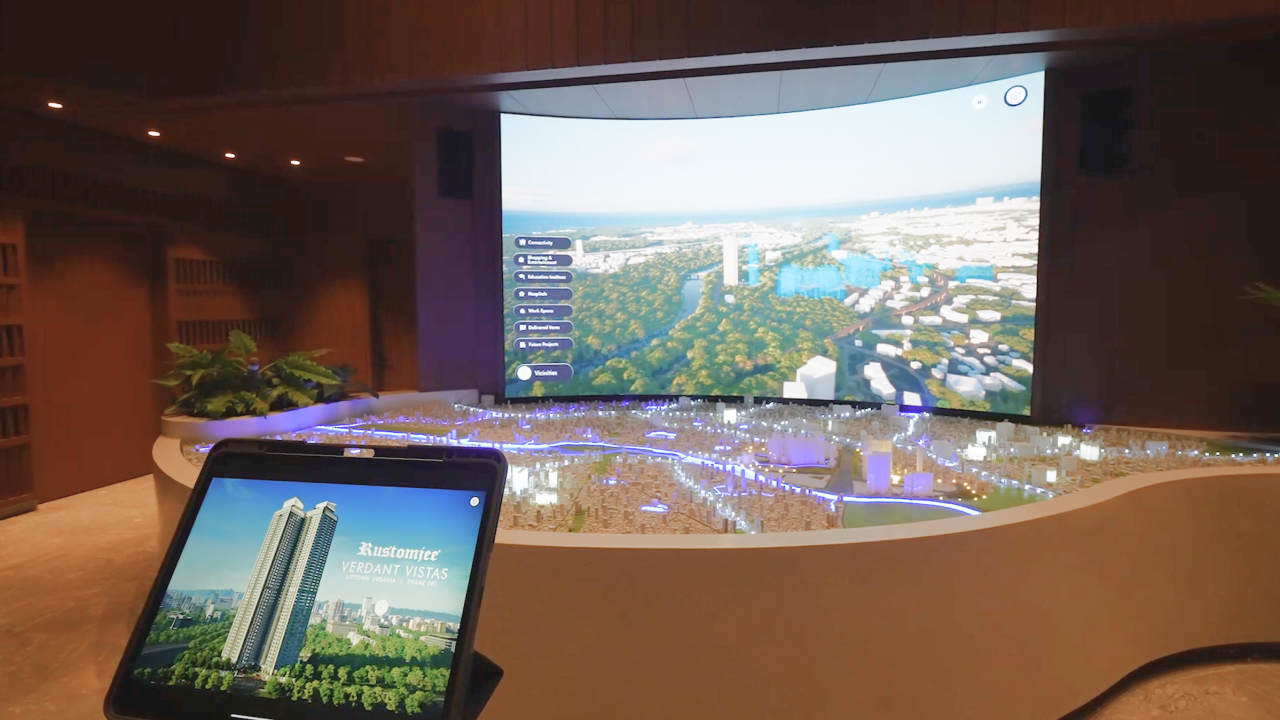
Physical scale models sit adjacent, reinforcing spatial accuracy. The digital overlay matches the physical unit exactly, creating psychological alignment in buyers' minds.
Core Features That Address Developer Challenges
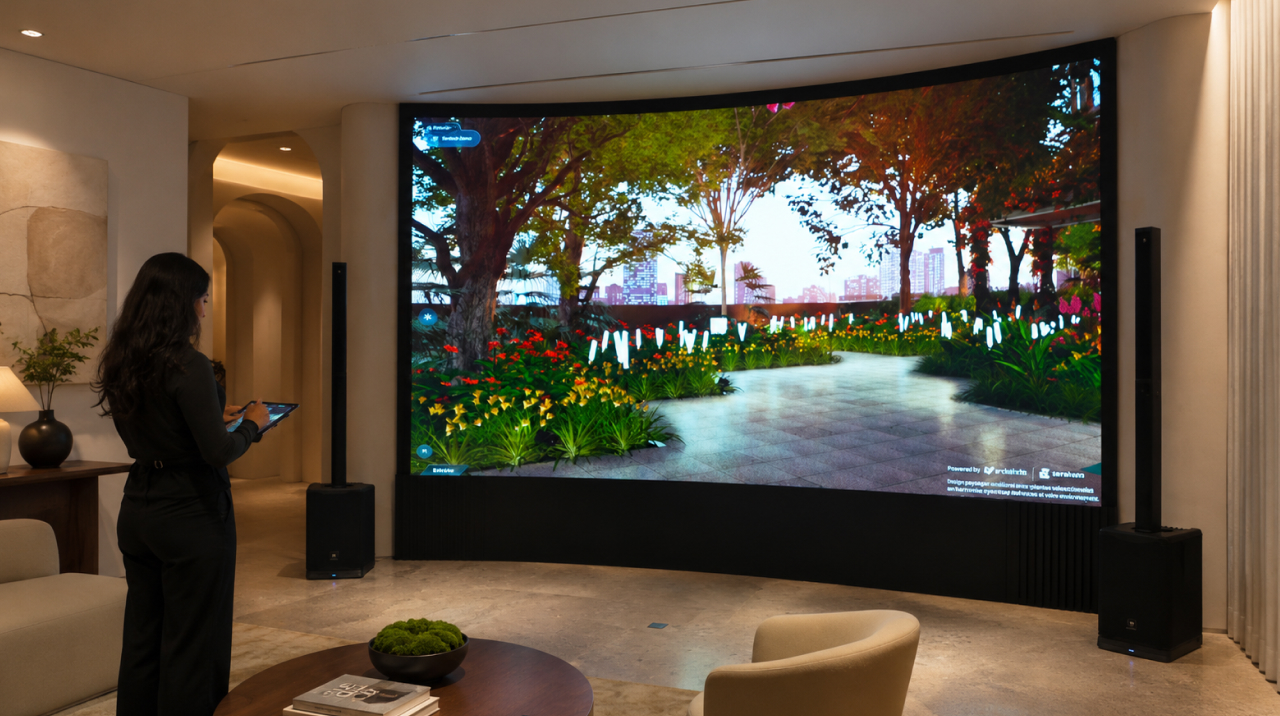
Photorealistic 3D show flats render minute environmental details—how afternoon light enters specific windows, what the evening cityscape appears like from the balcony, how natural ventilation flows through the unit. Buyers don't just see the property; they experience temporal variations within it.
Amenity mapping systems layer nearby facilities onto digital maps. Schools, healthcare centers, retail zones, and metro lines appear with color coding: blue for current projects, green for upcoming developments, numbered radii showing commute times.
Dynamic customization shifts beyond static visualization. Buyers paint walls live, test furniture placements, adjust ceiling heights in showrooms with standardized units, and toggle between seasonal appearances. This personalization increases engagement duration by 40% and deepens emotional investment.
Zero technical barriers. No Wi-Fi passwords. No loading screens. No buffering during critical moments. Activations remain stable through power fluctuations common in India's commercial districts.
Measurable Impact: What Field Deployments Reveal
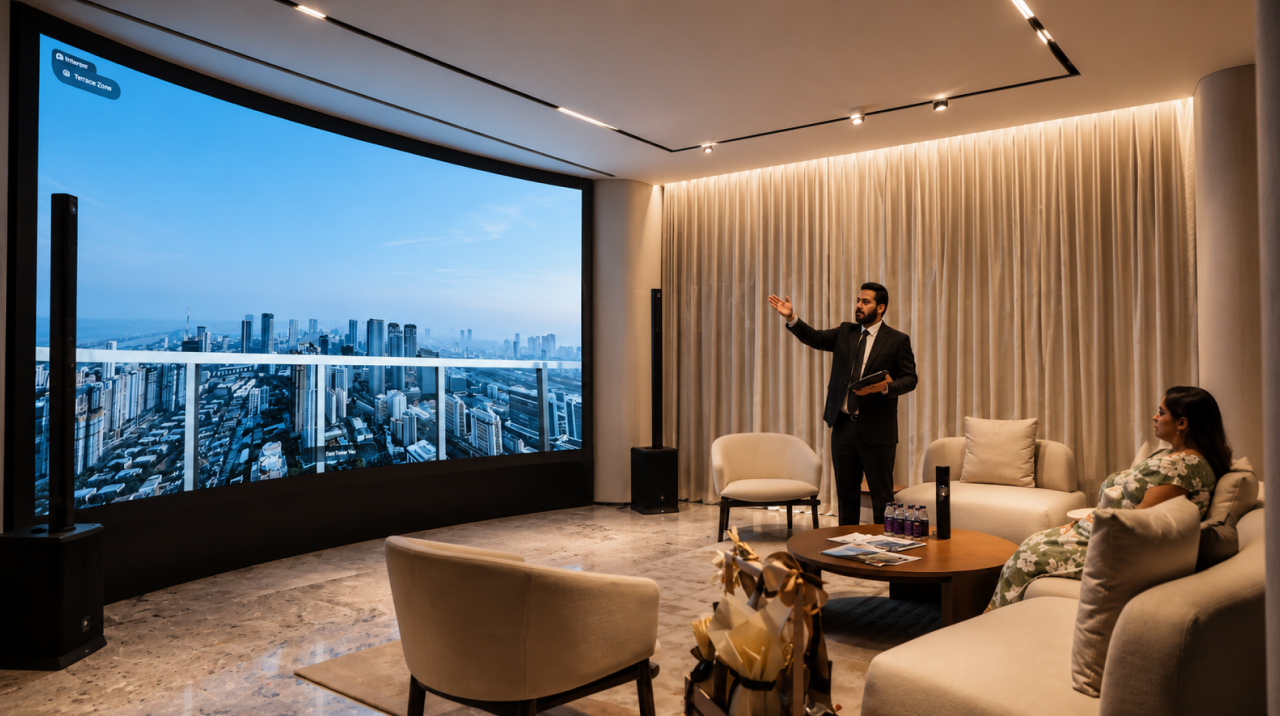
A 500-visitor weekend activation at a Mumbai township produced concrete results:
Lead volume increased 35% through customization-driven engagement
Average pitch duration fell to 7 minutes from 12-15 minutes
Buyer confidence scores reached 92% when offline sync eliminated technical friction
Verbal commitments rose 28% in follow-up conversations
Delhi's luxury segment tested similar implementations. Offline reliability proved decisive during infrastructure interruptions. Blackouts occurred mid-activation; other showrooms lost momentum. V-Estate deployments continued uninterrupted.
Cost analysis across deployments showed 45% reduction in demo-related expenses. Digital swaps replaced physical model iterations. Design changes required no external vendor involvement. Scaling across multiple showroom locations became feasible without proportional cost increases.
Sales cycles compressed by 18 days. Marketing teams attributed this to reduced decision paralysis. When buyers control visualization and modify properties in real time, clarity accelerates choice.
Why Offline Activation Matters for Your Bottom Line
Offline activation removes operational dependency. Your team doesn't rely on internet stability, vendor turnaround, or cloud architecture decisions made by external platforms.
This independence carries strategic weight:
Proprietary control keeps buyer interaction data within your systems
Deployment flexibility enables rapid showroom setup without infrastructure prerequisites
Cost predictability eliminates cloud subscription scaling
Reliability consistency ensures identical experience across all locations and activation times
For marketing heads managing multiple projects, centralized asset libraries reduce coordination overhead. Update a building amenity once; deploy across five showrooms instantly via USB transfer.
Operational Integration for Your Sales Team
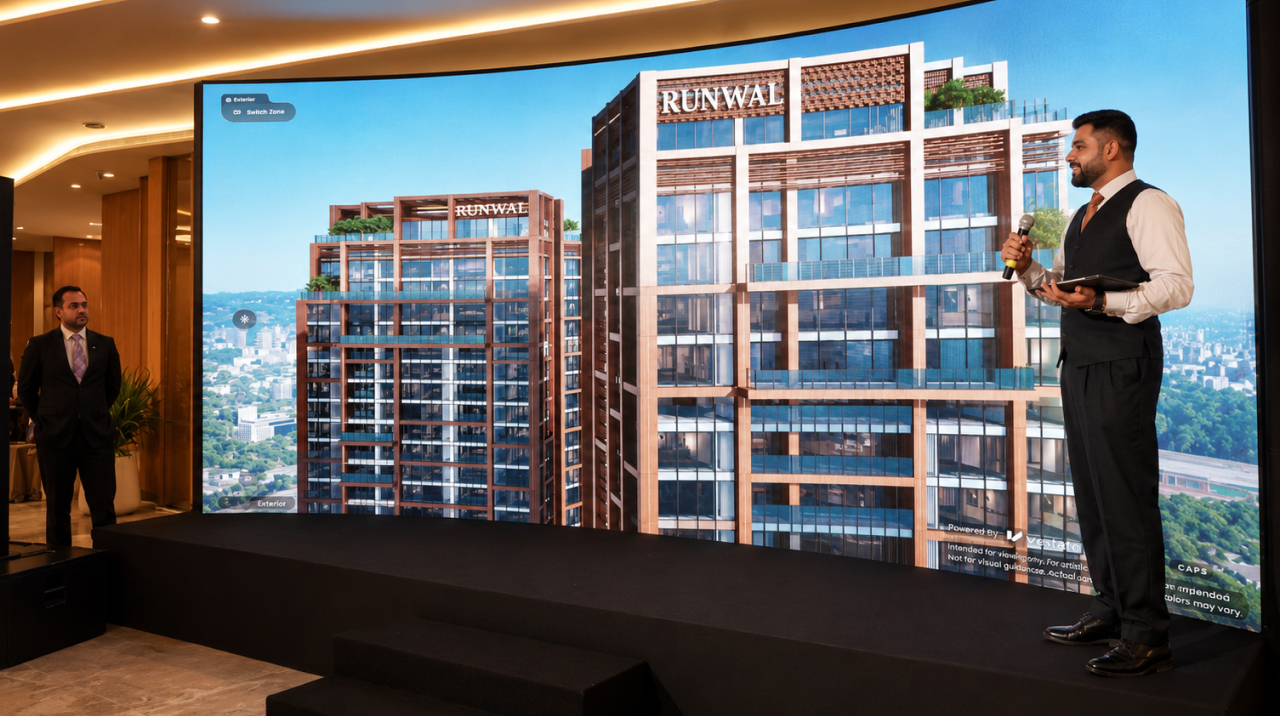
Implementation starts simple. Pair curved LED displays with a standard tablet running V-Estate. Cable the tablet to your sales desk. Preload property assets overnight using GIS data for amenities and architectural blueprints for unit layouts.
Sales representatives learn gesture controls in under one hour: pinch to zoom, swipe to customize, tap to switch between properties. The demo flow follows buyer interest: overview → personalization → amenity exploration → qualification.
Portable kits fit standard SUVs for roadshow activations. Setup takes 30 minutes. Teardown requires 15 minutes. You reduce logistical overhead while expanding reach beyond fixed showrooms.
The Trust Mechanism: Buyer Confidence Through Spatial Understanding
Curved screens amplify wraparound vision. Buyers process space viscerally, not intellectually. They lean toward properties they're mentally inhabiting. Nodding increases. Questions become specific rather than general.
Mirror neuron activation occurs when buyers interact directly with digital spaces. The brain treats customized, controlled environments as increasingly real. Hesitation converts to conviction.
Follow-up conversion rates improve measurably. Buyers retain spatial memories vividly. Price objections decrease when confidence in unit features runs high.