Buyers walk into sales offices with high expectations. Most walk out unconvinced.
That gap — between what a developer promises and what a buyer can picture — is where deals die. It is not a pricing problem. It is not a product problem. It is a visualization and trust deficit built into how most real estate sales environments are designed.
Traditional show flats address part of this. Static renders address less. Brochures solve almost nothing. The result: lead drop-off rates between 60 and 70 percent post-visit — a number most marketing heads quietly absorb because they have no alternative framework.
There is a better framework. It starts by rethinking what happens inside the sales floor.
The Real Cost of Passive Sales Environments
Most sales offices operate on a passive model. A prospect arrives. Staff present. Brochures are handed over. A model unit is shown. The buyer leaves to "think about it."
That thinking window is where competitors close.
The core problem is not the buyer's hesitation. It is the environment's inability to answer questions in real time. Buyers do not just want to see a flat. They want to know what morning light looks like in the master bedroom. They want to understand the commute. They want to see how their furniture fits. They want to visualize a monsoon afternoon from the balcony.
None of that is answered by a physical show flat alone. And no amount of verbal assurance fills the gap that immersive, interactive proof can.
What Experience Centers Actually Deliver
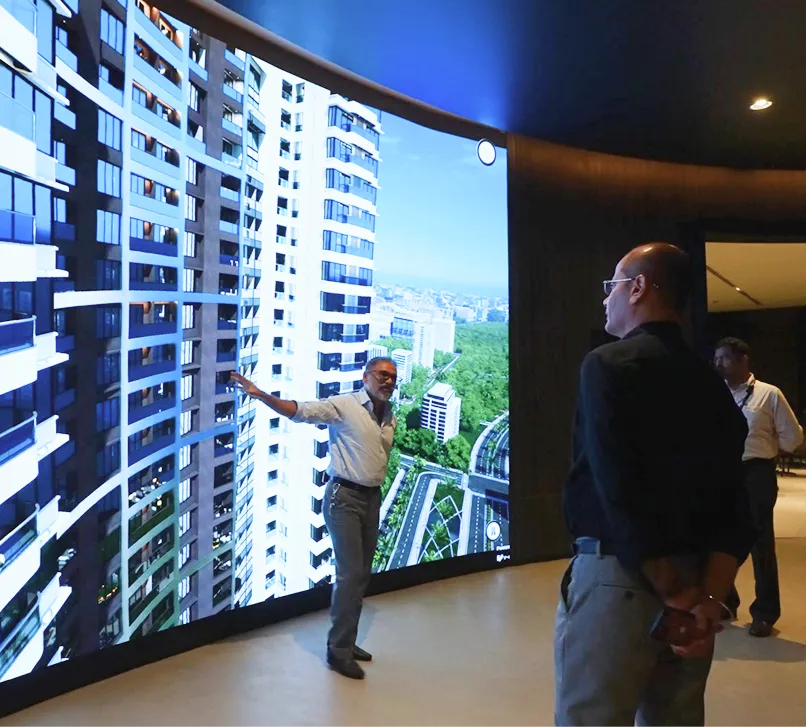
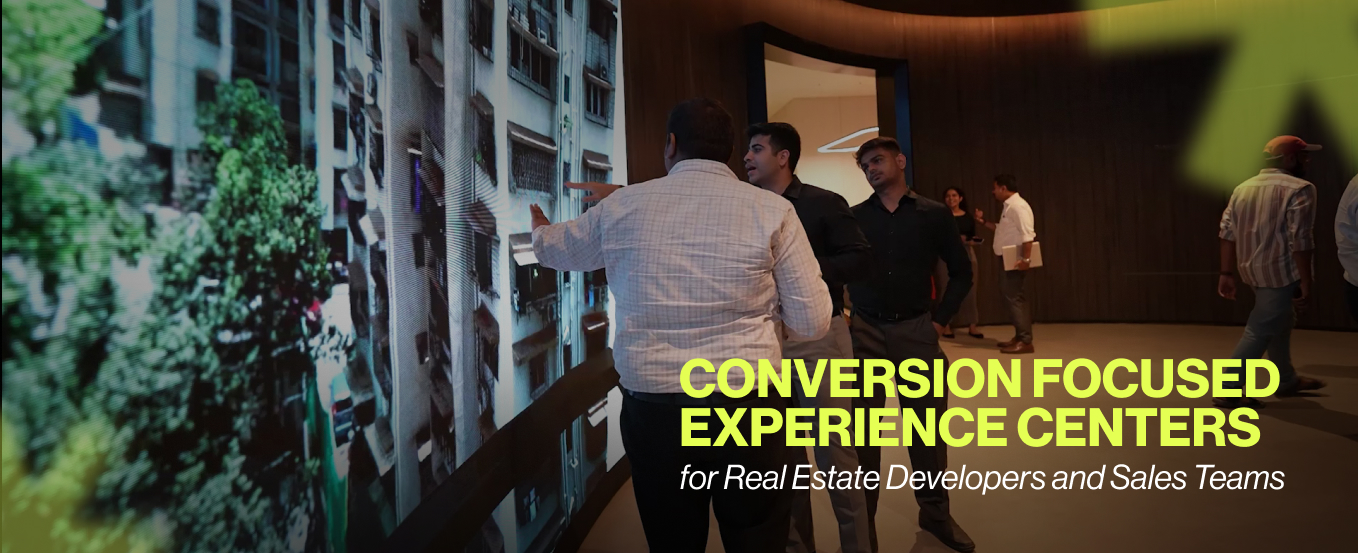
A well-built experience center is not a display room. It is a decision engine.
It replaces static presentations with live, interactive property journeys — all running offline, on local servers, without dependency on internet connectivity. This matters enormously for site offices in peripheral locations, new project launches, and high-footfall weekends where bandwidth collapses.
Offline activation is non-negotiable. Any tool that requires stable internet is a liability at a sales event. Hardware-integrated setups running on local processing eliminate that variable entirely.
The experience a buyer gets inside a properly built center covers four core layers:
1. Photorealistic 3D Virtual Show Flats
These are not renders. They are immersive, lifelike property walkthroughs that recreate the actual unit — down to window perspective, material texture, and spatial proportion.
A buyer seated inside a virtual living room can see exactly what the view outside looks like at sunset. They can assess room depth. They can evaluate ceiling height. No vague promises. No imagination required.
Load times under 10 seconds. No buffering. No dropped frames. Staff guide the walkthrough without technical interruption.
2. Amenity Mapping and Neighborhood Connectivity
Buyers do not just purchase a flat. They purchase a location, a lifestyle, and a daily routine.
Interactive amenity maps allow prospects to explore the surrounding ecosystem — schools, hospitals, transit links, retail zones, upcoming infrastructure. Layers toggle on demand. Commute time estimates appear in context. Future development overlays give buyers confidence in long-term area value.
This context is what seals emotional buy-in. A buyer who understands their daily life inside a project commits faster than one who doesn't.
3. Live Customization Controls
Buyers engage differently when they have control.
Wall paint selection. Flooring options. Furniture placement. Window view adjustments. All rendered in real time. A buyer watching their sofa fit correctly into a digital living room stops being a prospect. They start making ownership decisions.
This interaction layer reduces objections because it answers them live. It also creates a psychological investment — the buyer has already personalized the space. Walking away means leaving something they built.
4. Dynamic Lighting and Weather Simulation
A flat that looks good in a brochure may feel different at 6 AM or during peak summer.
Lighting and weather controls let buyers cycle through real conditions — dawn, noon, evening, night. Seasonal shifts. Monsoon light. Dry summer glare. The property is evaluated across its actual usage context, not a single idealized moment.
Sales teams use this to preempt objections before they surface.
Operational Impact for Developers
The business case for experience centers is measurable, not theoretical.
On-site conversions increase 25 to 40 percent when buyers go through an interactive journey versus a passive presentation. Qualification happens faster — buyers who self-filter unsuitable options shorten the sales cycle for both parties.
Physical staging costs drop by up to 50 percent. Digital assets are reusable across project launches. A township and a high-rise can share the same infrastructure with different content layers.
Sales teams handle significantly more visitors per day without increasing headcount. Fewer callbacks are needed because questions get answered on the floor, in the moment, with proof.
Post-visit, interaction data integrates with CRM workflows. Customizations a buyer made during the session — paint colors, furniture preferences, window views — feed directly into follow-up communication. Personalized nurture sequences reference what the buyer built. Retention improves because outreach feels relevant, not generic.
Implementation Without Disruption
Deployment begins with a site audit — footfall volume, floor space, hardware configuration. A single kiosk suits boutique projects. Multi-station setups handle large site offices and launches.
Staff training runs in two-hour sessions. The interface is built for guided use, not self-service. Sales staff remain the relationship. The technology supports the close.
Built-in interaction logs track dwell time, feature engagement, and drop-off points. Marketing heads use this data to identify which property features drive the most interest — and align campaign messaging accordingly.
The Competitive Reality
Developers who continue relying on passive sales environments will absorb higher costs, longer sales cycles, and lower conversion rates. The buyers have not changed. The standard for proof has.
Experience centers are not a premium add-on. They are rapidly becoming baseline infrastructure for competitive project launches. The developers who deploy them now compress their sales cycles, reduce staging costs, and build the kind of buyer trust that referrals come from.
The sales floor is still your highest-leverage conversion environment. Build it accordingly.