Buyers in infrastructure-led micro-markets do not buy on faith. They buy on clarity. If your sales centre cannot answer — in the first three minutes — where the airport is, how the sea link changes commute time, and what the tower looks like from the top floor, you lose the sale before the conversation starts.
Static brochures do not answer these questions. AV presentations scratch the surface. Neither format moves inventory at the pace infrastructure-linked projects demand.
A growing number of large-format real estate developers have moved to CGI-grade walkthroughs deployed in dedicated offline experience centres. The results — faster decisions, higher per-session conversions, and measurable trust at scale — are reshaping how sales teams approach high-volume launch events.
The Core Problem: Selling What Buyers Cannot Yet See
Infrastructure-led projects carry a specific sales burden. The full value proposition is future-dated. Growth corridors, transit connectivity, and neighbourhood development exist on timelines — not on the ground today.
Sales teams compensate with maps, renders, and verbal pitch sequences. None of it lands the way physical presence does. Buyers leave with doubts. Follow-ups become harder. Sales cycles stretch.
The fundamental gap is spatial. Buyers need to feel scale, understand distance, and visualise daily life in a location that does not yet fully exist. That requires a medium that maps, brochures, and standard AV simply cannot deliver.
CGI-Grade Experience Centres: The Offline Activation Advantage
The shift happening across developer sales operations is from print-and-pitch to immersive offline activation. This is not a virtual tour sent via WhatsApp. It is a purpose-built experience deployed inside the physical sales centre — designed for groups, engineered for volume, and calibrated to compress decision timelines.
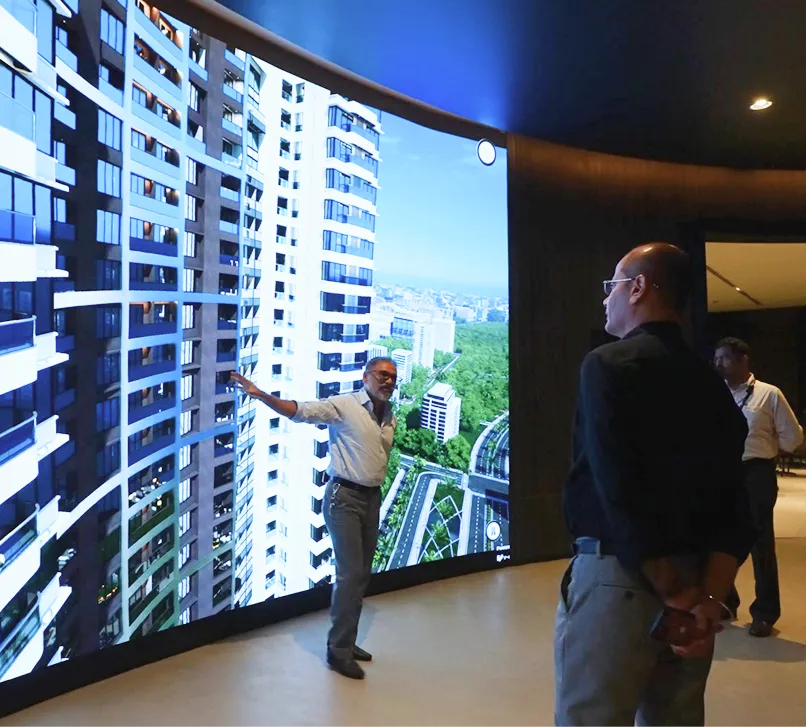
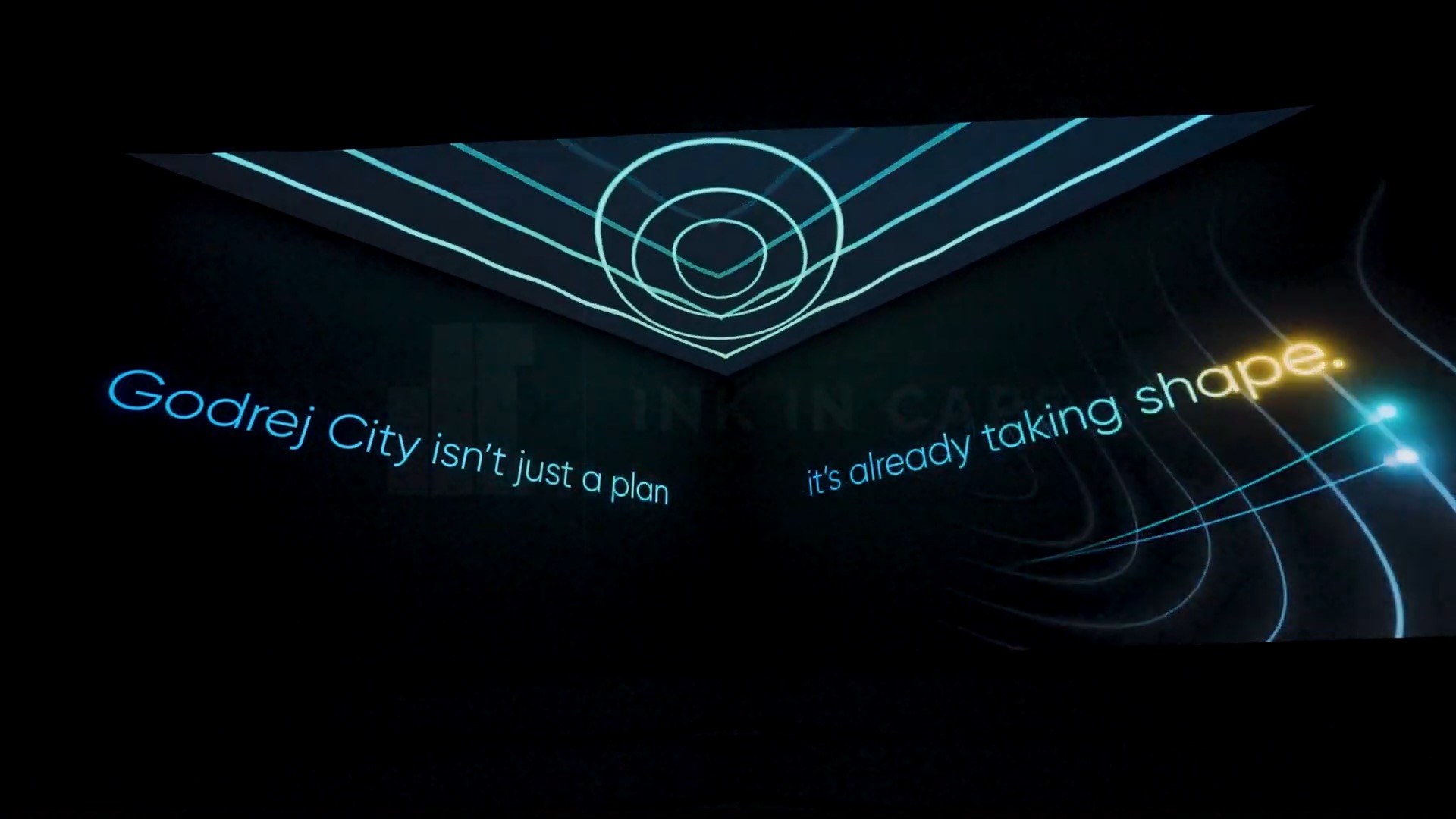
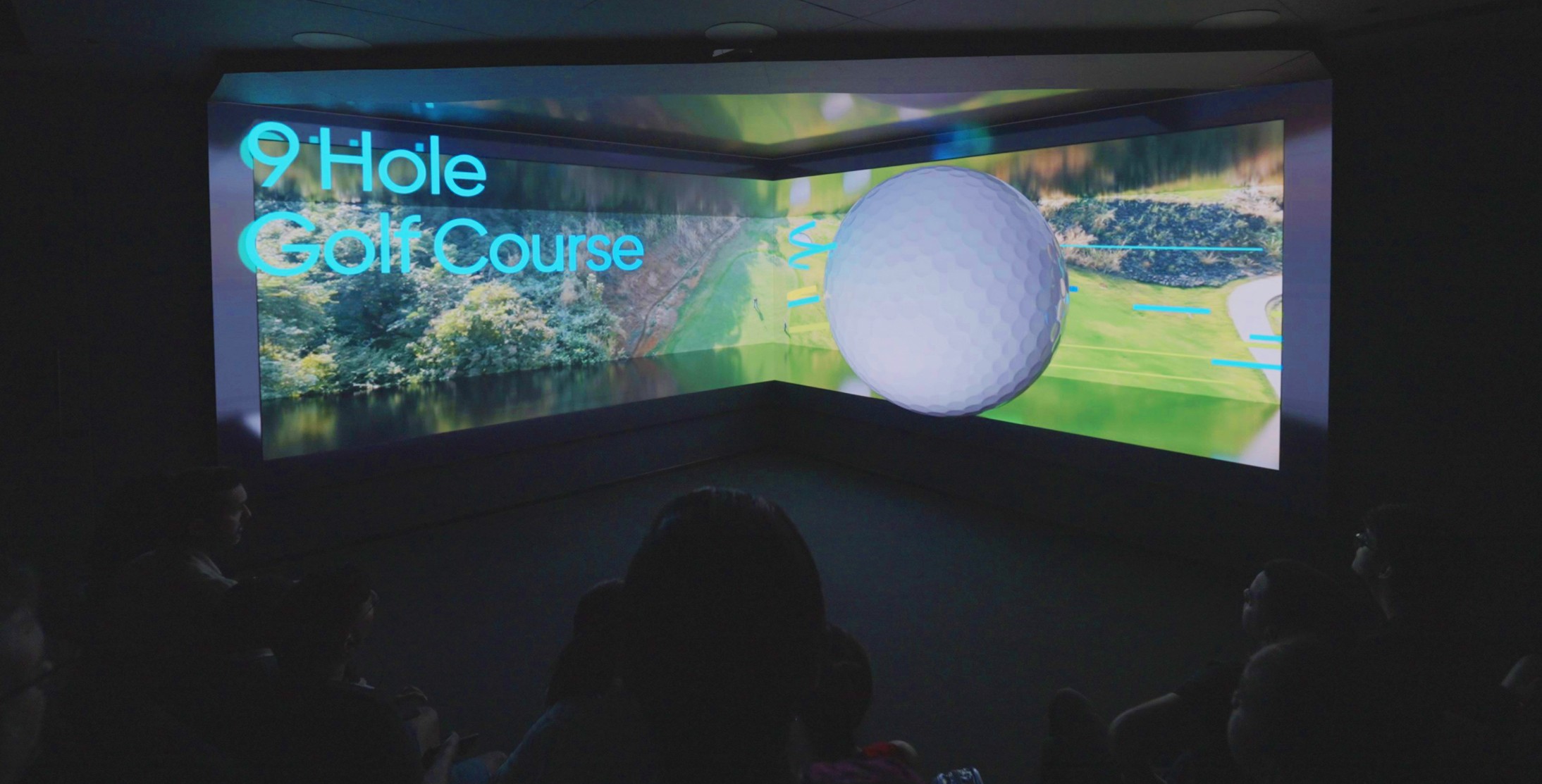
Amphitheatre-format projection environments anchor this model. A single cohesive film — typically 180 seconds — delivers a structured three-act journey: past execution, current site progress, and future infrastructure impact. Every second is weighted. Nothing is decorative.
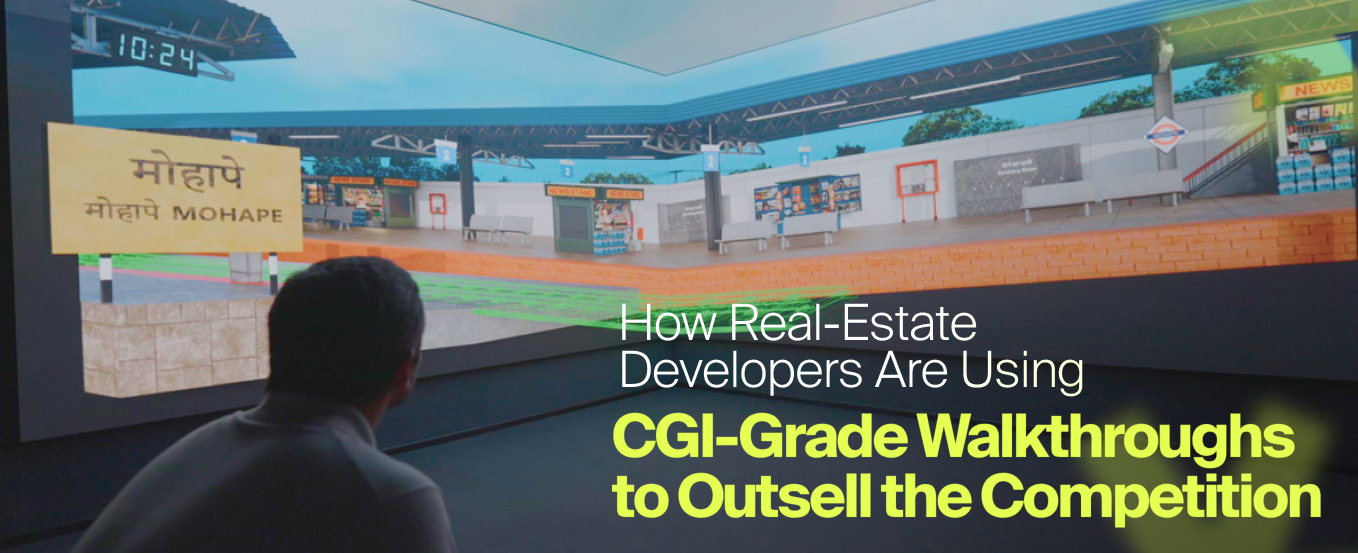
This configuration was deployed for a 145-acre project in Panvel, where the challenge was proving future connectivity across airport access routes and trans-harbour links to a daily flow of buyers unfamiliar with the micro-market.
Three-Act Structure: Past, Present, Future
The 180-second film is not a product showcase. It is a credibility architecture. Each act serves a distinct trust-building function.
Act 1 — Execution Track Record. Completed projects anchor the opening. Delivered towers, handed-over communities, and long-standing infrastructure form the base. Buyers see proof of delivery before they assess intent. This is not branding. It is evidence sequencing.
Act 2 — Current Site Reality. Live construction views follow. Tower progress, foundation activity, and surrounding neighbourhood context appear in sequence. Renders are grounded against real site footage. The juxtaposition closes the credibility gap between promise and progress.
Act 3 — Anamorphic 3D Infrastructure Visualisation. This is where CGI-grade production separates from standard AV. Anamorphic 3D projections bring infrastructure into the room. Airport proximity registers as spatial experience, not as a map annotation. Sea links, growth corridors, and transit routes appear at scale — distances felt, not read. Photoreal walkthrough rendering closes Act 3 with unit-level detail. Finishes, balcony sightlines, amenity spaces, and layout flows render at production quality. Buyers assess liveability, not imagination.
.JPG)
Photoreal Walkthrough Rendering: Specification-Grade Visual Output
Developer teams frequently underestimate what render quality communicates in a group sales setting. A low-fidelity interior render is a liability, not an asset — it raises questions about specification integrity and finish standards.
Production-grade renders used in these activations operate at a different benchmark:
Material fidelity: Finishes rendered under accurate lighting, matching actual specifications.
Sightline accuracy: Balcony and window views modelled to precise floor and orientation data.
Amenity context: Common areas and leisure spaces shown in proportionally accurate environments.
Layout legibility: Floor plan transitions rendered for spatial intuition, not just scale reference.
When render quality matches delivery standard, buyer confidence in specification commitment rises. Objections about finish quality and space perception drop measurably.
Interactive Sales Integration: Converting Group Engagement to Individual Leads
Group screenings generate collective conviction. The operational challenge is converting shared excitement into structured lead capture. Experience centres that integrate interactive layers alongside the main projection solve this at scale.
Touch table configurations linked to the main display allow buyers to run commute simulations, filter amenities against personal preferences, explore individual unit layouts, and scan QR codes to save session data directly to mobile.
CRM auto-tagging captures buyer interest signals in real time. Sales teams enter follow-up conversations with context — not cold call lists. Priority sequencing improves. Conversion velocity increases.
Operational Scale: Built for High-Volume Sales Environments
Standard sales tools fail under volume. Brochure distribution gets chaotic. One-to-one presentations cannot handle 15-person groups. Digital demos lose resolution under projection conditions.
Amphitheatre layouts process 15+ visitors per session without quality degradation. The system operates across 12+ daily hours on looped content without technical instability. Infrastructure that fails during a launch weekend is not a sales tool — it is a liability.
The operational architecture of CGI-grade experience centres is engineered for developer launch realities: high daily footfall, consistent output quality, and zero dependency on individual presenter performance.
.jpg)
Measured Outcomes Across Key Sales Metrics
Outcomes from large-scale CGI-grade offline activation show consistent patterns:
5,400+ monthly visitors processed through structured immersive sessions.
15-person group sessions converted to qualified individual leads at scale.
180-second delivery window sufficient to communicate past, present, and future value in full.
Infrastructure comprehension increased significantly — airport proximity, sea link connectivity, and growth corridors landed spatially rather than conceptually.
Buyer conviction in micro-market positioning strengthened, reducing objection frequency and shortening decision timelines.
Purchase readiness improves when spatial clarity replaces verbal persuasion. These numbers reflect that shift.
Relevance for Infrastructure-Heavy Project Launches
Marketing heads and sales leadership evaluating experience centre investment should benchmark against one question: can your current setup spatially prove future value to a 15-person group in under three minutes?
If the answer is no, the sales centre is creating friction, not removing it. Visitors leave carrying unresolved spatial doubts. Follow-up teams inherit conversations that should have closed on-site.
CGI-grade walkthrough rendering combined with anamorphic 3D infrastructure visualisation directly addresses this friction point. It does not depend on pitch quality, presenter availability, or individual buyer patience.
The model scales. It handles volume. It delivers consistent conviction architecture across every session, every day.
For developers building in infrastructure-led corridors — where value is real but visibility is limited — this is not a production upgrade. It is a sales infrastructure decision.