.jpg)
Buyers don't reject properties. They reject uncertainty. In micro-markets driven by future infrastructure — airports not yet open, sea links still under construction, growth corridors visible only on master plans — the gap between a developer's vision and a buyer's confidence is the biggest obstacle to closing. Most sales tools widen that gap. Anamorphic projection, deployed correctly in an offline experience centre, closes it.
Infrastructure-Driven Micro-Markets Face a Distinct Sales Problem
Future-led projects are not new. But the buyer profile has changed. Today's buyer is better researched, more skeptical, and unwilling to rely on brochure promises. When a project's core value proposition rests on a road not yet built or a transit link still in approval, static media breaks down completely.
Brochures compress nuance. Presentation decks lose attention after slide three. Digital walkthroughs feel flat on a laptop screen. None of these formats communicate scale, distance, or spatial reality. For the Godrej Panvel project — a 145-acre development positioned around airport access, Navi Mumbai sea-link proximity, and regional growth corridors — standard sales tools were inadequate.
The actual challenge had four dimensions:
Buyers could not contextualise pending connectivity without experiencing scale.
High visitor volumes demanded a format that worked for groups, not just individuals.
Decisions needed to accelerate — not weeks later after repeated visits.
Trust required more than developer claims. It required spatial proof.
Offline Activation Over Digital Substitutes
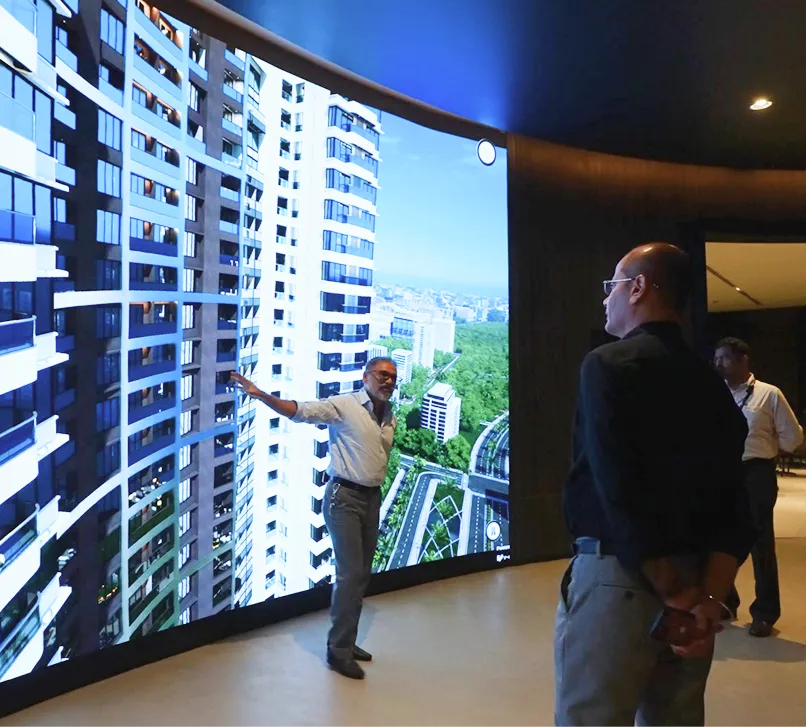
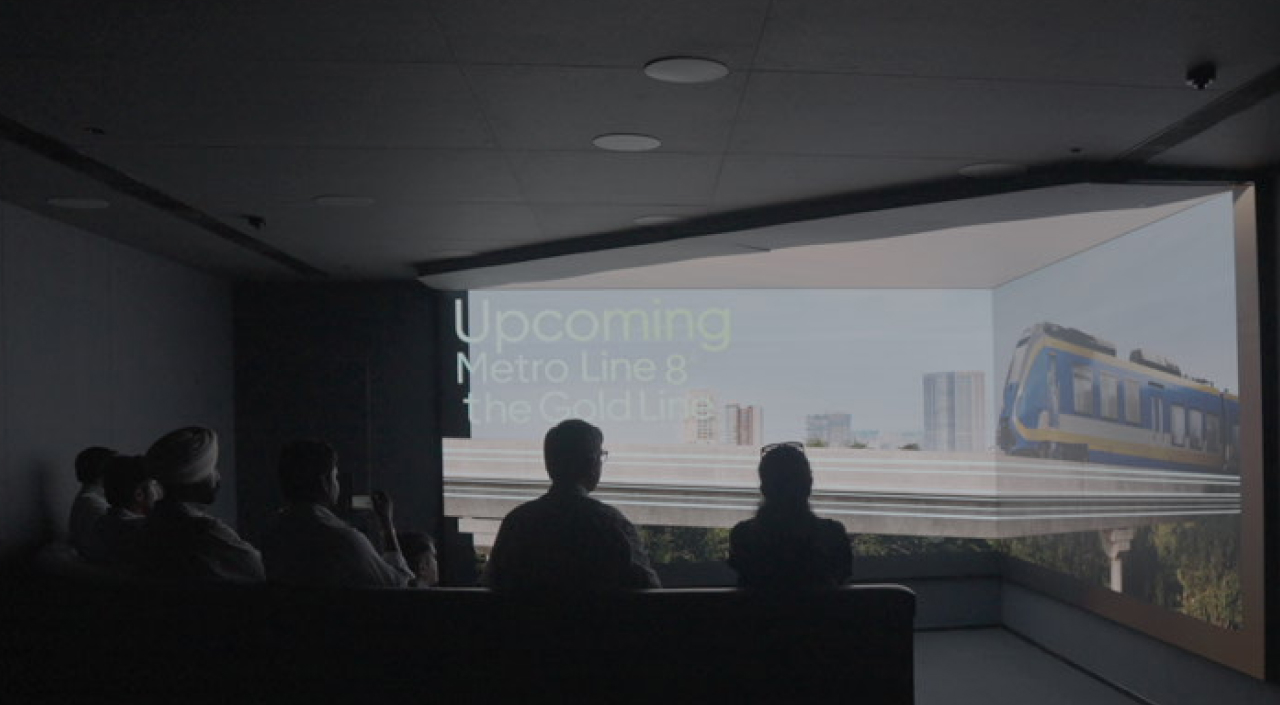
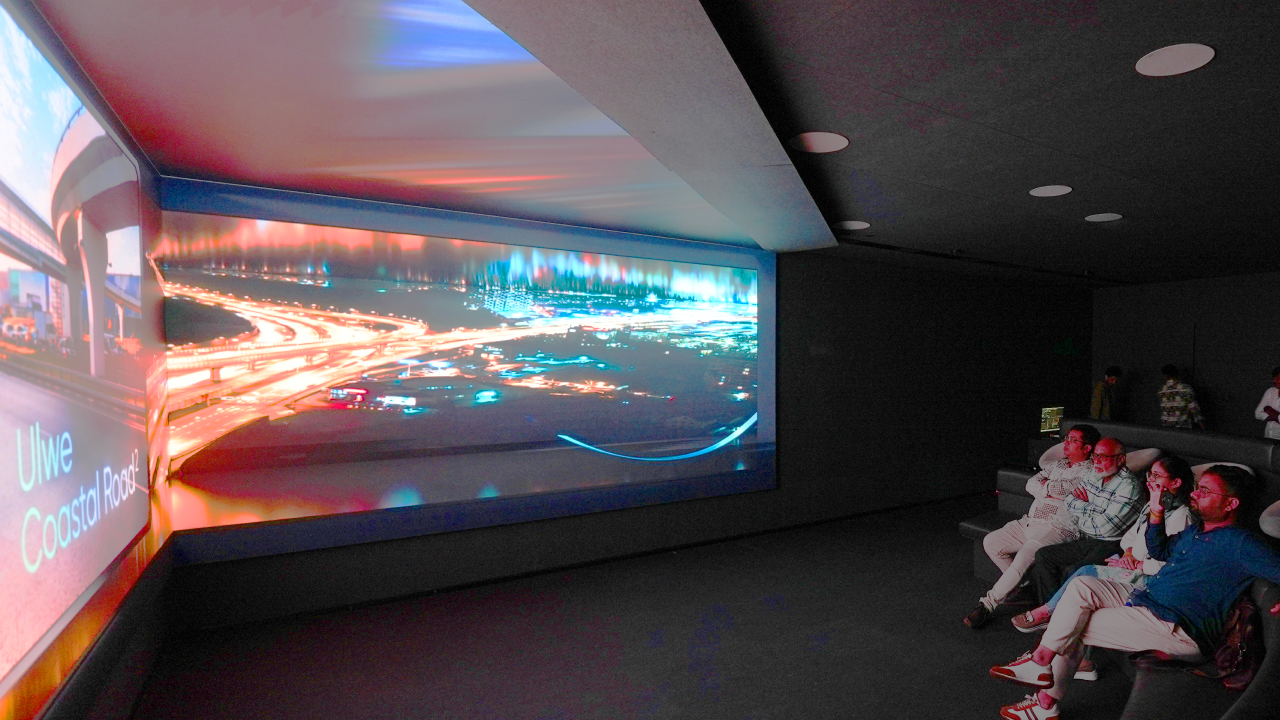
The solution was not an app upgrade or a better render. It was a purpose-built offline experience centre with amphitheatre-style projection architecture. Visitors entered as groups. Projections filled the room. No headsets, no individual screens, no fragmented attention.
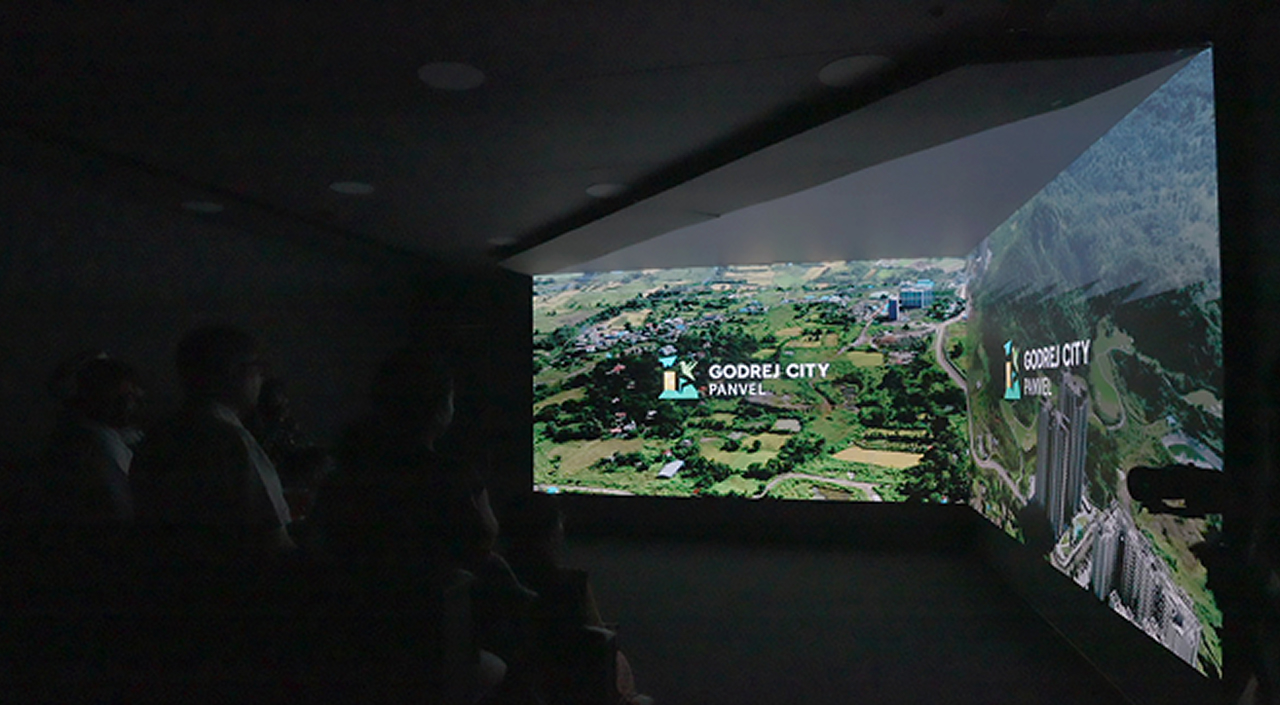
The format ran continuously — 12+ operational hours daily, handling 15+ visitors per session. Anamorphic 3D visuals projected infrastructure into the physical space of the room. Photoreal walkthroughs followed. The entire experience ran for 180 seconds.
That's the critical design choice. Not a 20-minute presentation. Not a 45-minute guided tour. A precisely structured three-minute sequence built to compress context, build credibility, and move buyers toward readiness — at scale.
The 180-Second Sequence — Structure Drives Conviction
The session ran across three acts. Each act served a specific credibility function.
Act 1 — Delivered Projects. Completed Godrej developments appeared first. Towers already standing. Neighbourhoods already functioning. Execution track record established in under 60 seconds. Buyers entered Act 2 without doubt about the developer's ability to deliver.
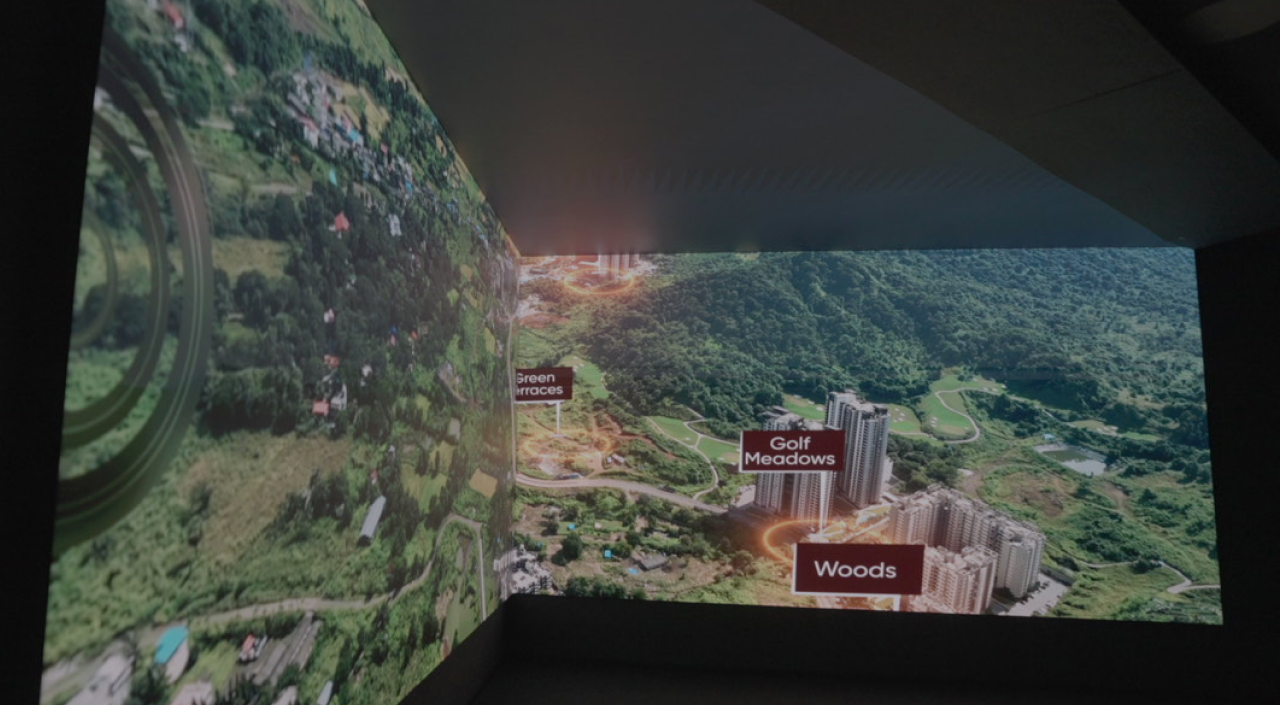
Act 2 — Current Site Reality. Live site conditions followed. Construction progress updated. Surrounding context grounded. Buyers saw what existed today — not a render, not a promise. This anchored the experience in verifiable fact before the future infrastructure sequence began.
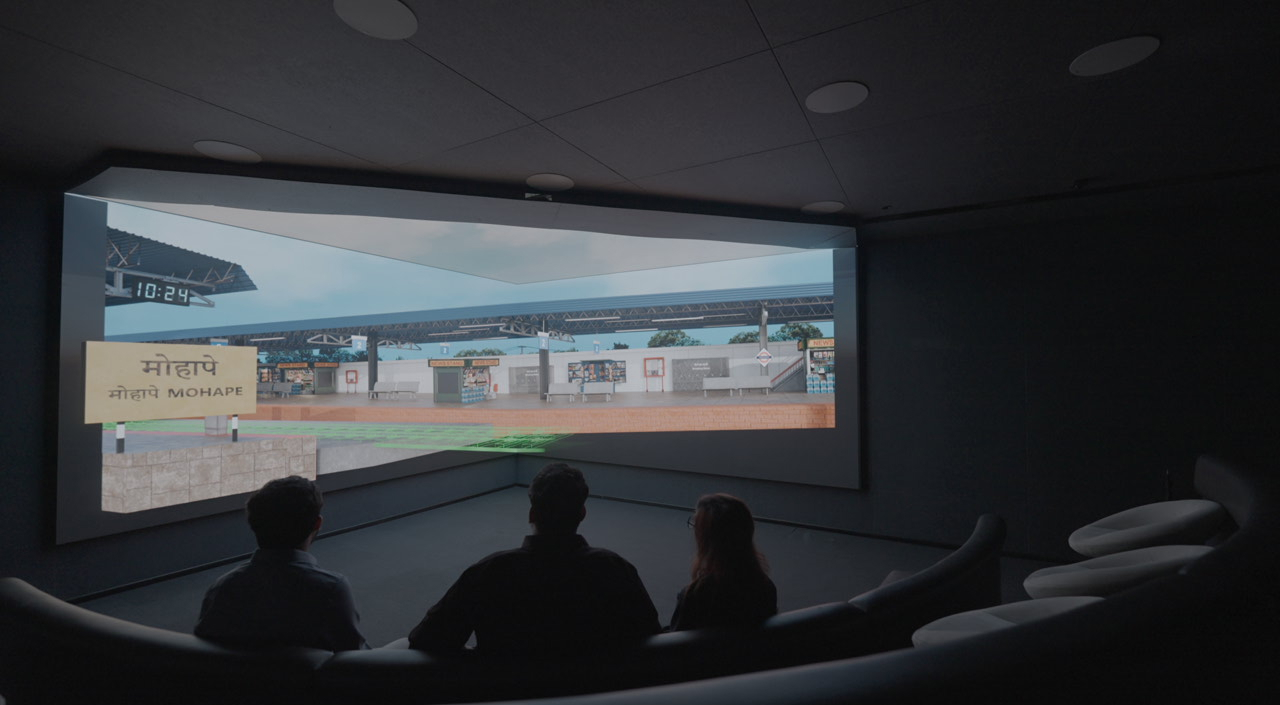
Act 3 — Future Infrastructure in Anamorphic 3D. Airport access routes unfolded spatially. Sea-link proximity rendered at life-size scale. Growth corridors extended outward from the site in real proportion. Buyers didn't read about connectivity — they experienced it as spatial reality.
Photoreal walkthroughs concluded the sequence — balconies, amenities, sightlines rendered with material and lighting accuracy. The progression from proven past to verified present to credible future created a logical conviction arc. Retention spiked. Objections dropped.
Anamorphic Projection for Infrastructure Visualisation — Technical Merits
Anamorphic projection bends visuals to create depth perception without headsets. Invisible infrastructure becomes spatially tangible. Distances register instinctively. Scale matches lived experience.
For real estate developers, the practical advantages are specific:
Macro infrastructure impacts communicate without jargon or explanation.
Spatial simulation precision replicates real-world distance and proportion.
Room-scale integration converts flat master plans into three-dimensional environments.
Group legibility allows 15+ viewers to read the same spatial information simultaneously.
The result is recall, not just comprehension. Buyers leave with a spatial memory of the infrastructure — not a slide deck they'll revisit once and forget.
Photoreal Rendering — Grounding the Future in Architecture
Anamorphic infrastructure visuals create macro conviction. Photoreal architectural renders close the micro gap. Buyers need both.
Production-grade renders delivered material finishes, lighting behaviour, amenity proportions, and balcony sightlines at specification accuracy. Buyers assessed lifestyle feasibility visually — not by reading a spec sheet or trusting a verbal description.
The balance between spectacle and realism is deliberate. Anamorphic sequences create emotional readiness. Photoreal renders create rational validation. Both are required for a buyer to move.
Lead Intelligence and CRM Integration at the Session Level
Group conviction alone doesn't close deals. The experience centre converted group engagement into individual intent data.
Touch tables linked to the main projection allowed buyers to simulate commute routes, filter amenities, and explore unit layouts. QR codes captured session interactions. Mobile deep-links let buyers revisit content post-visit. CRM systems auto-tagged interest signals.
Sales teams received qualified lead data — not footfall counts. Excitement measured as intent. Priority follow-up focused on buyers who had already self-selected through deeper interaction, not cold inquiries.
Throughput Metrics — Operational Efficiency for High-Volume Projects
The format wasn't built for boutique launches. It was engineered for sustained volume.
5,400+ monthly visitors engaged through the experience centre.
15+ buyers processed per 180-second session.
12+ operational hours daily without projection or content degradation.
Infrastructure comprehension improved — airports, sea links, growth corridors understood without supplementary explanation.
Micro-market confidence lifted — buyer perception gaps demonstrably closed.
Developers running high-footfall launches understand the throughput challenge. Quality cannot decrease as volume increases. Amphitheatre architecture and looped projection content solved this without adding operational staff.
Applicability for Infrastructure-Heavy Projects Across Markets
This format is not Panvel-specific. Any project where the primary value driver is pending infrastructure carries the same sales challenge. Transit-oriented developments, airport-adjacent projects, industrial corridor housing, coastal connectivity plays — each has buyers who cannot see what they're buying.
Anamorphic projection solves the visibility problem offline. It scales for volume, integrates with CRM, and compresses sales cycle duration by delivering full context in the time a buyer would otherwise spend reading a brochure.
Marketing heads evaluating upcoming launch formats should assess one metric: how long does your current format take to establish infrastructure credibility, and what percentage of visitors leave without it?
If the answer is unclear, the format is the problem. A site walkthrough with spatial projection specialists is the starting point — not a new brochure, not a revised deck.