Property buying decisions carry significant financial and emotional weight. Customers invest substantial savings. They commit to long-term financial obligations. They make life-altering choices about where their families will live and grow.
The stakes could not be higher. Yet the tools most developers use to support these decisions — static renders, 2D images, printed brochures — remain stuck in an earlier era.
The mismatch is increasingly costly. Static visualizations cannot support the complexity of modern property decisions. They fail to provide the information customers need. They create uncertainty where confidence should exist.
The Limitations of Static Visualizations
Static renders serve a basic purpose. They show what a building might look like. They depict interior layouts. They suggest design intent.
However, they stop there. They cannot show perspective from different angles. They cannot demonstrate spatial relationships. They cannot convey how spaces feel at different times of day.
They offer single viewpoints. What customers see is what they get. They cannot explore beyond the frame. They cannot validate proportions. They cannot test alternatives.
Static images cannot address specific customer questions. What is the view from this window? How does light enter this room? Can I fit my furniture here? How does this space connect to that one?
These questions matter in high-stakes decisions. Inability to answer them creates hesitation.
The Imagination Barrier
Static renders place a cognitive burden on customers. They must mentally transform flat images into three-dimensional experiences. They need to imagine themselves moving through spaces. They have to infer scale and proportion from limited visual data.
Many customers struggle with this transformation. The leap from static image to lived experience proves too large. They cannot visualize daily life in the property. They cannot assess functionality from pictures alone.
The difficulty compounds with complexity. Large-format apartments, multi-level homes, integrated villas — these properties resist understanding through static imagery alone.
Customers who cannot visualize properly defer decisions. They request multiple visits. They seek reassurance from family and friends. They comparison-shop extensively. The sales cycle extends indefinitely.
The Information Gap in Property Decisions
High-stakes decisions require comprehensive information. Customers need to understand spatial relationships between rooms and areas, circulation patterns and movement through spaces, natural light variations throughout the day, window views and external context, storage capacity and practical functionality, and furniture placement and spatial utilization.
Static renders address none of these effectively. They show surfaces, not spaces. They depict appearances, not experiences. They communicate style, not substance.
The information gap forces customers to guess. They make assumptions about critical aspects. They hope their mental models match reality. This hope conflicts with the magnitude of the investment.
The Cost of Uncertainty in Sales Cycles
When customers lack confidence, sales cycles extend. Decisions that should take days stretch to weeks or months. Each postponement increases the likelihood of lost sales.
Extended sales cycles create multiple problems: sales team productivity declines as they maintain prolonged follow-ups with uncertain prospects, marketing costs increase to nurture leads through extended decision periods, forecast accuracy suffers as tentative bookings fail to convert, and inventory management becomes unpredictable with uncertain demand signals.
The cumulative impact affects business performance. Working capital gets tied up in slow-moving inventory. Marketing efficiency deteriorates. Opportunity costs mount as sales teams spend time on stalled deals.
Interactive Alternatives to Static Renders
The solution lies not in better static images but in fundamentally different approaches. Interactive visualizations allow customers to explore properties dynamically rather than viewing them passively.
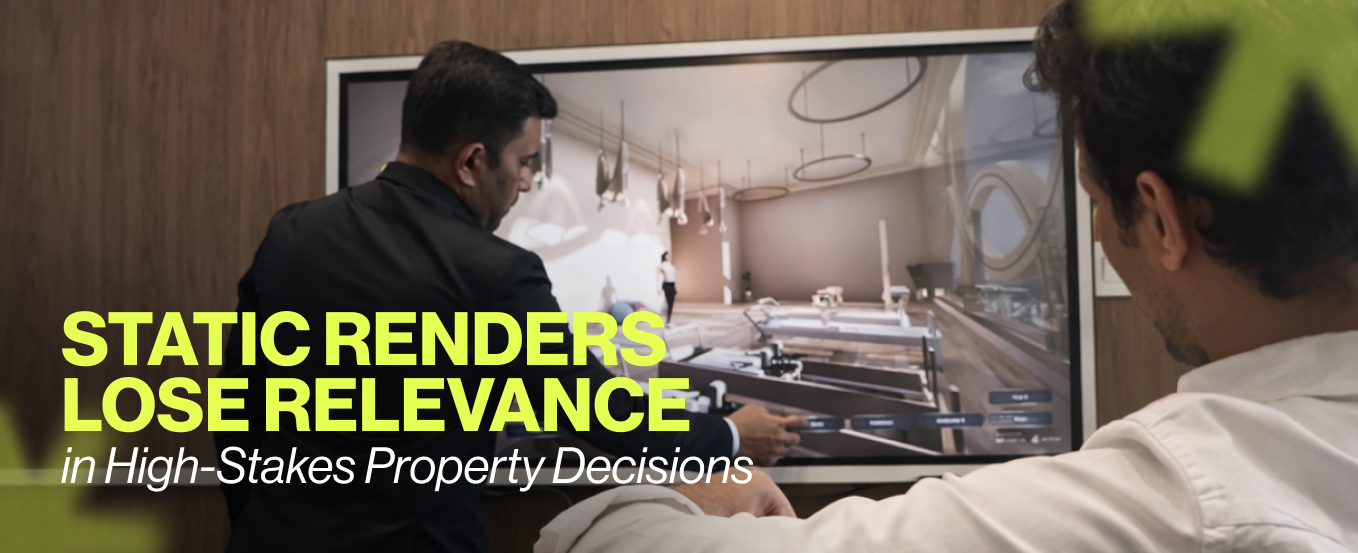
3D virtual environments enable natural navigation. Customers move through spaces at their own pace. They understand proportions through experience rather than estimation. They validate assumptions about size and scale.
Real-time customization allows experimentation. Customers test different furniture arrangements. They switch between finish options. They compare alternative layouts. They see immediate results.
Environmental simulation provides context. Customers experience spaces at different times. They understand natural light patterns. They assess views from different vantage points. They appreciate neighborhood context.
These capabilities deliver the information customers need for confident decisions.
Real-World Impact on Decision Quality
Developers who implement interactive visualization report significant changes in customer behavior.
Decision confidence increases. Customers understand what they are buying. They ask better questions. Their expectations align with reality.
Sales cycles shorten. The reduction from weeks to days is common. Customers reach decisions faster when they have comprehensive information.
Post-purchase satisfaction improves. Fewer customers report unmet expectations. Complaints about discrepancies between marketing and reality decline.
Referral rates increase. Satisfied customers recommend properties to peers. Word-of-mouth marketing becomes more effective.
Integration into Physical Sales Environments
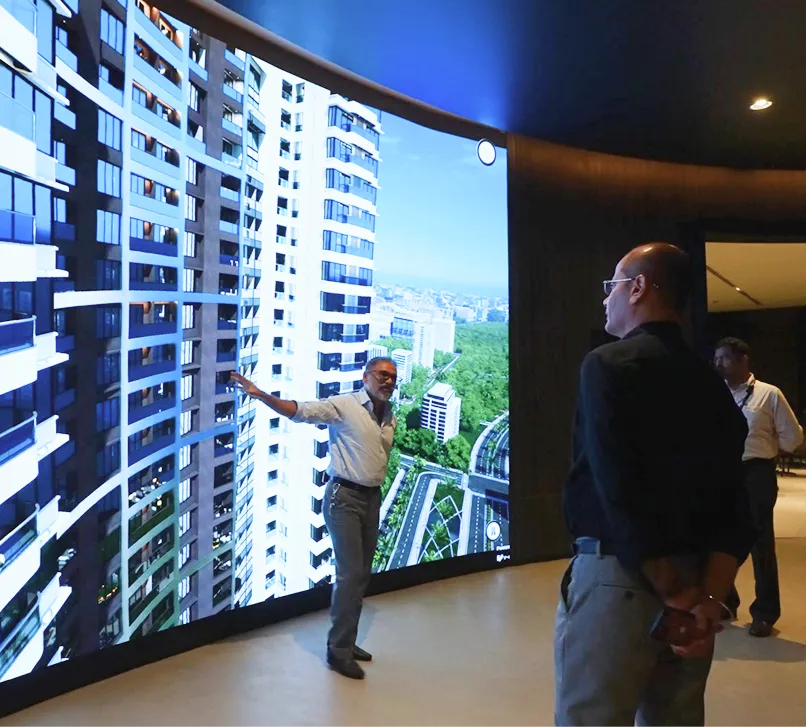
Interactive visualization technology belongs in physical sales spaces. Experience centers, sales lounges, and site offices provide the context for engagement.
The technology operates alongside traditional sales tools. It does not replace sales personnel. It enhances their effectiveness by providing better tools for customer interaction.
Sales teams transition from explaining static images to facilitating interactive exploration. They observe customer behavior. They identify preferences through interaction patterns. They provide targeted information based on observed interests.
The combination of human expertise and interactive capability creates powerful sales experiences.
Addressing Common Implementation Concerns
Cost considerations affect every investment decision. However, static visualization also carries costs — photography, rendering, printing, and the hidden cost of extended sales cycles. Interactive visualization represents a reallocation rather than a pure addition.
Customer acceptance questions emerge regularly. Will customers, particularly older demographics, engage with technology? Experience shows broad acceptance when the interface is intuitive and the value proposition clear.
Content creation complexity raises concerns. Developing interactive 3D environments requires expertise. However, the investment creates reusable assets. The same content serves multiple customers across extended periods.
The Competitive Advantage of Superior Visualization
Property markets are competitive. Products often appear similar on the surface. Differentiation becomes difficult.
Superior visualization creates memorable experiences. Customers remember interactive exploration long after forgetting static images. The impression influences their decision-making.
The advantage compounds in pre-sales scenarios. When customers cannot visit completed properties, visualization quality becomes the primary experience differentiator. Those who provide superior exploration capabilities win preference.
Strategic Considerations for Developers
Match visualization capability to project complexity. Larger projects, unusual designs, and premium segments benefit most from advanced visualization. Standard products may require less sophistication.
Consider the customer profile. Younger demographics and tech-savvy buyers expect interactive experiences. Traditional buyers may require more guidance but adapt quickly to intuitive interfaces.
Evaluate the sales cycle impact. The primary ROI comes from reduced sales cycle duration and improved conversion rates. Projects with high customer acquisition costs justify greater visualization investment.
Plan for content reuse. Visualization assets serve multiple purposes — sales presentations, marketing campaigns, website content, and investor communications.
The Future of Property Visualization
Static renders will not disappear overnight. They will gradually become supplementary rather than primary tools. Interactive exploration will become expected, especially for significant investments.
The trajectory is clear. Customer expectations are rising. Technology capabilities are advancing. Competitive pressure is increasing.
Developers who embrace interactive visualization early establish market leadership. They create reputations for transparency and customer-centricity. They build competitive advantages that strengthen over time.
Making the Transition
Moving from static to interactive visualization requires planning but does not demand disruption. The transition can be gradual.
Start with pilot projects. Test interactive approaches with select properties before broader implementation.
Train sales teams thoroughly. Ensure personnel understand how to facilitate interactive experiences effectively.
Gather customer feedback. Learn from initial deployments. Refine based on user experience.
Measure business impact. Track changes in sales cycle duration, conversion rates, and customer satisfaction.
The Business Case for Moving Beyond Static
The investment in interactive visualization delivers returns through multiple channels: reduced customer acquisition cost through improved conversion efficiency, shorter sales cycles freeing sales team capacity, higher customer satisfaction generating referrals and repeat business, and better brand positioning differentiating from competitors.
For high-stakes property decisions, the tools matter. Static renders served their purpose. That purpose has passed.
Interactive visualization represents the new standard for supporting confident property decisions. The transition is underway. The benefits are proven.
The question is not whether to move beyond static renders. The question is how quickly competitors will make the move first.