Real estate developers are spending more on marketing than ever before. Yet conversion rates remain flat. Decision cycles keep getting longer. And buyers keep asking the same questions — even after visiting the site office.
The problem is not reach. The problem is clarity.
The Real Bottleneck in Premium Real Estate Sales
Most marketing budgets are built around visibility. Digital ads. Hoardings. Social campaigns. Lead generation portals.
These tools fill the pipeline. They do not close it.
Buyers today carry more information, more doubt, and more options than any previous generation.
Premium positioning requires more than repetition. It requires understanding. When a buyer cannot fully visualize a property — its scale, its light, its views, its layout — they delay. They revisit. They compare. They stall.
Incomplete visualization is the silent conversion killer.
No amount of advertising solves this. More impressions do not replace missing spatial clarity.
What Traditional Tools Cannot Deliver
Sample flats show one unit. One configuration. One version of reality.
Brochures show selective angles. Controlled lighting. Curated perspectives.
Websites present what developers want buyers to see — not what buyers need to verify.
None of these give the buyer control.
And control is exactly what a high-value purchase demands.
When buyers feel they are being shown something rather than allowed to explore it, trust weakens. Objections increase. The sales team spends more time explaining and less time closing.
The communication model itself is the structural flaw.
Advertising Dependency Drives Costs Without Fixing Conversion
Here is a pattern most marketing heads recognize immediately.
Lead volumes look healthy. Intent is shallow. Follow-up cycles stretch for weeks. Sales productivity drops. Marketing responds by increasing spend.
The loop repeats. Costs rise. Conversion quality does not.
The underlying issue stays untouched — buyers are not confident enough to decide. They need one more visit. One more brochure. One more conversation.
High advertising spend is often a symptom of low product clarity.
When the product cannot fully communicate itself, external persuasion has to do the work. That persuasion has a ceiling — and a significant cost.
Shifting From Persuasion-Led to Experience-Led Positioning
The model that works for premium positioning is not about pushing messages harder.
It is about letting buyers explore deeper.
When a buyer navigates a project on their own terms — choosing what to look at, comparing units in real time, checking views from specific floors, understanding the surrounding ecosystem — their confidence builds organically.
They are not being sold to. They are discovering.
This shift changes the entire sales dynamic. Objections reduce. Questions become specific. Decisions accelerate.
The product earns trust through experience, not through frequency.
3D Sales Platforms as an On-Site Conversion Infrastructure
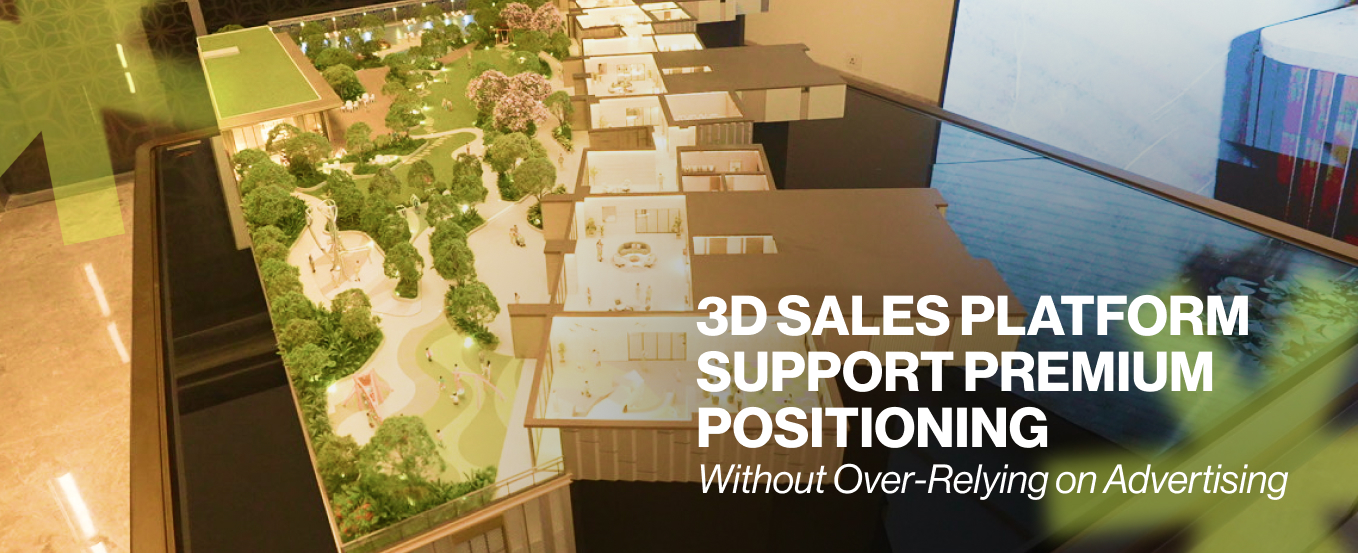
This is where structured 3D sales enablement enters the process — not as a digital marketing tool, not as an online campaign asset, but as a physical on-site sales infrastructure.
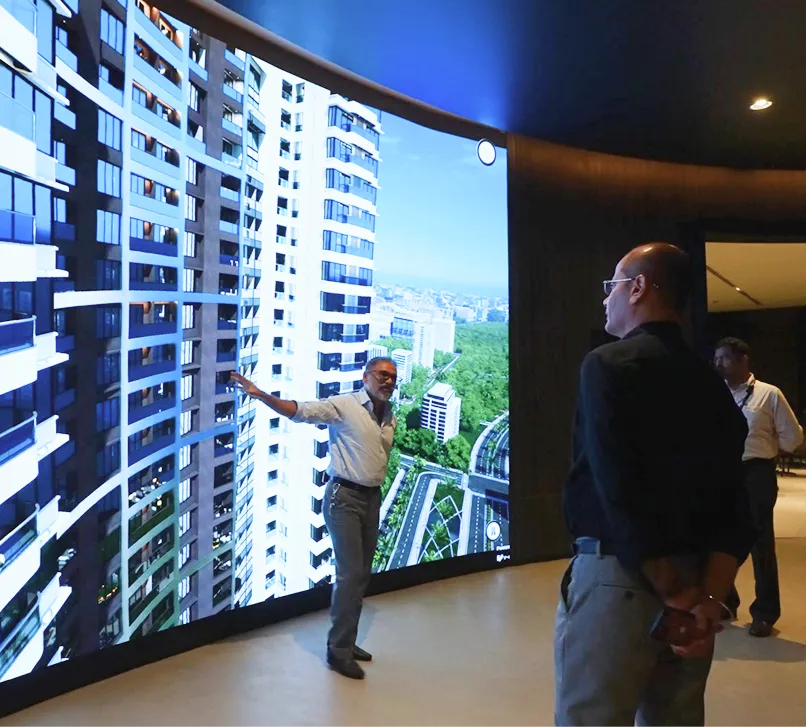
Deployed inside the site office or experience center, an interactive 3D sales platform replaces the static presentation model with controlled, buyer-led exploration.
What it enables:
Photorealistic virtual show flats with accurate proportions and material finishes
Dynamic lighting and weather simulation — buyers see the property across different times of day and year
Detailed window views from specific units, floor by floor
Real-time interior customization — wall colors, furniture, finish options
Amenity mapping with current and upcoming infrastructure
Multi-unit comparison within a single session
The buyer is no longer imagining. They are verifying.
This distinction matters enormously in premium and mid-segment projects where purchase decisions carry significant financial and emotional weight.
Impact on Sales Team Productivity
Sales teams operating with a 3D platform shift their role entirely.
Less time spent on explanation. More time spent on confirmation.
Buyers arrive at the sales conversation pre-educated. Their questions are specific. Their preferences are already partially formed. The sales team guides decisions rather than building basic understanding from scratch.
This improves conversion ratios. It improves per-visit productivity. It reduces the number of follow-ups needed before commitment.
The sales process becomes structured, not reactive.
Operational Efficiency for Developers
Sample flats and experience centers carry real costs — construction, maintenance, updates, staffing. Every time a phase changes or inventory shifts, physical infrastructure demands revision.
A 3D sales platform eliminates much of this overhead.
Multiple configurations presented without building each one. Inventory updates without physical reconstruction. The same platform scaled across locations.
Operational efficiency and buyer experience improve simultaneously. That is a structural advantage, not a marginal one.
The Positioning Outcome
Developers who reduce their dependence on advertising volume and invest in buyer-side clarity report a consistent pattern.
Lead quality improves. Low-intent inquiries drop off earlier. High-intent buyers engage longer and convert faster.
Cost per acquisition falls. Not because spending decreases, but because the same spend yields better-qualified interactions.
Project perception strengthens. When buyers experience a project deeply, they articulate its value more accurately — to themselves and to others.