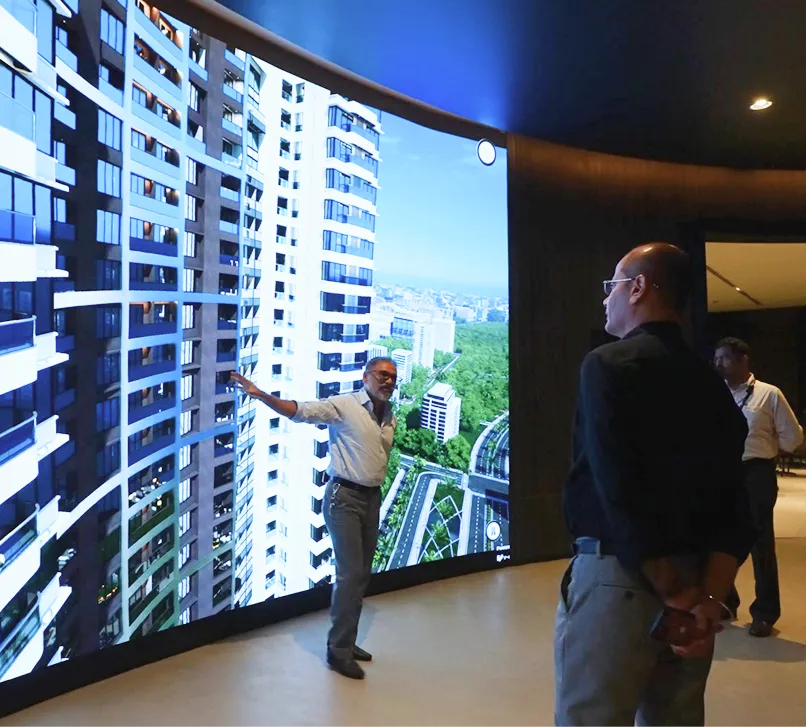
For real estate leadership teams, unbuilt inventory has always represented a paradox. It is the most critical revenue component of a project, yet it is also the hardest to sell. Unlike ready inventory, where the buyer’s decision is anchored in physical validation, under-construction units rely heavily on assumption, interpretation, and trust.
This gap between what is promised and what is perceived has direct financial consequences. Slower conversions extend cash flow cycles. Inventory overhang increases carrying costs. Sales teams spend disproportionate effort resolving basic clarity issues rather than accelerating closure.
What is often overlooked at the CXO level is that this is not a demand constraint. It is a decision environment failure.
Buyers are willing to invest in unbuilt properties, but only when they can understand, validate, and emotionally connect with the outcome. Traditional tools such as brochures, 2D layouts, and static renders fail because they require buyers to do the cognitive heavy lifting.
This is where 3D visualization for real estate is fundamentally altering the equation. It shifts the burden of imagination from the buyer to the system.
Why Traditional Sales Tools Break at Scale
As projects scale, the limitations of conventional sales infrastructure become more pronounced. What works for boutique developments fails under high footfall, competitive launches, and price-sensitive segments.
The breakdown is not theoretical. It is operational.
Buyers struggle to translate 2D plans into real spatial understanding, leading to repeated discussions and delayed decisions
Critical variables such as views, tower spacing, and environmental context remain ambiguous, increasing perceived risk
Sales effectiveness becomes inconsistent, heavily dependent on individual team capability rather than system design
These inefficiencies compound during peak launch phases, where the volume of enquiries is high but the ability to deliver consistent, high-clarity engagement is limited.
For CMOs, this creates a leakage in the funnel. For CXOs, it translates into slower inventory absorption and delayed revenue realisation.
From Visualization to Decision Systems with 3D Visualization Real Estate Software
With advanced 3D architectural visualization software, the buyer journey transitions from passive consumption to active exploration:
Layouts are experienced at real scale, eliminating guesswork around proportions
Tower placement, distances, and sightlines are visually validated rather than verbally explained
Amenities and infrastructure are understood in relation to the overall master plan
Environmental context is simulated, enabling buyers to evaluate the project as a complete ecosystem
This is the critical shift. The system does not just inform. It removes ambiguity, which is the single largest barrier to faster decision-making.
Engineering Conversion at Scale: The Rustomjee Urban Woods Deployment
To understand how 3D property visualization translates into measurable business impact, it is essential to examine a deployment where scale, complexity, and performance intersect.
At Rustomjee Urban Woods, the challenge was not simply to market an unbuilt project. It was to sell at high velocity in a competitive environment while maintaining brand positioning.
Designing a Sales System for High Footfall Environments
The project was engineered to handle:
190 to 210 families per day
Approximately 30 families per hour
Multiple simultaneous buyer journeys
Zero physical construction at launch
This immediately reframes the problem. The requirement is not just clarity. It is clarity at scale without performance degradation.
Structuring the Buyer Journey to Eliminate Decision Friction
Instead of relying on unstructured sales conversations, the experience was built as a controlled, stage-wise journey, where each layer solved a specific buyer uncertainty.
1. Context-First Engagement Through AV Theatre A five-minute film was designed not as a branding asset but as a decision tool:
Initial focus on connectivity and infrastructure to anchor rational evaluation
Followed by project vision to build emotional alignment
This sequencing ensured that buyers entered the evaluation phase with clarity on fundamentals, reducing early-stage objections.
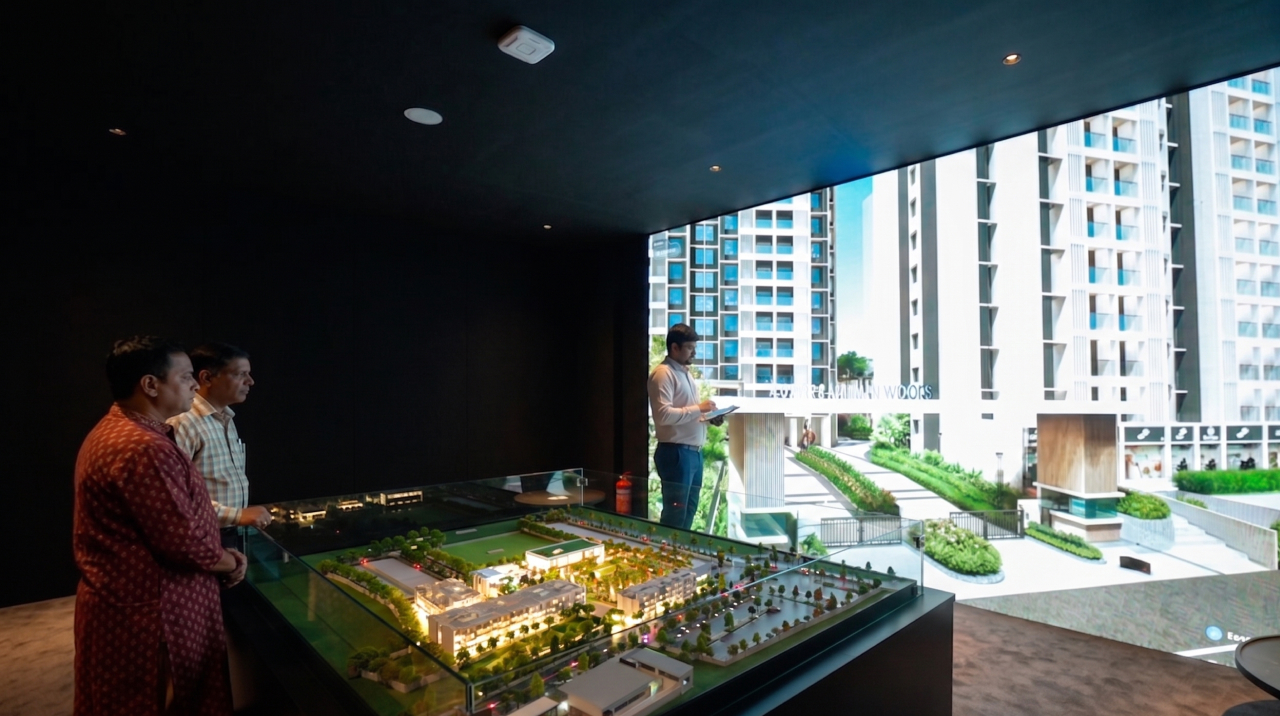
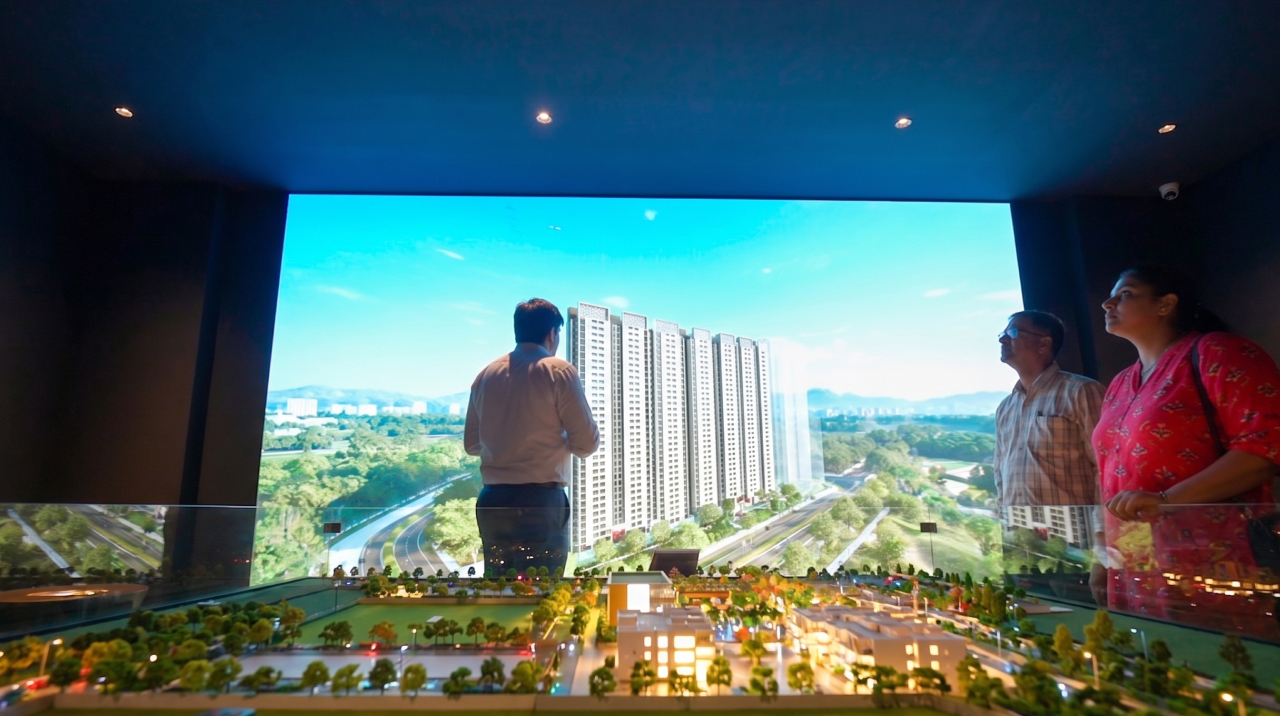
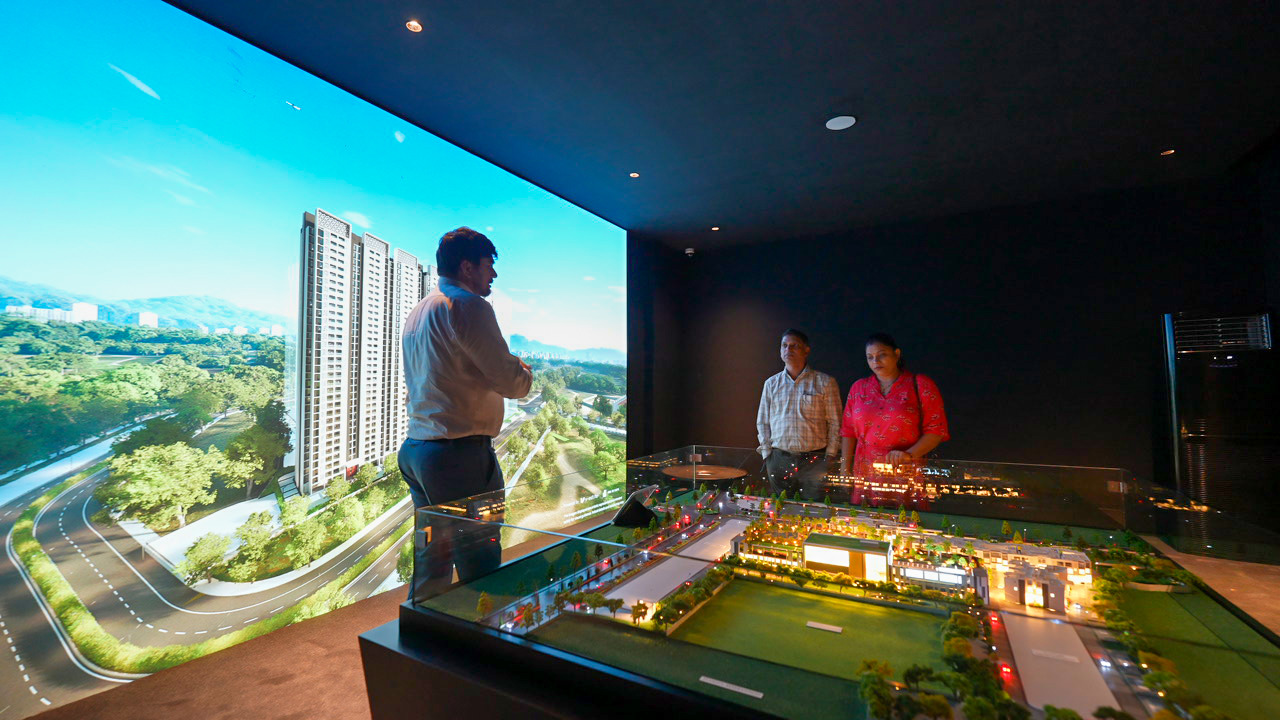
2. Real-Time Spatial Understanding via IoT-Enabled Scale Model The scale model was integrated with an interactive system:
28 touchpoints linked to amenities
Instant visual response across physical and digital layers
This allowed buyers to understand how different components of the project interact spatially, rather than viewing them in isolation.
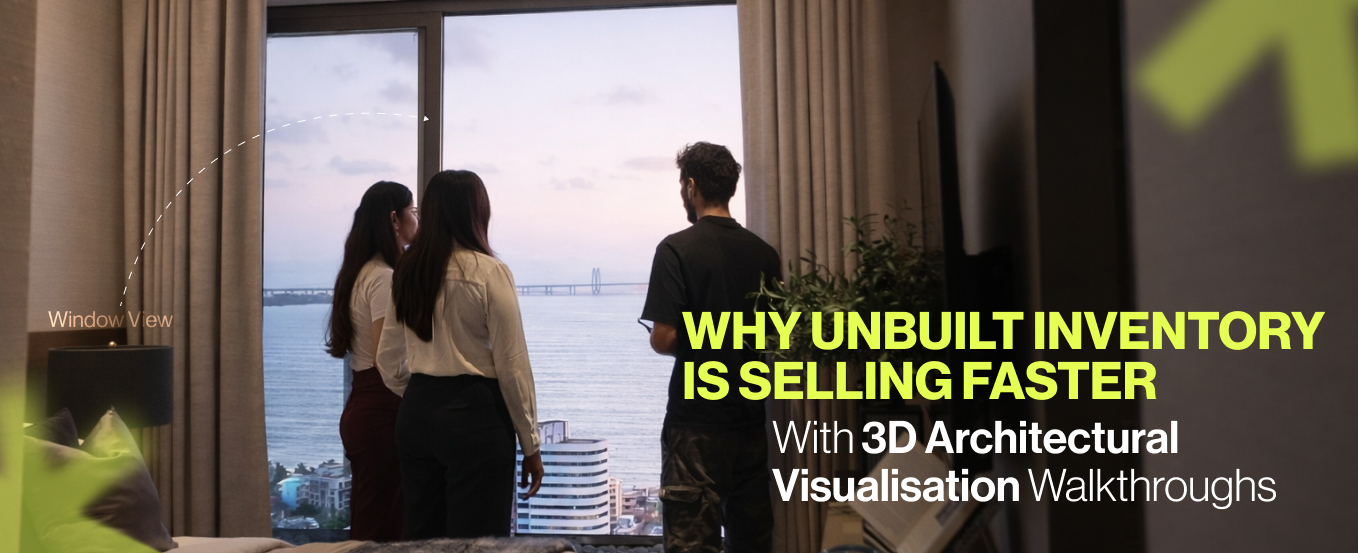
3. Removing View Uncertainty with Window Level Simulation One of the most significant sources of hesitation in unbuilt projects is the lack of clarity on views.
This was addressed through:
360 degree drone footage mapped onto window displays
Realistic representation of what buyers would see from their units
This is not a visual enhancement. It is a risk reduction mechanism.
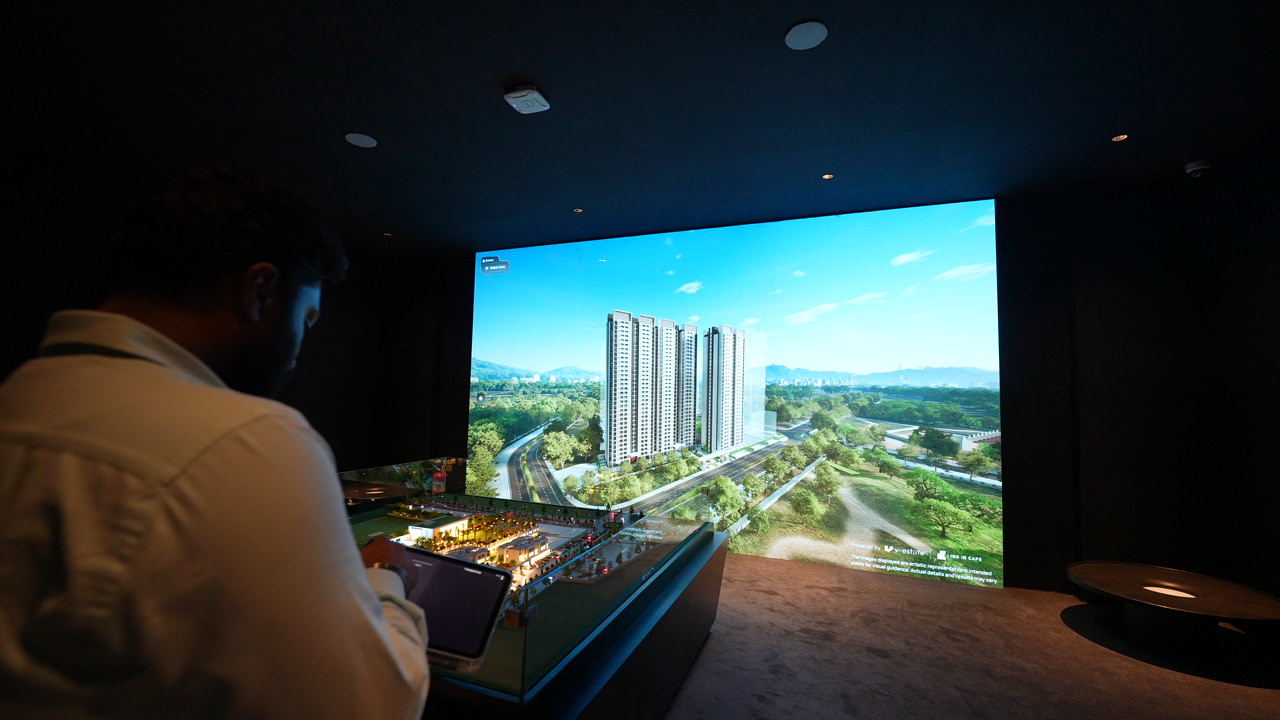
4. Precision Decision Making Through 3D Architectural Visualization Walkthrough
The final stage leveraged 3D architectural visualization walkthrough environments:
Ten parallel discussion rooms
Live navigation across masterplans, towers, and layouts
Instant resolution of queries through real-time interaction
At this stage, there is no dependency on imagination. Every aspect of the project is demonstrated, not just described.
Technical Architecture That Enables Reliability at Scale
For CXOs evaluating 3D visualizer software, the question is not just capability but consistency under load. This is where the deployment stands out.
High-Density Environment Simulation Using Procedural Systems
The project site lacked surrounding built context. To create a realistic environment:
Procedural Content Generation frameworks were used to simulate large-scale greenery
Millions of elements were rendered without compromising performance
Frame rates were consistently maintained at 30 to 35 FPS
This ensured that buyers experienced the project within a credible environmental context, not an abstract setting.
Continuous Runtime Optimization
Unlike traditional visualization setups, this system was designed for sustained operation:
Continuous usage across daily sales cycles
No performance drop despite high interaction frequency
Uniform experience across all sessions
This transforms 3D architectural visualization from a presentation tool into a reliable operational system.
Fault Tolerant Infrastructure for Zero Downtime
A dual-server architecture was implemented to eliminate risk:
Primary and backup systems operating in parallel
Seamless failover in case of disruption
Six months of uninterrupted live operation
For leadership, this ensures that technology enhances sales rather than introducing operational vulnerabilities.
Adaptive Deployment Under Real-World Constraints
Execution environments are rarely static. During deployment:
Infrastructure requirements changed mid-project
Network systems were redesigned and deployed within 72 hours
Delivery timelines and sales operations remained unaffected
This highlights the importance of execution agility alongside technical capability.
Translating Technology into Measurable Business Outcomes
The effectiveness of 3D visualization real estate systems is ultimately defined by their impact on sales performance.
Accelerated Decision Timelines
With real-time 3D architectural visualization:
Buyers resolve multiple queries within a single visit
Repeat engagements are minimized
Decision cycles are significantly shortened
This directly improves conversion velocity and sales throughput.
High Volume Engagement Without Compromising Quality
The system supported:
190 to 210 families daily
Structured flow preventing congestion
Parallel discussion environments maintaining personalization
This demonstrates that scale and experience quality are not mutually exclusive when supported by the right system design.
Reduction in Sales Variability
Over 25 sales professionals were trained within this ecosystem:
Standardized storytelling aligned with visualization tools
Reduced dependency on individual interpretation
Consistent buyer experience across interactions
This shifts performance from individual-driven to system-driven, which is critical at scale.
Transparency as a Conversion Driver
By integrating real views, accurate layouts, and environmental context:
Buyer trust is built through demonstration rather than assurance
Perceived risk is reduced significantly
Competitive differentiation becomes immediate
In markets with multiple launches, this becomes a decisive advantage.
Long-Term Strategic Value Through Reusability
The system was designed as a reusable framework:
Software and environment pipelines can be adapted for future projects
Deployment timelines reduce significantly
Investment scales across multiple developments
This positions 3D architectural visualization software as a long-term asset rather than a project-specific expense.

Strategic Implications for CXOs and CMOs
The adoption of architectural visualization at this level has implications beyond marketing.
For CXOs:
Faster inventory movement improves liquidity cycles
Revenue generation becomes less dependent on construction milestones
Capital efficiency improves through quicker turnover
For CMOs:
Lead-to-conversion ratios improve due to higher clarity
Customer experience becomes a measurable differentiator
Brand perception strengthens through transparency and innovation
The Behavioral Shift Driving Faster Conversions
At a buyer level, immersive 3D property visualization fundamentally changes how decisions are made:
Complex information becomes intuitive and easy to process
Buyers develop emotional ownership before possession
Uncertainty is replaced with visual confirmation
This is why unbuilt inventory is selling faster. The system does not push buyers toward a decision. It enables them to arrive at it with conviction.
Closing Perspective: Building a Conversion-First Sales Infrastructure
The future of real estate sales will be defined by how effectively developers can sell before they build.
Static tools will continue to create friction. High-performance 3D architectural visualization walkthrough systems will continue to remove it.
V-Estate, through its expertise in 3D visualization for real estate, is enabling developers to transform their sales environments into high-velocity, high-clarity conversion systems.
The opportunity is not just to improve presentation. It is to redefine how inventory is monetised.
Book a demo with V-Estate to experience how immersive 3D visualization can turn your unbuilt inventory into a scalable sales engine.