At the ₹10 crore and above bracket, real estate decisions operate on an entirely different axis.
Buyers in this segment are not evaluating options. They are validating decisions.
They arrive with a clear expectation of what luxury should feel like, how it should function, and what level of detail should be visible even before construction begins. What slows them down is not lack of interest but gaps in conviction.
Those gaps typically emerge in three areas:
The inability to fully understand scale, especially in large, master-planned developments
Lack of clarity around how infrastructure, surroundings, and future developments will evolve
Difficulty in translating design intent into a lived, believable experience
Traditional tools tend to flatten complexity. They simplify what should be deeply understood. And in ultra-luxury, oversimplification creates scepticism.
This is where 3D architectural visualization software shifts the dynamic. It does not just present the project better. It structures how the buyer arrives at certainty.
3D Architectural Visualization Software as a Decision Infrastructure
In most real estate setups, visualization is treated as a support layer for marketing. In high-value developments, it operates closer to a decision infrastructure.
The role of 3D architectural visualization software in this context is to ensure that every critical question a buyer might have is addressed within the experience itself, not through follow-up conversations.
This includes:
Understanding how the project integrates with its urban context
Evaluating how design elements behave under real conditions, including light, depth, and materiality
Exploring layouts with accuracy rather than approximation
Connecting macro-level planning with micro-level detail
When these elements are embedded into a single system, the buyer journey becomes less fragmented. Instead of gathering information across multiple touchpoints, the buyer builds conviction within a single, cohesive interaction.
Where Sales Cycles Actually Slow Down in Ultra-Luxury
To understand how acceleration happens, it is important to identify where delays originate.
Sales cycles in premium real estate typically extend due to:
Fragmented understanding Buyers receive information in parts and need time to connect it themselves.
Delayed clarity on critical details Infrastructure, views, and long-term surroundings are often explained later in the journey.
Repetitive validation loops Buyers revisit the same questions across multiple meetings to confirm accuracy.
Dependence on imagination The more a buyer has to imagine, the longer they take to decide.
3D architectural visualization software addresses these friction points by consolidating understanding into a single, high-fidelity experience.
How High-Fidelity Visualisation Compresses Decision Timelines
It Aligns Macro Vision with Micro Detail in One View
One of the biggest challenges in large-scale developments is helping buyers connect the overall masterplan with their specific unit.
Advanced visualization systems enable:
A seamless transition from city-level context to tower-level detail
Clear visibility of how infrastructure such as metro lines and roads interact with the project
Precise understanding of unit placement within the larger development
This alignment reduces the need for multiple layers of explanation and helps buyers make faster, more informed decisions.
It Converts Technical Complexity into Visual Intuition
Ultra-luxury buyers often demand technical clarity early in the process. However, technical explanations can slow down conversations if they are not presented intuitively.
With 3D architectural visualization software, complex elements are translated into visual narratives:
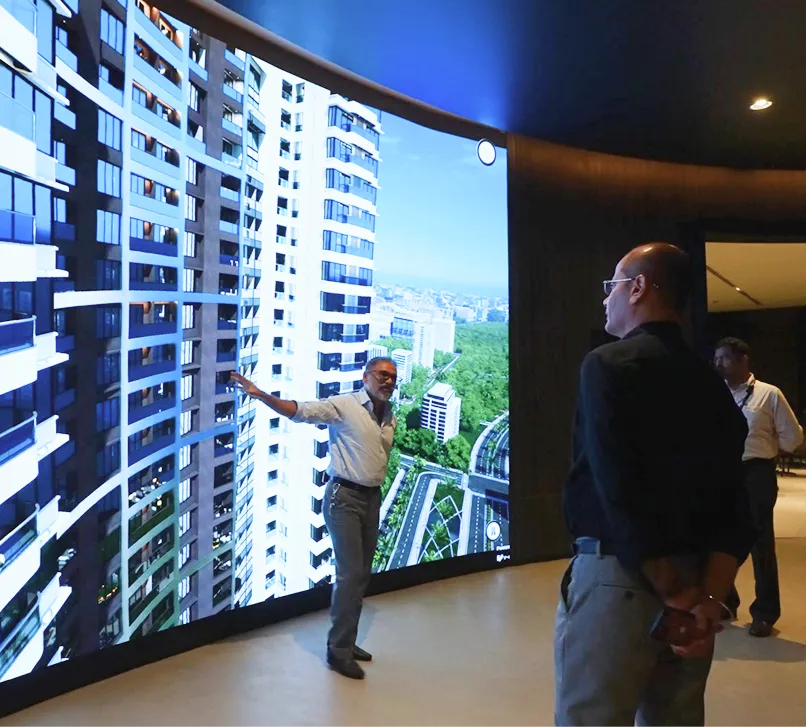
Infrastructure is experienced through dynamic, moving visualisation rather than static explanation
Glass façades reveal depth, lighting, and reflection in real time
Landscape planning becomes a navigable environment instead of a listed feature set
This reduces cognitive effort and increases processing speed.
It Replaces Linear Presentations with Adaptive Exploration
Traditional sales flows are linear. Every buyer is taken through the same sequence, regardless of their priorities.
Visualization-led systems introduce adaptability.
Buyers can:
Move directly to areas of interest without waiting for a predefined sequence
Explore specific units, views, or amenities in greater depth
Control both the pace and direction of the interaction
This makes the experience more relevant, and relevance accelerates decisions.
Engineering Conviction: The Case of Adani Realty Codename LIT
When Context Complexity Becomes a Sales Barrier
The development presented a unique set of challenges that made conventional sales approaches insufficient.
The land parcel had an industrial legacy, making it difficult for buyers to visualise its transformation
The master plan involved multiple components that required clear spatial understanding
The surrounding infrastructure played a critical role in the project’s value proposition
Buyers expected detailed answers early, particularly around connectivity and long-term development
The solution was not to simplify the narrative but to make complexity accessible.
Building a Unified Visualization Ecosystem
Instead of deploying isolated tools, the project integrated multiple layers into a single system powered by 3D architectural visualization.
The ecosystem included:
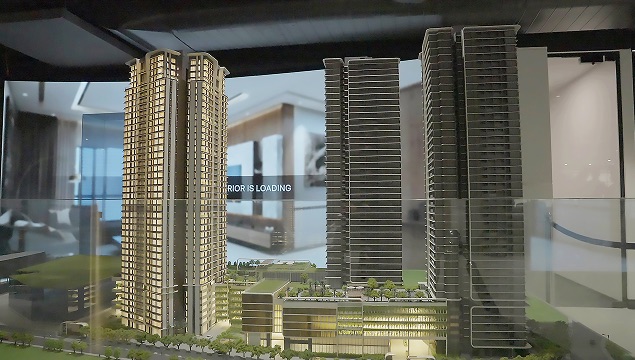
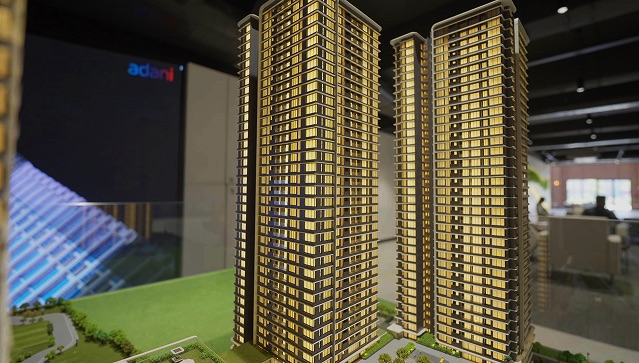
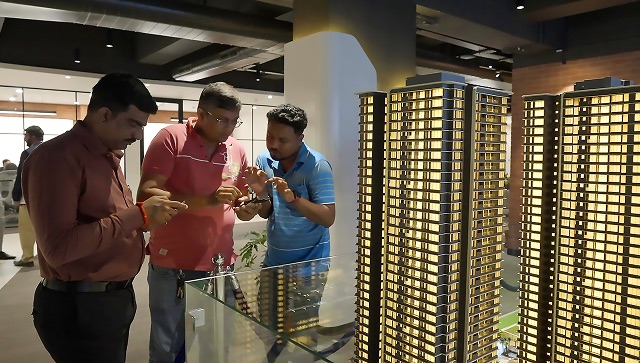
An IoT-enabled physical scale model with 38 interactive touchpoints This allowed buyers to physically anchor their understanding of the project while interacting with specific zones.
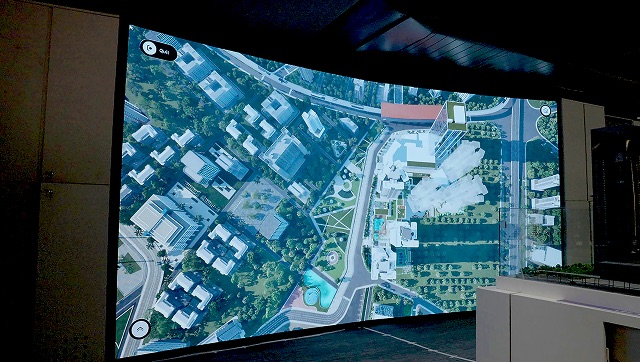
A real-time Unreal Engine 5.2 environment The digital layer delivered high-fidelity visuals with accurate lighting, materials, and environmental context.
A tablet-based control interface for sales teams This ensured that the experience could be navigated fluidly, adapting to each buyer’s line of inquiry.
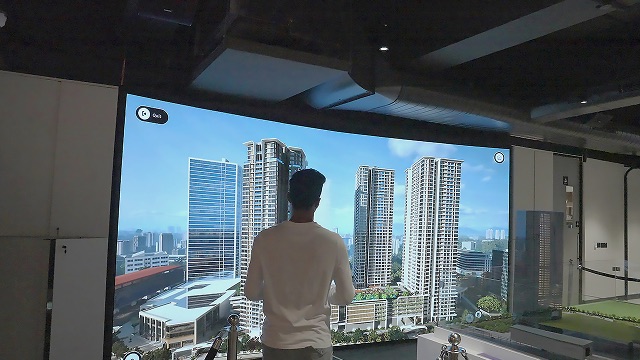
Large-format visualization displays Curved LED walls and discussion-room screens maintained visual continuity across group and individual interactions.
The strength of this system lay in how these components worked together, rather than independently.
Making Infrastructure and Context Visually Verifiable
One of the most critical aspects of the implementation was how surrounding infrastructure was handled.
Using custom tools within the visualization environment:
Metro lines, flyovers, and bridges were accurately modelled
Movement was introduced to simulate real-world dynamics
Connectivity was demonstrated visually rather than described verbally
This shifted the conversation from claims to evidence.
Solving for Performance Without Compromising Detail
High-fidelity visualization often comes at the cost of performance. In a live sales environment, this trade-off is not acceptable.
The system addressed this through:
Nanite-based optimisation techniques to manage heavy assets efficiently
Selective texture resolution strategies to balance detail with speed
Controlled shader complexity to ensure smooth rendering
Parallax systems to simulate depth in glass-heavy structures without increasing geometry load
The result was a system that delivered both realism and responsiveness.
Structuring the Sales Journey Around the Visualization System
The visualization ecosystem was embedded into a clearly defined sales process.
Initial onboarding and assignment of a dedicated sales representative
Interactive walkthrough anchored by the physical-digital model
Transition to a sample flat for tactile validation
Final discussion in a controlled environment for decision closure
Two distinct engagement formats ensured flexibility:
High-volume launch interactions with concise walkthroughs
Deep consultative sessions lasting 40 to 50 minutes for serious buyers
This structure ensured consistency while allowing depth where required.
Measurable Shifts in Buyer Behaviour
The impact of the system was visible not just in outcomes but in how buyers engaged.
Engagement duration increased significantly, indicating deeper involvement
Questions became more specific and technical, reflecting higher confidence
The need for repeated clarification reduced sharply
Decision timelines shortened as buyers reached clarity faster
The system did not push buyers towards a decision. It enabled them to arrive at one with greater certainty.
The Strategic Implication for Developers
For developers operating in the ultra-luxury segment, the implications are clear.
The competitive advantage is no longer defined by what is being built but by how effectively it can be understood before it is built.
Investing in 3D architectural visualization software enables the following:
Faster movement from inquiry to conviction
More efficient utilisation of sales resources
Stronger differentiation in crowded micro-markets
Higher alignment between design intent and buyer perception
This is particularly critical in markets where multiple premium projects compete for the same buyer attention.
Conclusion: Conviction is the New Currency of Speed
In ultra-luxury real estate, time does not compress because buyers are rushed. It compresses because buyers are certain.
3D architectural visualization software plays a central role in building that certainty by removing interpretation, aligning expectations, and delivering clarity at every stage of the journey.
When buyers can
See the project in its full context
Understand design and infrastructure with precision
Experience the space before it exists
They move forward with conviction.
For developers looking to accelerate sales without compromising on experience, the focus needs to shift towards building systems that engineer conviction into every interaction.
If the objective is to design immersive, high-performance sales environments that convert faster and scale across projects, the next step is to explore how V-Estate can build this ecosystem for your brand. Book a demo with V-Estate.